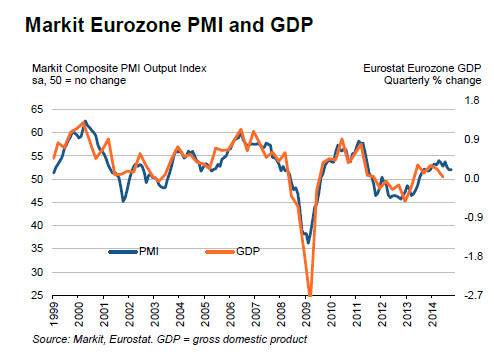
The eurozone saw growth stabilise at the start of the final quarter. The rate of economic expansion was little-changed from September’s ten-month low, with
modest output growth registered at manufacturers and service providers alike. Job losses were reported for the first time since November 2013, while price pressures remained muted.The final Markit Eurozone PMI® Composite Output Index edged higher to 52.1, up from 52.0 in the prior month. The headline index has now remained in expansion territory for 16 successive months. Ireland and Spain remained at the head of the PMI output growth table in October. Rates of increase in business activity ticked higher in both nations to recoup some of the momentum ceded in the prior month. Germany also posted a solid expansion and Italy edged back into expansion. In contrast, the rate of contraction in France accelerated to a four-month record.
The main factor stymieing output growth was the subdued trend in new business inflows. The level of new work placed in the eurozone rose only marginally and to the weakest degree during the current 15-month sequence of expansion. Underlying the slowdown in new order growth were lacklustre domestic market conditions, slower global economic growth and ongoing client uncertainty. Ireland, Spain and Germany all reported increases in new business, but this was partly offset by contractions in Italy (fastest in 11 months) and France (steepest in 16 months).
With new work rising at a slower pace and backlogs of work falling for the fifth month running, job losses were reported for the first time in almost a year.Cuts at service providers were only partly offset by a marginal gain in manufacturers’ payroll numbers. Employment rose in Germany, Spain and Ireland, but fell in France and Italy.
Weaker market conditions and efforts to boost sales led to a solid reduction in selling prices in October, the steepest since the global crisis. In contrast, input costs continued to rise, although the rate of inflation was modest by the historical standards of the survey. Manufacturers reported aslight drop in purchase prices, mainly due to the lower costs of commodities and fuel.
The slowdown in the eurozone service sector endured during October, with rates of expansion in business activity and new orders the weakest since March and January respectively. Adding to the subdued backdrop was a dip in business optimism to a 16-month low which, combined with the current slowdown, led firms to cut employment for the first time in seven months.
The Eurozone Services Business Activity Index posted 52.3 in October, down from September’s 52.4 and below the flash estimate (also 52.4). Business activity nonetheless rose for the fifteenth successive month in October. Germany, Spain and Ireland all reported solid increases of output – with Ireland seeing the strongest rate of growth – while Italy climbed back into expansion territory. France remained a cause for concern, however, as its rate of contraction accelerated.
Weaker growth of new business not only contained efforts to raise output further, but also held down average selling prices. Output charges declined at the fastest pace since February 2010, as firms looked to boost sales. All of the big-four nations reported lower selling prices. The reduction in Germany was only slight, while discounting was much steeper in France, Italy and Spain.
Average input prices rose again in October, with the rate of inflation ticking up from September’s five-month low. Steeper cost rises were reported in Germany and Ireland, whereas the rate of inflation eased sharply in Italy.
Service sector employment fell slightly in October. Job creation remained strong in Ireland, but eased to a seven-month low in Germany. Spain reported a return to jobs growth, in contrast to the cuts registered in France and Italy. A further decline in backlogs of work at eurozone service providers, the sharpest since mid-2013, also bodes negatively for the trend in employment in coming months.