FLASH PMIs
Eurozone output continues to rise as manufacturing returns to growth
The seasonally adjusted HCOB Flash Eurozone Composite PMI Output Index ticked up to 50.4 in March from 50.2 in February, signalling a third successive marginal monthly expansion in business activity across the euro area. Although only slight, the latest rise was the fastest since last August.
The overall increase in output reflected growth across both manufacturing and services. Service providers posted a rise in activity for the fourth month running, albeit with the pace of expansion easing to the weakest in this sequence. Meanwhile, manufacturing production returned to growth, rising for the first time in two years and to the greatest extent since May 2022.
Growth was sustained in Germany during March, in part thanks to a renewed expansion in manufacturing output. The overall rise was the fastest in ten months. On the other hand, business activity in France decreased for the seventh month running, albeit with the pace of contraction easing from that seen in February. Meanwhile, a further solid increase in output was recorded in the rest of the Eurozone, extending the current sequence of growth to 15 months.
While overall business activity rose for the third month running, companies continued to see new orders decline at the end of the opening quarter of the year. New business in the Eurozone has now fallen in each of the past ten months, with the pace of reduction little-changed since February. New orders were down across both manufacturing and services, although the drop in the former was the least marked in the current sequence of contraction that spans almost three years. New export orders also decreased. The pace of decline was unchanged from the previous month and the joint-weakest since May 2022
With output continuing to grow, Eurozone companies brought an end to a period of job shedding stretching back to August 2024. Staffing levels were broadly unchanged in March amid a faster rise in services employment and softer reduction in workforce numbers at manufacturers. The stable picture for employment overall was recorded despite further falls in staffing levels across the euro area’s two largest economies, Germany and France. The rest of the Eurozone posted a solid expansion in workforce numbers, and one that was the most pronounced since June last year.
With firms holding employment broadly steady in March, they were able to keep on top of workloads and deplete outstanding business. Backlogs of work have now decreased on a monthly basis throughout the past two years. The latest fall was solid and the fastest in four months
The rate of input cost inflation softened in March, ending a five-month sequence in which the pace of increase had quickened. The latest rise was the weakest since November last year and slower than the series average. The slowdown in inflation was centred on the service sector, although here the rise was still sharp. Manufacturing input costs increased at a relatively muted pace, but one that was the most marked since last August.
Selling prices also increased at a slower pace at the end of the first quarter, with the pace of inflation the weakest in the year-to-date. Services charge inflation eased, while manufacturing output prices increased for the first time in seven months. Germany posted a softer rise in charges during March, while rates of inflation in France and the rest of the Eurozone were unchanged from February
Signs of recovery in the euro area’s manufacturing sector led to a less pronounced scaling back of purchasing activity during March. The latest fall in input buying was solid, but the weakest since August 2022. Further reductions in stocks of both purchases and finished goods were registered. Meanwhile, suppliers’ delivery times shortened for the second month running and to the greatest extent in nine months
Business confidence dipped for the second successive month in March and remained subdued relative to the series average. Confidence regarding the 12-month outlook for business activity was the lowest since last November amid waning optimism in both manufacturing and services. French companies were pessimistic about the prospects for growth, but German firms were more bullish than in February. Strong confidence was again recorded in the rest of the euro area, albeit with sentiment easing from the previous survey period
Commenting on the flash PMI data, Dr. Cyrus de la Rubia, Chief Economist at Hamburg Commercial Bank, said:
“Just in time with the beginning of spring we may see the first green shoots in manufacturing. While we should not be carried away by a single data point, it is noteworthy that manufacturers expanded their output for the first time since March 2023. It’s also encouraging, that the index output has risen for three months straight. This is complemented by a much softer fall in new orders and employment.
One could pour some cold water on this development arguing that it’s the temporary tariff-related import boom from the US which has driven the improvement in manufacturing. However, given the will of Europe, to invest heavily in defense and infrastructure – in Germany a corresponding historical fiscal package has been approved only last week – hope for a more sustained recovery seems well founded.
“The price development in the services sector, which is very much under scrutiny of the ECB, will be well received by the doves of the monetary authority. Both input costs and selling prices are rising at a slower pace compared to recent months. Lower input cost inflation points to less pressure from wages which are a key ingredient of input costs in the labour intensive services sector.
Meanwhile, in manufacturing, price increases for both selling and purchasing remain moderate, helped along by declining energy costs. However, there are still plenty of risks on the ECB’s radar, like potential retaliation tariffs from the US, measures to curb goods coming from China, and higher food prices spurred by extreme weather. These factors, coupled with overall uncertainty, make some ECB members hesitant to cut rates too aggressively.
“Interestingly, Germany outperformed its key European trading partner France in March in both manufacturing output and services activity. Still, if we zoom out and look over the past two years, France’s industry has only contracted by about 1% since early 2023, while Germany’s has dropped by roughly 8%. In this respect, Germany has a lot of catching up potential.
“Business expectations are well below average in the services sector and at average in manufacturing, which is of small wonder given the challenges companies are faced with amid the challenges around tariffs, geopolitical tensions and uncertainties surrounding monetary policy.
There is some likelihood, that Europe seizes the opportunity and shows more unity with respect to reforms, defense spending, and completing the capital market union, to name a few things. This could send a clear message that Europe’s position as a key business hub is set to strengthen in the years ahead.”

Japan: Business activity declines for first time in five months
The March Flash PMI data indicated that Japanese firms had a disappointing end to Q1, with private sector business activity falling for the first time since last October.
Underlying data showed that this was partly due to a fresh fall in service sector activity, while manufacturing output declined at the quickest pace for a year.
The reduction in overall activity coincided with a slight drop in composite new business, with firms noting that strong inflationary pressure had dampened sales and made some customers hesitant to commit to orders.
Growth of new business slowed notably at services companies and fell solidly at goods producers. New export orders increased slightly at the composite level, however, as a strong rise at services companies offset a further drop in foreign demand for manufactured goods.
The survey also signalled that cost pressures remained elevated in March, with overall input costs rising sharply across both monitored sectors, leading to a solid rise in selling prices.
Strong inflation, coupled with concerns over labour shortages, an ageing population, subdued client spending and increased uncertainty over the international trade environment dampened optimism around the outlook. Notably, overall confidence regarding future business activity dipped to the lowest since August 2020 at the end of the first quarter.


The important U.S. flash PMI is out later today.
White House Narrows April 2 Tariffs Tariffs on industrial sectors like cars and microchips are no longer expected to be announced on that date
President Trump has declared his April 2 deadline to be “Liberation Day” for the U.S., when he will put in place so-called reciprocal tariffs that seek to equalize U.S. tariffs with the duties charged by trading partners, as well as tariffs on sectors like automobiles, pharmaceuticals and semiconductors he repeatedly said would be enacted on that day.
Those sector-specific tariffs, however, are now not likely to be announced on April 2, said an administration official, who said the White House is still planning to unveil the reciprocal tariff action on that day, though planning remains fluid. (…)
The focus of the reciprocal action now looks to be more targeted than originally thought, according to people with knowledge of the planning, though it will still hit countries that account for most of the U.S.’s imports.
The administration is now focusing on applying tariffs to about 15% of nations with persistent trade imbalances with the U.S.—a so-called “dirty 15,” as Treasury Secretary Scott Bessent put it last week. Those nations, which Bessent said account for most of the U.S.’s foreign trade, will be especially hard-hit with higher tariffs, said people with knowledge of the matter, though other nations could be given more modest tariffs as well. (…)
Nonetheless, the administration’s plan for April 2 could raise tariffs on the U.S.’s most significant trading partners to levels not seen in decades, and people with knowledge of the planning said that targeted nations can expect to receive significantly higher tariffs.
Trump’s team could make tariffs effective almost immediately on April 2 using the president’s emergency economic authority, said people familiar with the discussions, emphasizing that final decisions haven’t been made. That would be a shift from February, when a White House official said a report outlining reciprocal tariffs could be released that day but imposition would come later. (…)
Trump told oil executives last week during a meeting at the White House that he didn’t want to grant exceptions on tariffs, according to a person who attended the meeting, but said he would consider occasional ones.
When one attendee asked about steel and aluminum exemptions, Trump wouldn’t commit to any, this person said. When U.S. Trade Representative Jamieson Greer spoke to the oil executives, he said he wasn’t interested in doing exemptions because they felt like they granted too many in the first Trump administration. Commerce Secretary Howard Lutnick also told the oil-industry executives that he didn’t expect exemptions, the attendee said.
A White House official disputed that description of the meeting, saying tariffs didn’t come up.
(…)
Companies are also just desperate for clarity. One Fortune 500 CEO said April 2 can’t get here fast enough.
Trump previously gave automakers a temporary reprieve from tariffs on Canada and Mexico, before pausing those levies more broadly for all products that comply with the USMCA trade agreement. But on Friday, he lamented that people had criticized him for backing down, and hinted that his approach to tariffs could shift in the coming days and weeks.
Once you give exemptions for one company, “you have to do that for all,” Trump said, adding that “the word flexibility is an important word. Sometimes there’s flexibility, there’ll be flexibility.”
- “April 2nd is going to be liberation day for America. We’ve been ripped off by every country in the world, friend and foe,” Trump said in the Oval Office Friday.
- “I think markets need to change their expectations, because it’s not everybody that cheats us on trade, it’s just a few countries and those countries are going to be seeing some tariffs.” (Kevin Hassett, Trump’s National Economic Council director)
- “it’s roughly 15% of countries that are the worst offenders.” (Treasury Secretary Scott Bessent)
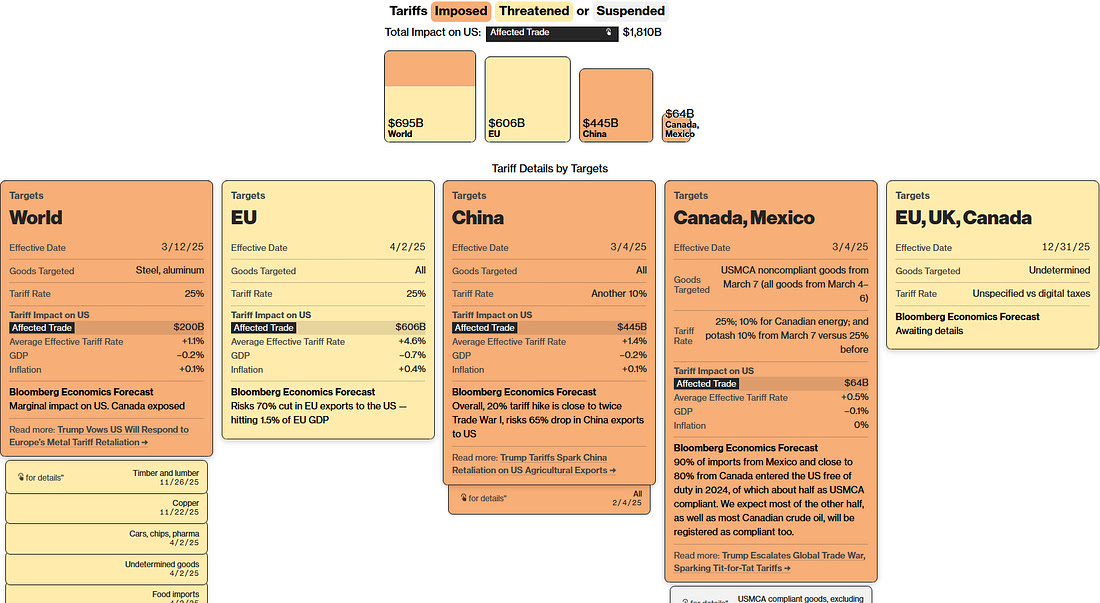
Bloomberg’s comprehensive chart of U.S. tariffs imposed, threatened & suspended:
- Carmakers rush to ship vehicles to US ahead of new round of April tariffs Carmakers rush to ship vehicles to US ahead of new round of April tariffs Vessels have been directed to Asia and Europe to carry ‘thousands’ more cars to America than usual
Dealing With Social Security Is Heading From Bad to Worse The agency that administers benefits is cutting staff and restricting services as part of a Department of Government Efficiency review
The federal agency that administers Social Security benefits is facing a customer-service mess.
The Social Security Administration is cutting staff, restricting what recipients can do over the phone and closing some local field offices that help people in person. The number of retirees claiming benefits has risen in recent years as baby boomers age.
Few federal agencies reach as far into Americans’ lives as the Social Security Administration, which delivers a monthly check to some 70 million people. Many fear that the changes, part of President Trump’s push to overhaul the federal government through the Department of Government Efficiency, are eroding confidence in the nearly 90-year-old program.
Agency officials have acknowledged that because of a planned reduction in services over the phone, there will be longer wait and processing times. An estimated 75,000 to 85,000 additional visitors a week could show up at local field offices, according to an internal memo sent by Doris Diaz, the acting deputy commissioner for operations. (…)
Social Security has a reputation as the “third rail“ of American politics, a benefit to which elected officials make cuts at the risk of their own re-election. President Trump has vowed not to cut benefits. But he and DOGE’s leader, Elon Musk, have made unfounded claims of widespread fraud in the program. (…)
Only a “fraudster” would care if they miss a Social Security check, Commerce Secretary Howard Lutnick said in a new interview this week.
Lutnick discussed how he believes Americans would respond to going a month without a Social Security check during an interview on the podcast All-In with Chamath, Jason, Sacks & Friedberg.
During the appearance, Lutnick said the average American, using his mother-in-law as an example, would not complain about not receiving their checks for a month but that someone who was hacking the system would do so.
“Let’s say Social Security didn’t send out their checks this months. My mother-in-law is 94, she wouldn’t call up and complain. She just wouldn’t. She would think something got messed up and she’d get it next month,” he said. “A fraudster always makes the loudest noise, screaming, yelling and complaining.”
Lutnick said the “easiest way to find a fraudster is to stop payments and listen” for “whoever screams.” Most recipients trust the government and would understand if they didn’t receive the check, he said.
BTW: More than 70 million Americans receive Social Security checks, including most people over age 65, people with permanent disabilities and survivors of deceased workers. Many of the program’s recipients depend on the checks as their sole source of income.
EARNINGS WATCH
With all the uncertainty on prices, demand and margins, analysts are getting more cautious, but only cautiously. Growth rates are being ratcheted down by assumed lower margins while estimated revenue growth rates are maintained.
Analysts have kept 2025 revenues essentially unchanged between Feb.14 (lower bar) and now. How they are factoring in tariffs, known or unknown, and demand is a crucial unknown when most economists are reducing their GDP growth forecasts. Is higher inflation merely offsetting weaker real revenues?


We know that more than 50% of U.S. households are struggling. Will the other half keep spending merrily given the rising uncertainty(ies) and weakening wealth effect?
For now, bottom up EPS are still seen rising 10.7% in 2025 to $269.91 from their current trailing $245.39.
Investors Who Were All In on U.S. Stocks Are Starting to Look Elsewhere American exceptionalism was this year’s big trade. Now some are hedging their bets.
(…) Just two months after JPMorgan Chase declared American exceptionalism “the broad and dominant” investing theme of 2025, ordinary investors across the world are looking elsewhere. Instead of riding the wave of U.S. outperformance, they are parsing the potential implications of tariff wars and major shifts in U.S. foreign policy. And for much of this volatile stretch, markets in China and Europe outpaced expectations. (…)
Trump’s America-first agenda will force European businesses to become more aggressive. (…)
In the first two months of the year, investors added more than $2 billion more than they pulled from U.S.-based exchange-traded funds that invest predominantly in European stocks, according to Morningstar. That marks a sharp reversal from the second half of 2024, when over $8.5 billion leaked from those same funds. Meanwhile, the pace of flows into U.S. equity ETFs was slower in the first two months of 2025 than in the last two months of 2024.
So far this year, the S&P 500 lost 3.6%, while the Europe Stoxx 600 gained 8.3%. (…)
Some worry that keeping all of their eggs in an American basket might no longer be the way to go. (…)
Markets around the world are trading at near-record discounts to the U.S.; the price-to-corporate-earnings ratio of companies in the Stoxx Europe 600 over the past year is around 18.7, while it is 24.6 for the S&P 500, according to Dow Jones Market Data. The Hang Seng Index’s ratio is less than 13. (…)
“You’ve got 27 countries in the EU,” he said. “You’ve got 27 different cultures and languages and retirement ages. I think the U.S. will always outperform Europe. But during certain periods, like right now, we’re going to see little pockets of opportunity.”

TECHNICALS WATCH
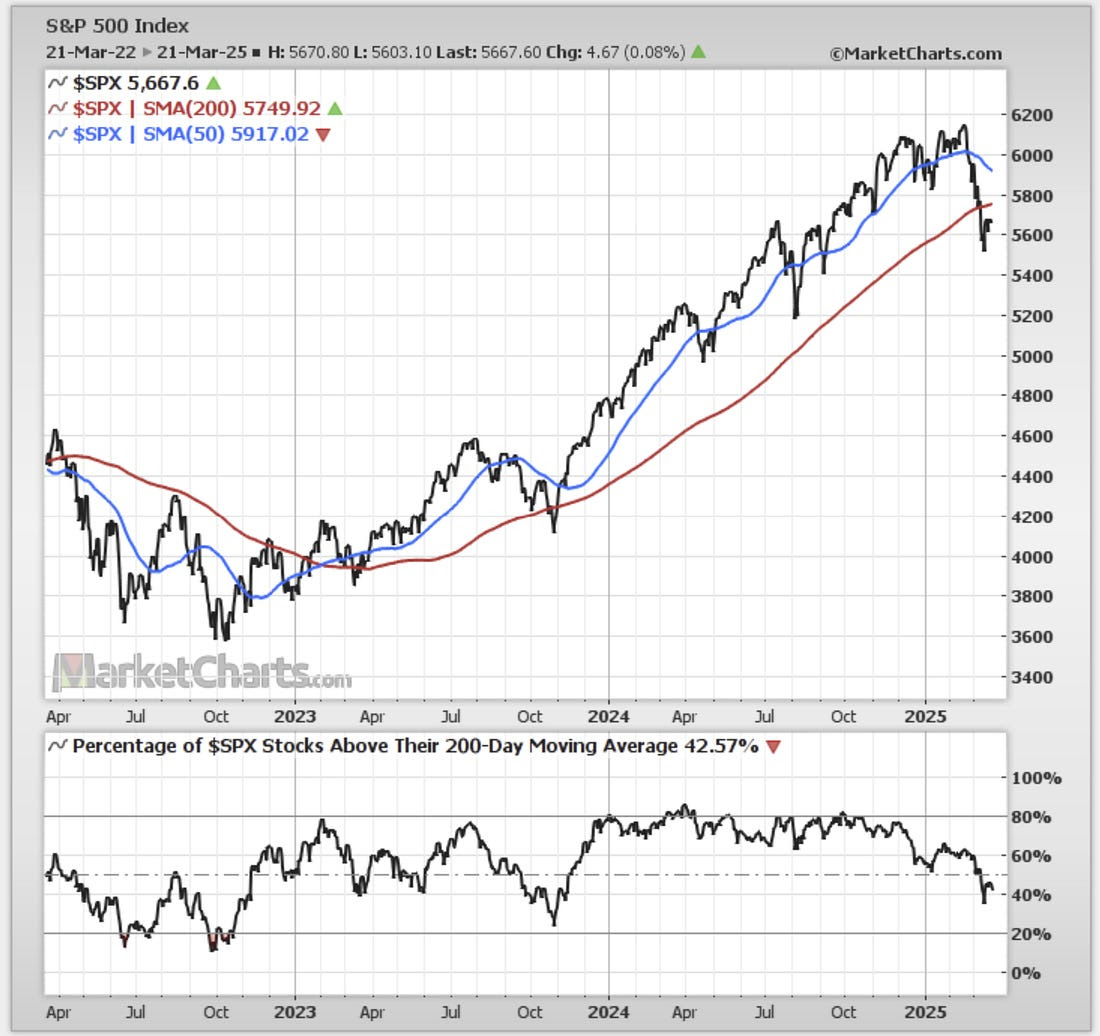
The S&P 500 index is below its 200-day average (and over 50% of constituents below their respective 200dma). Paul Tudor Jones has been attributed as saying: “Nothing good happens below the 200-day moving average.” (Callum Thomas)
But the 200dma (5749) is still risin… though both the 50dma and the 100dma (5933) are declining.
Source: MarketCharts
The S&P 500 is now down 1.5% below its 200-day moving average. In the past, corrections were often associated with 5%-10% declines below this average. Bear markets tended to bottom when the index was more than 20% below its 200-dma. (ed Yardeni)
- The 13/34-Week Exponential Moving Average must be watched:

Source: Stockcharts.com (via Steve Blumenthal)
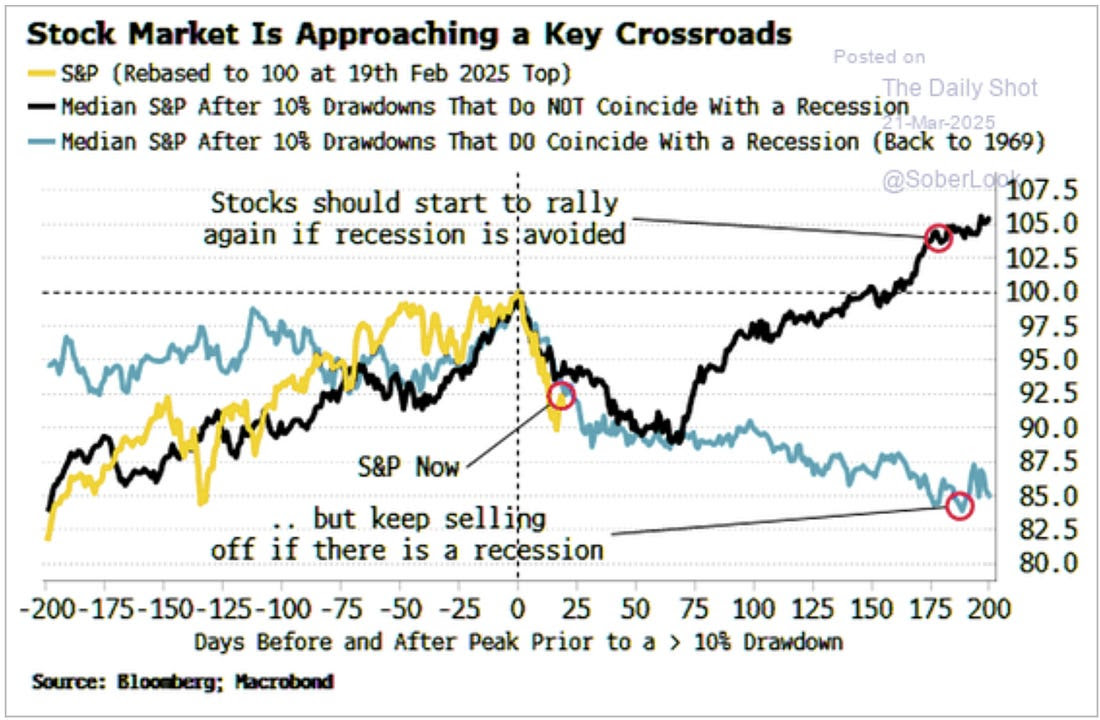
Recession or not?
Source: The Daily Shot
Cheap or not?

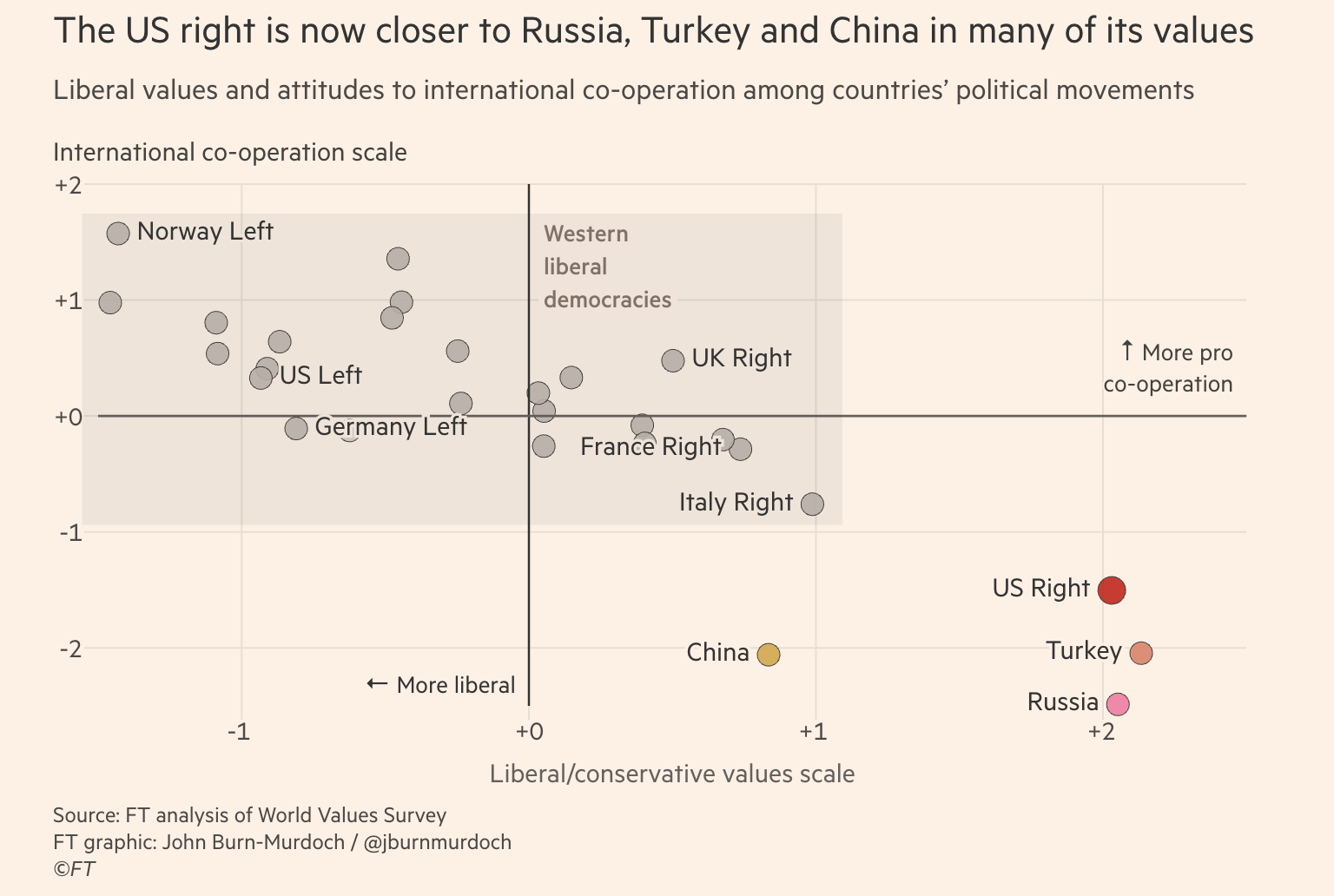
Do these matter or not?
Source: Financial Times
- With New Decree, Trump Seeks to Cow the Legal Profession A presidential memorandum aimed at lawyers everywhere struck a menacing tone.
The memorandum directs the heads of the Justice and Homeland Security Departments to “seek sanctions against attorneys and law firms who engage in frivolous, unreasonable and vexatious litigation against the United States” or in matters that come before federal agencies. (…)
Mr. Trump’s memo “attacks the very foundations of our legal system by threatening and intimidating litigants who aim to hold our government accountable to the law and the Constitution.” (…)
Since being sworn into office he has targeted three firms, but the new memo seems to threaten similar punishment for any lawyer or firm who raises his ire. (…)
Trump’s attacks on law firms, and Paul Weiss’s decision to cut a deal rather than fight it out in court, have sent shock waves through the legal community. The sweeping nature of the president’s latest demand comes as he has also stepped up his public attacks on judges and the very notion that the courts can tell him what to do or not do.
The executive branch “should neither fear nor punish those who challenge it and should not be the arbiter of what is frivolous — there are protections in place to address that,” Ms. Gupta said. (…)
Mr. Trump’s Friday night memo, titled “Preventing Abuses of the Legal System and the Federal Court,” complains that lawyers have long engaged in unethical conduct in opposing him, or opposing deportations. The memo also suggests that the Trump administration will make disciplinary referrals against lawyers who pursue cases without merit “particularly in cases that implicate national security, homeland security, public safety, or election integrity.” (…)
- FCC’s Carr Threatens to Block M&A for Companies With DEI Using merger reviews as a way to stop companies from pursuing DEI initiatives is a new tactic
The US Federal Communications Commission is prepared to block mergers and acquisition proposals from companies that promote “invidious” DEI policies, according to chairman Brendan Carr. (…)
In addition to considering a company’s hiring practices, Carr said the commission may evaluate other aspects of its business, including supplier diversity efforts and programming choices. (…)