The enemy of knowledge is not ignorance, it’s the illusion of knowledge (Stephen Hawking)

It ain’t what you don’t know that gets you into trouble. It’s what you know for sure that just ain’t so (Mark Twain)

Invest with smart knowledge and objective odds

YOUR DAILY EDGE: 18 March 2025: Hmmm…#2

CONSUMER WATCH

Pick your retail sales story:

The WSJ: Retail Sales Edge Up in February but Miss Expectations Falling auto sales dragged down overall figures; ‘people are browsing more than buying’

Retail sales rose modestly last month, offering reassurances that while consumer spending has slowed this year, it hasn’t buckled.

Sales edged up a seasonally adjusted 0.2% in February from the prior month, the Commerce Department reported Monday. That was less than the 0.6% gain expected by economists polled by The Wall Street Journal.

Sales figures for the prior month were revised lower. They fell 1.2% in January.

The slimmer gain in February sales, relative to economists’ expectations, was concentrated in sales at automobile and auto-part dealers, where sales fell 0.4%. Excluding those, overall sales rose 0.3%, in line with expectations. (…)

The parts of the report that feed directly into the Commerce Department’s gross domestic product calculations—a so-called control group—rose 1%. Even with a modest, downward revision to January control sales, that suggests that while GDP appears to have slowed in the first quarter, it hasn’t contracted. (…)

Goldman Sachs: Core Retail Sales Well Above Consensus Expectations

Core retail sales rose 1.0% in February (ex-autos, gasoline, and building materials, month-over-month seasonally adjusted), well above consensus expectations. The level of core retail sales was revised down 0.1% in January, reflecting a 0.1pp upward revision to December but a 0.2pp downward revision to January core retail sales growth. Combining data from the latest retail sales and CPI reports, we estimate that real core retail sales rose 0.9% in February and 2.7% on a three-month annualized basis.

Wells Fargo: Worries in Soft Data Corroborated by Weak Retail Sales

Despite a downward revision that makes last month’s drop in retail sales the biggest monthly decline since 2021, overall retail sales rose a scant 0.2% in February. The 1.0% gain in control group sales offers little consolation as it mirrors a decline of the same magnitude in January. (…)

The key thing to understand in today’s report is that last month’s sales figures were revised sharply lower resulting in what turns out to be the worst month for retail sales since 2021. The 0.2% increase in headline retail sales for February was just a third of the 0.6% increase that had been expected. The fact that this modest bounce comes on the heels of the downward revision makes it all the more disappointing. (…)

Despite the evidence of deteriorating fundamentals for the consumer, control group retail sales actually rose the most in five months in February. The control group excludes sales from some of the more volatile categories to offer an assessment of underlying spending and tends to be a good predictor of consumer spending as it eventually gets tallied in the GDP report.

As it happens, many of the excluded categories were among the big decliners this month (auto dealers, gas stations, bars & restaurants).

February 2024 had 29 days so Feb. 25 was 3.5% shorter in days. Seasonal adjustments should take care of that, we hope. Just in case, using non-adjusted numbers, sales/day were up 2.6% YoY in February after +4.4% in January.

My proxy for retail inflation (.35x CPI Durables + .65x CPI Non-Durables) was up 0.6% and 0.4% YoY in January and February respectively. Real sales were thus up 3.8% YoY in January and 2.2% in February. Still decent growth but a marked slowdown, especially after +4.2% in December and +4.4% in November.

The most worrying indicator is the sharp decline in restaurant spending: adjusted for days, January was up 5.4% YoY and February 1.2%. In real terms: +2.0% and –4.9%.

Restaurant outings are often the first casualties of cautious or squeezed consumers.

The FT reported yesterday that “Traffic to US fast-food restaurants was down 2.8% in February, according to Revenue Management Solutions, with visits at breakfast time dropping by double digits. “It’s the easiest meal to make at home or skip entirely,” the consultancy said.”
The FT also had early March stats:

  • Footfall to US stores fell 4.3% YoY in early March, according to RetailNext, a consultancy — extending declines that began at the start of the year.
  • Placer.ai, which aggregates signals from consumers’ mobile devices, has recorded fewer visits to big-box stores including Walmart, Target and Best Buy in recent weeks.
  • Sales of discretionary general merchandise fell by 3% in the week ending March 8 compared with last year, continuing a string of annual declines in February, data from Circana showed.

America Airlines president said at a conference: “Economic uncertainty is a big deal, and we have really seen some weakness in March.”

Gleaned here and there yesterday:

  • TSA Throughput: For the week ended March 13th, passenger throughput declined 3% y/y,
  • Hotel occupancy was 62% (-90 b.p. y/y) for the week ended March 8.
  • ISI company surveys fell from 48.4 to 47.3 last week on softer data across consumer and industrial surveys.

Services are the biggest job providers in the U.S.. Leisure and hospitality companies have been the third best job creators in the U.S. in the past 2 years.

Ed Yardeni, blaming the weather for much of the retail weakness, “still expect to see strong sales numbers in March and April.” I would not bet on that. Ed also would not bet that we have seen the bottom in equities:

So we doubt that Thursday marked the bottom in the stock market correction. On April 2, the Trump administration will reveal its reciprocal tariffs on all of America’s major trading partners. That event might cause further turmoil before the Fed Put is activated and makes the bottom.

U.S. Tariff Increases to Slow Global Economy, Boost Inflation, OECD Says Its largest growth-forecast downgrades were for Mexico and Canada

(…) Its largest downgrades were reserved for the two economies that trade most heavily with the U.S. and face significantly higher barriers to their exports. The OECD now expects Mexico’s economy to contract by 1.3% this year and 0.6% in 2026, having previously forecast growth of 1.2% and 2.8%.

For Canada, it now expects growth of 0.7% in both 2025 and 2026, having previously forecast expansions of 2%.

The OECD said the U.S. economy will now likely grow by 2.2% this year and 1.6% next. It previously forecast growth of 2.4% and 2.1%. (…)

The global economy is now forecast to grow by 3.1% in 2025 and 3% in 2026, having previously been projected to expand by 3.3% in each year.

Those forecasts assume that tariffs on almost all imports to the U.S. from its North American neighbors will be increased by 25 percentage points from early next month, while an increase in tariffs on Chinese imports of 20 percentage points will remain in place, as will higher duties on aluminum and steel imports.

However, future increases in tariffs are likely. President Trump has threatened to impose so-called reciprocal duties on any trading partner that charges tariffs or imposes other trade barriers on U.S. products, with an announcement due April 2.

The OECD said fresh increases in taxes on imports would do further harm to the global growth outlook and U.S. prospects. It said an increase in tariffs of 10 percentage points that provoked retaliation would reduce global economic output by 0.3% from 2026.

With consumer prices rising at a faster rate, the OECD said real incomes in the U.S. would be 1.25% lower three years after the fresh tariff increase, equivalent to a loss of $1,600 for the average household.

While the tariffs would raise additional revenue for the U.S. government, the OECD warned that would be more than offset by lower revenues from other taxes as the economy slows, “implying that additional tax increases or lower fiscal expenditure are needed to keep the overall budget deficit unchanged.”

Even without further increases, the OECD forecast that inflation across the world’s largest economies will be a third of a percentage point higher this year and next as a result of higher tariffs. That could lead central banks to cut borrowing costs more gradually than would otherwise have been the case, another headwind for growth.

“If some countries face additional pressures, we would not be surprised if central banks become more cautious,” said Pereira.

The OECD now expects the Federal Reserve to keep its key interest rate at current levels of 4.25% to 4.5% until “well into 2026.” It had previously expected the Fed to lower its key rate to between 3.25% and 3.5% by the first quarter of 2026.

The research body raised its growth forecast for China in 2025 to 4.8% from 4.7%, since it expects recent efforts by the government to stimulate activity will more than offset the impact of higher tariffs on the country’s exports to the U.S..

The OECD lowered its growth forecasts for the eurozone, and Germany in particular. But those new projections don’t take into account plans to increase spending on defense and infrastructure under an incoming government that is likely to be led by Friedrich Merz. Should those plans come to fruition, the outlook for the currency area’s economy would improve.

“Germany has had an infrastructure gap for a long time,” said Pereira. “They definitely need to spend more.”

More China Consumers Feel Better Off, Deutsche Bank Survey Shows

(…) Some 54% of respondents polled this quarter said they feel financially better off than a year ago, up from 44% on average in 2024, according to a report released by the German bank on Tuesday. The results also showed the proportion of those anticipating an income increase in the year ahead rose for the second straight quarter to 60%. (…)

Still, the shift in sentiment doesn’t mean people have grown more hopeful when it comes to real estate, with the share of respondents who cited property volatility as a reason to cut spending reaching 63% from 60% earlier. (…)

The poll found 52% of respondents are willing to increase their discretionary expenditures, the highest share in a year. (…)

April Fools Coming!

Trump has dubbed April 2 “the big one,”

Discussions are ongoing about what exactly Trump and his team will announce early next month and final decisions have not been made. Developing levies on hundreds of countries designed to match their tariffs and other trade barriers, including wages and tax regimes, on US exports is a complex endeavor unprecedented in modern American history. Lutnick said earlier this month on Bloomberg Television that some duties can be announced right away and others could come weeks or months later.

One likely outcome is for USTR to create a formula for a single rate for each country based on that nation’s average tariff level and other measures the Trump team considers discriminatory, according to people familiar with the plans. The rates, though, could be adjusted based on Trump’s perception of whether a country has been cooperative or combative, one of the people said.

Meanwhile:

Auto While American car makers get wrapped around a protectionist cape and try to figure out Trump`s chaotic tariff “strategy”, Chinese entrepreneurs are investing on R&D and developing smarter cars at lower costs.

Cheap Chinese Cars Are Taking Over Roads From Brazil to South Africa Trump’s tariffs look powerless to stop the incursion of inexpensive cars from China — and may speed it up.

Donald Trump wants to keep Chinese carmakers out of the US, but that won’t stop them from taking over the rest of the world. They already are.

From Bangkok to Johannesburg to Sao Paulo, the streets are increasingly jammed with inexpensive compacts, crossovers and SUVs made by companies like Great Wall Motor Co., BYD Co., Chery Automobile Co. and SAIC Motor Corp.

While the Trump administration is expected to shield the US’s Big Three from Chinese rivals at home, and Canada and the European Union have placed tariffs on Chinese-made electric vehicles, buyers in emerging markets have welcomed Chinese cars and trucks with open arms — posing a new threat to growth-hungry global automakers. (…)

“I get to have all the tech that are extras on known brands,” Mabuela said.

Mabuela isn’t alone. Buyers like him have helped Chinese automakers grab market share at astonishing speed. In South Africa, China-made vehicles account for nearly 10% of sales, or about five times the volume sold in 2019. In Turkey, Chinese brands claimed an 8% share in the first six months of 2024, up from almost none in 2022. In Chile, they have accounted for nearly a third of auto sales for several years running.

image

“Chinese automakers have pushed into lots of global markets with high quality and competitively priced vehicles,” said Abby Chun Tu, a Shanghai-based auto research analyst at S&P Global Mobility. “It’s the same strategy that worked for South Korean and Japanese brands, but they also have the advantage of advanced software and lots of features — even in their mass-market models.”

While leaders in the US and Europe have long been concerned that China could become a dominant seller of electric vehicles, the Chinese automaker association’s data show gas-powered vehicles accounted for nearly 80% of total vehicle exports last year.

Many underdeveloped markets don’t have charging stations or a reliable enough electrical grid to support fully electric models. But Chinese automakers have found in those places a ready market for gas-powered cars that they can no longer sell at home in large volumes.

Global market share for Chinese automakers outside their home country is expected to climb to 13% in 2030 from 3% today, according to AlixPartners. Including China, that worldwide share jumps to 33%, and in Africa and the Middle East it’s projected to hit 39% by then. (…)

“The moment I got into the car I thought: It’s in line with BMWs, Audis, with top-notch car finishing,” he said. “It has everything I want.” (…)

BYD and Great Wall are now building plants in Brazil — on sites where Ford and Daimler once ran facilities. (…) “From Brazil, it’s easier to reach other South American markets: Argentina, Chile, Colombia and even Peru.” (…)

Asia’s biggest automakers are also trying to fend off Chinese upstarts. Toyota Motor Corp. enjoys a 17.4% share in the Middle East and Africa, but is being chased by Chery and Geely, which have claimed shares of 5.3% and 2%, respectively, according to Jato Dynamics. Toyota is feeling similar pressure in Southeast Asia, where it controls 35.7% of the market but Geely and SAIC grabbing respective shares of 5.1% and 1.4%.

As in Brazil, China has taken advantage of policies designed to encourage sales of electric vehicles to expand its presence in Thailand’s auto market. The Chinese brand share in the country, long known as “the Detroit of Southeast Asia,” has grown to 13.3% as of the last quarter of 2024, up from just 5.5% two years earlier, according to S&P Global Mobility. More telling: China’s share of Thailand’s EV market in that same timeframe has mushroomed to 71%, up from 22% in 2022. (…)

Toyota and other Japanese carmakers, which spent decades building up gas-powered vehicle production investment and infrastructure, were slow to adapt. Subaru Corp. stopped making cars in the country last year and Suzuki Motor Corp. plans to shutter its Thai plant by the end of 2025. Nissan Motor Co. also will close one of two vehicle assembly lines in Thailand this year. That has left an opening for lesser-known Chinese rivals. (…)

(…) BYD unveiled its new charging technology, which it said is capable of providing 400 kilometers of range in five minutes of charging time. That means users can charge their EVs as quickly as it takes conventional cars to refuel, BYD said.

The charging system will be available on the company’s new Han L sedan and Tang L sport-utility vehicle models, which will go on sale next month, BYD said. (…)

BYD remained the top EV seller in China with total deliveries of 318,233 units for February. Meanwhile, rival Tesla has seen its market share erode in China, the world’s largest EV market, with its February sales sliding 49% from the prior year to 30,688 units. (…)

Bloomberg:

From ‘more features for no more price’ and ‘smart driving for all,’ BYD can now add ‘charging as fast as refueling’ to its marketing slogans, helping it to capture further share from legacy automakers and more direct rivals like Elon Musk’s Tesla Inc. (…)

image

For BYD, the real competition is probably more on its own doorstep from rival Chinese brands. Li Auto Inc., for example, uses a battery from Contemporary Amperex Technology Co. Ltd., or CATL, in one of its vehicles that offers 500 kilometers of range from a 12 minute charge.

BYD says it has made such leaps that its Han L, one of the EVs that will now come with the new Super e-Platform, is comparable to a Formula E racing car.

(…) BYD has self-developed a next-generation automotive-grade silicon carbide power chip. The chip has a voltage rating of up to 1500V, the highest to date in the car industry. (…)

There’s also a mass-produced 30,000 RPM motor. Luo Hongbin, BYD senior vice president, said the motor “not only significantly boosts a vehicle’s speed but also greatly reduces the motor’s weight and size, enhancing power density.” (…)

Some EV makers, like Xpeng Inc., which is also working on super fast charging technologies, have unique energy storage units at their charging stations to help manage the elevated power demand. (…)

The Han L starts from 270,000 yuan while the Tang L sport utility vehicle starts from 280,000 yuan. Both also boast the company’s latest God’s Eye smart driving features.

That’s about $40k with free self driving software that Tesla sells for $8k.

(…) The shift in plans at Volkswagen is emblematic of the disarray within the auto and auto-parts industries as the sector tries to anticipate the fallout from new US tariffs. While the end result is far from clear, the impacts are immediate: Investment decisions are being postponed as executives wait for clarity, while costs are beginning to climb in an industry where affordability is already limiting demand. (…)

Joe Perkins has been working in the auto industry for 35 years, but even that hasn’t fully prepared him for the stress of navigating the situation. As the CEO of Paslin, he says last year was tough for the Michigan-based supplier because the slowdown in electric-vehicle demand led automakers like Ford and General Motors Co. to cancel orders. Now, an onslaught of tariffs and on-again, off-again threats for more have paralyzed decision making at Paslin’s customers, leaving orders on hold and Perkins unable to plan.

“It’s a real challenge of leadership,” Perkins said in an interview. “I am thinking day and night, how do I manage my cost structure today, without impacting my ability to really hit the ground running when sourcing opens up?”

Perkins says he has cut back on employee hours and prohibited overtime to rein in costs while he waits for things to pick up. (…)

“The industry is in paralysis,” said Michael Robinet, vice president of forecast strategy for S&P Global Mobility. “No one has any idea where to invest or how to invest. This is worse than Covid in the sense that there is a lack of a stable planning environment.” (…)

“In reality, he’s hurting American jobs,” said D’Agnolo, referencing Trump’s threats to tariff Canadian car parts. “This is going to devastate our industry, sure, but it will devastate the American industry, too.” (…)

Aznavorian of Clips & Clamps Industries, a third-generation company in Plymouth, Michigan, said the cost of carbon steel started going up right after Trump’s inauguration, long before the administration’s 25% tariff on steel and aluminum took effect.

An industry benchmark for hot-rolled carbon steel has surged more than 35% since Trump’s inauguration. (…)

He dismissed the notion that adding the tariffs will bolster US steel production and help bring down domestic prices.

“When the tariff kicks in and domestic producers raise their prices because they can, all that does is reset it to exactly where you were before,” said Aznavorian, who has 49 employees and an average of $15 million in revenue a year. (…)

“Most of what we’re focused on with our supplier clients is cost recovery — passing it on. Who’s going to pay for it?” she said. “Are there going to be some consolidations, are some of the smaller ones going to go under and go away? Probably. But it hasn’t led to an ongoing dialogue about bringing the business back from Mexico.” (…)

But no worries, Trump said it’s only “a little distortion, and it won’t be long”. “But we’re OK with that”.

Some people are not OK with that:

BofA Survey Shows Biggest-Ever Drop in Exposure to US Equities

Fund managers’ allocation to US stocks sank to about 23% underweight, the lowest since June 2023. A net 44% of respondents in the survey conducted in March said they expected global growth to deteriorate, rising sharply from the previous month.

“Pessimism on global growth outlook is bad news for stocks,” strategist Michael Hartnett wrote in a note.

Global investors are hunting for opportunities elsewhere after US stocks tipped into a correction earlier this month. Chinese tech stocks are in hot demand and Europe has also benefited due to a brighter regional economic outlook. (…)

The survey was conducted from March 7th to March 13th and canvassed 171 participants with $426 billion in assets under management.

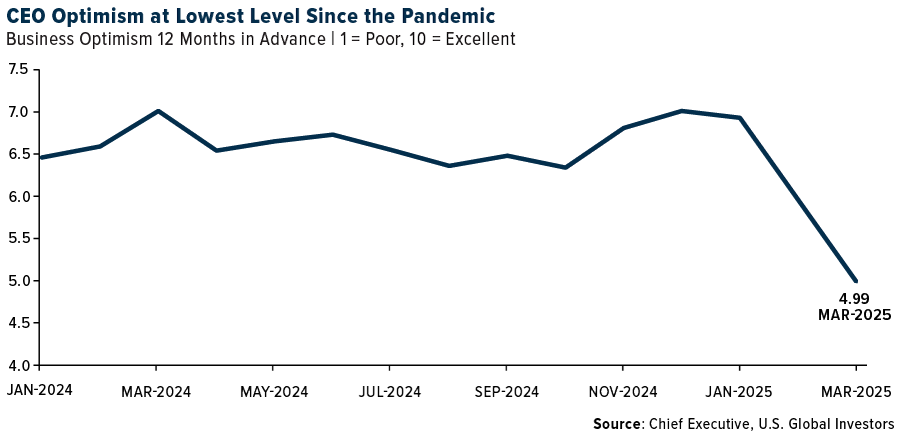
FYI: Looking ahead 12 months in the future, CEOs’ business optimism fell to 4.99 this month, a 28% decline from January and the lowest recorded level since the spring of 2020, when the pandemic shut down the global economy. (U.S. Global Investors)
AI CORNER

Tencent Touts Open-Source AI Models to Turn Text into 3D Visuals

YOUR DAILY EDGE: 17 March 2025: Hmmm…

CONSUMER WATCH

The Bank of America Institute data suggest a decent February (over a weak January), particularly in services:

imageConsumers’ credit and debit card spending per household dropped 2.3% year-over-year (YoY) in February, compared to a rise of 1.9% YoY in January, according to Bank of America aggregated card data. However, that decline reflected the extra leap day in February 2024, which boosted spending last year and depressed the YoY growth rate for February 2025. Seasonally adjusted (SA) spending per household rose 0.3% month-over-month (MoM), with the three-month seasonally adjusted annualized growth rate (SAAR) at 2.4%.

Spending continued to be strong in services in February on a MoM basis, though there was a continued decline in restaurant spending. Additionally, retail spending (ex- gas and restaurants) was flat MoM, after declining in January.

Via The Transcript:

  • “In February, our first quarter trend started out weaker than we had planned or expected. Now I think that’s consistent with what you’ve heard from other retailers who’ve reported.” — Burlington Stores ($BURL ) CEO Michael O’Sullivan
  • “We are lowering our RASM guide today by 3 points to an increase in the 2% to 4% range year-over-year…2 points are primarily due to softness in bookings and demand in large part due to the macro environment.” — Southwest Airlines ($LUV ) CEO Bob Jordan
  • “There’s certainly — we have also seen weakness in the demand market. It started with government…we’ve seen some bleed over to that into the domestic leisure market. Good news is that international, long haul, Hawaii, premium, all remain really strong. But we have seen government and some low-end consumer leisure weakness, which also appears consistent to me with a lot of other data that they look at.” — United Airlines ($UAL ) CEO Scott Kirby
  • “Every CEO I talked to right now is talking about, it just doesn’t feel as good as it did in the fourth quarter…There’s no question in this quarter and a lot of it is because of the reorientation, the destabilization, understanding what’s going on…People are pausing, consumers are pausing, M&A is pausing, corporations are pausing, everybody is pausing and you start — you’re going to start seeing that in the economic results. And the question is, will we start seeing elevated inflation starting in the second quarter when it starts rolling into — through the economy?” — BlackRock ($BLK ) CEO Larry Fink

Airline bookings are a good advance indicator of “don’t buy now so you don’t have to pay later”…

The FT offers some more recent data points:

  • Footfall to US stores fell 4.3% YoY in early March, according to RetailNext, a consultancy — extending declines that began at the start of the year.
  • Placer.ai, which aggregates signals from consumers’ mobile devices, has recorded fewer visits to big-box stores including Walmart, Target and Best Buy in recent weeks.
  • Sales of discretionary general merchandise fell by 3% in the week ending March 8 compared with last year, continuing a string of annual declines in February, data from Circana showed.
  • Traffic to US fast-food restaurants was down 2.8% in February, according to Revenue Management Solutions, with visits at breakfast time dropping by double digits. “It’s the easiest meal to make at home or skip entirely,” the consultancy said.
  • Four big US airlines this week warned of a slowdown in demand, in part due to retrenchment by leisure travellers.

Also via The Transcript:

“Economic uncertainty is a big deal, and we have really seen some weakness in March. So that has led to the guide that we issued earlier today, and you’ve seen this…This is disappointing.” — American Airlines Group ($AAL ) President Robert Isom

Even services are now weakening.

Hmmm…

Consumers and Businesses Send Distress Signal as Economic Fear Sets In

(…) President Trump’s stop-and-start trade wars and other rapid-fire policy changes are making Americans feel gloomy about the economy. Their 401(k)s are down, and their expectations for inflation are up. Now they are paring back spending on extras such as vacations and home-improvement projects.

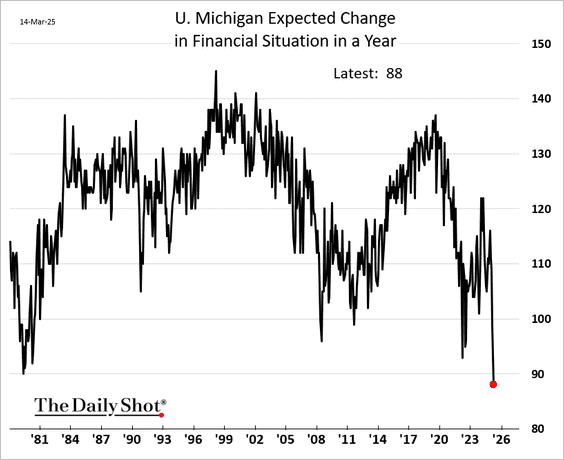
The University of Michigan’s closely watched index of consumer sentiment nosedived 11% to 57.9 in mid-March from 64.7 last month. Sentiment among Democrats was the lowest ever recorded, including the depths of the 2008-09 financial crisis. Even Republicans are feeling worse, although many think that any short-term economic pain caused by Trump’s moves will be worth it. (…)

Bleak sentiment about the economy can become a self-fulfilling prophecy. Nervous consumers tend to cut back, which weighs on spending and economic growth. While economists have been marking down their estimates for the economy, they still expect it to grow. (…)

In February, small-business uncertainty reached its second-highest level in the more than 50 years that the National Federation of Independent Business has been polling small-business owners, the group said. The highest reading was in October, just before the election. Sales expectations declined for a second month in a row after surging following the vote. (…)

The article goes on with stories of several businesses seeing sales declines in recent weeks.

Anecdotes are all investors can feed on until hard data reflecting Trump 2.0 reality start coming in. Ed Yardeni is among the increasingly shaky optimists:

We continue to bet on the resilience of the economy. However, we acknowledge that it is being severely stress-tested now by Trump 2.0’s tariff turmoil and shotgun approach to paring the federal workforce.

Perhaps the biggest surprise is that President Donald Trump wasn’t bluffing or even just exaggerating when he often said during his presidential campaign rallies that he loves tariffs. (…)

On March 7, Commerce Secretary Howard Lutnick said, “We’re going to make the External Revenue Service replace the Internal Revenue Service.” In other words, revenues from tariffs will replace revenues from taxes on individuals and corporations. That’s simply dangerous and delusional nonsense. It certainly isn’t passing the sanity test in the US stock market. (…)

Of course, the above assumes that funding the External Revenue Service of America doesn’t instigate a global trade war, which might cause a depression and a collapse of global trade, including US imports! That is probably a bad—and very dangerous—assumption, since some countries are already retaliating against Trump’s tariffs. So far, that group consists of just Canada, China, and the European Union. But lots of others may join the fray on April 2, when the US is scheduled to impose reciprocal tariffs. (…)

Our message to the White House: Mr. Trump, don’t build your tariff wall! Tear down tariff walls around the world by negotiating free-trade deals! (…)

The latest batch of economic indicators released on Monday, Tuesday, and Wednesday supported our resilient economy scenario with subdued inflation. (…)

Yet Goldman’s economists cut their real GDP growth projection for 2025 from 2.4% to 1.7% in response to Trump’s tariffs. That was on Tuesday. On Wednesday, Goldman’s strategists lowered their year-end S&P 500 target from 6500 to 6200.

(…) we can’t ignore the potential stagflationary impact of the policies that Trump 2.0 is currently implementing haphazardly.

Today, we are blinking on the valuation multiple of the S&P 500. But for now, we are sticking with our strong estimates for S&P 500 companies’ aggregate earnings per share of $285 this year and $320 next year. We are still targeting forward earnings per share—i.e., the average of analysts’ consensus estimates for this year and next, time-weighted to represent the coming 12 months—of $320 at the end of this year and $360 at year-end 2026.

On the other hand, under the circumstances discussed above, we are lowering our forward P/E forecasts for the end of 2025 and 2026 to a range of 18-20, down from 18-22. That lowers our best-case S&P 500 targets for the end of this year from 7000 to 6400 and for the end of next year from 8000 to 7200.

The worst-case scenarios using the same forward earnings and the same 18 forward P/E assumptions would be 5800 and 6500 for this year and next year.

That’s if President Trump relents, as we expect he will to avoid a recession that would cost the Republicans their majorities in both houses of Congress in the mid-term elections in late 2026.

One of the best economists and strategists now tells us that, hoping that the self-proclaimed Tariff Man will soon come to his senses and, within 2 weeks, suddenly leaves the table without showing his professed winning hand simply saying, with a totally straight face, “sorry folks, only bluffin’, but t`was fun!’’

With all due respect to Ed, this is fantasy!

We are too late in the game, everybody`s chips are in the pot. Everybody is apparently losing but, supposedly, The Donald. If he “relents” now, he loses all credibility. He’s done as a poker player.

President Donald Trump on Thursday [March 12] doubled down on his escalating tariff plans, even as his economic agenda continued to rattle investors and contribute to a weekslong stock market sell-off.

“I’m not going to bend at all,” Trump said when asked about his tariff plans during an Oval Office meeting with NATO Secretary General Mark Rutte.

“We’ve been ripped off for years, and we’re not going to be ripped off anymore,” he said.

Trump specifically said he would not change his mind about enacting sweeping “reciprocal tariffs” on other countries that put up trade barriers to U.S. goods. The White House has said those tariffs are set to take effect April 2. (…)

Trump added, “There’ll be a little disruption, but it won’t be very long.” (CNBC)

Yardeni keeping his “strong estimates for S&P 500 companies’ aggregate earnings per share of $285 this year and $320 next year” looks increasingly risky. Cutting his P/E range shows his weakening confidence.

EARNINGS WATCH

From LSEG IBES:

495 companies in the S&P 500 Index have reported earnings for Q4 2024. Of these companies, 73.7% reported earnings above analyst expectations and 18.8% reported earnings below analyst expectations. In a typical quarter (since 1994), 67% of companies beat estimates and 20% miss estimates. Over the past four quarters, 78% of companies beat the estimates and 17% missed estimates.

In aggregate, companies are reporting earnings that are 6.9% above estimates, which compares to a long-term (since 1994) average surprise factor of 4.2% and the average surprise factor over the prior four quarters of 6.6%.

Of these companies, 63.4% reported revenue above analyst expectations and 36.6% reported revenue below analyst expectations. In a typical quarter (since 2002), 62% of companies beat estimates and 38% miss estimates. Over the past four quarters, 62% of companies beat the estimates and 38% missed estimates.

In aggregate, companies are reporting revenues that are 1.2% above estimates, which compares to a long-term (since 2002) average surprise factor of 1.3% and the average surprise factor over the prior four quarters of 1.2%.

The estimated earnings growth rate for the S&P 500 for 24Q4 is 17.1%. If the energy sector is excluded, the growth rate improves to 20.6%.

The estimated revenue growth rate for the S&P 500 for 24Q4 is 5.2%. If the energy sector is excluded, the growth rate improves to 5.8%.

The estimated earnings growth rate for the S&P 500 for 25Q1 is 7.8%. If the energy sector is excluded, the growth rate improves to 9.4%.

Earnings are indeed very strong. Trailing 12-m EPS are now $245.37, up 9.4% YoY.

But equity investors are dubious, telling analysts to curb their enthusiasm…

…even more than what they have done so far:

image

Actually, forward EPS have only declined 0.9% to $270.36 since peaking at $272.92 in January. Forward EPS are still up 7.5% YoY. Ed Yardeni’s $285 EPS forecast is 5.5% above consensus which is still 11% above 2024 actuals. His P/E range applied on the EPS consensus puts the S&P 500 Index between 4868 and 5409, down between 4.1% and 13.7%.

The current P/E of 20.9x “shaky” forward EPS is still above the high end (20.0) of its historical range:

image

Ed is playing Trump’s poker game with a twin set of seemingly inflated chips.

Some charts FYI:

  • We all agree that consumers will get hit by broadly rising prices (though possibly only transitory) “but we`re OK with that and it won’t be very long”.
  • The bigger, more damaging and longer lasting risk, is that employment is impacted. The March employment report comes out April 4. The latest JOLTS report was OK but that was for January. The more timely and well correlated Indeed Job Postings series (through March 7) shows a clear break in labor demand since January and accelerating since mid-February. The next employment report could really jolt the market. Companies will seek to protect their profits amid rising costs and highly uncertain demand trends. Investors might not want to wait and see through this extraordinary chaos.

image

  • This is what awaits the world.

image

  • Soft data: Consumers are totally confused and worried. Note how historically weak some of these readings are:

image

image

image

image

image

  • Hard data: Bloomberg tracks debit card transactions daily. The January exuberance has totally disappeared in late February. The 28-d m.a. only remains positive because of the late-January stronger data points.

image

  • Hard data: weekly unemployment claims, after slowing to nearly zero in January-February, bounced back up 5% YoY since mid-February. Claims had been declining most of 2024 (last data point March 19):

image

  • Trump better be right because the federal government has little wiggle room if the “strategy” results in more than “a little distortion”.

image

  • J.P. Morgan reckons that a bit more than half of the expected 11.6% profit growth comes from further margin expansion…

Sources of earnings growth and profit margins

  • … which only happens in the Mag-7 companies.

image

  • Where would multiples go if earnings don’t deliver?

image

The stakes are high. We all have our own chips in Trump’s game and if he loses, we’re no winners: the potential combo of declining profit and mean reverting P/E multiples could take equity markets down another 15-25%.

  • To return to the high end of its 15-20 P/E range: 4900 on stable trailing EPS;
  • To return to its median P/E of 17.5: 4300 on stable trailing EPS;
  • To return to the Rule of 20 Fair Value: 4100 on stable trailing EPS;
  • Add your estimate of the profit damage and your estimate of the currency damage.

That’s the risk. Upside potential? 5800  (+3%) this year and 6500 (+15%) next year per the optimistic (hopeful?) Ed Yardeni. Two-year Ts will give you 8.2% risk-free for 2 years.

image

image

  • Sentiment is now so low, tempting contrarians. But maybe just not before a solid base has formed.

  • Another reading from Callum Thomas: “Similarly, my Euphoriameter indicator still looks kind of early in the process of rolling over from record high levels. This one is *not* at buy levels, and if anything is maximum bearish from a market cycles analysis standpoint (the worst signal is when it goes really high *and then rolls over*).”

Source:  Topdown Charts Euphoriameter

Slumping Stocks Threaten a Pillar of the Economy: Spending by the Wealthy Consumer spending is highly dependent on the affluent, who are highly dependent on the stock market

(…) The Harvard economist Gabriel Chodorow-Reich estimates that with all else equal, a 20% drop in stocks in 2025 might reduce growth by as much as a percentage point this year. The S&P 500 at Friday’s close was down 4.1% so far in 2025. (…)

The S&P gained 53% over 2023 and 2024, both reflecting and sustaining a strong economy. Alongside higher home prices, stock gains handed the wealthiest Americans more funds for a shopping spree. The top 10% of American earners now account for roughly half of all spending, up from 36% three decades ago, according to Moody’s.

As of 2022, families in the top 10% of income, on average, each owned about $2.1 million of stocks, about 32% of their net worth, according to a recent Federal Reserve survey. In 2010, stocks made up about 26% of average net worth for this group. Over the past four years, this group of top-10% earners has boosted spending by 58%.

It is not just the best-off who are pouring into stocks. Vanguard and Fidelity report record participation and contributions to their 401(k) plans for wage earners. At the end of last year, 43% of American households’ financial assets were in stocks, the highest share ever, according to Fed data. Many lower-income households don’t own equities, but the proportion that do continues to climb. (…)

U.S. households owned more than $56 trillion of stock at the end of last year, directly or through products such as mutual funds, according to Fed data, so the cents add up.

The economists Sydney Ludvigson and Martin Lettau studied wealth effects in the early 2000s. They concluded that steady stock gains boost spending over time, but that people usually don’t overreact to short-term fluctuations in the market.

Once in a while, a big move in stocks proves persistent and does change the course of consumer spending, Ludvigson said in an interview. The challenge for economists, she said, is that you can’t know which rallies or routs will be lasting until they are in the past.

image

This chart plots households net worth deflated by PCE inflation and the savings rate. The latter declines when real wealth growth exceeds its trend line and vice-versa.

image
Trade War With Europe Puts $9.5 Trillion at Risk, U.S. Firms Say Damage could ripple far beyond whiskey and Champagne, American business group warns

The escalating trade war between the U.S. and Europe threatens a commercial relationship that is worth an estimated $9.5 trillion in two-way trade and investment, say American businesses caught in the crossfire.

The American Chamber of Commerce to the European Union, which represents U.S. companies that operate in Europe, said tariffs risk damaging far more than just sales of goods that are directly taxed. They could also harm trans-Atlantic investments, which are more than three times as valuable.

Two-way trade in goods between the U.S. and Europe, including the U.K., hit a record of about $1.3 trillion last year, while total trade in services between the two economies was estimated at more than $750 billion, AmCham EU said in a report published Monday.

But sales by companies that have invested across the Atlantic were far higher, the report said. European affiliate sales in the U.S. were likely above $3.5 trillion and U.S. affiliate sales in Europe were likely more than $4 trillion last year, according to estimates from the report’s authors. (…)

President Trump has largely focused on trade in goods when talking about the U.S.’s trade relationship with Europe. He has repeatedly raised concerns about the U.S. goods trade deficit with the EU, which was $235.6 billion last year, according to the Commerce Department.  (…)

The impact of tit-for-tat tariff threats could be even broader, said Dan Hamilton, a fellow at Johns Hopkins University and one of the authors of the AmCham EU report. The EU could retaliate against the U.S. by taxing services, where the U.S. has a trade surplus. And tariffs could have spillover effects on companies’ trans-Atlantic activities.

More American foreign direct investment goes to Europe than to the rest of the world combined, according to the AmCham EU report. European firms account for almost two-thirds of global foreign direct investment to the U.S.

Tariffs might make it harder for a European company to send parts that it makes in Europe to an affiliate’s U.S. factory, while countertariffs from the EU or another U.S. trading partner could make it harder to export a final product from the U.S., Hamilton said. Policy uncertainty could lead companies to hold back on trans-Atlantic investments.

“The ripple effects of conflict in the trade space will not be confined to trade,” Hamilton said.

China Economic Pickup Tops Forecasts Before Tariff Pain Deepens

Chinese consumption, investment and industrial production exceeded estimates to start the year, pointing to signs of resilience for an economy still in need of more stimulus as Donald Trump’s tariffs threaten growth.

The upswing suggested Beijing’s pro-growth pivot since late September continued to feed momentum for the world’s second-biggest economy. At the same time, the property market stayed under pressure and unemployment rose, a sign of vulnerabilities that could be exposed if US tariffs inflict more pain across China’s manufacturing sector.

Retail sales clocked their best reading in the first two months since October, the National Bureau of Statistics said Monday, while industrial output exceeded the median estimate in a Bloomberg survey of analysts. Growth in fixed-asset investment marked the fastest since the gain in the first four months of 2024. (…)

image

An expanded program to subsidize consumers and businesses who trade in old equipment is helping lift demand, while front-loading of shipments by exporters is propping up manufacturing.

As authorities increasingly turn the attention on generating more consumption — their top priority this year — the goal is to shift from what one official called China’s previous “supply-focused” approach to one driven by both supply and demand. (…)

China’s front-loading of shipments abroad has been supporting industrial production at the start of the year, while an early roll-out of fiscal stimulus this year contributed to faster infrastructure investment growth, according to Jacqueline Rong, chief China economist at BNP Paribas SA. Exports reached a record $540 billion in the first two months of the year.

However, a prolonged property sector slowdown continues to weigh on the economy and higher tariff woes loom ahead, she cautioned. The floor space of new home sales shrank again in the last two months and property development investment slumped 9.8%, according to NBS numbers.

“The real estate sector will remain a drag on the economy this year,” Rong said. “Looking forward, the tariff impact on exports will become evident sooner or later, and the downside risks on exports will definitely show up.” (…)

Prices in 70 cities, excluding state-subsidized housing, dropped 0.14% from January, when they slid 0.07%, National Bureau of Statistics figures showed Monday. Values of used homes fell 0.34%, the same pace as a month earlier. (…)

In a precarious sign, used-home prices dropped 0.1% from January in top-tier cities, falling for the first time since authorities introduced a major stimulus package last September. Such prices are widely seen as a bellwether because they face less intervention by local governments and sales of secondhand homes have surpassed those in the primary market.

Residential sales dipped 0.4% in the first two months from a year earlier, improving from a 17.5% drop last year, other data showed Monday. (…)

Year-on-year price declines eased slightly. New-home prices fell 5.22% in February, compared with January’s 5.43% drop, the statistics bureau said. Existing-home values slid 7.53%, versus 7.8% in January. (…)

China’s leaders unveiled more steps to shore up the property market at a national parliament meeting this month, where they also set a bullish economic growth goal despite the escalating trade tensions with the US under President Donald Trump.

They included a pledge to give regional governments more say in how they buy unsold homes to clear inventory. Policymakers are considering scrapping a price cap for local authorities during that process, Bloomberg reported. The changes could improve some of the plan’s unattractive economics for both developers and state buyers. (…)

image

The Real Threat to American Soft Power Moral authority matters more than foreign aid.

(…) In Washington’s foreign policy circles, the destruction of USAID has also prompted a paroxysm of anxiety about the US’s place in the world. The consensus holds that by throttling foreign aid, the administration has inflicted grievous damage to American soft power. There is also the obligatory hand-wringing about the vacuum that might be filled by China.

But just as the public overstates the magnitude of foreign aid spending, policy wonks have a tendency to overstate its contribution to American soft power. For those of us who grew up in the shadow of the Cold War, American influence was less about the flow of dollars and more about the image the country projected of itself as the proverbial shining city on the hill. It’s what Trump and Musk plan to do to America — not to foreign aid — that may tarnish that image and do the most damage to US soft power.

The concept of soft power emerged from the mind of Joseph S. Nye, a Harvard professor and former Clinton administration official, in a seminal 1990 essay for Foreign Policy. Nye would go on to author several books and monographs on the topic, including the definitive Soft Power: The Means to Success in World Politics.

Since then, the concept of “soft power” has become a kind of secular religion among foreign policy professionals worldwide — and Nye’s book one of the scriptures of international-relations theory.

Nye defined soft power as “the ability to affect others to obtain the outcomes one wants through attraction and persuasion rather than coercion or payment.” The soft power of a country like the US, he argued, rested on “its resources of culture, values and policies.”

Where does foreign aid fit in? Amid the whine of Musk’s wood chipper, I put the question to Nye himself. His response was telling: Aid, he said, is merely an instrument of foreign policy, and the pulverization of USAID may affect American soft power — but only marginally. Of far greater import, Nye said, are international perceptions of Trump’s assault on America’s culture and values.

Nye pointed to Trump’s bullying of allies such as Canada and his threats to annex Panama and Greenland, as well as his disregard for international bodies like the World Health Organization and frameworks like the Paris Agreement. “The impact of these things will be more profound in the long run,” he said.

This view was echoed by Victoria De Grazia, professor emerita of history at Columbia University and co-editor of Soft-Power Internationalism: Competing for Cultural Influence in the 21st-Century Global Order. She added “deporting people and terrorizing minorities” to the list of Trump’s infringements on American values, but said the greatest damage to US soft power is the country’s failure “to uphold the liberal order” — that intricate web of institutions, norms and relationships that has defined the post-1945 world. (…)

The Soviet example should be a cautionary tale for contemporary China, which has spent the better part of two decades attempting to manufacture soft power through economic engagement with the developing world. The parallels are not exact: Unlike the moribund USSR of the 1980s, today’s China can tell a compelling story about lifting hundreds of millions of its citizens out of poverty. But the similarities are nonetheless striking.

Like Moscow then, Beijing now aspires to near-total control over its global image management. But it has been even less successful than the Soviet Union at hiding how it treats its own people. Again thanks to modern communications technology, more people know about the forced labor camps for Uyghurs in Xinjiang, for instance, than were aware — in real time — of the gulags in the USSR.

Beijing’s obsession with message control only undermines its credibility, according to Nye: “Because there’s total Communist Party control over media and civil society, the narrative is treated with suspicion.” Ohnesorge concurred, observing that America’s free press, which mercilessly exposed flaws in US society and government throughout the Cold War, paradoxically strengthened the country’s soft power. “Soviet propaganda never worked because it was obviously propaganda,” he said. (…)

But if China faces a Sisyphean task in acquiring the soft power it so desperately craves, the US may be racing headlong in the opposite direction. Nye cautioned that the damage Trump does to American soft power cannot easily be fixed. (…)

BTW:

Trump Says Both Reciprocal and Sectoral Tariffs Coming April 2

“April 2 is a liberating day for our country,” Trump said. “We’re getting back some of the wealth that very, very foolish presidents gave away because they had no clue what they were doing.”

That’s a lot of “very, very foolish presidents”.

image

President Trump’s net approval for handling of the economy fell to -12% in the last CNN survey, lower than any any point in his entire first term (and consistent with other recent polls). But the Republican base continues to overwhelmingly approve the President — 92% overall & 88% still approve his handling the economy — suggesting full steam ahead from the White House for now. (Bruce Mehlman)