Blockade on Russia Central Bank Neutralizes Defense Against Sanctions, U.S. Says The follow-on sanction prevents Moscow from selling foreign currency to prop up the ruble. The governor of Russia’s central bank said she sees a liquidity crisis.
(…) The coordinated action blocks the central bank from selling dollars, euros and other foreign currencies in its reserves stockpile to stabilize the ruble. Announcing the move Monday in Washington before U.S. markets opened, U.S. officials said they intended the sanctions to stoke already surging inflation, and the actions against the Bank of Russia are intended in effect to neutralize the country’s monetary defenses.
The sanctions also target another major government stockpile of assets, a key sovereign-wealth fund called the Russian Direct Investment Fund, and prevent Moscow from using other government and private banks to sidestep sanctions on its financial system, the officials said. (…)
In Moscow, the governor of the Bank of Russia warned that the Western sanctions on Russia’s financial system had exacted a dire toll on the Russian economy. (…)
“The conditions for the Russian economy have altered dramatically,” Elvira Nabiullina said in a statement Monday. “The banking sector is now experiencing a structural liquidity deficit,” she said, referring to a shortage of easily accessible money critical to keep the financial system running. (…)
The government also imposed capital controls, blocking residents from sending money to foreign bank accounts and restricting payments on offshore debt. (…)
Since Western governments started warning four months ago that Russian President Vladimir Putin was planning to invade Ukraine, the ruble has lost roughly a third of its value. (…)
But hitting the Russian central bank risks squeezing exports of energy and other commodities from the world’s 12th largest economy, the Institute for International Finance, a consortium of the world’s largest financial institutions, said in a report Monday. The cumulative effect on Russia’s economy of the sanctions could add to global inflation, the group warned. (…)
- Central Bank Squeeze Lacks Energy to Cripple Russia’s Economy While blocking official currency reserves puts ruble and economy under heavy pressure, they are underpinned by commodity exports
(…) The bottom line is that the magnitude of Russia’s energy sector is so disproportionate—half of its exports and a fifth of the economy—that it probably puts a floor under how bad things can get for the ruble. (…)
The blow remains painful: Of the $630 billion held in reserve by the central bank, more than half is probably blocked. Gold held domestically made up less than a quarter of the pot in mid-2021, and it won’t be easy to sell quickly. Most reserves were liquid foreign deposits and securities, but less than 15% were in China. Almost all the rest is invested in Western markets. (…)
Investors shouldn’t fall for the trope that nations with current-account surpluses can’t suffer currency and financial crises. They can, and Russian banks will experience both. Swift exclusion will cause big disruptions, given persistent linkages with Western financial systems. On Monday, the European Central Bank said the European arm of Sberbank, Russia’s biggest lender, is likely to fail because of a run on its deposits. (…)
(…) Hopes that commodity prices had put in a high near the end of last year now appear to have been dashed decisively. At the same time, the point at which raw material prices begin to take headline inflation rates lower is moved further into the future. Economists’ forecasts still call for a peak in inflation some time in the next few months — the Ukrainian conflict looks as though it will delay that peak. (…)

- Oil is again closing in on $100 a barrel with West Texas Intermediate trading as high as $99.24 this morning. International benchmark Brent was at $101.40 by 5:50 a.m. Eastern Time. The move higher comes despite the U.S. and other nations considering a 60 million barrel release from reserves. Elsewhere, aluminum hit another record high and concerns rose over global wheat supplies. (Bloomberg)

CPI-“ESSENTIALS”

GOLDMAN SACHS’ INFLATION TRACKER


GOLDMAN SACHS’ WAGE TRACKER

- Most companies that we listen to have noticed surprisingly low price elasticity of demand, which means that they continue to raise prices without seeing significant impacts. (The Transcript)
- We’ve seen weakness around spending in our lower-income cohorts…we’re seeing the effects of inflationary pricing around that where there is a more elastic demand curve around that. Certainly, with higher income cohorts, you’ve got a more inelastic demand curve, and that’s a lower percentage of our base.” – PayPal (PYPL) CFO John Rainey
- ArcelorMittal just settled a strike in Québec: wages will increase 26% over 6 years and retirement benefits substantially improved.
Target to Set New Starting Wage Range and Expand Access to Health Care Benefits to More Team Members
(…) Target led the retail industry by announcing in 2017 that it would raise its starting wage to $15 per hour, hitting the milestone nearly two years ago. The company is now taking its next meaningful step by setting a new starting wage range from $15 to $24. The new approach will apply to hourly team members working in Target stores, supply chain facilities and headquarters locations, positioning Target as a wage leader in every market where it operates. The exact starting wage within the range will depend on the job and the local market, with market-level wages set by the retailer based on industry benchmarking, local wage data and more.
Beginning in April with its new benefits cycle, Target also will roll out broader, faster access to health care coverage for its hourly team members, in addition to new and enhanced benefits.
Preparing for the first winter without Russian gas The European Union can manage without Russian gas next winter, but must be united in taking difficult decisions, accepting that in many cases it won’t have enough time for perfect solutions.
(…) The main message is: if the EU is forced or willing to bear the cost, it should be possible to replace Russian gas already for next winter without economic activity being devastated, people freezing, or electricity supply being disrupted. But on the ground, dozens of regulations will have to be revised, usual procedures and operations revisited, a lot of money quickly spent and hard decisions taken. In many cases time will be too short for perfect answers.
Public intervention will be necessary to ensure sufficient imports over the next few months. This may take the form of a task force to coordinate purchases and prevent companies outbidding each other. Policymakers should support activation of potential supplies and offer political bargains to secure additional LNG volumes. Private companies are likely to hold back from buying gas at the current high prices that they might only sell with a substantial loss if Russia floods the market. Hence, the EU should provide companies that store gas, especially in the most vulnerable EU countries, financial insurance against such a scenario. One might conceive contracts for difference, which pay companies back the difference in case prices end up below €70/MWh next winter.
These efforts are necessary but not sufficient. Over the next 12 months, there is little that can be done to remove hard physical bottlenecks. Without Russian gas, there will remain a gap between supplies and a ‘normal’ year’s demand. Exceptional measures are possible to reduce demand. They would send a signal of united European defiance and stop billions of euros currently flowing from west to east.
Summers Says ‘More Dangerous World’ Requires an FDR-Like Pivot
(…) “We are looking at an event of potentially vast significance and concern,” Summers said in a follow-up interview Monday, referring to the Russian invasion of Ukraine and the tightening alignment of Russia with China. “Our ability to meet these challenges depends on recognizing them for what they are.”
Biden will need to rally Americans in a great campaign to support the principles of democracy in face of authoritarian threats, said Summers, a paid contributor to Bloomberg Television and a Harvard University professor. (…)
“The United States faces far graver challenges to its security than anyone would have thought likely even several years ago,” Summers said. “That needs to have ramifications for almost every aspect of our national life.” (…)
“There was a tendency for some CEOs to treat the United States as a kind of primitive loyalty, but to emphasize that they had to do what was best for their company — which could mean going anywhere and doing anything” in operations around the world, he said Monday.
While not advocating “hard and fast rules” for U.S. companies’ engagement with China, Summers said too much effort has been spent by policy makers on American corporate interests in that country. Washington in the meantime “underinvested” in U.S. technological competitiveness.
“When we see the dominant emphasis in the economic policies of many countries shift from international integration to self-reliance as a dominant economic value, we know we are headed into a much more dangerous world,” he also said.
Summers urged Biden to put “more emphasis on our stake in what’s happening globally” with regard to challenges ranging from resisting aggression, confronting the pandemic and addressing semiconductor shortages to safeguarding the dollar’s status as the world’s reserve currency by moving to contain inflation. (…)
- The U.S. is expected to lean on Chinese tech companies to join sanctions against Russia and help cripple its ability to buy key technologies and components. China is Russia’s biggest supplier of electronics, accounting for a third of its semiconductor imports and more than half its computers and smartphones.
- An international boycott of Russian vodka is building from the U.S. to Australia, targeting one of the country’s most iconic products. At least three U.S. governors ordered the removal of Russian-made or branded spirits from stores, while one of the largest alcohol retail chains in New Zealand pulled thousands of bottles of vodka including the Ivanov and Russian Standard brands—and filled the empty shelves with Ukrainian flags. (Bloomberg)
Fiona Hill in a Politico interview (well worth reading in its entirety):
(…) “Ukraine has become the front line in a struggle, not just between democracies and autocracies but in a struggle for maintaining a rules-based system in which the things that countries want are not taken by force,” Hill said. “Every country in the world should be paying close attention to this.” (…)
Unfortunately, we have politicians and public figures in the United States and around Europe who have embraced the idea that Russia was wronged by NATO and that Putin is a strong, powerful man and has the right to do what he’s doing: Because Ukraine is somehow not worthy of independence, because it’s either Russia’s historical lands or Ukrainians are Russians, or the Ukrainian leaders are — this is what Putin says — “drug addled, fascist Nazis” or whatever labels he wants to apply here.
So sadly, we are treading back through old historical patterns that we said that we would never permit to happen again. The other thing to think about in this larger historic context is how much the German business community helped facilitate the rise of Hitler. Right now, everyone who has been doing business in Russia or buying Russian gas and oil has contributed to Putin’s war chest. Our investments are not just boosting business profits, or Russia’s sovereign wealth funds and its longer-term development. They now are literally the fuel for Russia’s invasion of Ukraine.
Sanctions are not going to be enough. You need to have a major international response, where governments decide on their own accord that they can’t do business with Russia for a period of time until this is resolved. We need a temporary suspension of business activity with Russia. Just as we wouldn’t be having a full-blown diplomatic negotiation for anything but a ceasefire and withdrawal while Ukraine is still being actively invaded, so it’s the same thing with business. Right now you’re fueling the invasion of Ukraine. So what we need is a suspension of business activity with Russia until Moscow ceases hostilities and withdraws its troops.
Ordinary companies should make a decision. This is the epitome of “ESG” that companies are saying is their priority right now — upholding standards of good Environmental, Social and Corporate Governance. Just like people didn’t want their money invested in South Africa during apartheid, do you really want to have your money invested in Russia during Russia’s brutal invasion and subjugation and carving up of Ukraine?
If Western companies, their pension plans or mutual funds, are invested in Russia they should pull out. Any people who are sitting on the boards of major Russian companies should resign immediately. Not every Russian company is tied to the Kremlin, but many major Russian companies absolutely are, and everyone knows it. If we look back to Germany in the runup to the Second World War, it was the major German enterprises that were being used in support of the war. And we’re seeing exactly the same thing now. Russia would not be able to afford this war were it not for the fact that oil and gas prices are ratcheting up. They’ve got enough in the war chest for now. But over the longer term, this will not be sustainable without the investment that comes into Russia and all of the Russian commodities, not just oil and gas, that are being purchased on world markets. And, our international allies, like Saudi Arabia, should be increasing oil production right now as a temporary offset. Right now, they are also indirectly funding war in Ukraine by keeping oil prices high.
This has to be an international response to push Russia to stop its military action. India abstained in the United Nations, and you can see that other countries are feeling discomforted and hoping this might go away. This is not going to go away, and it could be “you next” — because Putin is setting a precedent for countries to return to the type of behavior that sparked the two great wars which were a free-for-all over territory. Putin is saying, “Throughout history borders have changed. Who cares?”
Ukraine has become the front line in a struggle, not just for which countries can or cannot be in NATO, or between democracies and autocracies, but in a struggle for maintaining a rules-based system in which the things that countries want are not taken by force. Every country in the world should be paying close attention to this. Yes, there may be countries like China and others who might think that this is permissible, but overall, most countries have benefited from the current international system in terms of trade and economic growth, from investment and an interdependent globalized world. This is pretty much the end of this. That’s what Russia has done.
What stops a lot of people from pulling out of Russia even temporarily is, they will say, “Well, the Chinese will just step in.” This is what every investor always tells me. “If I get out, someone else will move in.” I’m not sure that Russian businesspeople want to wake up one morning and find out the only investors in the Russian economy are Chinese, because then Russia becomes the periphery of China, the Chinese hinterlands, and not another great power that’s operating in tandem with China. (…)
But this is also a full-spectrum information war, and what happens in a Russian “all-of-society” war, you soften up the enemy. You get the Tucker Carlsons and Donald Trumps doing your job for you. The fact that Putin managed to persuade Trump that Ukraine belongs to Russia, and that Trump would be willing to give up Ukraine without any kind of fight, that’s a major success for Putin’s information war. I mean he has got swathes of the Republican Party — and not just them, some on the left, as well as on the right — masses of the U.S. public saying, “Good on you, Vladimir Putin,” or blaming NATO, or blaming the U.S. for this outcome. This is exactly what a Russian information war and psychological operation is geared towards. He’s been carefully seeding this terrain as well. We’ve been at war, for a very long time. I’ve been saying this for years. (…)
What Russia is doing is asserting that “might makes right.” Of course, yes, we’ve also made terrible mistakes. But no one ever has the right to completely destroy another country — Putin’s opened up a door in Europe that we thought we’d closed after World War II.
MANUFACTURING PMIs
The U.S. PMI is out later this morning.
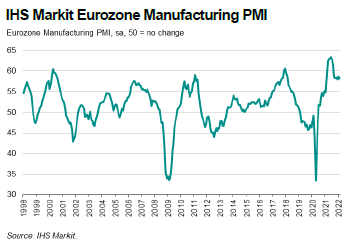
Eurozone: Manufacturing output growth supported by stronger demand and fewer delivery delays in February
More positive signals were seen in February’s IHS Markit PMI® data for the eurozone manufacturing sector, with growth in both output and new orders gaining further momentum following improvements in January. There were also fewer supplier delivery delays across the month, with lead times lengthening to the weakest extent for just over a year. Nevertheless, capacities across the sector continued to be tested and, while rates of both input cost and output price inflation slowed in February, they were still among the fastest on record.
Data split by the three broad market groups indicated stronger improvements at consumer and intermediate goods producers. While manufacturers of investment goods recorded a weaker expansion, they still performed strongest overall. The IHS Markit Eurozone Manufacturing PMI fell to 58.2 in February, down from 58.7 in January. Driving this result was the suppliers’ delivery times gauge (which is inverted in the calculation of the headline PMI), as the respective index recorded a notable increase since January. Partly offsetting this were the largest-weighted sub-components of the PMI – output and new orders – which experienced slightly positive directional changes. Employment growth was meanwhile stable, and stocks of purchases increased a slightly weaker pace.
By eurozone nation, it was the Netherlands that saw the strongest improvement in manufacturing conditions during February, followed by equally-sharp expansions in
Germany and Austria. Italy, Ireland and Greece also registered strong rates of growth, despite slowdowns in the latter two. Spain was the weakest-growing of the monitored euro area nations, followed by France.
Latest survey data signalled a strong increase in manufacturing output across the euro area midway through the first quarter. The expansion was the fastest since last September, following a marginal acceleration since January. Production volumes were supported by an improving trend in the demand for goods, with new orders rising sharply and at the quickest pace in six months. Export sales also increased over the month, with the expansion gaining momentum.
Eurozone manufacturers raised their employment levels during the latest survey period, extending an uninterrupted sequence of job creation which began in February 2021. The increase in staffing levels was sharp by historical standards and among the fastest since records began in 1997. Nevertheless, manufacturing capacities were strongly tested as backlogs of work rose at the fastest rate in four months.
Meanwhile, with new order growth continuing to outstrip that for output, stocks of finished goods were depleted for a twenty-first successive month. On the other hand, inputs placed into warehouses continued to rise, although the rate of accumulation slowed further from last December’s survey peak.
Eurozone manufacturers continued to be restrained by lengthening supplier delivery times during February, although the extent to which vendor performance deteriorated was the slowest since the beginning of last year and notably weaker than in January. This came despite another sharp rise in input demand during February.
Latest survey data continued to highlight strong pricing power among price setters, with steep rates of both input cost and output price inflation persisting. In both cases the increases were among the steepest on record, although they did slow since January.

China: Business conditions improve slightly in February
Latest PMI data signalled a slight improvement in business conditions across China’s manufacturing sector in February. Firms recorded a slight increase in output amid the fastest increase in total sales since last June. However, the pandemic continued to weigh on external demand, with new export orders falling again. Firms meanwhile registered a further drop in employment, which contributed to a fresh increase in unfinished business. Inflationary pressures meanwhile picked up, with both input prices and output charges rising at quicker rates. The outlook brightened, however, with optimism regarding future output improving to an eight-month high in February.
The headline seasonally adjusted Purchasing Managers’ Index™ (PMI™) rose from 49.1 at the start of 2022 to 50.4 in February, to signal a renewed improvement in overall business conditions. The rate of improvement was only slight, however, and softer than the long-run series average (51.0).
Supporting the higher headline index reading was a renewed increase in total new business placed with Chinese goods producers. Though modest, the rate of new order growth was the quickest seen for eight months, with a number of firms commenting on a relative improvement in market conditions and firmer customer demand.
However, new export orders continued to fall sharply, albeit less so than in January (which had seen the biggest drop in overseas demand for 20 months), suggesting the manufacturing sector remains heavily reliant on domestic demand as exports continue to act as a drag.
The improvement in overall demand conditions helped to drive a fresh increase in output in February. Production has now risen in three of the past four months, though the latest expansion was only slight.
Firms maintained a relatively cautious approach with regards to staffing levels, which fell for the seventh month running in February. The pace of job shedding was only modest, however, having eased since January. Nonetheless, there were signs of renewed capacity pressures, as firms registered a fresh increase in backlogs of work.
After a slight reduction in January, purchasing activity increased during February amid reports of higher production requirements. The rate of increase was marginal, however, and softer than the series average. Inventories of both pre-and post- production items meanwhile fell again in February, and at quicker rates than at the start of the year. A number of firms mentioned increased usage of current stocks for production and the fulfilment of orders, partly due to higher purchasing costs.
Suppliers’ delivery times lengthened again in February amid reports of shipping delays and material and staff shortages. That said, delays were not as marked as those seen in January and only modest.
Prices data showed a sharp and accelerated rise in average input costs. Notably, the rate of inflation hit a four-month high, with firms citing greater costs for raw materials, staff and transport. Selling prices likewise increased at the steepest rate since last October.
[However], fewer supply constraints, combined with government interventions in commodity markets, helped keep input price inflation lower than in the US and Europe, in turn feeding through to relatively muted selling price inflation.
China’s raw material and factory gate prices
Confidence regarding the 12-month outlook for output improved further in February to reach its highest since last June. Companies anticipate that a post-pandemic recovery and stronger demand conditions globally will help to support growth over the coming year.


ASEAN: Manufacturing conditions improve strongly during February
At 52.5 in February, the headline PMI pointed to a fifth successive monthly improvement in the health of the ASEAN manufacturing sector and one that was solid overall. Moreover, the latest figure was little-changed from January’s reading of 52.7 and remained among the highest on record.
Manufacturing conditions improved in six of the seven constituent ASEAN nations in February. (…)
Overall, the ASEAN manufacturing sector recorded a further strong performance in February with output growth remaining solid. New work rose at the quickest rate since last October, with demand from abroad also improving. As a result, firms continued to raise their purchasing activity in February. The rate of increase was the weakest in the current five-month sequence, but still moderate.
February data also highlighted sustained capacity pressures at ASEAN goods producers. Backlogs rose further, with the rate of accumulation easing only slightly from January’s peak, in part due to sustained supply issues as lead times for inputs lengthened sharply. Nonetheless, staffing levels decreased slightly in February.
Turning to prices, input costs increased steeply again in February. The rate of inflation slowed, but was nonetheless amongst the fastest on record. In response, firms raised their average selling prices at the quickest rate in the series history.
ASEAN manufacturers remained upbeat towards the outlook for output over the next year in February. That said, the level of sentiment moderated to a six-month low and was weak in the context of historical data.

Japan: Manufacturing sector records softer expansionin February
Businesses in the Japanese manufacturing sector signalled a further improvement in operating conditions in February, though the rate of expansion eased from January’s recent peak. A renewed rise in COVID-19 cases and sustained material shortages contributed to a renewed reduction in production levels, while new order inflows almost stagnated. Ongoing supply chain disruptions and delivery delays also placed strain on manufacturers resulting in an intensification of input price pressures not exceeded for thirteen-and-a-half years. In an attempt to protect against further delays and price rises, firms raised stocks of pre-production goods at the sharpest rate in the survey history.
The headline au Jibun Bank Japan Manufacturing Purchasing Managers’ Index™ (PMI) slipped from 55.4 in January to 52.7 in February. This indicated a thirteenth consecutive monthly improvement in the health of the sector, although the pace of expansion was the softest since last September.
The weaker headline reading was partly due to a renewed reduction in output. Though marginal overall, the decline in production levels was the first for five months, as material shortages and surging COVID-19 cases weighed on production.
New order growth slowed considerably in February. While remaining in expansion territory, the increase was only slight and signalled a near-stagnation in growth. The slowdown in demand was commonly linked to a rise in COVID-19 cases related to the Omicron variant, though anecdotal evidence also pointed to pockets of demand for automotive firms, most notably from abroad. As such, new export sales rose for the sixth successive month in February, following strong demand for automotives and electronics in China.
Japanese manufacturers indicated a rise in cost burdens for the twenty-first consecutive month in February. Moreover, the rate of input cost inflation accelerated from January to reach the fastest since August 2008. Rising input costs were widely attributed to higher raw material prices, notably for fuel and electronics. Manufacturers sought to partially pass higher costs to clients through prices charged, which rose at the third-fastest rate in the survey history.
Buying activity rose for the fifth time in as many months in February. Growth eased to a three-month low though remained solid overall, as firms purchased additional raw materials in light of delivery delays and material shortages. The former remained significant in the latest survey period, and contributed to a further marked deterioration in delivery times. As a result of additional purchases, firms built up safety stocks of raw materials and semi-finished goods to protect against future disruption and price rises, with stocks of purchases rising at the quickest pace in the history of the survey.
Concurrently, employment levels continued to increase in February, though the pace of job creation eased to the slowest since last November. In line with the trend for new orders, outstanding business also rose at a softer pace, with the rate of backlog accumulation the softest seen for 11 months.
Looking ahead, business confidence regarding output over the year ahead remained strong. However, the degree of optimism eased to a six-month low amid concerns regarding further waves of infection. Nevertheless, confidence was underpinned by hopes that the end of the pandemic and supply chain disruption would provide a broad boost to output.

 The EV revolution has begun
The industry sold 608,000 plug-in vehicles in 2021, up from 308,000 a year ago.
- EVs rose 85% and accounted for three out of four plug-ins sold (the vast majority of them Teslas).
- Plug-in hybrid sales grew 138%.
- The growth was remarkable, considering that overall vehicle sales were up just 3% in 2021.
The biggest transportation shift in more than a century has begun. (Axios)

Reproduced from DOE; Chart: Axios Visuals

 BTW: Lucid, the EV maker, slashed its production forecast by as much as 40%. (CNBC)
 Genius or not, the world flow of money is getting very messy. Never good. Watch for black swans.


