CONSUMER PRICE INDEX – DECEMBER 2020
The Consumer Price Index for All Urban Consumers (CPI-U) increased 0.4 percent in December on a seasonally adjusted basis after rising 0.2 percent in November, the U.S. Bureau of Labor Statistics reported today. Over the last 12 months, the all items index increased 1.4 percent before seasonal adjustment.
The seasonally adjusted increase in the all items index was driven by an 8.4-percent increase in the gasoline index, which accounted for more than 60 percent of the overall increase. (…) The food index rose in December, as both the food at home and the food away from home indexes increased 0.4 percent.
The index for all items less food and energy increased 0.1 percent in December after rising 0.2 percent in the previous month. (…)
The all items index rose 1.4 percent for the 12 months ending December, a slightly larger increase than the 1.2-percent rise reported for the period ending November. The index for all items less food and energy rose 1.6 percent over the last 12 months, as it did in the periods ending October and November. The food index rose 3.9 percent over the last 12 months, while the energy index fell 7.0 percent.

Where stimulus money is being or will be spent
The U.S. government is sending out another round of checks meant to stimulate economic activity during the coronavirus pandemic. Nearly half (44%) of U.S. recipients plan to save the money, Refinitiv discovered in a collaboration with Maru/Blue Public Opinion. About one-third (36%) of Americans will pay off their debts, while 20% will spend the funds. (…)
The survey also shows that those who plan to spend their stimulus money will do so for other personal expenditures and goods and services. They mainly plan to put the money towards basic living expenses, groceries, rent and mortgage. Others plan to renovate their home, upgrade their vehicle and spend on travel. Refinitiv discovered this in a collaboration with Maru/Blue Public Opinion, a panel and data service insight firm. The findings and detailed tables can be found here: https://www.marublue.com/american-polls.

EMPLOYMENT TRENDS
(…) The job openings level declined 1.6% to 6.527 million, down 3.9% y/y. The job openings level in the construction sector rose 9.8% y/y to 236,000 while in manufacturing, it rose 24.2% y/y to a greatly increased 498,000. It fell by 17.1% y/y in leisure & hospitality but rose 4.7% y/y in the professional & business service sector. In government, the number of job openings declined 7.5% y/y to the lowest level since June. (…)
In November, the level of hiring rose 1.1% (2.1% y/y) to 5.979 million following a 0.4% October improvement.(…)


Quite a rebound in manufacturing per JOLT! Not showing, yet, in actual jobs.

The Conference Board Employment Trends Index™ (ETI) was virtually unchanged in December, after seven consecutive monthly increases that started in May. The index now stands at 99.01, down from 99.05 (an upward revision) in November. The index is currently down 9.2 percent from a year ago.
“The latest Employment Trends Index numbers signal that the labor market recovery has paused, and in the coming months employment will likely remain stagnant or even dip,” said Gad Levanon, Head of The Conference Board Labor Markets Institute. “As the number of COVID-19 cases continues to rise and downside risks grow, it appears unlikely that the labor market will resume its recovery over the next few months. We expect in-person services such as restaurants, hotels, entertainment, passenger transportation, and personal and childcare services to take the biggest employment hit. The number of jobs in most other industries should continue to grow.” (…)

Nearly One-Third of U.S. Homebuyers Want to Move if They Can Work Remotely Post Pandemic About the same percentage have already moved, Redfin survey finds
(…) “We haven’t seen the end of pandemic-driven relocation,” Redfin chief economist Daryl Fairweather said in the report. “There will be a second wave of migration this year as permanent remote workers are able to let lifestyle preferences and affordability rather than proximity to the office dictate where they live.” (…)
About 72% of respondents expect to continue to work from home after the pandemic, with 17% saying they do not think they will be able to do so and 12% unsure, the data showed. (…)
Target Reports Holiday Sales Jumped on E-Commerce Boom
Target Corp. said sales jumped during the holiday period, with the big-box retailer appearing to solidify some of the gains it made in a turbulent 2020.
Same-store sales, an important gauge of retail success, rose 17%, the company said in a statement. That’s a slight slowdown from the 21% the company reported in the prior three months, but still a brisk pace for a well-established retailer. (…)
Additionally, customer traffic in stores rose 4.3% despite the pandemic, and the average shopping ticket increased 12%. Chief Executive Officer Brian Cornell said the strength has persisted in 2021. (…)
CFOs at U.S. Midmarket Companies Predict Revenues Will Rebound
Fifty-six percent of chief financial officers at publicly traded and privately held midsize companies predict revenue will increase over the next 12 months, according to a recent survey by BDO USA LLP, a professional-services firm. (…)
Middle-market companies usually generate between $100 million and $3 billion in annual revenue and grow at a faster pace than their larger counterparts. The improved outlook comes after a year during which middle-market firms sought to preserve cash, dial back investments and pause hiring plans amid economic uncertainty caused by the pandemic.
Midmarket companies reported median revenue growth of 2.9% in October and November, down from 8.3% in the prior-year period (…).
Despite lower revenue growth, midsize companies reported higher profits, as finance chiefs executed emergency cost cuts in addition to planned long-term reductions. Earnings growth in the first two months of the fourth quarter rose to 14.9% from 10% a year before, Golub Capital said. (…)
That means 44% predict revenues will not increase.
Moving beyond optimism to euphoria
(…) The chart below shows a fairly clear contrary nature to the model – when it’s high, the S&P’s returns over the next year tend to be low; when the model is low, the S&P’s returns are high.
Whenever this proxy was above 1, occurring about 14% of the time since 1988, the S&P 500 returned an annualized -3.7%, compared to an impressive +21.4% when it was below zero.
Even though this proxy isn’t as extreme as the one shown above, it did just record the 3rd-highest reading in 30 years.
The biggest difference between now and most of those other signals is quality and momentum. As we saw on Friday, there have been tremendous thrusts underlying the market (though with some recent, isolated oddities that are troubling). As Dean pointed out, the S&P’s recent new highs have been high-quality, not yet showing anywhere near the kind of deterioration we saw at other euphoric peaks.
The setup is ripe for a sustained pullback, and risk appears high relative to reward. We’re just not quite seeing the kind of consistent internal weakness that preceded most of the sustained and deep corrections following other overly-optimistic-to-euphoric bouts of sentiment.


TANTRUM?
U.S. 10Y Treasury yields reached 1.12% yesterday, up from 0.93% Monday of last week before the Georgia runoffs and up from their 0.60% range between April and September.
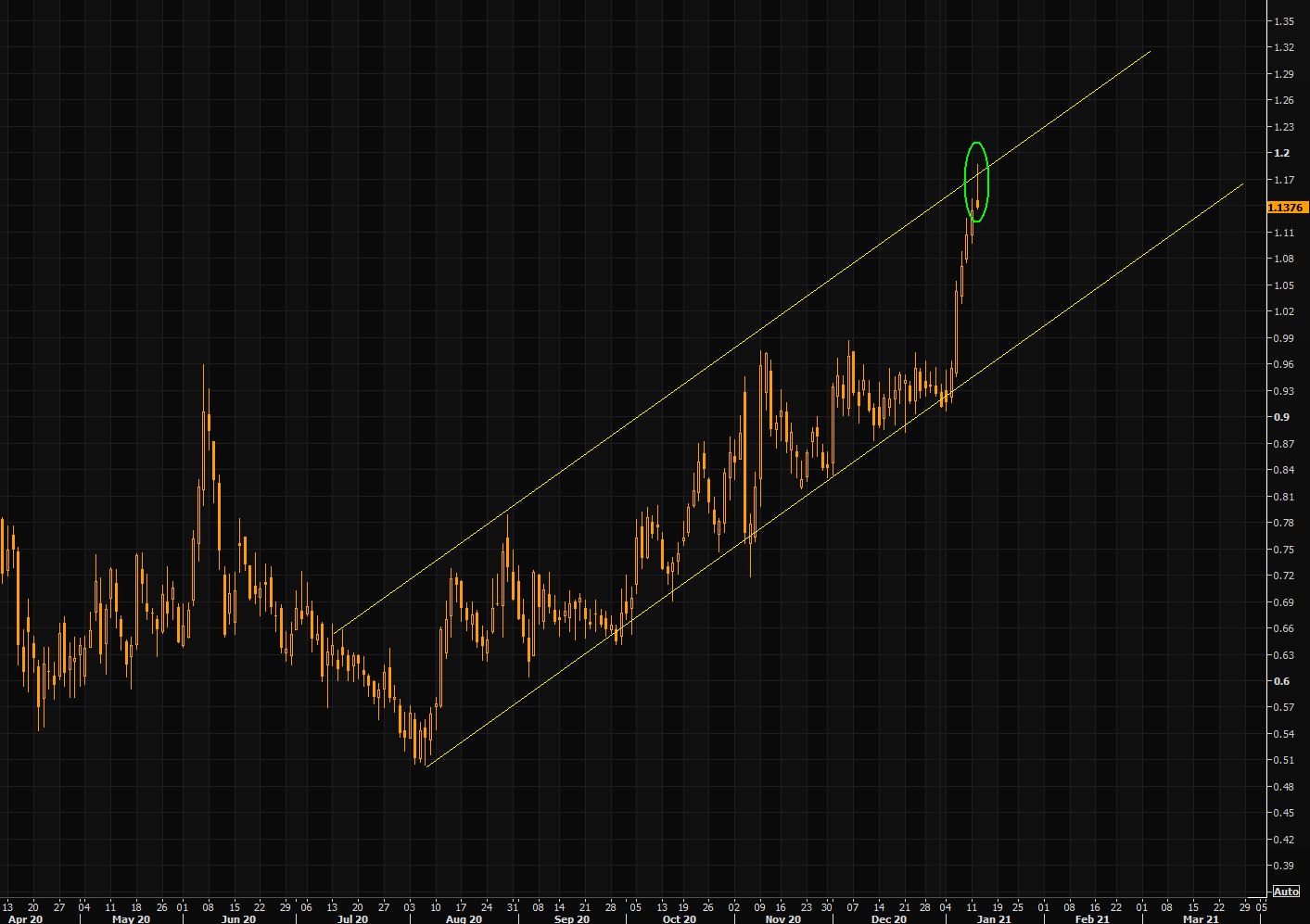
Bloomberg’s Joe Weisenthal argues that a market tantrum is unlikely:
Here we have a potential for major fiscal expansion, risky assets at all-time highs, expectations for extremely rapid growth in 2021 (knock on wood), and yet we’re still below February yields.
If you forgot, February yields were 1.5-1.6%. Recent Fed quotes:
- Harker – “I could see, potentially, that occurring at the very end of 2021 or early 2022…It could cause disruption in the markets if we try to do it too soon”.
- Bostic – “I’m definitely open to the possibility that we may pull it back sooner than people expect….Possible very strong rebound could change Fed policy outlook”
- Kaplan – “There will be a point at which it’ll be much healthier for the economy and for the markets to be weaning off some of these extraordinary measures,”
- Evans – “It could be the case that things are going a lot better, and we do end up doing some type of tapering” (late 21 early 22)
- Clarida – “My economic outlook is consistent with us keeping the current pace of purchases throughout the remainder of the year.”
However, Goldman Sachs’ Jan Hatzius warns:
For the last several months, equity and credit markets have looked through the near-term virus deterioration and have focused instead on the longer-term recovery theme, while government bond markets have been reassured by low inflation and the promise of ample monetary policy support. But since yearend, an important change in this friendly environment has occurred, with the 10-year US Treasury yield backing up sharply to its highest level since March 2020. Under our forecast for another fiscal package, improving growth, and (temporarily) higher core PCE inflation in the spring, the move higher in yields could well extend. If so, this might cause some short-term indigestion in risk asset markets.
NOW THIS: COVID-19
Global coronavirus cases and fatalities are setting new records. In a few countries—the UK, Ireland, and South Africa—much of the blame lies with new variants that are more transmissible than the original virus. Elsewhere, the significance of the new variants is less clear so far. However, experts suspect that they are already spreading underneath the surface in a number of economies, including not only the Euro area but also the US where genomic surveillance is less developed and public health officials are therefore “flying blind” to some degree. If so, the nature of exponential growth suggests that the greater transmissibility of the new variants could have serious consequences for new case numbers, hospitalizations, and ultimately fatalities across a larger range of countries. (GS)

More charts form Fathom Consulting:


 Good Read: