Moderna Vaccine Found Highly Effective at Preventing Covid
Moderna Inc. said its Covid-19 vaccine was 94.5% effective in a preliminary analysis of a large late-stage clinical trial, another sign that a fast-paced hunt by scientists and pharmaceutical companies is paying off with potent new tools that could help control a worsening pandemic. (…) A preliminary analysis of data from more than 30,000 volunteers showed Moderna’s vaccine prevented virtually all symptomatic cases of Covid-19, the disease caused by the coronavirus, the company said in a statement on Monday. (…)
The vaccine also appeared to be effective in preventing the most serious Covid-19 infections. There were no severe cases among people who got the vaccine, compared with 11 in volunteers who received placebo shots, according to Moderna’s statement.
“The thing that got me the most excited today was the severe disease,” Moderna Chief Executive Officer Stephane Bancel said in an interview. “That for me is a game-changer.” (…)
In its statement, Moderna said it could seek a go-ahead from regulators in the coming weeks.
The company said it would expect an emergency authorization to be based on a final analysis containing 151 cases, along with two months of safety follow-up data that U.S. regulators want to see. That final data is expected later this month. (…)
Moderna said on Monday that new stability data showed its vaccine is stable at refrigerator temperatures for 30 days, much longer than a previously estimated seven days. For longer-term storage, it can be kept in freezers, though it doesn’t need the special facilities required for the Pfizer vaccine. (…)
The analysis of Moderna’s data found no significant safety concerns, the company said. It said some participants had severe fatigue, muscle pain, joint pain and headaches after getting the vaccine, though the side effects were generally short-lived. (…)
The U.S. recorded more than 1 million new COVID-19 cases in the past 6 days. (Axios)
Covid-19’s Spread Covers All of U.S.
(…) In earlier surges, infections were concentrated in cities such as New York and Chicago, or populous states like Florida and Texas. Many of the outbreaks then were linked to travelers returning from overseas or so-called superspreading events such as conferences, weddings and rallies.
Now, it is everywhere. People are becoming infected not just at big gatherings, but when they let their guard down, such as by not wearing a mask, while going about their daily routines or in smaller social settings that they thought of as safe—often among their own families or trusted friends. (…)
Most of the new cases are in the Midwest, which is experiencing a major surge. But even states and cities that had successfully beaten the virus down to low levels are struggling with rising numbers of illnesses. (…)
The number of hospitalizations has reached a new high, though hospital stays are shorter and fewer people are dying than in the spring, likely due to more medical knowledge and better treatment. (…)
The virus, having spread for months, is now more entrenched in communities, epidemiologists say. (…) “You don’t need to go to hot spots anymore.” (…)
The Big Unknown Is Where People Are Getting Infected
(…) In Germany, authorities say they don’t know where 75% of people who currently test positive for the coronavirus got it. In Austria, the figure stands at 77%. In Spain, the health ministry said that it was able to identify the origin of only 7% of infections registered in the last week of October. In France and Italy, only some 20% of new cases have been linked to people who previously tested positive. (…)
Asian nations that have used contact tracing successfully to control the disease interview 10 or more contacts for each case. In the U.S., France, the U.K. and Spain, tracers are identifying fewer than four contacts for each case, according to government data.
Even when data can be gleaned from such limited and partial contact-tracing records, it is likely to be skewed by statistical distortions. (…)
The problem is exacerbated by the way this virus works, especially the fact that people can take up to 10 days to develop symptoms. They can also be infectious without showing any symptoms at all. (…)
Consumer Sentiment Fell in First Half of November Mood of Americans darkened amid Republicans’ post-election pessimism and a national coronavirus surge
The University of Michigan’s index of consumer sentiment dropped to 77.0 in the two weeks ended Nov. 10, from 81.8 in October. The index of expectations drove the decline, falling to 71.3 from 79.2 in October. (…)
“Interviews conducted following the election recorded a substantial negative shift in the Expectations Index among Republicans, but recorded no gain among Democrats,” said Richard Curtin, the survey’s chief economist.
A measure of expectations among Republicans declined to 76.4 from 96.4. It edged up to 69.3 from 68.6 among Democrats.
Republicans’ economic outlook in early November fell to levels not seen since President Trump was sworn in, said Mr. Curtin. Meanwhile, Democrats’ worries about the coronavirus resurgence likely offset any increased optimism about the economy, he said. Nearly 60% of Democrats reported that the pandemic had dramatically changed their daily lives, compared with just 34% among Republicans. (…)
The American Consumer Is Flush With Cash After Paying Down Debt
(…) Record-low mortgage rates, reflecting the ultra-easy Fed policy, have prompted a steady wave of refinancing and allowed homeowners to reduce monthly payments or tap equity. Americans are also holding more cash, helped in part by stimulus from the government. (…)
“The consumer here in the U.S. is relatively stable and, honestly, somewhat relatively better than we might have feared back in the height of the pandemic in the second quarter of 2020,” Marianne Lake, JPMorgan Chase & Co.’s chief executive officer for consumer lending, said Nov. 9 at a virtual investor conference. “The consumer’s willingness to carry on spending is a pretty positive sign for sort of a broader economic recovery.” (…)
While the pandemic has financially been harder on working-class families than the wealthy ones who have been stockpiling much of the cash, data shows that they too have more money in the bank now. That’s important because they are much more likely to spend that money — and give the economy an added jolt — than the rich are. (…)
While “cash buffers” of those who benefited from fiscal stimulus are starting to weaken, their financial positions remain elevated compared with pre-pandemic levels, JPMorgan’s Lake said. “I think there’s enough juice to get people to year-end.” (…)

But the same JP Morgan’s consumer spending tracker seems to be rolling over:
• On November 09, our tracker of Chase consumer card spending fell from -6.7% to -7.4%.
• The tracker fell -3.9%-pt over the prior week, and it is 33.5%-pt above its low of -40.9% on March 30.

And the same JP Morgan’s employment model, based on alternative data, suggests a stall in the labor market in November. (Via Bloomberg)

WSJ Survey: Recovery Seen Staying on Track Most forecasters say Congress will approve a fresh round of stimulus spending, with the highest probability in the first quarter of 2021.
(…) Forecasters see an unemployment rate of 6.7% at the end of this year, down from 7.8% in last month’s survey. They now expect gross domestic product to contract 2.7% this year, measured from the fourth quarter of 2019, an improvement from the 3.6% contraction they predicted last month. They forecast expansions of 3.6% in 2021 and 2.9% in 2022, only slightly slower than in the prior month’s survey. (…)
Forecasters in this month’s survey assigned a 61% probability of a fresh round of stimulus in the first quarter of 2021 and a 24% likelihood that it will come later that year. They put a 38% probability on a package in the current fourth quarter and a 17% probability that there would be no further stimulus at all.
When asked how much near-term support the economy needs, the majority of economists in November’s survey, 58%, said a stimulus package should be in the $1 trillion to $2 trillion range. Some 29% said it should be less than $1 trillion, while 13% said an appropriate aid package should be in the $2.1 trillion to $3 trillion range. (…)
More than half of economists, 55%, said tax increases would be unlikely under a Biden presidency with a Republican-controlled Senate. Only a third of economists saw higher taxes as likely. (…)
U.S. Housing Affordability Improves in September as Interest Rates Decline
The National Association of Realtors reported that its Fixed Rate Mortgage Housing Affordability Index edged 0.4% higher (-3.1% y/y) to 159.6 in September. Despite the gain, affordability was 7.0% below its April high.
The effective mortgage interest rate declined to a record low of 2.95% in September (figures date back to 1981). Median family income improved 0.3% (2.3% y/y) following a 1.5% August decline. The median sales price, which was reported last month, increased 0.4% (15.2% y/y) to a record high of $316,200, following three straight months of strong gains. Combined, monthly principal and interest payments eased 0.2% (+5.6% y/y) to $1,060, leaving the payment share of income at 15.7%. That share has increased from 14.6% in April.


U.S. Producer Price Index Increases; Core Prices Hold Steady in October

China Economy Gathers Steam, Setting Stage for a Strong End to the Year China’s economic activity posted a broad-based recovery in October, as investment and consumer spending grew faster year-over-year, while industrial production held firm.
(…) Industrial output, which has led the nation’s economic recovery in recent months, rose 6.9% in October from a year earlier, on par with September’s pace and higher than market expectations for a 6.5% increase, according to data released Monday by the National Bureau of Statistics.
Fixed-asset investment rose 1.8% in the January-October period, accelerating from 0.8% growth in the first three quarters of the year and coming in higher than the 1.6% increase expected by economists polled by The Wall Street Journal.
Retail sales, a key gauge of Chinese consumer spending, rose 4.3% in October from a year ago, accelerating from a 3.3% increase in September, but lower than a 4.6% increase expected by surveyed economists. (…)
“Economic growth in the fourth quarter is expected to be even faster than that of the third quarter,” Fu Linghui, a spokesman for the statistics bureau, said in a briefing Monday, adding that the growth in China’s imports and exports will outpace that of the world as a whole, even though uncertainties hover over the overseas economy. (…)

Source: Bloomberg
Japan’s Economy Expands as It Recovers From Pandemic The growth in the July-September period occurred at the fastest pace in at least 40 years as private consumption and exports improved along with the reopening of the global economy.
The world’s third-largest economy after the U.S. and China expanded 5% in the third quarter of 2020 from the previous quarter, the first growth in four quarters and the biggest expansion since 1980, the period for which comparable data are available. The result came after a record drop in the second quarter and was better than economists’ forecast.
On an annualized basis, which reflects what would happen if the third-quarter pace continued for a full year, Japan’s economy expanded 21.4%, compared with a consensus forecast of 18.9%. In the third quarter, the nation’s gross domestic product totaled an annualized 508 trillion yen, equivalent to $4.85 trillion, recovering a little more than half of what it lost in the coronavirus pandemic. (…)
Economists say any further recovery is likely to be slow in coming quarters. The services sector remains weak owing to fears of infection, and the virus is spreading again in some countries.
China, 14 other countries sign world’s biggest trade pact
China and 14 other countries agreed Sunday to set up the world’s largest trading bloc, encompassing nearly a third of all economic activity, in a deal many in Asia are hoping will help hasten a recovery from the shocks of the pandemic.
The Regional Comprehensive Economic Partnership, or RCEP, was signed virtually on Sunday on the sidelines of the annual summit of the 10-country Association of Southeast Asian Nations. (…)
The accord will take already low tariffs on trade between member countries still lower over time and is less comprehensive than an 11-country transpacific trade deal that U.S. President Donald Trump pulled out of shortly after taking office.
Apart from the 10 ASEAN members, it includes China, Japan, South Korea, Australia and New Zealand, but not the United States. Officials said the accord leaves the door open for India, which dropped out owing to fierce domestic opposition to its market-opening requirements, to rejoin the bloc. (…)
The agreement is expected to help China, Japan and South Korea finally reach a trilateral free-trade deal after years of struggling to bridge their differences.
(…) having won over disaffected rust-belt voters in Michigan and western Pennsylvania in the Nov. 3 election, Mr. Biden is “not going to squander that by going back into TPP,” Michael Jonathan Green of the Center for Strategic and International Studies said in a web seminar.
But given concerns over China’s growing influence, Mr. Biden is likely to seek much more engagement with Southeast Asia to protect U.S. interests, he said.
The fast-growing and increasingly affluent Southeast Asian market of 650 million people has been hit hard by the pandemic and is urgently seeking fresh drivers for growth.
RCEP originally would have included about 3.6 billion people and encompassed about a third of world trade and global GDP. Minus India, it still covers more than two billion people and close to a third of all trade and business activity. (…)
U.S. Crop Prices Are Rising, and China Is Buying Dry weather, China’s push to fatten its pigs and the lockdown-induced baking bonanza are lifting prices for U.S. row crops.
(…) Dry weather in the U.S. Great Plains, Argentina, Russia, Ukraine and Brazil have reduced yields and expectations for what were forecast to be bumper crops.
Meanwhile, China has been restocking its grain bins and rebuilding its hog herds after culling millions of pigs last year to combat an outbreak of African swine fever.
The U.S. Agriculture Department predicts that China this season will import record volumes of coarse grains, which are mostly corn, and buy more foreign wheat than it has in a quarter-century.
China’s buying has been particularly bullish for soybeans. U.S. soybean sales to China have doubled since the countries signed a bilateral trade agreement earlier this year. Though China has bought more than $23 billion of U.S. agricultural goods, it has billions yet to spend to fulfill the terms of the countries’ so-called phase-one deal, according to the Office of the U.S. Trade Representative. (…)
China bought so many soybeans from Brazil that the world’s largest exporter is running low at home. Last month, Brazil lifted import tariffs on soybeans and corn. Earlier this month a ship loaded with 38,000 metric tons of soybeans left the U.S. bound for Brazil, taking a rare trade route, according to Randy Giveans, a Jefferies shipping analyst. (…)
The Agriculture Department last week said it expects U.S. inventories of wheat and corn to end their current marketing years 15% lower than in the prior ones. It slashed expectations for soybean production following poor yields in Ohio, Indiana and other states and expects season-end stockpiles to be about a third of what they were a year earlier.
Farmers and traders are watching the weather in Argentina and Brazil, where a lack of rain threatens harvests. (…)
Trump Plans More Actions on China in Coming Weeks to Bind Biden Actions under consideration include protecting U.S. technology from exploitation by China’s military, countering illegal fishing and more sanctions against Communist Party officials or institutions causing harm in Hong Kong or the far western region of Xinjiang, the official said, without providing specifics.
EARNINGS WATCH
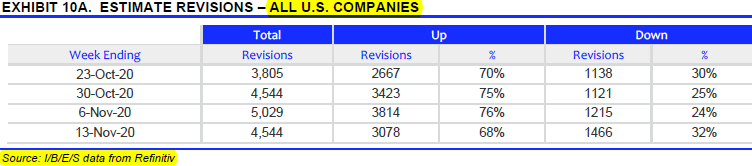
From Refinitiv/IBES:
Through Nov. 13, 462 companies in the S&P 500 Index have reported earnings for Q3 2020. Of these companies, 84.4% reported earnings above analyst expectations and 12.6% reported earnings below analyst expectations. In a typical quarter (since 1994), 65% of companies beat estimates and 20% miss estimates. Over the past four quarters, 73% of companies beat the estimates and 21% missed estimates.
In aggregate, companies are reporting earnings that are 19.2% above estimates, which compares to a long-term (since 1994) average surprise factor of 3.5% and the average surprise factor over the prior four quarters of 8.7%.
Of these companies, 77.7% reported revenue above analyst expectations and 22.3% reported revenue below analyst expectations. In a typical quarter (since 2002), 60% of companies beat estimates and 39% miss estimates. Over the past four quarters, 61% of companies beat the estimates and 39% missed estimates.
In aggregate, companies are reporting revenue that are 3.5% above estimates, which compares to a long-term (since 2002) average surprise factor of 1.5% and the average surprise factor over the prior four quarters of 1.1%.
The estimated earnings growth rate for the S&P 500 for 20Q3 is -7.4%. If the energy sector is excluded, the growth rate improves to -3.2%.
The estimated earnings growth rate for the S&P 500 for 20Q4 is -11.0% [-13.6% on Oct. 1]. If the energy sector is excluded, the growth rate improves to -7.9%.
Analysts estimates keep rising:


-
This Bullish Earnings Spin Shouldn’t Be Dismissed While executives have an incentive to talk up their results, the strength of their language amid a pandemic is notable.
(…) Andrew Lapthorne of Societe Generale SA keeps a regular spreadsheet of flash estimates — those most recently changed. These reveal that estimates for the first two quarters of next year for the S&P 500 are gently improving, which is better than the alternative — but there has been no great reassessment since midsummer:
Looked at geographically, estimates for next year are actually getting a little worse virtually everywhere, although this data won’t yet incorporate any of the rising vaccine hopes. Base effects mean that next year will see great growth, particularly in Europe, though the change from 2019 to 2021 will be slightly negative. (…)
When we try looking more qualitatively, however, things look a little brighter. Bankim Chadha and David Kostin, U.S. equity strategists at Deutsche Bank AG and Goldman Sachs Group Inc. respectively, perform the valuable public service of culling earnings calls for trends in what executives have been saying. In general, they are being more bullish than usual, or than they need to be. (…)

However, corporate guidance for Q4 tallied by Refinitiv is actually more cautious than during Q3. So far this quarter, of the 24 additional preannouncements vs at the same time during Q3’20, 16 were negative and 7 positive.

And corporate insiders don’t seem to be all that bullish…
 (Barron’s)
That recent spike is confirmed by INK’s data which shows increased insider selling across the board:

NORMALIZATION
Bottom up estimates for 2021 forecasts earnings rising 22.9% to $168.64, slower than the +27.7% seen on Oct. 1. But top-down estimates are being revised up:
Partly because of the vaccine news, JPMorgan Chase & Co. strategists led by Dubravko Lakos-Bujas boosted their 2021 profit projection for the S&P 500 by $8 to $178 a share. Based on that forecast, the S&P 500’s multiple would come down to 20.
The vaccine development means corporate America’s earnings power may be greatly under-appreciated, according to Jim Paulsen, chief investment strategist at Leuthold Group. Even as companies beat third-quarter expectations at a record pace, analysts’ 2021 forecasts for S&P 500 earnings have increased only 1% since the end of September. Paulsen sees the potential for profits to hit as high as $200 a share. That implies a price-earnings ratio of 17.9, close to the index’s average multiple in the past five years. (Bloomberg)
FYI, $200 a share would be +46% from the $137 estimated for 2020 and beat the current 2022 consensus of $195.
Also, the red line below is at 17.9 times 18m forward EPS so you can judge how “close to the index’s average multiple in the past five years” 17.9 is.

Now that the probability of a 2021 vaccine is high enough, we can try to normalize earnings. Pre-pandemic, 2020 earnings were estimated at $175, up 7.7% from 2019, the latter being up 0.6% from the tax-reformed 2018 level.
Goldman Sachs currently has among the most optimistic economic and financial forecasts. Its top-down EPS estimates are back on trend in 2022. But what trend? GS sees earnings growth sharply accelerate from its long-term trend but that includes the 2018 tax-reform boost. My red dash line perpetuates the historical trend but from the 2018 stepped-up level. Since 2005, S&P 500 EPS are compounding at a 4.68% annual rate (to 2017).

From their 2019 level, a growth rate of 4.7% would take 2021 EPS to $178 and 2022 EPS to $187, ceteris paribus, meaning no lasting impact from the pandemic, no change in profit margins and no change in fiscal laws.
At 3600, the S&P 500 trades at 20.2 times the 2021 figure and 19.2 times 2022.
On the Rule of 20 scale, the 2021 earnings level gives 21.8 (estimate to be reached by February 2022) while the 2022 number gives 20.9.
It is early to know the lasting impact from the pandemic and who knows what a split Congress will do. But trends in pre-tax margins were already negative pre-pandemic. Economy-wide, corporate margins peaked in 2013:


S&P 500 companies’ margins have held up better, particularly after-tax, but it would seem preposterous that large companies’ margins would meaningfully dislocate from the economy for much longer.

In October, prior to the Pfizer/BioNTech announcement, the savvy buy-side investor KKR raised its S&P 500 2021 earnings estimate from $155 to $164, essentially back to the 2019 level. Assuming that 100% of pre-Covid EPS trend would be recovered by 2025, KKR calculated that fair value was in the 3350-3450 range with potential risk-reward between 2995 and 3922 (median = 3460).

If we boost KKR’s estimate by JP Morgan’s +4.7% factor to account for the eventual pandemic end, we get $172 in 2021. That would give a current P/E of 20.9 (refer to chart above) and a Rule of 20 P/E of 22.5.
In his November 4 update, Fiera Capital’s also savvy Jean-Guy Desjardins was using $170 for 12-m forward EPS on the S&P 500 Index which then already assumed a vaccine would be available no later than Q1’21. Here’s Jean-Guy’s summary:
A therapeutic is discovered in the near-term and proves sufficient in gaining control over the proliferation of the virus. As the outbreak recedes,
sentiment improves drastically and isolationism and social distancing measures abate in accordance. In response, factories and services are
able to reopen for business in a smooth fashion, while government efforts to bridge the income gap stemming from the economic stop prove
successful in alleviating the damage to both businesses and consumers. As a result, economic activity snaps back dramatically at a rapid pace
during the third quarter as confidence is restored and pent-up demand is unleashed, while the lagged impact of massive monetary and fiscal
stimulus amplifies the rebound through the second half of 2020 and into 2021. As an extended period of robust, above-trend growth ensues,
newly announced stimulus measures are unlikely (and unnecessary) in this optimistic scenario.
Fiera’s 12-month target would be 3740 on the S&P 500 under this now more probable scenario (22 P/E).
Morgan Stanley Says Go Risk-On and ‘Trust the Recovery’ in 2021
(…) The Morgan Stanley team doesn’t expect a smooth path upwards and noted that significant challenges remain. Risks include a worse-than-expected Covid-19 winter wave, and a return to austerity in the longer term, according to the note.
Investment calls in the report include:
- A base case for the S&P 500 to reach 3,900 by the end of 2021
- A 10-year U.S. Treasury yield at 1.45% by the end of next year
- The U.S. Dollar Index to weaken about 4% by the end of 2021
- A preference for high-yield credit over investment grade and leveraged loans over high-yield bonds
- A cut in the forecast for gold to $1,825 an ounce on average for 2021 from a previous $1,950 on the expected economic recovery
Will 10Y Treasuries actually rise to 1.45%? That is also Fiera’s view (1.40%). Will the Fed let that happen?
Big Gains From Small Stocks Power Russell 2000 Surge Shares of small companies are posting outsize gains, driven by investors’ bets that a rebounding economy and potential Biden administration policies will boost profits at smaller U.S. companies.
POLICY UPDATE NEEDED
Zuckerberg defends not suspending ex-Trump aide Bannon from Facebook -recording Facebook Chief Executive Mark Zuckerberg told an all-staff meeting on Thursday that former Trump White House adviser Steve Bannon had not violated enough of the company’s policies to justify his suspension when he urged the beheading of two senior U.S. officials, according to a recording heard by Reuters.