The enemy of knowledge is not ignorance, it’s the illusion of knowledge (Stephen Hawking)

It ain’t what you don’t know that gets you into trouble. It’s what you know for sure that just ain’t so (Mark Twain)

Invest with smart knowledge and objective odds

THE DAILY EDGE: 21 OCTOBER 2020

Coronavirus Stimulus Talks Make Progress Despite Resistance White House and Democratic negotiators said they would press ahead with efforts to reach a coronavirus relief deal after making progress even as the prospect of a roughly $2 trillion package sparked opposition from Senate Republicans.

(…) White House chief of staff Mark Meadows said on CNBC that the day’s talks had been “productive enough to continue to have discussions tomorrow,” adding that Mrs. Pelosi and the administration were now trying to secure “some kind of agreement before the weekend.”

Any deal approaching $2 trillion would encounter deep resistance in the GOP-controlled Senate. Senate Majority Leader Mitch McConnell (R., Ky.) told Senate Republicans at their weekly lunch Tuesday that he had advised the White House not to divide the Senate GOP right before the election and that a $2 trillion relief bill would split the caucus, according to people familiar with the comments.

“That’s a high number to me,” Senate Appropriations Committee Chairman Richard Shelby (R., Ala.) said Tuesday of a deal upwards of $1.8 trillion. “I am not optimistic about us doing anything.” (…)

In the face of Senate GOP resistance, he [Trump] said he would be willing to pass the bill with largely Democratic votes. (…) “Just right now, procedurally, the mechanics of getting a deal done [before the election] would be challenging to say the least,” Mr. Thune said Tuesday. (…)

Mrs. Pelosi said that two policy issues remained the biggest sticking points: how much funding to include for state and local governments, and what kind of legal protections to provide businesses and other entities operating during the pandemic. (…)

Goldman Sachs yesterday:

The Senate voted down PPP funding today, and is likely to vote down the Senate Republican stimulus package tomorrow. The outcome of today’s vote was widely expected, as it appeared aimed mainly at putting senators on record. Tomorrow’s vote is also expected to fail, as Senate Democrats have already objected to the Republican proposal.

Negotiations are likely to continue, because neither side benefits from ending them. (…) Some of the biggest issues remain unresolved and a deal doesn’t seem particularly close. (…) even if a deal in principle is announced in coming days—this seems possible, but not likely—it looks very unlikely that it would pass before Election Day.

New York Faces $59 Billion Revenue Shortfall New York governments and authorities are projecting one of the deepest funding holes of any state through 2022 because of the continuing coronavirus crisis

Gov. Andrew Cuomo, a Democrat, said services will be cut and taxes will increase if Congress doesn’t pass another relief package—which Democrats say should include direct aid to states and cities hit by the pandemic. Mr. Cuomo said recently that he will postpone decisions in the hope that Democrats make gains on Election Day Nov. 3. (…)

Moody’s Investors Service is forecasting the fiscal shock to the state government will be $29 billion through the end of the 2022 fiscal year. That is 1.9% of gross state product, which is above the national average, said Moody’s economist Emily Mandel. (…)

Going into the pandemic, New York was the state with the seventh smallest rainy day fund, or cash it keeps on hand for an emergency, according to a study by the Pew Charitable Trusts. The combined $59 billion shortfall facing the state, transportation authorities and local governments represents more than half the state’s annual operating budget. (…)

“My position is, the state is not liable for this deficit. It was caused by the federal government’s negligence. So, I’m not taking action to close the deficit—the federal government has to make up for the deficit,” Mr. Cuomo said Oct. 7. (…)

The state has so-far postponed scheduled raises for public workers that were due in April. Some organizations and schools laid off employees as a result of the delays.

New York City officials said they are requiring managers and City Hall staff—including Mayor Bill de Blasio—to begin furloughs, but the Democratic mayor said last week that planned layoffs for public workers were on hold because he was able to defer payment of some back wages to teachers. (…)

Many Workers Gave Up Looking for Jobs Across the U.S. in September Declining unemployment rates in states masked signs of labor-market deterioration, data suggest

Workers gave up looking for jobs across the U.S. in September, with the size of the labor force shrinking in more than half of the 30 states in which unemployment rates fell last month, Labor Department data released Tuesday showed. (…)

In New York, some 300,000 workers came off the unemployment rolls in September, pushing the unemployment rate down 2.8 percentage points to 9.7%. But this wasn’t because of a hiring boom. Instead, the hard-hit state saw an even bigger number of workers stop searching for work, suggesting that workers who had been employed in August exited from the workforce, too. (…)

This busy chart gives all kinds of unemployment measures. U-6 (orange) is 12.8%, down from 22.8% in April but up from 7.0% in February. This is still missing some. e.g. the PEUC recipients. Estimates are that 25.3 million Americans were receiving some form of unemployment benefits at the end of September. That’s 15.8% of the labor force.

fredgraph - 2020-10-21T062002.632

Local government employment is down 939k (-6.4%) since February, a significant drop for what is normally a stabilising force during recessions. States and municipalities have had to close many services due to the pandemic. But the fiscal hit will come nonetheless and trigger more layoffs well after the crisis.

fredgraph - 2020-10-21T071938.073
U.S. Housing Starts Rebound in September

Housing starts rose 1.9% (11.1% y/y) in September to 1.415 million units (SAAR) from 1.388 million in August, revised from 1.416 million. The increase left starts 12.5% below their January peak of 1.617 million. The Action Economics Forecast Survey expected 1.450 million starts in September.

Starts of single-family homes rose 8.5% last month (22.3% y/y) to 1.108 million from an unrevised 1.021 million in August and 992,000 in July, revised from 981,000. The latest level was roughly two-thirds above the April low. Offsetting the increase was a 16.3% decline (-16.6% y/y) in multi-family starts to 307,000 units from 367,000 in August, revised from 395,000. It was the lowest level of multi-family start in five months and down 51.1% from the peak this past January.

Building permits rose 5.2% (8.1% y/y) to 1.553 million units from 1.476 million in August, revised from 1.470 million. It was the highest level of permits since March 2007. Permits to build single-family homes rose 7.8% (24.3% y/y) to 1.119 million, the fifth consecutive month of strong increase. Permits to build multi-family homes eased 0.9% (-19.2% y/y) to 434,000 after falling 13.4% in August.

By region, housing starts in the Northeast surged by two-thirds (26.1% y/y) to 145,000, the highest level since January. In the South, starts rose 6.2% (8.9% y/y) to 755,000 following August’s 15.3% decline. In the West, starts improved 1.4% (13.6% y/y) to 350,000, the highest level since February. To the downside were housing starts in the Midwest which fell 32.7% (+4.4% y/y) to 165,000. It was the lowest level in four months. (…)

 image image

Next two charts from Goldman Sachs:

image
image
Apartment Rents Are Plunging in the World’s Richest Cities. It’s Time For You to Negotiate Desire for space and stuck-at-home students weigh on formerly desirable areas — but for how long?

(…) In Westchester County — a region north of New York with more than 20,000 acres of parkland — purchase prices for single-family homes have surged 16% from a year ago.

By contrast, Manhattan apartments are the cheapest they’ve been since 2013. Listings have tripled from a year ago while the median rent has tumbled 11%, with even bigger declines for studios. (…)

The median monthly rent for a studio in San Francisco tumbled 31% in September from a year earlier to $2,285, compared with a 0.5% decline nationally, according to data released by Realtor.com.

[In Toronto], Rents have plunged, down 14.5% in the third quarter compared with the same period last year, according to data from research firm Urbanation Inc. Properties are also sitting on the market for longer — 26 days in August compared with 14 a year earlier. (…)

[In London], In the capital’s wealthiest areas, rents slumped 8.1% in the year through September, the steepest drop in more than a decade, according to broker Knight Frank. (…)

[Singapore] rental volumes of private units were down 8% from a year ago, according to data from real estate portal SRX Property. Rents are 17% lower than their peak in 2013. By contrast, home sales are at the highest level in more than two years. (…)

Canadian home prices rise in September as housing market firms, according to Teranet data

The Teranet-National Bank Composite House Price Index, which tracks data collected from public land registries to measure changes for repeat sales of single-family homes, showed prices rose 1.1 per cent in September from August.

In addition to the 11 major markets included in the index, Teranet also tracks 20 other cities across the country. All 31 posted gains for the month, the first across-the-board monthly gain since tracking of the current bundle began in 2009.

Prices were up 2.3 per cent in the capital region of Ottawa-Gatineau and 2.2 per cent in Quebec City, with Montreal and Hamilton both up 1.9 per cent in September from August.

On a year-over-year basis, the index was up 6.7 per cent in September, rising at a faster pace than the previous month. (…)

Pfizer Sets Up Its ‘Biggest Ever’ Vaccination Distribution Campaign The drugmaker is urgently laying the groundwork so it can move quickly if its vaccine gets the go-ahead from the Food and Drug Administration and other regulators around the world.

(…) The U.S. pharmaceutical giant says it wants to deliver up to 100 million doses this year and another 1.3 billion in 2021. (…) Pfizer says it may know whether its vaccine works by the end of October and that it could be ready to apply for emergency-use authorization of its Covid-19 vaccine by late November. (…)

Cargo airlines are scrambling to arrange scores of extra flights to move the vaccines. They could hit distribution channels at the height of the peak season for shipping goods ahead of the year-end holidays, squeezing expedited shipping capacity. (…)

Will a vaccine stop Covid? Even if it’s effective, the logistics of delivering it are monumental
Roche CEO Warns Against High Hopes for Speedy Covid Vaccines

It is “completely unrealistic” to expect a Covid-19 vaccine to be widely available by the end of this year, and most people probably won’t have access to a shot until the second half of 2021, Schwan said in an interview with Bloomberg TV anchor Francine Lacqua. Companies need time to test the candidates in enough people to be sure they’re safe and then scale up production, he said. Though Roche isn’t working on a coronavirus vaccine, it’s partnering with Regeneron Pharmaceuticals Inc. on a potential treatment. (…)

Novartis CEO Vas Narasimhan cited a similar late-2021 timeline in an interview last month. Pfizer Inc., one of the leaders in the vaccine race, said last week it wouldn’t be able to apply for an emergency authorization for use in the U.S. before late November of this year — and that it will need to continue monitoring safety for two years. And because not everyone will choose to get the shot, Covid-19 will probably be endemic even if a vaccine is available, said David Ricks, CEO of Eli Lilly & Co.

THE SHORT AND THE LONG OF IT

One of the inputs causing our sentiment models to become extremely positive in March, and then stay elevated into May, was the behavior of speculators in the major equity index futures contracts. They shorted heavily and remained short through much of this rally.

Commercial hedgers take the opposite sides of large and small speculators, so hedgers were curiously net long since March. Over the past decade, in particular, a large net long position by this “smart money” group has invariably been an excellent buy signal.

That changed in a drastic way in the past week. Thanks to a dramatic change in positioning in the Nasdaq 100, hedgers’ positions cycled from a large net long position to a large net short one. Over the past couple of years, when their net short neared $40 billion, stocks struggled.

Historically, hedgers have established much larger shorts against stocks than they have now, so the absolute level of their exposure isn’t too troubling. But when hedgers have been net long for at least 6 weeks and then flipped to a net short position, stocks have struggled over the short- to medium-term. (SentimenTrader)

Smart money commercial hedger in equities

THE DAILY EDGE: 20 OCTOBER 2020: Deal or No Deal?

Pelosi, Mnuchin Narrowing Gap on Stimulus, to Talk Again Tuesday While Trump has said he’s ready to match the $2.2 trillion spending level demanded by Democrats — or go higher — Senate Majority Leader Mitch McConnell has consistently warned that most GOP senators will oppose any coronavirus relief package that big.

From Howard Marks’ latest Memo:

(…) But this is not an academic matter. The trillions of dollars paid out thus far were not stimulus payments, but support. They weren’t made to get the recipients to spend so much as to keep them and the economy
alive. In short, the amounts distributed to the unemployed, families with incomes below $100,000, companies and institutions were designed to replace lost income and maintain, rather than stimulate, the economy. Individuals got money so they could buy the necessities of life. Companies got money to replace lost revenues, so they could continue to employ people. These needs have not dried up, even as the disease has ground on and the supplemental unemployment benefits have expired. (…)

Another pressing need can be found at state and local governments. Their revenues have withered as the take from taxes and fees has declined. But their need to spend is unabated savings in connection with the slower economy and in fact it has grown.

The economic recovery everyone’s counting on is not an independent event, unaffected by developments. Rather, it is highly dependent on progress against the disease, as described above, but also on the continuation of fiscal expenditures in the interim. (…)

Jerome Powell has made clear that fiscal help is more critically needed than monetary support:

  • “fiscal support has been essential in the good progress we see so far”
  • “the power of fiscal policy is really unequaled by anything else.”
US voters no longer see Trump policies helping recovery Final pre-election FT-Peterson poll shows more believe president is hurting the economy

What about the Fed?

Axios informs us that Americans’ trust in the Fed fell again in October, with just 34% saying they have a fair amount or a great deal of trust in the central bank in the latest Axios/Ipsos poll. While trust in the Fed rises with age, income level and among those who say they know more about the institution, there was not a single group where even half of respondents said they trusted the Fed. Most groups register below 40%, including college graduates, higher-income earners and Americans between 50 and 64 years old.

Gallup tells us that 45% of Americans have “none” or “very little” confidence in Congress.

So, beware this next headline:

Consumer Confidence Rises Again in October

This measure of confidence, or lack thereof, is from Refinitiv. Yes, it rises again…very slowly, from the abyss…

image

WHAT IF NO DEAL?

If Joe Biden wins November’s presidential election, there is a reasonable chance that the Democrats will keep the House and take the Senate. Under this scenario, we would expect further fiscal support to be the administration’s number one priority. Reports suggest that advisors are pushing for an immediate $1 trillion support package. Meanwhile, Biden’s policy platform will require a big increase in spending that is only partly offset by fresh taxes on corporations and high earners. The overall impact would be a large net fiscal stimulus versus the counterfactual, with associated upwards pressure on GDP growth (real and nominal) as well as higher budget deficits, with some upside risk to inflation and interest rates.

(…) our baseline expectation is that a Trump second term would be hamstrung by House Democrats, and any prospective fiscal support would be comparatively small. In this scenario, a second-term Trump administration would have its biggest impact on foreign policy. Sino-US tensions have already increased sharply. Without the need to win another election, it seems possible that President Trump could take a more confrontational approach to Beijing. (Refinitiv)

A holiday unlike any other we’ve seen

From Deloitte’s holiday retail report: Shoppers expect to spend $1,387 per household during the holiday season this year, down -7% YoY.


38% of shoppers plan to spend less YoY because of concerns around economic instability

image

Note the propensity to save, almost double the last few years.

McKinsey’s survey sounds similar:

Despite increased optimism in the economy, most Americans continue to believe that the impact of the crisis on their routines and personal finances will last beyond the next four months. Compared to prior weeks, consumers report a slight decline in overall spending and will continue their shift to essentials. Americans are approaching the holiday season with similar spending caution, particularly low- and middle-income Americans.

Pandemic boosts automation and robotics Companies turning to technology provide boost to global trade but labour market will feel implications
U.S. Home Builder Sentiment Logs Another Record High

The Composite Housing Market Index from the National Association of Home Builders-Wells Fargo increased 2.4% to a record 85 during October from 83 in September. The index has risen 19.7% during the last twelve months. (…) The NAHB figures are seasonally adjusted. Over the past 15 years, there has been a 70% correlation between the y/y change in the home builders index and the y/y change in new plus existing home sales.

The index of present sales conditions rose 2.3% to 90 in October, a new record high. The index level is 15.4% higher over the last twelve months. The index of expected conditions in the next six months increased 3.5% to a record 88 and is 15.8% higher y/y. The index measuring traffic of prospective buyers held m/m at 74 (37.0% y/y). (…)

image

The Great American Move Accelerates

Never before have space and location been more important. The housing industry continues to benefit from The Great American Move. We continue to track the acceleration of movements to exurban communities—those in the affordable West and South.

Many growing families rely on 20-foot moving trucks when moving to a larger home, ideal for 2–3-bedroom homes or large apartments. We just updated our analysis of U-Haul rental rates between cities, which gives us insight into migration patterns:

With the shift to staying home and technology now enabling work from home, buyers can relocate. Not only did the eight California markets we track experience the most outmigration in the country, they all also showed more out-migration than one year ago.

Retirees and first-time buyers are now making the move south and seeking more space. New York, Baltimore, Boston, and DC were the next 4 largest out-migration markets. Renting a truck from Washington, DC, to Houston cost $1,600 pre-COVID-19 and now costs $2,900. This equates to $1,200 more to leave.

Previously, Seattle and Portland have been in-migration markets. They have flipped to out-migration markets for two quarters in a row, now that buyers are moving to more attainably priced locations or further out submarkets.

Pre-COVID, the cost to rent a 20’ truck from Seattle to Austin was $1,446. Now that same truck costs $2,567—a $1,121 difference!

Good podcast on housing (tks Mark): Ivy Zelman on the Single-Family and Multi-Family Housing Markets

Covid-19’s Global Divide: As West Reels, Asia Keeps Virus at Bay A surge in coronavirus infections is forcing U.S. states and European countries to shut down bars, open field hospitals, and limit social gatherings, but in much of Asia, such measures are becoming distant memories.

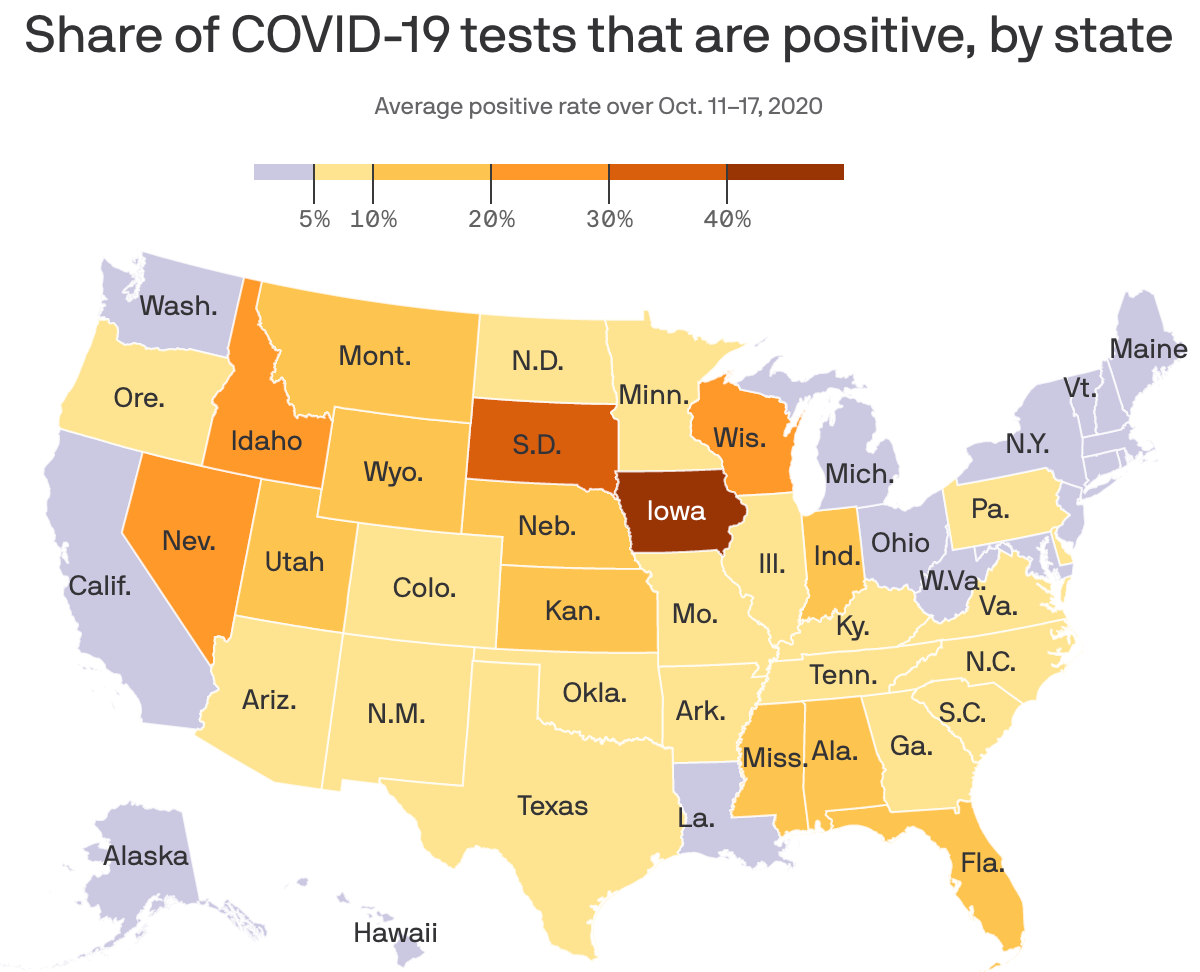
Meanwhile, there is less and less divide within the USA.Unlike previous waves, this surge is all over

The COVID Tracking Project. Map: Naema Ahmed/Axios

Moderna CEO Expects Covid-19 Vaccine Interim Results in November Moderna Chief Executive Stéphane Bancel said the federal government could authorize emergency use of the company’s experimental Covid-19 vaccine in December, if the company gets positive interim results in November from a large clinical trial.

(…) if sufficient interim results from the study takes longer to get, government authorization of the vaccine may not occur until early next year. (…) Mr. Bancel’s comments suggest Moderna’s timetable isn’t far off from Pfizer’s, which said last week it expects to seek U.S. authorization of emergency use of its vaccine by late November.  (…)

Markets Are Tuning Out a Lot of Unpleasantness Stocks are showing a heroic faith in the prospects for fiscal stimulus, ongoing central bank support, and the swift arrival of a Covid vaccine.

(…) activity has been trundling along at a significantly lower level than usual for months:

relates to Markets Are Tuning Out a Lot of Unpleasantness

(…) Amid such conditions, and with authorities in disarray over how to deal with the pandemic, how can stock markets remain so close to all-time highs? In brief:

  1. There is hope that a fiscal stimulus will be along shortly, as a result of Democratic victories in the U.S. elections (even though betting markets are moving to give Trump a better chance of holding on to power);
  2. Central banks are still largely trusted to keep the lid on interest rates at historically low levels — which effectively leaves investors with little choice but to buy stocks rather than bonds; and
  3. A vaccine should be along shortly (or possibly not).

Whether this is masterly tuning out of political noise, or dangerous obliviousness to elevated risks is a matter of taste. (John Authers)

Lawmakers on Both Sides Call for Antitrust Action Against Big Tech
Seek truth from facts (实事求是)

In December 1978, Deng Xiaoping delivered an important speech at the Closing session of the CCP Central Committee working conference. Under the headline “Emancipate the mind, seek truth from facts and unite as one in looking to the future“, Deng delivered a blow to the partisans of the status quo and bolstered the reformists, urging the Party to move beyond its dogmatism, excessive centralization of power and “bureaucratism”.

To seek the truth from facts is an appeal to reason and science that first appeared in the Book of Han, a monumental collection of historical, scientific and philosophical essays published in China at the beginning of the first century A.D. It was quoted by Mao during a speech delivered in 1938, as an appeal to pragmatism and it became part of the CCP doctrine although logic and science were sidelined during the heights of the Cultural Revolution. It was astute from Deng Xiaoping to use it back in a speech intended to jumpstart a wide ranging agenda of reforms, dubbed the “Four modernizations”, which radically changed the Chinese society, the Chinese economy and for that matter the global economy.  Two decades later, in the early part of 1992, during his famous “Southern tour” Deng chose the city of Shenzen as a springboard for a second wave of economic liberalization and reforms.

It is tempting to draw parallel between Deng Xiaoping’s southern trip and Xi Jinping’s trip to Shenzen to celebrate the 40th anniversary of the Shenzen special economic zone. Domestic and external conditions have hugely changed since then. However, the emphasis on science and innovation is as important today as it was forty years ago when China was faced with the existential goals of technological catch up – first and foremost for military reasons – and economic growth – to contain social discontent and to enlarge the CCP’s power base .

As reported by the South China Morning Post, “Shenzhen should build high grounds for technology and innovation with global influence. It should plan innovation chains around its industries and plan its industries around innovation chains,” Xi told over 800 officials and entrepreneurs from the mainland, Hong Kong and Macau. The speech came two weeks before a key Communist Party plenum which will approve the country’s new five-year plan. The emphasis is put on the potential of the Greater Bay Area which includes Hong Kong and Macau. It could be seen as another way of minimising the role played by Hong Kong as a gateway between China and the rest of the world, all the more as there are now not only physical but also financial bridges connecting Hong Kong to its sister cities in the Bay Area, through the so-called “Bond Connect” and the Stock Connect.

Meanwhile in the United States, the fatherland of Benjamin Franklin, Melvis Dewey and Thomas Edison, the political polarization that has been ramping up since the global financial crisis of 2008 has given birth to “fake news” and “alt-truth” trough the build-up of so-called “informational bubbles” that comfort people in their stereotypes and jingoistic tendencies. The fact that the bizarre Q-Anon conspiracy theory achieved some form of respectability tells you a lot about the widening gap between the political discourse and the hard facts. Some factions in the American left are not devoid of such practices, especially when it comes to launching a cancel culture against what they perceive as a white male dominant capitalist establishment. The 2020 election could serve as a pivotal moment to move back to facts or as a catalyst toward an even further slide into informational bubbles and ideological dislocation. Perhaps the US political establishment should be well advised to … seek truth from facts.

From Morning Consult:

Nearly 40% of Republicans Who Have Heard of QAnon Believe Its Claims Are at Least Somewhat Accurate

Those who have heard of QAnon were asked whether they believe the conspiracy theory’s claims are accurate or inaccurate.

unnamed (88)

That even 16-18% of Democrats and Independents would find anything credible is incredible. But 38% of Republicans? Where are the facts?

More fake stuff: 42%!

Five stars? Fake reviews on Amazon during the pandemic have reached levels typically only seen during the holiday shopping season. About 42% of 720 million reviews assessed by monitoring service Fakespot from March through September were unreliable, up from about 36% in the same period last year. The surge coincided with lockdown measures. (Bloomberg)

The polls are wrong. The U.S. presidential race is a near dead heat, this A.I. ‘sentiment analysis’ tool says

An analysis of the emotions being expressed on social media indicates that the upcoming U.S. presidential election may be a much closer contest than many commentators and pollsters believe.

That’s the conclusion of Expert.ai, a company with offices in Modena, Italy, and Rockville, Md., that uses an A.I. technique called “sentiment analysis” to understand the emotions being expressed in social media posts.

The company’s analysis puts Democratic candidate Joseph Biden ahead of President Donald Trump, 50.2% to 47.3%, a margin that is much narrower than the double-digit lead that Biden has over Trump in most national opinion polls. (…)

Trump was the focus of far more social media activity than Biden, accounting for almost 60% of all the posts Expert.ai analyzed, compared to slightly less than 17% for Biden. But Biden ranked higher in terms of positive emotions such as “success” and “hope,” while Trump scored higher on negative emotions such as “fear” and “hatred.”

The only positive emotion on which Trump scores better than Biden, according to a statement from Expert.ai, is “action.”
Walt Mayo, Expert.ai’s chief executive officer, said the company’s ability to analyze hundreds of thousands of social media posts in real time gives it “insight into what voters are discussing and how their attitudes are evolving as we get closer to the election.” (…)

But here’s a real “no contest”!

97% of the jokes Stephen Colbert and Jimmy Fallon told about the presidential candidates in September targeted President Trump, AP’s Dave Bauder writes from a study by George Mason University’s Center for Media and Public Affairs. That’s 455 jokes about Trump, to 14 for Joe Biden. That doesn’t even count 64 jokes made about Trump’s family or administration. (Axios)