The enemy of knowledge is not ignorance, it’s the illusion of knowledge (Stephen Hawking)

It ain’t what you don’t know that gets you into trouble. It’s what you know for sure that just ain’t so (Mark Twain)

Invest with smart knowledge and objective odds

THE DAILY EDGE: 28 FEBRUARY 2020: Fairly Valued, Not Cheap

Virus Update
  • Confirmed cases worldwide pass 83,000; deaths top 2,800
  • Iran reports 143 more infections; Iran also reported eight more deaths, taking the total death toll to 34. “Iran expects an upward trajectory in confirmed coronavirus cases in the next few days,” the health minister said.
  • South Korea adds 571.
  • Limited virus testing in Japan masks true scale of infection. Japan’s northern island of Hokkaido has declared a state of emergency due to the outbreak of coronavirus there, national broadcaster NHK said. Residents have been asked to stay indoors over the weekend.
  • China is making progress in the battle to get back to work

Cases in Italy soared to 650 on Thursday from 400 a day earlier, bringing the European total to more than 700. South Korea has raised its travel advisory for Italy’s Lombardy, Veneto, and Emilia-Romagna regions to level 2.

Germany quarantined about 1,000 people. Authorities in Heinsberg, near the Dutch border, asked people who came into contact with a married couple with the disease to stay at home.

Switzerland banned large events, leading to the Geneva car show being canceled. Nigeria, Africa’s most populous country, confirmed the first infection south of the Sahara desert. Algeria has also reported a case.

Netherlands reported its second confirmed infection. Five new cases were earlier confirmed in Sweden, bringing the total confirmed cases in the country to seven.

A patient admitted to Mexico’s INER hospital tested positive for coronavirus and a counter-test is now being made, El Universal reported, citing the Health Secretary. The patient is a 35-year-old man who recently traveled to northern Italy, five family members are also under observation.

New Zealand confirmed its first case after a person who recently returned from Iran was diagnosed with the illness, the Ministry of Health said Friday. The person in their 60s is in isolation in Auckland hospital, the ministry said in an emailed statement.

Separately, Lithuania reported its first case. The person was infected in the Italian city of Verona, RIA Novosti said.

Fast Retailing Co., the owner of the Uniqlo clothing brand, reopened more than 100 stores in China in the past week, Reuters reported, citing a statement. Almost all partner factories restarted work, while 125 stores in China are still closed because of the virus.

The Food and Drug Administration confirmed the first drug shortage relating to the coronavirus, Commissioner Stephen Hahn said in a statement. The announcement didn’t name the manufacturer but said “there are other alternatives that can be used by patients.” The shortage is due to an active ingredient used to make the drug, the FDA said.

FYI: the Johns Hopkins University Center for Systems Science Engineering maintains a nice and up-to-date dashboard. The FT has this chart today:

For coverage on the novel coronavirus and up-to-date graphics, please visit ft.com/coronavirus-latest

This chart suggests that the growth of new coronavirus cases, ex-Mainland China, might be peaking. From Pantheon Macro via Isabelnet

Number of New Coronavirus Cases, Ex-Mainland China

Some personal observations FYI:

  • This all started in one area in China with the usual Chinese news repression and mismanagement. It then spread outside Wuhan and the Hubei region before authorities started adequate containment measures.
  • But it was too late to prevent the virus from travelling.
  • The Diamond Princess got infected and an unprepared staff also totally mismanaged the situation.
  • The world got to know the meaning of “quarantine” and its potential economic and financial impact.
  • Then came Italy and a spreading of cases throughout the world as people, travelling from Iran and Italy and other places, carried the virus worldwide.
  • Yaddi, yaddi, yadda, recession(s) became possible (probable somewhere), further aggravated by a correction in very overvalued equity markets, in complacent mode, increasingly influenced by small investors joining in this apparent one-way market.
  • Machine trading and the ETF phenomenon kicked in and we got a 13.5% correction in 9 days. In the end, we will have broken all previous economic and financial records when this cycle is over.

The coronavirus vs influenza:

image

Uncertainty and the impacts of quarantines makes it scary as we are in totally uncharted territory. Yet, the reasonable odds are that this epidemic will be contained and that the world will return to normal during Q2.

What we don’t know:

  • the short-term economic impact and the shape of the recovery
  • Recession(s) somewhere?
  • the hit on profits in Q1
  • how it will affect supply chains and operating costs longer term
  • black swans out there, given all the debt accumulation

What we know:

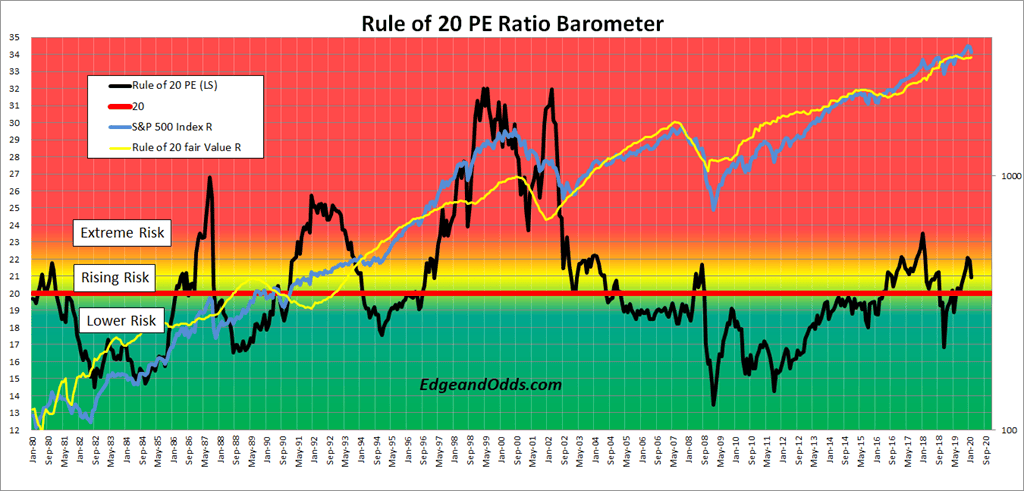
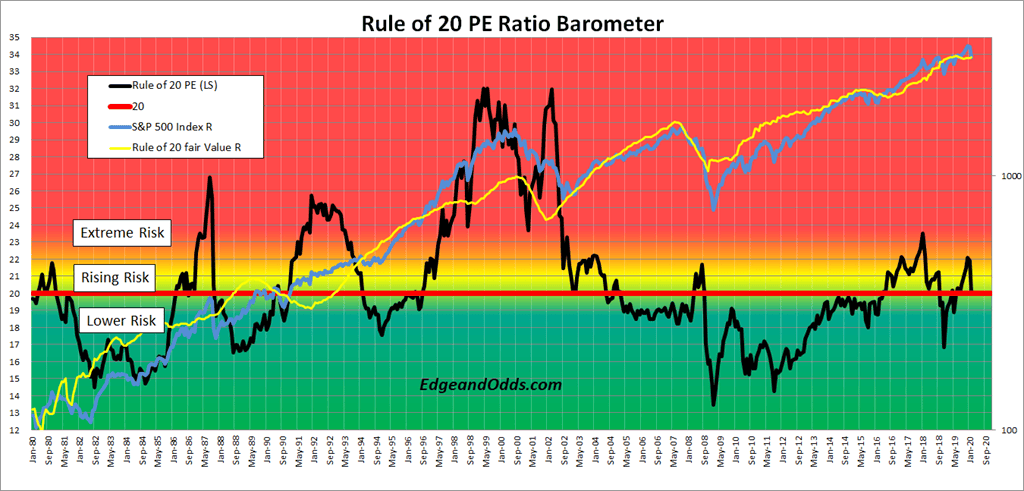
  • We have had the correction we deserved and equities have re-priced at “fair value” per the Rule of 20.
  • Interest rates have come down world wide
  • commodity costs have dropped
  • central banks and governments world wide will be leaning towards stimulation
  • sentiment has changed and cost control will get back to center stage

So:

  • Tempting to bottom fish. Possible home runs in some battered sectors (e.g. travel).
  • Recessions? Could profits tumble 20% making current valuation readings still too high?
  • Is panic/machine selling over? March/April stats will be pretty bad…

Remember

  • the December 2018 low was at 16.85 on the Rule of 20 P/E (now 20.0) and 14.6 on the regular P/E on trailing EPS (now 17.7). So this market is not cheap, just fairly valued on trailing data
  • trailing earnings could start declining again in Q1 or Q2
  • a recession would hit hard given widespread indebtedness
image

  • An adviser to Prime Minister Shinzo Abe said Japan should compile another economic package with fresh spending of at least 5 trillion yen ($45 billion) to respond to a severe hit from the coronavirus outbreak. “We should take it very seriously that this is terrible timing, coming right after the sales tax hike,” Etsuro Honda, one of the key architects of Abenomics, said in an interview. “The impact could be devastating in the short term.” (BB)
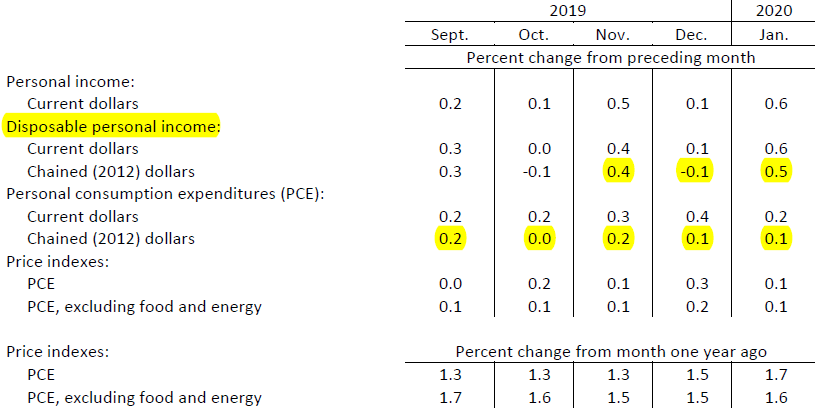
Personal Income and Outlays, January 2020

Real income growth remains fairly solid at +3.3% a.r. in the last 2 and 3 months but real spending was a slow +1.6% a.r.image
OPEC leaning towards larger oil cuts as virus hits prices, demand: sources

Saudi Arabia, the biggest producer in OPEC, and some other members are considering agreeing an output cut of 1 million barrels per day (bpd) for the second quarter of 2020, more than an initially proposed cut of 600,000 bpd, the sources said. (…) They are scheduled to meet on March 5-6 in Vienna to decide further policy. (…)

Saudi Arabia is already making unilateral curbs of more 500,000 bpd in crude supplies to China for March, two sources with knowledge of the matter said. (…) A source in a Russian oil company said it made sense to deepen the cuts.

U.S. Pending Home Sales Rebound Amidst Lower Interest Rates

The National Association of Realtors (NAR) reported that pending home sales gained 5.2% in January (5.7% year-on-year), more than reversing December’s 4.3% drop. Pending sales are up 9.6% since the four-and-a-half year low reached at the end of 2018, when mortgage rates hit 4.71%.

The number of signed contracts in December increased in every region of the country except the West, where they declined 1.1% (+5.5% y/y). Pending sales jumped 8.7% and 7.3% in the South and Midwest (7.1% and 6.5% y/y respectively). Activity was up 1.3% in the Northeast (1.2% y/y).

image

HERE AND THERE

JPMorgan Chase & Co. issued global restrictions on non-essential travel to protect its employees and its business against the spreading coronavirus.

British Airways parent IAG SA slumped after saying it couldn’t provide an earnings forecast this year, as weak demand in Asia rippled across to Europe and companies cut back on business travel. EasyJet Plc said that it had seen a softening in demand and made plans to cancel flights.

Finnair dropped after it revised outlook, citing the coronavirus and its wider than originally estimated impact. Alitalia plans to extend temporary layoffs for about 4,000 workers following the outbreak in Italy, Ansa reported. Amadeus IT Group SA, which operates software for flight bookings, fell 5% after saying that airline travel sales are slowing globally.

Cisco Plans New Round of Layoffs The networking-equipment maker faces the prospect of slowing sales growth because of global economic uncertainty.

(…) The San Jose, Calif.-based company said this month it expects revenue to drop between 1.5% and 3.5% in its current quarter. The decline would come on top of a 3.5% year-over-year drop in revenue for the company’s fiscal second quarter, which ended Jan. 25. (…)

The chemical industry became the latest sector to be hit by the coronavirus after German giant BASF SE warned the outbreak could help lead to the lowest growth in production since the financial crisis more than a decade ago.

Hyundai Motor Co. halted operations at its No. 2 plant in Ulsan for disinfection after a worker tested positive, Maeil Business Newspaper reported, without citing anyone.

TECHNICALS WATCH

Lowry’s Research says its “short-term indicators such as the % of NYSE Issues above 10-DMA and Stochastics, are now deep in oversold territory. The longer-term % NYSE Issues above 30-DMA is also at a level last seen at the Dec. 2018 low. In order to know that a bottom has been formed, the market needs to demonstrate the return of Demand (…). It is the two-step process of Supply exhaustion and Demand resurgence that creates a quality market bottom.”

Red rose The prestigious Wharton business school’s new dean will be first woman and person of color in its nearly 140-year history

(…) She has a Ph.D. and master’s degree in organizational psychology from the University of Michigan, in Detroit and received a bachelor’s degree in psychology from Pomona College of the Claremont Colleges, in California. (…)

From the WSJ:

(…) Applications to U.S. M.B.A. programs have fallen for five straight years as young professionals have questioned the wisdom of taking two years out of a hot job market to go back to graduate school. Applications to Wharton’s two-year M.B.A. program were down about 5% in 2019.
THE DAILY EDGE: 26 FEBRUARY 2020: Major Known Unknowns

Virus Update
  • Global deaths surpass 2,800, with more than 82,300 cases
  • China death toll at 2,744, up 29; cases climb to 78,497, up 433
  • First U.S. case of unknown origin; Pence in charge of response
  • South Korea cases rise, U.S. urges travelers to reconsider trips

Gleaned here and there:

Saudi Arabia halted religious visits that draw millions to cities including Mecca and Medina, while Japan asked for all schools to shut from March 2. More new cases were reported outside China than within the country for the first time, highlighting the spread of the epidemic.

Kuwait reported a jump in coronavirus cases to 43, from 26 previously, with all the cases linked to Iran, the hub of the outbreak in the Middle East. Iran has reported 158 cases, including 19 deaths. The United Arab Emirates, which has 13 cases and hasn’t given an update since Saturday, said it’s setting up a medical facility to quarantine patients.

Britain added two cases, Switzerland three and South Korea reported 505 new infections. The U.S. identified the first coronavirus case that doesn’t have ties to a known outbreak, as President Donald Trump assured Americans they face little risk.

The U.S. Centers for Disease Control and Prevention said the patient doesn’t appear to have traveled to China or been exposed to another known case of the coronavirus. Health authorities have been increasingly concerned about what’s known as community spread, where the virus begins circulating freely among people outside of quarantines or known contacts with other patients.

The CDC said the case was picked up by doctors in California, and that the patient may have been infected by a traveler who brought the disease in.

China plans to suspend retail government bond sales and Malaysia unveiled a stimulus package valued at about $4.8 billion.

The Israeli government has asked citizens to reconsider plans to travel abroad, as the coronavirus spreads to more countries. The ministry added Italy to the list of destinations from which Israelis are required to enter into quarantine upon return. It’s the first non-Asian country on the list.

Emirates, which gets 60% of its Middle East revenue from Saudi Arabia, will stop flying tourists from more than 20 countries to the kingdom to prevent the spread of the coronavirus.

China’s top container ports unclog backlog as virus curbs ease

(…) “The turning point has arrived… We are seeing that port congestion has eased and logistics start to revive,” said Xu Kai, director of the Shipping Information Research Institute at SISI. (…)

Some ports have even managed to surpass year-ago processing rates in an effort to clear the backlog. (…)

  • But TomTom’s live traffic index for Shangai shows congestion levels 22% less than average.
  • Using migration data from map-and-search company Baidu Inc., Nomura estimates that a little more than a third of the people who left cities such as Beijing, Shanghai and Shenzhen for the Chinese Lunar New Year in late January and early February have returned. By this time last year, nearly all had. Migrant laborers make up about 40% of China’s workforce and are needed for manufacturers to resume production. (WSJ)
The German Economy Was Faltering, Then Came the Coronavirus Companies in Europe’s largest economy are rushing to limit the impact of the spreading coronavirus epidemic, which hits a weakened German economy in a painful spot: the supply chains of its export-oriented manufacturers.
European companies face coronavirus hit to supply chains Italian auto supplier warns car groups’ production lines may be brought to a standstill
Coronavirus disruption at Samsung could threaten S Korea economy
Virus Creates Dilemma for Europe’s Public Gatherings, Open Borders The threat of the coronavirus spreading across Europe’s open borders has put authorities and others in a bind over whether to call off fashion shows, soccer games and other major gatherings.
Homegrown problems make Canada’s economy more prone to rising coronavirus fears

(…) On Wednesday, Bank of America slashed its 2020 growth forecast for Canadian gross domestic product to 1 per cent from 1.5 per cent, citing the spreading impact of China’s coronavirus outbreak as the primary, but not the only, reason for its considerable leap in pessimism. The widespread protests that have disrupted rail service have further clouded Canada’s economic outlook – which, coming out of a final quarter of 2019 with near-zero growth, was murky enough to begin with. (…)

African growth dampened as South Africa slumps, Chinese demand falters amid virus outbreak
Google, Microsoft shift production from China faster due to virus ‘Made in Vietnam’ Pixel phones and Surface laptops expected in 2020
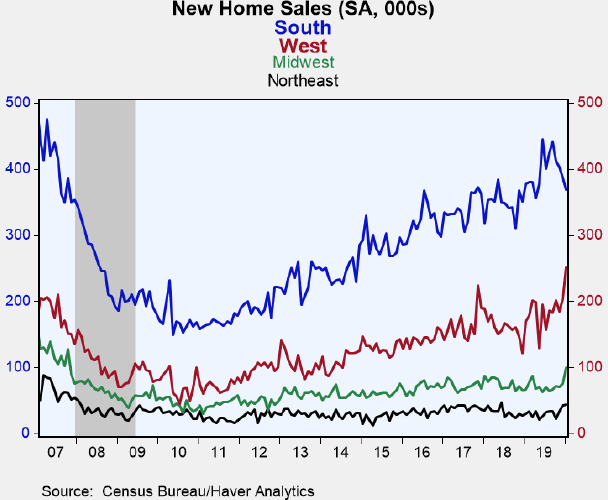
U.S. New Home Sales Jump to 2007 High; Prices Reach Record

Sales of new single-family homes increased 7.9% (18.6% y/y) during January to 764,000 units (SAAR), the highest level since July 2007. Sales increased from 708,000 in December, revised from 694,000. Figures for 2019 were revised. The Action Economics survey expected sales of 710,000.

The median price of a new home rose 7.4% (14.0% y/y) last month to a record $348,200. The average price of a new home also increased to a record of $402,300 (11.4% y/y).

Sales activity was mixed across the country in January. In the Midwest, sales rose 30.3% (47.8% y/y) to 99,000. Sales in the West rose 23.5% (49.1% y/y) to 252,000 units. Sales in the Northeast gained 4.8% (46.7% y/y) to 44,000. Working 4.4% lower to 369,000 (-2.4% y/y) were new home sales in the South.

image

The Fed Can’t Wait to Respond to the Coronavirus The pandemic is a threat to the global economy. U.S. central bankers should lead a global response.

By Kevin Warsh, a former member of the Federal Reserve Board, and a distinguished visiting fellow in economics at Stanford University’s Hoover Institution, in the WSJ:

A central bank’s primary job is to offset major disturbances to the economy. Today, the novel coronavirus is a material risk to the economy. It represents an unexpected shock, and the Federal Reserve should lead the world’s central banks in taking immediate action.

In a coordinated move alongside the People’s Bank of China, the European Central Bank, the Bank of England, the Bank of Japan and others so willing, the Fed should announce a 0.25-percentage-point interest-rate cut and make clear it’s open-minded about further action. The Fed should also encourage other central banks to take appropriate simultaneous action to loosen monetary policy in their jurisdictions. Global action would help make the most of scarce policy ammunition. (…)

China’s first-quarter growth is likely to be negative. Aggregate demand is falling fast. Chinese consumers are paring consumption markedly. The inventories of key Chinese exports, including consumer products and intermediate industrial goods, are declining rapidly. High levels of indebtedness, especially at smaller firms, are leading to an increase in insolvencies. Many employees have stayed home in February, which is constraining the production side of China’s economy. It isn’t clear when people will be returning to work or how bad the contagion risks will be when they do. (…)

Even if the virus is more contained than people think, or dissipates in the spring, economic activity in unlikely to spring back to life. The disruption to global supply chains will take several months to reset. Business confidence in the U.S., which has turned decidedly more negative in recent weeks, will also take to time to reassert itself, especially in an election year. (…)

Fed leaders call the current, ostensibly low level of inflation the greatest challenge for this generation of monetary policy makers. I disagree. An exogenous, uncertain, global economic shock is a far bigger and more pressing challenge. And a far more compelling rationale for policy action.

A coronavirus pandemic would be the biggest threat to the global economy since the financial crisis. We simply don’t know what will happen. The Fed should be in the business of responding to “tail risks”—unlikely events that would have highly damaging effects on output and inflation—not fine-tuning around the base economic outlook.

EARNINGS WATCH

We now have 452 Q4’19 reports in, a 71% beat rate and a +4.7% surprise factor. Q4 earnings are now seen up 3.1%, much better than the –0.3% forecast of Jan. 1. Revenues are also much better than expected: +5.9% vs +4.1% expected on Jan. 1.

As good as it is, investors currently don’t care about the past, trying to assess the immediate future.

Official corporate pre-announcements, while still looking good, have become less upbeat in the past 10 days as companies are getting more info nearly two-thirds into the first quarter. By Feb. 11, negative guidance for Q1’20 was 1.8x higher than positives. Since then, the N/P ratio has shot up to 2.5x.

image

Not included in the above total:

  • Anheuser-Busch InBev NV, the world’s largest brewer, slumped after forecasting the steepest decline in quarterly profit in at least a decade due to the coronavirus.
  • Microsoft became joined Apple and HP in cutting outlook, while Standard Chartered said it may take longer to hit a key target.

Q1’20 estimates still call for earnings to rise 2.9% but this is coming down fast as more corporations feel a need to update their guidance and analysts become increasingly worried. Expected Q1 growth was +6.3% on Jan. 1.

Trailing EPS are now $164.64 and the Rule of 20 P/E has retreated from its recent 22.87 (@ 3386) high to 20.91 at today’s pre-opening of 3070. The Rule of 20 P/E has a habit of always at least cycling back to its 20 mean or Fair Value, currently 2920.

image

Goldman, Citi Strategists Say S&P 500 Rout Is Bound to Worsen The biggest sell-off in U.S. stocks in two years is just getting started, they say.

While the S&P 500’s average correction has lasted for four months, this pullback is likely to be longer because of the lingering uncertainty over the coronavirus and the constraint facing Federal Reserve policy makers, according to Christian Mueller-Glissmann and Alessio Rizzi at Goldman Sachs Group Inc. That means the retreat that started last Thursday might not find a bottom until at least July.

At Citigroup Inc., strategists led by Jeremy Hale are also leery, citing a lack of clarity on both the virus outbreak and Fed monetary policy. To illustrate where risky assets may become attractive, they pointed to the S&P 500 falling to 2,730, 10% below its 200-day moving average. Reaching that level would require the index to drop an additional 12% from its current level. That would put it on the edge of a 20% bear market decline when measured from the Feb. 19 record. (…)

GS’s David Kostin:

(…) US companies will generate no earnings growth in 2020. We have updated our earnings model to incorporate the likelihood that the virus becomes widespread. Our revised baseline EPS estimates are $165 in 2020 (previously $174) and $175 in 2021 (previously $183), representing 0% and 6% growth. Our reduced forecasts reflect the severe decline in Chinese economic activity in 1Q, lower end-demand for US exporters, supply chain disruption, a slowdown in US economic activity, and elevated uncertainty. Consensus forecasts imply EPS will climb 7% in 2020 and 11% in 2021.

Our top-down base case assumes S&P 500 firms will report a decline in EPS during 1H 2020. (…) The trajectory of the US and global economy is highly uncertain at this time. For modeling purposes, we assume economic growth slows sharply during 1H 2020, but rebounds in 2H 2020 and 2021. A more severe pandemic could lead to a more prolonged disruption and a US recession. Under a recessionary scenario, S&P 500 EPS would fall by 13% to $143 in 2020 before rebounding by 10% to $158 in 2021. In an upside scenario where COVID-19 spread is more contained, EPS would equal $170 (+3%) in 2020 and $180 (+5%) in 2021.

Path of S&P 500: 2900 near-term (-7%) but rebound to 3400 by year-end (+9%). (…)

In its recession scenario, GS sees the S&P 500 at 2450 which, on $158 EPS, would mean a R20 P/E of 17.8. At the low of the growth scare in December 2018, the market troughed at a R20 P/E of 16.85 which would be 2300.

In truth, nobody knows anything, from how bad the virus will get, to how much economic impact it will have, to how serious the disruptions to the global supply chains will get, to the effects on corporate profit margins and, eventually, to global inflation.

Goldman’s “path of the S&P 500” cited above, the risk reward ratio is –7% to +9%, but that omits its recession scenario which calls for –21% to 2450  (-26% to 2300). However you weigh the recession scenario, the risk/reward balance is unfavorable.

European Companies in China See ‘Severe’ Impact From Outbreak

Hundreds of European companies with operations in China say the coronavirus outbreak is forcing them to lower annual business targets, according to a survey.

Almost 90% of a total of 577 respondents said they were seeing medium to high impact, with half planning to revise their financial goals. (…)

The chambers added that nearly half of the respondents predict a double-digit drop in revenues for the first half of 2020, and a quarter expect a drop of over 20%.

CFOs, Ratings Firms Keep Close Eye on Liquidity, Cash Flow as Coronavirus Spreads Companies could face ratings downgrades and funding problems amid continued outbreak

(…) Businesses whose operations could be affected by the outbreak could see a downgrade to their credit ratings as a result, ratings firms said.

A drop in revenue can impact companies’ overall financial situation and force them to rely on liquidity reserves, raise additional capital or reduce spending to make up for the shortfall. Adding to the challenge is the lack of clarity about how wide the outbreak will spread and how long it will last, which means that companies have to draw short-, medium- and long-term contingency plans. (…)

S&P is asking CFOs and other executives about contingency plans, cash flow and how long they expect their factories to be offline, said Gregg Lemos-Stein, the head of analytics and research for corporate ratings at S&P. “We will act and get as much information from CFOs as possible,” he said. (…)