The enemy of knowledge is not ignorance, it’s the illusion of knowledge (Stephen Hawking)

It ain’t what you don’t know that gets you into trouble. It’s what you know for sure that just ain’t so (Mark Twain)

Invest with smart knowledge and objective odds

THE DAILY EDGE: 22 AUGUST 2019: Very Weak U.S. PMI

Also posted today: “OPEN SESAME!” MOMENTS
Stumbling Economies Fan Recession Fears Data paint a bleak picture of the global economy ahead of Jackson Hole symposium
FLASH PMIs

August data signalled a renewed slowdown in the rate of U.S. private sector business activity growth. The seasonally adjusted IHS Markit Flash U.S. Composite PMI Output Index dipped from 52.6 in July to 50.9 in August, to signal only a slight increase in business activity and the slowest pace of expansion for three months. Moreover, the latest reading was the joint-lowest since February 2016.

image

Weaker business activity growth largely reflected a loss of momentum in the service sector during August. Although manufacturing production rose at a broadly similar pace to that seen in July, the rate of expansion remained softer than that recorded in the service economy.

Private sector companies revealed a marked slowdown in new business growth in August, with the latest upturn in order books the weakest since the series began in October 2009. Survey respondents often cited subdued corporate spending in response to softer business conditions and concerns about the global economic outlook.

A number of private sector firms noted that less favorable demand conditions had held back staff recruitment during August. The rate of job creation eased to its weakest since February 2010. Meanwhile, confidence in relation to the year-ahead business outlook dropped for the seventh month running to its lowest since this index began in July 2012.

The latest survey indicated an overall decline in average cost burdens for the first time since the index began in October 2009. Meanwhile, prices charged by private sector companies decreased for the first time in three-and-a-half years.

At 50.9 in August, down from 53.0 in July, the IHS Markit Flash U.S. Services PMI™ Business Activity Index eased to a three-month low and pointed to only a marginal rate of expansion. Subdued demand conditions continued to act as a brake on growth, with the latest rise in new work the slowest since March 2016. This contributed to a decline in backlogs of work for the first time in 2019 to date. Meanwhile, business expectations among service providers for the next 12 months eased in August and were the lowest since this index began nearly a decade ago.

The seasonally adjusted IHS Markit Flash U.S. Manufacturing Purchasing Managers’ Index™ (PMI™)1 registered 49.9 in August, down from 50.4 in July and below the neutral 50.0 threshold for the first time since September 2009.

The decline in the headline PMI mainly reflected a much weaker contribution from new orders, which offset a stabilization in employment and fractionally faster output growth. New business received by manufacturing companies fell for the second time in the past four months during August. Although only marginal, the latest downturn in order books was the sharpest for exactly 10 years. Latest data also signalled the fastest reduction in export sales since August 2009.

Survey respondents indicated that a drop in sales often cited a soft patch across the automotive sector, alongside a headwind to manufacturing exports from weaker global economic conditions.

Meanwhile, manufacturing companies continued to trim their inventory levels in August, which was mainly linked to concerns about the demand outlook. Pre-production inventories fell for the fourth month running, while stocks of finished goods decreased to the greatest extent since June 2014.

Tim Moore, Economics Associate Director at IHS Markit:

August’s survey data provides a clear signal that economic growth has continued to soften in the third quarter. The PMIs for manufacturing and services remain much weaker than at the beginning of 2019 and collectively point to annualized GDP growth of around 1.5%.

The most concerning aspect of the latest data is a slowdown in new business growth to its weakest in a decade, driven by a sharp loss of momentum across the services sector. Survey respondents commented on a headwind from subdued corporate spending as softer growth expectations at home and internationally encouraged tighter budget setting.

Manufacturing companies continued to feel the impact of slowing global economic conditions, with new export sales falling at the fastest pace since August 2009.

Business expectations for the year ahead became more gloomy in August and remain the lowest since comparable data were first available in 2012. The continued slide in corporate growth projections suggests that firms may exert greater caution in relation to spending, investment and staff hiring during the coming months.

The recent soft patch in the eurozone economy continued into August, according to latest PMI data from IHS Markit, with activity rising modestly amid a marginal increase in new business. The recent pattern of services growth compensating for a downturn in manufacturing was repeated midway through the third quarter. August did see a drop off in confidence among companies in the single currency area, with firms becoming more wary of hiring additional staff as a result.

The IHS Markit Eurozone Composite PMI® ticked up to 51.8 in August according to the ‘flash’ estimate, up from July’s three-month low of 51.5 but still one of the weakest readings for six years. Although narrowing slightly from the previous month, there remained a wide divergence in performance between the manufacturing and service sectors. Services activity continued to increase at a solid pace, with growth recorded in Germany, France and across the rest of the euro area.

image

In contrast, manufacturing output was down for the seventh month running, albeit to a lesser extent than in July. While France was able to eke out production growth, falls were seen in Germany and outside of the ‘big-2’.

Total new business rose marginally again, with the rate of expansion unchanged from that seen in July. Overall new orders were hindered by a decline in export business (which includes intra-euro area trade). New export orders were down for the eleventh successive month in August.

image

A sizeable drop in confidence regarding the 12-month outlook was registered in August as the global economic slowdown tempered optimism. Sentiment was down to the lowest since May 2013, with confidence weaker across both monitored sectors. Softer optimism was recorded in France and the rest of the eurozone, while German firms were pessimistic about the prospects for business activity for the first time in almost five years.

Fading confidence led to further caution around hiring midway through the third quarter. The rate of job creation was modest, having ticked down from that seen in July to the weakest since April 2016. Services job creation softened, while the manufacturing sector posted job cuts for the fourth month running. Despite slower job creation across the euro area, companies were still able to comfortably deal with incoming new orders and also work through backlogs of work. In fact, outstanding business decreased to the greatest extent since November 2014.

Spare capacity was also evident in manufacturing supply chains, with vendors able to shorten their delivery times for the sixth month running amid a sharp reduction in demand for inputs. Rates of both input cost and output price inflation ticked up in August, but remained subdued given the softer demand environment. Moreover, manufacturers continued to signal outright reductions in both their cost burdens and selling prices.

While output growth in Germany picked up slightly in August, there were worrying signs on the new order front as inflows decreased to the greatest extent since April 2013. Negative sentiment among companies in the eurozone’s largest economy was highlighted by the strongest pessimism in the manufacturing sector in the over seven-year series history. France fared better in comparison, seeing solid expansions in both output and new orders as the manufacturing sector returned to growth to join services in expansion territory. The rest of the euro area as a whole saw little change in the rate of growth during August, as solid expansion in services outweighed falling manufacturing output.

(…) While the rate of overall expansion ticked up, we’re still looking at GDP only rising by between 0.1% and 0.2%, based on the PMI data for the third quarter so far. (…) It appears that companies are braced for a sustained period of weakness, and as a result are showing greater reluctance to take on additional staff. (…) . The risk remains, therefore, that the euro area’s largest economy will have fallen into technical recession in the third quarter.

image

image

 image image

image

China’s yuan falls to fresh 11-year lows on trade war worries, despite state bank support Spot yuan ended the domestic session down 0.34% at 7.0875 per dollar, its weakest such close since March 14, 2008.

As the Fed Frets, Retailers Rake in Sales Strong results from Target, Lowe’s are latest indication the U.S. consumer is doing just fine

(…) Strong results from some of America’s biggest retailers suggest worries that an unsettled global environment is about to send U.S. consumers into retreat are overblown. (…) What makes the disconnect even more remarkable is that big retailers aren’t just reporting good results, they are expressing a lot of optimism. Target raised its earnings forecast for 2019, as did Walmart. Home Depot said escalating tariffs with China might rattle consumer confidence, but also that real-time data don’t show this yet. (…)

U.S. Job Growth Weaker Through March Than Earlier Reported, New Data Show The Labor Department lowered its estimate of total U.S. employment in March by 501,000, or 0.3%.

Government agencies in recent weeks have substantially lowered their estimates of job gains, output growth and corporate profits over different periods since early 2018 through the first quarter of this year, as part of their regularly scheduled updates based on fuller data.

On the flip side, personal income—which comes from pay, dividends, interest and other sources—rose more and households saved more in 2018 and the first quarter of this year than earlier estimated. (…)

Employers added about two million jobs in the year through March, down 501,000 from a prior estimate, the Labor Department said Wednesday. That brought down the average monthly gain over that period to about 168,000 from 210,000—still solid but not as robust as once thought.

The total number of jobs in March was 0.3% less than the earlier estimate, a larger-than-usual annual revision. And the 12-month gain was a substantial 20% lower than the prior tally. (…)

The department also said a key measure of corporate profits fell 2.2% in the first quarter of this year compared with a year earlier, after previously reporting that profits grew 3.4%. (…)

More-recent data show output grew at a 2.1% annual rate in the second quarter and that average monthly job growth has remained around 165,000 this year, below the 2017 average gain of 179,000. (…)

The bright spot in the revisions was Commerce’s new estimate that personal income rose 5.6% in 2018 from the year before, up from its previous 4.4% estimate. The biggest upward revisions were made to growth in income from dividends and interest, which flow disproportionately to wealthier households. (…)

image

(New York Times)

In Reversal, Trump Says He Is No Longer Considering Tax Cuts President Trump ruled out a cut in the payroll tax and also said he wasn’t looking to reduce capital-gains taxes by indexing gains to inflation.
Fed was divided on rate cut, wanted to avoid appearing on path for more cuts Federal Reserve policymakers were deeply divided over whether to cut interest rates last month but were united in wanting to signal they were not on a preset path to more cuts, a message not likely to sit well with U.S. President Donald Trump.

Minutes from the two-day meeting released on Wednesday showed policymakers’ ultimate decision to lower the central bank’s benchmark interest rate by a quarter percentage point drew more opposition than was reflected in the rate-setting panel’s 8-2 vote, announced after the meeting adjourned on July 31. (…)

“Participants generally favored an approach in which policy would be guided by incoming information … and that avoided any appearance of following a preset course,” according to the minutes. (…)

U.S. Existing Home Sales Rise While Prices Slip

The National Association of Realtors reported that sales of existing homes increased 2.5% during July to 5.420 million (0.6% y/y) from 5.290 million in June, revised from 5.270 million. Sales were 9.9% higher than the recent low during January. (…)

image

The median price of all existing homes sold weakened 1.6% last month (+4.3% y/y) to a $280,800 (NSA) from the record of $285,300 in June. The average sales price fell 1.3% (+3.1% y/y) to $317,100 from June’s record of $321,400.

Existing home sales rose in most sections of the country during July. Sales in the West jumped 8.3% (-0.8% y/y) to 1.180 million and reversed the 3.5% decline during June. Sales in the South gained 1.8% (2.7% y/y) to 2.310 million after a 2.6% decline. Existing home sales in the Midwest improved 1.6% (0.8% y/y) to 1.270 million and repeated the June rise. Working the other way, sales in the Northeast declined 2.9% (-4.3% y/y) to 660,000 and reversed June’s gain.

Sales of existing single-family homes increased 2.8% (1.0% y/y) to 4.840 million units, the highest level since February. Sales of condos and co-ops were unchanged at 580,000 units (-3.3% y/y).

The number of homes on the market declined 1.6% y/y. The months’ supply of homes on the market fell m/m to 4.2, but remained up from a low of 3.1 months in December 2017.

Manufacturers Want to Quit China for Vietnam. They’re Finding It Impossible.

(…) The specialized supply chains that made China a production powerhouse for smartphones and aluminum ladders and vacuum cleaners and dining tables are nowhere near as developed in Vietnam. Factories with U.S.-focused safety certifications and capital-intensive machinery aren’t as easy to find.

And Vietnam, with less than one-tenth China’s population, is already running into labor shortages as global manufacturers rush to set up shop here to avoid U.S. tariffs. (…)

As a result, a new global manufacturing landscape is starting to take shape, executives say. Production leaving China is getting divvied up among developing countries, with a small portion going to the U.S. on the back of automation. The reordering of supply chains is likely to leave China with a diminished but still significant share of the pie. (…)

The Chinese model of the past 20 years thrived on suppliers being close to each other, making production quicker, less expensive and more efficient. Now, as operations become more fragmented, they are threatening to raise costs, stretch delivery times and expose companies to multiple tax and labor regimes. (…)

Federal Deficits to Grow More Than Expected in Next Decade, CBO Says Deficits are projected to grow by $809 billion, to $12.2 trillion, over the next decade thanks to last month’s budget deal.

(…) The deal agreed upon by congressional leaders and the White House will add roughly $1.7 trillion to deficits between 2020 and 2029, assuming federal spending continues to rise by the rate of inflation beyond 2021. Much of that increase will be offset by lower-than-expected interest rates, which will reduce the cost of servicing the government’s swelling debt by $1.4 trillion over the next decade, the CBO said in the updated budget projections.

In total, deficits are now expected to rise $809 billion more than the agency projected just a few months ago, bringing total deficits over the next decade to $12.2 trillion.

Annual deficits as a share of economic growth are expected to average 4.7% over that period, higher than the 4.4% the CBO estimated in May and well above the 2.9% average over the past 50 years.

Overall, the CBO said government debt as a share of the economy is expected to rise from 79% this year to 95% in 2029—up from 92% when the agency released its 10-year forecasts in May and the highest level since just after World War II, when debt exceeded the size of the economy. (…)

The CBO said Wednesday higher tariffs are expected to reduce the level of U.S. GDP by 0.3% by 2020, primarily by raising prices, which reduces consumers’ purchasing power and increases the cost of business investment. Tariffs also reduce average real household income by $580, or 0.4%, by 2020, the CBO projected. (…)

Germany Sells 30-Year Bonds With Negative Yields In an unprecedented move, Germany sold 30-year bonds at a negative yield, as investors desperate for safe assets bet that further falls in yields will boost the value of the bonds in the future.
TECHNICALS WATCH

I don’t know and use much technical stuff but I can’t resist seeing 2 things on this chart: a rising channel with higher highs and higher lows and what seems to be strong resistance at current levels which, perhaps coincidentally, is right at 20.0 on the Rule of 20 scale.

spy

image

Note the yellow line wanting to bend lower. This is the Rule of 20 Fair Value which rises with trailing EPS and declining inflation. Currently, trailing EPS have plateaued while inflation is creeping up. A declining FV is headwind for equity markets.

The 13/34–Week EMA remains positive (CMG Wealth)

However, demand for equities is evaporating at the fastest rate since 2008 as SentimenTrader shows:

image

SentimenTrader also points out that fixed income investors are getting out of the riskiest holdings. Last December, the sell-off was widespread:

image

Bond Market: Why Is Everything Upside Down?

Good primer on negative yields.

The WeWork IPO

If you care, Ben Thomson offers his analysis. I will single out the governance issue:

The tech industry generally speaking is hardly a model for good corporate governance, but WeWork takes the absurdity an entirely different level. For example:

  • WeWork paid its own CEO, Adam Neumann, $5.9 million for the “We” trademark when the company reorganized itself earlier this year.
  • That reorganization created a limited liability company to hold the assets; investors, however, will buy into a corporation that holds a share of the LLC, while other LLC partners hold the rest, reducing their tax burden.
  • WeWork previously gave Neumann loans to buy properties that WeWork then rented.
  • WeWork has hired several of Neumann’s relatives, and Neumann’s wife would be one of three members of a committee tasked to replace Neumann if he were to die or become permanently disabled over the next decade.
  • Neumann has three different types of shares that guarantee him majority voting power; those shares retain their rights if sold or given away, instead of converting to common shares.

Byrne Hobart has made the case that some of the real estate transactions with Neumann are justifiable, but given how bad everything else in this list is, not assuming the worst is a generous interpretation; meanwhile, Neumann has already reportedly cashed out $700 million of his holdings via sales and loans. Everything taken together hints at a completely unaccountable executive looting a company that is running as quickly as it can from massive losses that may very well be fatal whenever the next recession hits.
“OPEN SESAME!” MOMENTS

Amid all the coverage on the Fed and the trade war in recent weeks, Danny, one of our sons, informed me that Alibaba recently announced that it has designed and released the world’s most powerful RISC-V processor yet. Reuters and Bloomberg were among the few mainstream media to carry the news:

The semiconductor division of Chinese tech giant Alibaba Group Holding Ltd released its first core processor IP on [July 25], as the e-commerce giant continues its steady push into advanced technologies. (…) Alibaba’s chip unit Pingtouge said its Xuantie 910 can serve advanced applications such as edge computing and autonomous driving and is based on RISC-V, an open source chip architecture developed by a consortium of tech companies and researchers. (Reuters)

Xuantie is the first fully formed product to emerge from a chip-making subsidiary Alibaba set up last year to power its foray into cutting-edge circuity. Led by the unit T-head or Pingtouge, it’s part of the company’s expansion into artificial intelligence and development of pivotal technology for the Internet of Things. (BB)

Tech Times offered more details (my emphasis):

The 16-core Xuantie 910 achieves 7.1 Coremark/MHz at a frequency that reaches 2.5GHz on a 12nm process node, which is 40 percent more powerful that the best RISC-V processors ever produced. (…)

Alibaba said that in the fields of 5G, AI, network communication, and autonomous driving, the processor can more than double the performance of chips and slash the cost of chips by more than half.

Alibaba is an e-commerce giant. Why and how could they do this?

Danny (Elec. Eng., Math, Computer Sc., MBA/MIT, ex-McKinsey) has been telling me for years that software is the new ruler and that companies able to attract and retain the best engineers/coders would be the best performing companies. “Everything now is software driven. Once you have enough great engineers, you can do anything.”

This is the how. Alibaba has a large and smart crew of software engineers who can perform on just about anything, including coding much smarter software for chips.

As to the why,

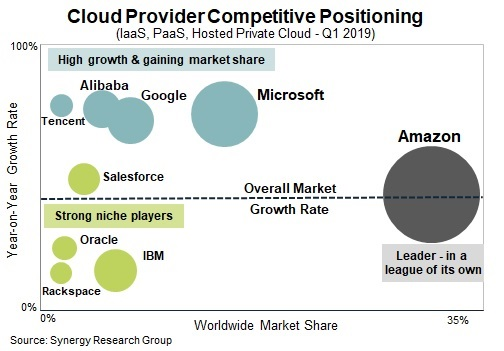
Alibaba Cloud is the largest cloud computing company in China. Like Amazon, it provides cloud computing services to online businesses and its own e-commerce ecosystem. It operates in 19 data center regions and 56 availability zones around the globe.

In 2015, Alibaba got serious with Cloud and expanded it throughout Asia, the Middle East, Europe and the U.S. to offer cloud capabilities to Chinese companies expanding globally. In less than 5 years, Alibaba has become the fifth largest provider of cloud infrastructure and related services behind Amazon, Microsoft and Google and IBM.

This recent internal technological advance provides Alibaba with a substantial competitive advantage on chip costs and performance. But there is a much wider effect:

Alibaba said it intends to monetize its processor intellectual property (IP) by licensing it to chipmakers. It also said it will release parts of related code on public repository GitHub to stimulate related development.

The open-source nature of RISC-V also mitigates risk of Chinese firms losing access to Arm architecture should geopolitical events cause a rift in the global chip industry. Arm was one of several companies to cease serving Huawei Technologies Co Ltd after the United States banned business with Huawei on national security grounds.

OPEN SESAME!

In effect, Alibaba just gave China its first major escape card from the U.S. stronghold of the chip market. Alibaba having cracked the software, better versions will follow.

“Trade war has also bolstered China’s determination to become more independent when it comes to technology,” Sanford C. Bernstein analyst Mark Li said. “Alibaba’s backing of RISC-V may threaten the businesses of existing chip intellectual property companies.”

On February 21, 2019, President Trump tweeted

I want 5G, and even 6G, technology in the United States as soon as possible. It is far more powerful, faster, and smarter than the current standard. American companies must step up their efforts, or get left behind. There is no reason that we should be lagging behind on something that is so obviously the future. I want the United States to win through competition, not by blocking out currently more advanced technologies. We must always be the leader in everything we do, especially when it comes to the very exciting world of technology!

Speaking of 5G, Forbes informs us that

Huawei has been championing, for almost a decade, an alternative coding method for 5G data transmission named “polar codes,” that is considered a direct challenge to the U.S.-developed coding method “LDPC” (low-density parity check). (…)

With such an important network infrastructure on the horizon, the world’s telecom giants have agreed to form an international standardization body to ensure 5G works the same way whether in Tokyo to Mississippi. Voting began taking place in 2016 for an accepted coding technology and naturally the top contenders were the Huawei-backed polar codes and U.S.-backed LDPC. Because each has a compelling case, voters ended up voting for both to work side-by-side–for now.

While the U.S. government and companies such as Qualcomm are keen to push for LDPC over polar codes, the Turkish professor/doctor who invented the code takes a more diplomatic approach.

Dr. Erdal Arikan, who has a PhD in electrical engineering from Massachusetts Institute of Technology said “there is no clear cut answer yet” for which code is superior. “Depending on the application, someone may prefer LDPC, while for others polar code,” the professor added. “There is not one solution that fits all.” (…)

[Huawei] began looking into 5G solutions in 2009 and came across Arikan’s polar code theory in 2010. Huawei’s head of wireless research, Wen Tong, said the company was impressed by the polar codes but knew it would be risky to back that theory.

From  an engineering perspective, [polar codes] were premature tech, so it was very high risk for us, but it was also high reward.” “At that point, we only knew that polar codes were theoretically possible, we didn’t know for sure.”

Huawei took the gamble. Eight years–and countless billions spent on research later–it is considered to be the leader in 5G development.

The same day Trump tweeted that he wanted “the United States to win through competition, not by blocking out currently more advanced technologies”, US Secretary of State Mike Pompeo said the US won’t partner with countries that adopt Huawei’s technology. “We can’t forget these systems were designed with express work alongside the Chinese PLA, their military in China,” he said. “The risk to privacy from this technology is very, very real.”

On July 16, 2019

A UK Parliament committee rejected a proposed ban on British telecom carriers using Huawei gear. “There are no technical grounds for excluding Huawei entirely from the UK’s 5G or other telecommunications networks,” UK Member of Parliament Norman Lamb, chair of the Science and Technology Committee, wrote in a letter explaining the committee’s conclusions. The committee’s decision follows the European Union’s decision in March not to ban Huawei outright, but instead to ask member countries to assess the risks to their 5G networks.

Lamb’s letter acknowledged the security issues highlighted in the previous reports. But it points out that the UK government discovered these issues because Huawei allows the government to audit its proprietary source code. The government doesn’t have similar access to code from other vendors, such as Ericsson and Nokia, so it’s unable to say whether Huawei’s products pose a greater threat than those made by other companies. (…)

Opening its code to government inspections is part of Huawei’s strategy to regain trust around the world. The company opened its Brussels Cyber Security Transparency Centre last March to help assure EU institutions that its products are safe to use. (Wired)

I quizzed Danny on technological spying, more specifically on whether he thought that Chinese technology companies can hope to be labeled “safe” by Western nations. He explained that it is extremely difficult to detect sophisticated spyware on chips. Conversely, it is also impossible to prove that there is none. Whistle-blowers involved in the actual chip design are the only people capable of proving that a chipset has been compromised. Whistle blowing on highly sensitive government stuff has not proven very rewarding, anywhere in the world, has it?

It is thus easy to set paranoia and opportunistically impede growth of tech companies and nations. Chinese and Russian companies are particularly vulnerable because of these countries’ political status, leadership setups and doubtful reputation in the West.

But the U.S. has also been caught spying, not only on foreigners, but also on its own citizens as a 2012 NYT video revealed:

Following 9/11, the NSA began a top secret surveillance program to spy on U.S. citizens without a warrant. Code-named Stellar Wind, the full scope of the surveillance has not been made public until William Binney, a NSA whistle-blower, came out with the story.

A totalitarian state is understandably less likely to be trusted than a democracy, making it easier to seed doubt and caution, something the Trump administration has openly exploited with China. But Trump is losing credibility on his national security threats when he lets ZTE free after Xi intervenes and when he includes Huawei in his trade negotiations.

In any case, whatever is or is not (and I am not whitewashing China here), China and all other nations have learned a crucial lesson in the past 2 years: the USA is no longer the trusted partner it has long been. In fact, the lesson is even wider-reaching given the Trump-designed template: any nation must now consider its relations with other nations as vulnerable to the next elected politician or party, signed treaties or not. Any nation, in fact, any company, must now think about protecting itself from unexpected, even improbable events that could impede their ability to do business.

Forget “one for all, all for one”. It’s now “each for himself”.

There is also an important Open Sesame! moment for investors in all this: it is fair to say that we are witnessing the end of globalization for cost/efficiency considerations and the launch of a drive towards corporate diversification of production and distribution assets. Low costs and optimum logistics have become secondary to security of market access for both inputs and outputs. Transportation costs will continue to matter, however, which will prompt companies to locate plants and offices nearest to their major markets.

By KKR’s calculations,

there are 828 million millennials in Asia, with fully 40%, or 330 million, in China. There are ‘just’ 66 million millennials in the U.S. Said differently, China’s millennial population alone is now roughly the same size as the entire population of the United States. Also, millennials are now a sizeable proportion of the overall Chinese population. Given this heft and growth, they will unequivocally dominate the labor force and consumer markets over the next two decades.

It is widely accepted that globalization and offshoring to China have been instrumental to the disinflation of the last 25 years. It also happens that corporate pretax profit margins more than doubled during the same period, partly because of contained labor costs due to offshoring but also because said offshoring improved overall corporate efficiency throughout the production and distribution channels.

image

As corporate officers shift their priorities towards securing market access, they are likely to reorganize production and distribution in order to secure competitive access to their main markets. Inevitably, the list of target markets will generally begin with Asian countries given their sheer size and growth, particularly their trend-setting millennials.

Factors like gross margins and wages will lose importance to secure competitive market access, the hope being that the ensuing higher costs will be passed on to consumers, something that is normally easier to achieve in strong economies with rising demand.

Alibaba’s door opening could thus prove to be the catalyst for new far reaching trends as China’s dependence on the U.S. chip industry will decline rapidly and as its competitiveness will improve owing to potentially better and cheaper 5G networks while Ai technology invades our daily lives.

America should also take advantage of this Open Sesame! moment to look through the opening and realize that MAGA (“Make America Great Again”) may not be aiming quite right. While Trump’s MAGA doctrine aims at revitalizing America’s traditional manufacturing industry, Xi’s “Made in China 2025” program aims to transform China into a “science and technology superpower.”

Arthur Herman, a Senior Fellow at the Hudson Institute and Director of the Quantum Alliance Initiative, wrote in Forbes in September 2018:

America is in a race for high-tech supremacy with China. The question is whether we will have enough future engineers and scientists to secure our lead in that race; or whether, for the first time, leadership in advanced technologies will pass to a leading geopolitical and economic competitor.

The issue isn’t whether our colleges and universities are training students and Ph.D’s in computer science and engineering and the physical sciences. It’s whether enough of them are American students. In fact, if many of those departments in our leading institutions of higher learning had to rely on American students alone for enrolments, they would probably have to shut their doors.

(…) leading trends in our higher education suggest that the U.S. is fast approaching a STEM [science, technology, engineering, and mathematics] crisis like no other—one that systematically benefits foreign countries and companies, at the expense of our own. A future shortfall in Americans trained in science and engineering bodes ill not only for our economic well-being, but for our national security as well. This is because so many current and future defense systems will depend on technologies in which America still leads in development and innovation, such as cyber, artificial intelligence, quantum research, and even nanotechnology—but where competitors are pushing hard to overtake us and dominate the high-tech future.

The leading competitor is China, whose political leadership [President Xi is a chemical engineer from Tsinghua University] understands only too well how important STEM leadership is for global leadership. The World Economic Forum calculates that China had at least 4.7 million recent STEM grads as of 2016; India had 2.6 million as of 2017; the U.S. pulls in at third at 568,000. (…)

Last year [2017], 62 percent of all international students in US colleges and universities were in science and engineering fields [48% in STEM programs]. Almost seventy percent of those were from either India or China. (…) Indeed, without international students, graduate programs in STEM subjects in many schools couldn’t survive. (…)

Twenty years ago, only 10% of Chinese students graduating in American colleges returned home to work. Chinese Americans now make up 10% of  the entire Silicon Valley workforce. According to a study by a UC Berkeley professor, since 1998, one out of five high tech start-ups in Silicon Valley were led by Chinese Americans.

In recent years, 80% of Chinese students graduating in American colleges returned home to work.

Jonathan Ward, author of China’s Vision of Victory, in an interview with The Diplomat:

The goals of the Chinese Communist Party, as described in China’s Vision of Victory, may be even more ambitious than those of the USSR – the CCP envisions a future in which China ascends to the top of every major industry and technology, in which most of the world’s continents and markets are linked together with China as the economic and strategic center, and in which China has built a military that “can effectively secure China’s overseas interests.” The ultimate rise of China, if fully realized, could look more like the British Empire than an economically weak USSR engaged in global ideological struggle with the U.S.

In this “race for high-tech supremacy with China”, America has to overcome challenges like never before:

    • A domestic market 75% smaller with American millennials 80% less numerous and rapidly growing wealth among the Asian middle-class.
    • A regional market (USMCA) of 500M people, barely growing, against a 4.5B fast growing Asian population.
    • Large, fast growing, technology-savvy and financially sound tech, e-commerce and fintech competitors, well established in China and Asia and eager to expand world-wide; 110 of the Fortune Global 500 companies are Chinese (U.S. 126) but McKinsey estimates that only 18% of their revenue is earned overseas (S&P 500 companies: 44%).
    • A much smaller pool of STEM students to feed a fast evolving and complexifying technology market.
    • Generally higher cost structures.

    Looking through the “opening”, the outlook for American tech-supremacy has never been so daunting. The White House agrees, in its own ways:

    In June 2018, the Trump administration announced plans to limit the time Chinese graduate students will be allowed to study in certain critical areas of high-tech research, including robotics, aeronautics, and high-tech manufacturing, from five years to one. On December 2, 2018, Voice of America reported: “US Considers New Restrictions on Chinese Students.”

    The gist of the story was that American officials have growing worries about spying by Chinese students who are studying in the United States, and about the loss of new technologies important for national security to China through their efforts. In addition to the new visa restrictions, officials are considering whether to carry out additional investigations of Chinese students attending U.S. schools. Reuters reported that officials want to examine student phone calls. They are also considering looking at students’ personal accounts on Chinese and U.S. social media sites.

    But again, the issue of Chinese students needs to be seen in a larger lens. The greater focus should be on how we get more Americans, especially young Americans, to study and get excited about STEM subjects, especially the high-tech STEM disciplines that have crucial national security implications. (American Affairs)

    The other focus might be to seriously consider the notion of friendship, trust and cooperation among nations. Were MAGA not to live up to Trump/GOP expectations, the USA could find itself in a much less enviable position to promote friendship and cooperation 10-15 years from now.

    Foreign policy is not foreign to economic policy. The FT ran this piece on August 9, 2019.

    The watchword of the American security establishment since the cold war has been “credibility”. The idea is that if America is to maintain its status as a superpower and a world policeman, then its international commitments must be clear and believable. Anything less, it is argued, would leave America’s friends and foes confused. And confusion could lead to miscalculation, raising the risk of conflict.

    That prediction may now be coming true, as a number of regional conflicts flare up around the world — against a background of an incoherent and unpredictable US foreign policy led by Donald Trump, the president who tweets compulsively, insults allies, praises dictators and discards close advisers like used tissues. (…)

    The confusion is further increased by the fact that, on other fronts, the US is ramping up confrontation with China. Last week, Mr Trump ordered increased tariffs on $300bn of Chinese goods. And the Pentagon is talking of deploying intermediate-range missiles in east Asia to deter China. US allies that might be asked to host these missiles, such as Japan, would be nervous of making such a commitment under any circumstances. But with such an unpredictable US president, they will be even more wary of taking American guarantees at face value.

    Jonathan Ward again:

    The world’s democracies are still about 65 percent of the global economy and if we work together and find alternatives to China, we are going to be successful at preserving a world order in which democratic norms and freedoms continue to prevail. If we fail to do this, however, China may enjoy a relatively unimpeded rise to power – and let’s not forget that China has quite a range of adherents too, from Russia to Pakistan, all of which have important strategic value in helping China distract its adversaries and achieve its goals.

    The problem is that democracies around the world are weakening by the day as their economies suffer from the US/China trade war feeding rising populism and isolationism. President Trump makes things even worse, disengaging from treaties and threatening more tariffs against just about every one of America’s “allies” to achieve its MAGA doctrine built on erroneous premises.

    Dr. Lauren Brent, a biologist, explains the importance of friendship in a scientific way:

    It’s an evolutionary puzzle. You invest time, energy, and real goods like money or stuff that you own, that you share. Why in the world would you do that with someone you’re not related to? There must be some way you get a return on your investment. How exactly is the big question mark over the scientific study of friendship. We don’t know exactly — especially if we want to go back in time to early humans and how they were benefitting from friendship. We can guess: when you get in a fight, maybe your friend comes and supports you and makes it less likely that you get fatally injured, or you might want to be friends with the woman who knows where all the best berry patches are, because she’d take you there or come back with lots of food and share with you.

    Even though our lives are now removed from simple ecological pressures [hmmm…not really], there’s still that power dynamic and social navigation going on, just for different specific reasons. But the basic reason is still the same: you want information and access to resources. It’s maybe not the most satisfying answer, but the basic take-home message is that we make friends because it gets us something. We know this definitively because lonely people are more likely to die and to have heart disease; and there are all the reward chemicals in our brains that are like, “This feels good. Keep doing this.” (Fader)

    Mark Twain, one of the early “international Americans” wrote:

    When we think of friends, and call their faces out of the shadows, and their voices out of the echoes that faint along the corridors of memory, and do it without knowing why save that we love to do it, we content ourselves that that friendship is a Reality, and not a Fancy–that it is builded upon a rock, and not upon the sands that dissolve away with the ebbing tides and carry their monuments with them.

    Throughout my 47 years of professional investing, friendship and cooperation among democracies were a given. Following the fall of the Berlin wall, the collapse of the USSR and the rapprochement with Russia, we thought the world was pretty close to total peacefulness and friendship. Communist China and North Korea were not significant then and Iran was only a big risk factor for oil traders. Since 9/11, things have totally changed. And now, for the first time, the U.S. is acting aggressively against a much stronger and critical China and even against its long-time allies.

    There is also Brexit, a totally dysfunctional Eurozone, Iran, rising tensions between Japan and South Korea, Putin and Kim Jong-un, to name only the other most significant uncertainties.

    Investors currently trying to peek into the future get very low visibility short, medium and long term as it is almost impossible to model how things will evolve. What we know is that economic growth has slowed and business costs have increased right when debt, corporate and government, is clearly excessive. Central bankers seem confused and short of effective tools.

    Take another look at the chart above. Notice how pretax margins have declined since 2015 and are now below their 2007 peak. The 2018 tax cuts have masked this fundamental trend. Labor costs have bottomed against business sales and are now rising much faster than inflation. Contrary to small companies, large corporations have maintained high margins but this is changing this year: Q1’19 revenues for S&P 500 companies have increased 5.7% but net income dropped 0.8%; Q2 revenues are up 4.6% while earnings are up 1.1%.

    S&P 500 companies have seen their revenue growth rate slow from the 8-10% range in the first 3 quarters of 2018 to 4.6% in Q2’19 and 3.8% expected in Q3 per Refinitiv/IBES numbers. Total Business Sales per the U.S. Census Bureau display an even steeper downtrend with quarterly growth down to 1.8% YoY in Q2’19 (May +1.5%, June +1.3%).

    image

    Street analysts, always the optimists, are modeling the low in Q3 and a smart recovery through the end of 2020. Before you bet too much money on such a turnaround, examine these charts from Ed Yardeni:

    • the recent steep drop in revenues, unlike that of 2015, is not solely oil-related.

    image

    • The OECD LEI for the U.S. remains in a downtrend as of June and suggests near zero growth in revenues:

    image

    • Manufacturing orders growth is now negative and recent PMI surveys point to continued weakness:

    image

    • And if you think U.S. merchandise exports don’t matter much, their recent collapse should still worry you. The July U.S. PMI survey showed export orders contracting for the second time in the last 3 months.

    image

    In the July FOMC minutes, the words “uncertainties” and “risk” were used 69 times (48 times in June) discussing the economy. Looking at corporate revenue growth, margins and profits, there is no uncertainty about the sudden sharp slowdown but much uncertainty about its duration and magnitude.

    Looking at the whole world, the uncertainty is more about how and when can things such as cooperation and friendship turn for the better, if ever. In the meantime, brace for  slow revenue growth, rising costs and compressed profit margins as corporations adjust to the new definition of globalization.