November CPI Report Raises Doubts About US Inflation Data
In a report fouled by the record-long government shutdown, inflation in several categories that had long been stubborn seemed to nearly evaporate. Chief among those were shelter costs, which make up about a third of the consumer price index, but other categories like airfares and apparel notably declined.
Because of the shutdown, the Bureau of Labor Statistics couldn’t collect prices throughout October and started sampling later than usual in November. The so-called core CPI, which excludes food and energy, increased 2.6% in November from a year ago — the slowest pace since 2021 and below all estimates in a Bloomberg survey of economists.
Several forecasters pointed to the absence of that October data — which resulted in pages of blank spaces in the widely watched report — as effectively the same as assuming no price growth for the month. That culminated in sizable downward pressure on the November inflation figures, they said. Some noted the shortened collection period could have also skewed the data.
Stacey Standish, a spokesperson for BLS, said the agency used a process called carry-forward imputation for key housing price metrics. This method “imputes the price by using data from the last collected period, effectively proceeding as if the price had not changed,” she said. “Rents for October 2025 were carried forward from April 2025, yielding unchanged index values for rent and owners’ equivalent rent for October.” (…)
The shutdown limited the BLS’s ability to calculate standard month-over-month price index values, so it mostly observed changes from September to November instead. In FAQs and other supporting documents published the day before the report, the agency forewarned that some of the data may not be totally trustworthy.
“If bimonthly CPI data are volatile, then less confidence should be placed in estimates for the missing months,” BLS said Wednesday in a document explaining how to approximate missing data points. (…)
The month-over-month changes for key housing categories will largely be sorted with the release of the December CPI — though they may look “high,” Sharif said. But the annual changes will likely be impacted for longer.
That’s because BLS samples several panels of households about their rents on a rolling six-month basis, so some of the errant October values may not fall out of the index until April.
Despite the idiosyncrasies, several economists maintained that inflation is cooling, just perhaps not as much as Thursday’s report would suggest.
“Through the noise, we believe inflation is slowing on trend, even if today’s reading overstates the magnitude of the slowdown,” Wells Fargo & Co. economists said in a note.
Goldman Sachs explains why CPI data will be almost useless until April 2026.:
Rent and OER are calculated based on a six-month rotating panel in the CPI, so the month-over-month increase in November is roughly the 6-month average monthly increase since May. This monthly rate is applied to the October index level—which the BLS assumed was flat relative to September—so the shelter components only increased by one month’s worth of rent inflation between September in November.
The Bureau of Labor Statistics (BLS) has not said how it will address these distortions, but today’s reading could be partially offset by a rebound in the shelter components in the April CPI, six months after October.
Core goods inflation was soft at 0.03% on average between October and November.
We suspect that some of the weakness could reflect later-than-usual price collection, as the BLS only collected prices in the second half of November when holiday promotions typically lead to lower prices, which is likely to be offset by higher measured inflation in December.
Apparel prices, household appliances prices, and sporting goods prices all declined 0.4% on average in October and November, toy prices declined 0.5%, hardware equipment prices declined 0.1%, and miscellaneous personal goods prices declined 1.2%, the largest two-month average decline since February 2021.
On the services side, the volatile airfares component declined 3.4%, weighing on the core by 4bp, and the health insurance component—which featured a semiannual update of the underlying source data this month—declined 1.4% (NSA), implying a drag of about 1.3bp on monthly core CPI until the next source data update in April.
Recreation services prices declined 0.3%, partially reflecting an unusual 1% decline in club membership fees—the second-lowest two-month-average reading in the series’ history.
Education and communication services prices increased 0.4%, and other personal services prices also increased 0.4%.
Headline CPI rose 0.10% on a two-month-average basis, reflecting a 0.5% increase in energy prices but flat food prices.
The distortions to shelter prices in today’s CPI will have a somewhat smaller effect on core PCE because shelter has a lower weight in CPI than PCE, but the drags on some goods prices in today’s report will receive more weight in core PCE.
Lots of things depend on CPI, including the calculation of the “inflation protection” in Treasury Inflation Protected Securities (TIPS), I-series savings bonds the government sells to retail investors, Social Security COLAs, and other inflation adjustments paid to investors and beneficiaries, and they will all be underpaid for inflation.
This data here also impacts broader economic data that is adjusted to inflation, including “real” consumer spending and “real” GDP because the BEA, which produces those overall economic indices, uses some of this CPI data, including OER, for its calculation of the PCE price index and the GDP deflator, among others.
BLS is now causing serious issues with all of them, with investors and beneficiaries getting short-changed on their inflation protection, and with inflation-adjusted economic data getting inflated, which would, of course, suit the administration’s narrative.
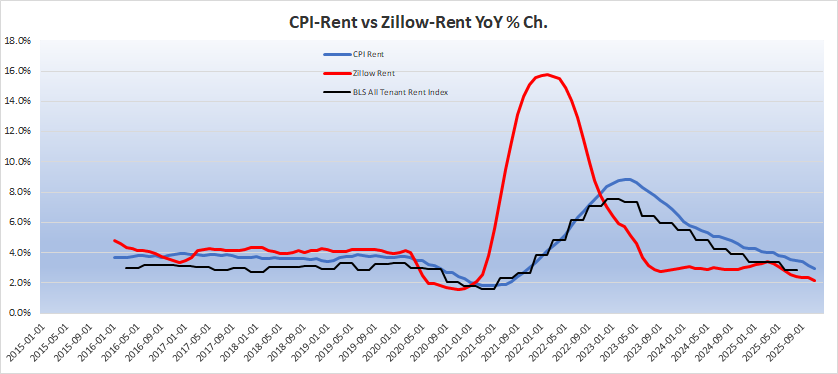
CPI-Rent for November per the BLS is up 3.0% YoY, down from 3.4% in September. Meanwhile, the Zillow rent index, actually declining MoM since September, is up 2.2% YoY in November from 2.3% in September. In truth, the BLS “data” is not that bad, actually overstating rent inflation a little, but on the right trend vs real world data.

Yes, this CPI release is not very useful but that’s not a big deal.
The World Is Awash With Oil and Prices Are Poised to Keep Falling
(…) Old and new producers alike are ramping up output as sanctioned barrels from Russia search for buyers, putting a record 1.3 billion barrels of crude on the world’s oceans. Benchmark oil prices are heading for their biggest annual loss since the pandemic, while US gasoline at the pump is less than $3 a gallon for the first time since 2021. (…)
Virtually all of the world’s biggest traders see the oil market in a state of oversupply early next year — the only question is by how much. The International Energy Agency estimates that output could exceed consumption by around 3.8 million barrels a day in 2026. Many traders predict smaller numbers than that, but storage levels are still expected to grow.
When that happens, oil prices usually fall. Global benchmark Brent crude is down 20% this year to trade near $60 a barrel. Trafigura, one of the world’s top commodities traders, says oil could be in the $50s through the middle of the year before recovering into the end of 2026.
“It’s a market where everybody agrees what’s going on,” Ben Luckock, global head of oil at the firm, said in an interview. “Prices should be lower, but they can’t be because there’s a war going on in Ukraine still.”
The oil market remains sensitive to geopolitical conflicts that could send futures soaring on any given day. A Ukraine-Russia ceasefire agreement, which could add even more Russian barrels to the market if sanctions are eased, remains elusive. Tensions between the US and Venezuela have escalated, with Trump ordering a blockade of sanctioned oil tankers to and from the South American country. A rapprochement or regime change could initially send prices up but ultimately bring more of that supply to market.
Any sustained price drop next year will be because of the scale of the supply additions that are emerging — fast outpacing uneven consumption growth. Brent crude hasn’t averaged below $60 a barrel for a full year since 2020, and before that the last time it did so was in 2017. (…)
Rising exports from OPEC and non-OPEC producers mean more oil is in transit or waiting to be sold as producers seek out willing buyers for their cargoes, according to Muyu Xu, senior crude oil analyst at Kpler.
“The growing oil-on-water levels point to a supply glut,” she said. (…)
This is a big deal, economically, financially and politically.
CPI-Services was up 3.0% YoY in November, down from +3.6% on average since March. Lower oil/gasoline prices will put downward pressures in services inflation while freeing up much discretionary income this winter, acting like a big tax cut for most consumers.
- Jobs Could Soon Replace Prices as Focus of Anxiety Inflation has been top-of-mind for years. That could change.
(…) Unemployment’s rise has been gradual and the level is still moderate, yet fragility is amply evident beneath the surface. The number of people working part time who wanted to work more leapt to 5.5 million in November, and is now up 23% from a year earlier. Those unemployed for more than half a year rose to 1.9 million from 1.8 million in September and 1.65 million a year earlier. It may not be a recession, but for anyone trying to find a job, it is starting to feel recession-like.
Meanwhile, average hourly earnings in November were up just 3.5% from a year earlier, the lowest since 2019 if pandemic-distorted figures are excluded. Other data do show firmer growth. But with employers reluctant to hire and unemployment growing, the pressure on wages is likely downward.
The question is why. Economic growth has topped 3% in the second and third quarter, according to the latest estimates. Corporate profits are strong, and the stock market is near record highs.
The labor market is usually closely linked to the pulse of the overall economy. Yet in its latest survey, the Business Roundtable finds that more chief executives plan to cut than add jobs for the third straight quarter, the lowest three-quarter reading since the 2007-09 recession.
One reason for the disconnect between the job market and the broader economy is tariffs. Economists expected them to show up as rising prices for imports. In real life, though, inputs don’t always map neatly to outputs. To cope with higher costs, whether for tariffs, energy, taxes, or health insurance, a business owner looks at all options, which may mean trimming head count instead of raising prices. Maybe it isn’t a coincidence that payroll growth stepped down sharply in the spring, just as Trump’s biggest tariff increases took effect, while the effect on inflation has been muted.
If so, relief is on the way. Tariff rates have stabilized and may actually drop if the Supreme Court rules against some in the coming weeks.
Yet even if the tariff effect fades, other headwinds remain, mostly artificial intelligence. “In three years this has gone from being a novelty party gag to being embedded in all your hiring plans and production,” Federal Reserve governor Chris Waller told executives at an event hosted by Yale University’s School of Management on Wednesday. “The speed at which jobs are going away is what’s frightening, and we are not able to see the jobs that are coming [although] they will come.”
Trump has locked arms with the AI industry. Politically, that could be a liability. Surveys by the Edelman Trust Institute find users in the U.S. are twice as likely to say they reject as embrace the growing use of AI. By a similar margin, they don’t believe business leaders are being fully honest about the impact on jobs.
The conventional wisdom in Washington is that costs will be the dominant issue heading into next fall’s midterm elections. The latest trends on AI and job security hint that the conventional wisdom may have to change.
China boosts AI chip output by upgrading older ASML machines Restricted chipmaking tools are being retrofitted to make advanced AI chips, exposing cracks in US-led export controls
According to people familiar with the matter, Chinese fabrication plants producing advanced smartphone and AI chips have bolstered the performance of advanced deep ultraviolet lithography (DUV) machines made by Netherlands-based ASML.
US and Dutch export controls prevent ASML from supplying its most advanced DUV machines to China, leaving many Chinese fabs to rely on older equipment — notably the Twinscan NXT:1980i system — to manufacture the seven-nanometre chips needed to develop AI systems.
According to those familiar with the techniques, Chinese fabs have obtained components on the secondary market. This includes an upgraded “stage”, a mechanical platform for the silicon wafer, as well as lenses and sensors that help ensure that chip layers are aligned with greater precision.
These improvements to ASML’s DUVs have enabled Chinese fabs to bolster their AI chip production. China’s chipmakers Semiconductor Manufacturing International Corporation (SMIC) and Huawei are among those known to be using older ASML machines to build seven-nanometre production lines — although it is unclear if they have secured further component upgrades.
The moves underscore how Chinese chipmakers are finding methods to overcome global export controls meant to stall the country’s technological rise. The US has sought to apply curbs to stop China accessing cutting-edge chips, while pressuring governments in the Netherlands, South Korea and Japan to also tighten their sales controls. (…)
Under this regulatory regime, ASML is allowed to provide engineering support for Chinese customers to service their existing equipment. But the Dutch company is restricted from servicing upgrades to the “overlay”, or positioning accuracy of the DUV machines, or from making changes that improve the “throughput” — or speed — of the machines beyond 1 per cent.
Multiple people familiar with the arrangements said local fabs sourced components overseas and ship them to China. They said that third-party companies provided on-site engineering to upgrade existing DUV machines. (…)
Export controls also prevent ASML from supplying China with even more advanced extreme ultraviolet (EUV) machines. That has led Chinese fabs to use techniques such as multiple DUV exposures — a process known as “multi-patterning” — to produce advanced chips.
But the method demands longer machine run-times, increasing production costs and reducing “yield” — the percentage of functional chips. Component upgrades had enabled the fabs to mitigate some of these constraints and raise output of AI and advanced smartphone chips, said those familiar with the matter.
Analyst group TechInsights said this month that SMIC continued to push the boundaries of this multi-patterning technique beyond the seven-nanometre process. It added that Huawei’s latest Kirin 9030 processor revealed China’s most advanced chip manufacturing process to date. “Chinese fabs have been able to achieve impressive feats without full access to the best equipment available to others like TSMC and Samsung,” said TechInsights chief strategy officer Dan Kim.
The US Bureau of Industry and Security had been probing what support ASML has been providing to Chinese customers and had been preparing to make the rules stricter to stop it providing some servicing support permitted under the current rules, said two people familiar with the agency’s thinking.
It is unclear if BIS will push ahead with rule changes after the Trump administration signalled a truce in its trade war with Beijing. ASML has lobbied against export controls on China, an important market and the world’s largest purchaser of wafer fabrication equipment in 2024. Former chief executive Peter Wennink argued such curbs provided no additional security benefit for the west, since China already had the equipment it needed to make chips for military purposes.
China’s newest production lines are running ASML’s newer 2050i and 2100i DUV tools, which incorporate an upgraded stage mechanism. The Dutch government revoked ASML’s export licence for both machines in September 2024, but only after numerous units had been shipped and installed.
ASML’s revenue from China has jumped as local chipmakers rushed to secure equipment before expected restrictions took effect. In 2023, the company booked €7.2bn in China sales, accounting for 26 per cent of global revenue. In 2024, that figure climbed to €10.2bn, or 36 per cent of total sales. It warned investors in October that sales to China would “decline significantly” next year.
 Reuters reveals that China is actually very close to making its own EUVs:
In a high-security Shenzhen laboratory, Chinese scientists have built what Washington has spent years trying to prevent: a prototype of a machine capable of producing the cutting-edge semiconductor chips that power artificial intelligence, smartphones and weapons central to Western military dominance, Reuters has learned.
Completed in early 2025 and now undergoing testing, the prototype fills nearly an entire factory floor. It was built by a team of former engineers from Dutch semiconductor giant ASML who reverse-engineered the company’s extreme ultraviolet lithography machines or EUVs, according to two people with knowledge of the project.
EUV machines sit at the heart of a technological Cold War. They use beams of extreme ultraviolet light to etch circuits thousands of times thinner than a human hair onto silicon wafers, currently a capability monopolized by the West. The smaller the circuits, the more powerful the chips.
China’s machine is operational and successfully generating extreme ultraviolet light, but has not yet produced working chips, the people said.
In April, ASML CEO Christophe Fouquet said that China would need “many, many years” to develop such technology. But the existence of this prototype, reported by Reuters for the first time, suggests China may be years closer to achieving semiconductor independence than analysts anticipated.
Nevertheless, China still faces major technical challenges, particularly in replicating the precision optical systems that Western suppliers produce.
The availability of parts from older ASML machines on secondary markets has allowed China to build a domestic prototype, with the government setting a goal of producing working chips on the prototype by 2028, according to the two people.
But those close to the project say a more realistic target is 2030, which is still years earlier than the decade that analysts believed it would take China to match the West on chips.
The breakthrough marks the culmination of a six-year government initiative to achieve semiconductor self-sufficiency, one of President Xi Jinping’s highest priorities. While China’s semiconductor goals have been public, the Shenzhen EUV project has been conducted in secret, according to the people. (…)
Chinese electronics giant Huawei plays a key role coordinating a web of companies and state research institutes across the country involving thousands of engineers, according to the two people and a third source.
The people described it as China’s version of the Manhattan Project, the U.S. wartime effort to develop the atomic bomb.
“The aim is for China to eventually be able to make advanced chips on machines that are entirely China-made,” one of the people said. “China wants the United States 100% kicked out of its supply chains.” (…)
Until now, only one company has mastered EUV technology: ASML, headquartered in Veldhoven, Netherlands. Its machines, which cost around $250 million, are indispensable for manufacturing the most advanced chips designed by companies like Nvidia and AMD—and produced by chipmakers such as TSMC, Intel, and Samsung. (…)
No EUV system has ever been sold to a customer in China, ASML told Reuters. (…)
One veteran Chinese engineer from ASML recruited to the project was surprised to find that his generous signing bonus came with an identification card issued under a false name, according to one of the people, who was familiar with his recruitment.
Once inside, he recognized other former ASML colleagues who were also working under aliases and was instructed to use their fake names at work to maintain secrecy, the person said. Another person independently confirmed that recruits were given fake IDs to conceal their identities from other workers inside the secure facility.
The guidance was clear, the two people said: Classified under national security, no one outside the compound could know what they were building—or that they were there at all.
The team includes recently retired, Chinese-born former ASML engineers and scientists—prime recruitment targets because they possess sensitive technical knowledge but face fewer professional constraints after leaving the company, the people said.
Two current ASML employees of Chinese nationality in the Netherlands told Reuters they have been approached by recruiters from Huawei since at least 2020.
European privacy laws limit ASML’s ability to track former employees. Though employees sign non-disclosure agreements, enforcing them across borders has proven difficult. (…)
The ASML veterans made the breakthrough in Shenzhen possible, the people said. Without their intimate knowledge of the technology, reverse-engineering the machines would have been nearly impossible. (…)
ASML’s most advanced EUV systems are roughly the size of a school bus, and weigh 180 tons. After failed attempts to replicate its size, the prototype inside the Shenzhen lab became many times larger to improve its power, according to the two people.
The Chinese prototype is crude compared to ASML’s machines but operational enough for testing, the people said.
China’s prototype lags behind ASML’s machines largely because researchers have struggled to obtain optical systems like those from Germany’s Carl Zeiss AG, one of ASML’s key suppliers, the two people said. (…)
The Changchun Institute of Optics, Fine Mechanics and Physics at the Chinese Academy of Sciences (CIOMP) achieved a breakthrough in integrating extreme-ultraviolet light into the prototype’s optical system, enabling it to become operational in early 2025, one of the people said, though the optics still require significant refinement. (…)
A team of around 100 recent university graduates is focused on reverse-engineering components from both EUV and DUV lithography machines, according to the people. (…)
While the EUV project is run by the Chinese government, Huawei is involved in every step of the supply chain from chip design and fabrication equipment to manufacturing and final integration into products like smartphones, according to four people familiar with Huawei’s operations.
CEO Ren Zhengfei briefs senior Chinese leaders on progress, according to one of the people. (…)
This is a big, big deal.
Here’s another big deal:
Inside Meta’s Pivot From Open Source to Money-Making AI Model
Meta Platforms Inc.’s Mark Zuckerberg, months into building one of the priciest teams in technology history, is getting personally involved in day-to-day work and pivoting the company’s focus to an artificial intelligence model customers pay to use.
One new model, codenamed Avocado, is expected to debut sometime next spring, and may be launched as a “closed” model — one that can be tightly controlled and that Meta can sell access to, according to people familiar with the matter, who declined to speak publicly about internal plans.
The move, which aligns with what rivals Google and OpenAI do with their models, would mark the biggest departure to date from the open-source strategy Meta has touted for years. Open-source models allow outside developers and researchers to review and build upon the code. Meta’s new Chief AI Officer Alexandr Wang is an advocate of closed models, according to the people.
Meta’s strategy shifted dramatically earlier this year after the company released Llama 4, an open-source model that disappointed Silicon Valley and Zuckerberg, Meta’s chief executive officer. He sidelined some of the people who worked on that project and personally recruited top AI researchers and leaders, in some cases offering them hundreds of millions of dollars in multiyear pay packages, and some, like Wang, who came in through a $14.3 billion investment deal. Now, Zuckerberg spends much of his time and energy working closely with those new hires, in a group called TBD Lab.
The TBD group is using several third-party models as part of the training process for Avocado, distilling from rival models including Google’s Gemma, OpenAI’s gpt-oss and Qwen, a model from the Chinese tech giant Alibaba Group Holding Ltd., the people said.
Training the new model on Chinese technology signals a shift in tone for Zuckerberg, who raised concerns on Joe Rogan’s podcast in January that Chinese models could be shaped by state censorship. Zuckerberg has since repeatedly advocated for US government support for American tech companies seeking to dominate the global AI race before China can, and said his open-source strategy was part of leading that mission. But Llama and other US efforts have fallen behind. “China is well ahead — way ahead on open-source,” Nvidia Corp. CEO Jensen Huang said earlier this month.
Zuckerberg has long maintained that giving the public access to emerging tools and technologies, particularly in AI, strengthens Meta’s products and encourages wider adoption. He’s likened Meta’s open-source approach for AI to Google’s Android operating system for smartphones. While Meta already builds some closed models for internal use, and Zuckerberg has teased the idea of developing other closed models in the past, several iterations of Meta’s current flagship AI model, Llama, are open-source.
On an earnings call with investors in late July, Zuckerberg hinted that the company would pursue both open and close models moving forward. (…)
The Bloomberg article goes on discussing Zuck’s leadership of its “elite” AI team.
But it missed the most important stuff: Meta ditching Llama for Alibaba’s Qwen LLM. Karl Zhao explained:
(…) What’s interesting isn’t just that Meta is using Qwen. It’s why:
Qwen has quietly become one of the most influential open-source models in the world. It’s already powering major US companies like Airbnb. Its rapid adoption highlights how global AI innovation has become.
Meta is reportedly “distilling” Qwen and other open models to accelerate Avocado’s training. Distillation isn’t illegal, but it raises ethical concerns in the AI community. Earlier this year, OpenAI publicly criticized DeepSeek for doing something similar.
The US–China AI gap is narrowing faster than many predicted. Alibaba’s open-source ecosystem is scaling rapidly and increasingly challenging Western hyperscalers in capability and developer mindshare.
That Airbnb and Meta’s Facebook and Instagram use Chinese open models highlights where China currently stands on AI: as good if not better, open and much cheaper. It also makes it problematic for the US to ban Chinese products or American products using Chinese AI.
From The South China Morning Post last week:
(…) Chinese-made models made up 17 per cent of total open model downloads in the past year, the data [from Hugging Face and MIT] showed, compared with 15.8 per cent for US-made models. Qwen and DeepSeek alone captured 14 per cent of downloads. (…)
According to leading third-party benchmarking firm Artificial Analysis, Qwen models scored highly on a new index that ranked models based on their combined openness and intelligence, in contrast to leading closed US models such as OpenAI’s GPT-5 and Google DeepMind’s Gemini 3 Pro, which had top scores for intelligence but low scores for openness.
In contrast, Meta was now looking set to abandon its open-source strategy, with Bloomberg reporting that the Avocado model could be released as a closed model despite CEO Mark Zuckerberg claiming in July last year that his company would continue on the open-source path.
“Meta is committed to open source AI,” he wrote at the time. “Open source AI is good for the world.”
Right!
China Points to Risk of Clash With US After Taiwan Arms Package
The military assistance served to “put the people in Taiwan on a powder keg, push the Taiwan Strait toward danger and inevitably increase the risk of China-US conflict and confrontation,” Foreign Ministry spokesman Guo Jiakun said at a regular press briefing in Beijing on Friday.
“Any move of arming Taiwan will face serious consequences,” he said, adding that Beijing had filed a diplomatic complaint with Washington. Guo again said his nation “will take all measures necessary to safeguard national sovereignty and territorial integrity,” without elaborating.
Also Friday, China’s Defense Ministry said it would “continue to intensify training and preparations for combat.” The military would “take strong measures to safeguard national sovereignty and territorial integrity,” the ministry added in its statement.
Thee comments come after the State Department approved one of the US’s biggest ever sales of weapons to the democracy, a package that included missiles, drones and artillery systems. The sale signals that the Trump administration wants to maintain its strong defense ties with the island even as it boosts its trade and economic relationship with China. (…)
Taiwan, primarily through Taiwan Semiconductor Manufacturing Company, manufactures 90% to 92% of the world’s most advanced semiconductors (7-nano or less). Currently, the US produces none of these advanced chips domestically, in total reliance on Taiwan for these critical chips.


 Source: U.S. Department of Commerce, Bloomberg Finance L.P. and Wells Fargo Economics


 Source: