RECESSION WATCH
It is always interesting to see how the same data can be read or interpreted so differently. Some people dig more than others, some are smarter than others and some also “talk their book” or their own bias. Or, like the Fed in recent months, some subtly switch their bias, from glasses half full to glasses half empty…This employment report lets everybody loose.
First, the influential WSJ:
-
Record Job Run Powers On Tested in January by a government shutdown and market volatility, the U.S. labor market added jobs for a 100th straight month.
Nonfarm payrolls rose a seasonally adjusted 304,000 in January, the Labor Department said Friday. The gain was well above last year’s average monthly job growth and showed that most private-sector businesses shrugged off the shutdown and kept on hiring. (…)
The unemployment rate rose to 4.0% last month from 3.9% in December. The Labor Department said the shutdown caused thousands of federal workers to be counted as on temporary layoff, contributing to the uptick. The rate has edged up the past two months since touching a 49-year low of 3.7% last fall. (…)
Hiring last month increased in nearly every major category. The leisure and hospitality sector, including restaurants, added 74,000 employees. Construction firms hired 52,000. The manufacturing, health-care and retail sectors also added jobs. The federal government added 1,000 jobs, despite the shutdown.
Furloughed federal workers were counted on payrolls in January because they received back pay for the time they missed, the Labor Department said. Since those workers didn’t report to work at all during the survey week, the week that includes the 12th of the month, many were counted as unemployed due to temporary layoff, in a separate survey of households that determines the unemployment rate. That helped push the jobless rate to the highest level since June 2018. (…)
The report also showed that a broader measure of unemployment, which includes those too discouraged to look for work and those stuck in part-time jobs but who want to work full-time, rose to 8.1% in January from 7.6% the prior month. The rate, known as the U-6, was the highest since February 2018. The rate remains elevated compared with last time the headline unemployment rate stayed near 4%, suggesting some slack may still exist in corners of the labor market.
Still, the tight labor market is drawing workers off the sidelines, including those with disabilities, lower levels of education and criminal backgrounds. Friday’s report showed the share of American adults working or looking for work rose to 63.2%, up a half percentage point from a year earlier. (…)
The widely read NYT and Bloomberg:
-
U.S. Job Gains Show Employers Shrugged Off Government Shutdown Unemployment ticked up to 4 percent, possibly a shutdown-related anomaly.
-
Jobs Report Validates Fed on Both Patience and Economic Strength Payrolls top forecasts while monthly wage gains cool
The excellent David Rosenberg:
David, currently sporting his ursid outfit, sees things with a darker hue, noting the low payroll diffusion index (61%) and the sharp deceleration in manufacturing employment gains with January’s +13k being the weakest figure in 5 months. Add the 0.2% decline in the factory workweek and you get “the equivalent of a 31k decline in manufacturing employment”.
 The facts are that we have seen similar deceleration in the past 12 months without falling in the same manufacturing winter as in 2015-2017:

And the fact also is that the factory workweek had increased 0.2% in December and that it has been in the 42.0-42.2 range since May 2018, a rather high level historically, while manufacturing production looks reasonably healthy amid all the trade wars going on.

Markit’s U.S. manufacturing PMI report for January revealed that
Overall operating conditions across the U.S. manufacturing sector improved in January, supported by faster expansions in output and new orders. Domestic demand drove new business growth (…). Business confidence about the year ahead also picked up markedly to reach a three-month high. Meanwhile, goods producers increased their workforce numbers strongly amid a quicker rise in new orders. (…) the upturn in new orders accelerated and was steep overall.
Still, David warns that “at turning points in the cycle, it is the Household survey that leads, not the Payroll survey.” Household employment “plunged 251k in the first decline in five months. While some of this can certainly be attributed to the government shutdown, the nonfarm private sector job tally sagged 130k.” He also notes that “employment among the “bread winner” class [25-54Y] declined for three months in a row.”
Factual, but this is a highly volatile series. The 105k bread winning jobs lost in the last 3 months are rather small (0.1% of the total), especially coming after the 559k October 2018 jump. Note that this series provided no advance warning in 2007. Employment in that age cohort was up 1.1% YoY in January, well within its range since 2014.
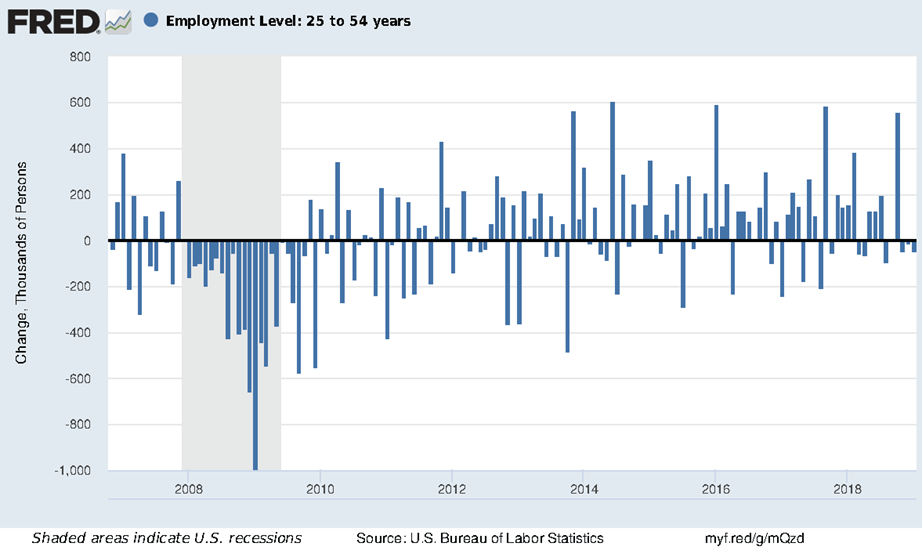
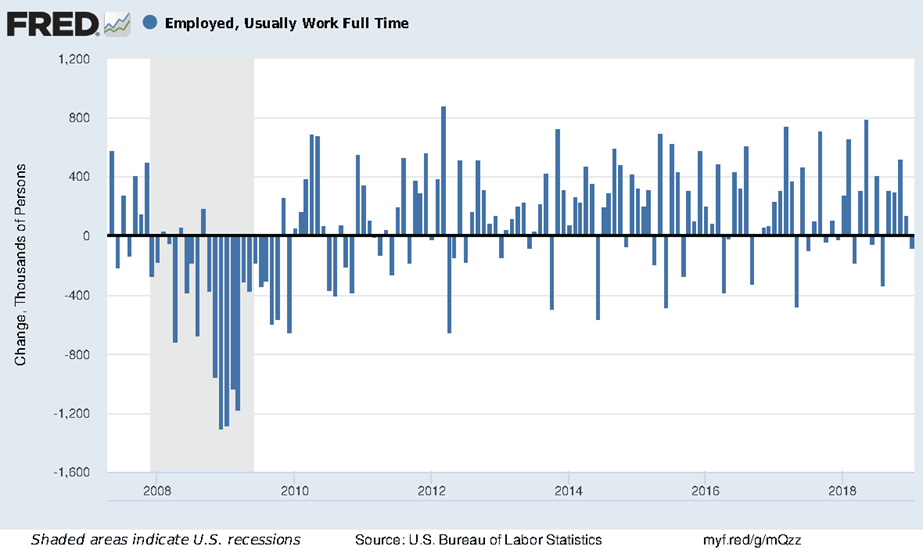
Rosenberg also notes that full-time employment dropped 76k in January. “This is a reason to rejoice?”. Certainly not, although we should all be happy for the other 1.26 million who found a full-time job during the previous 4 months. Note again that this series, like most employment data, is a poor leading indicator.
Smart National Bank Financial warns us that “temporary employment (a good leading indicator) was roughly flat”. To be monitored.

Finally, David Rosenberg highlights the fact that the unemployment rate, at 4.0%, is up 0.3% from its 3.7% cycle low and that “the mean, median and mode is for the jobless rate to rise 0.4 of a point from the low by the time the recession hits. We are now three-quarters there. Data back to 1950 shows that at no point in the past did we see a 0.6 point increase off the trough without seeing a NBER-defined recession”.
This is true with the only possible exception being June-Nov. 1959 when the U3 rate rose 0.8 points before falling back to a new low in Feb. 1960, two months before the recession (!). However, there have been six occasions since 1950 when the U3 rate rose 0.4 or 0.5 points without being followed by a recession.
The humble Edge and Odds:
The American consumer being the only solid pillar for the economy currently, the fact that Weekly Payrolls (employment x hours x hourly earnings) keep rising nicely (+5.7% YoY in January) while core inflation is muted (+1.9% in November) makes me think that the economy is in no immediate danger. Add the low oil prices and near zero food-at-home inflation, discretionary spending should remain solid for a while.


Fed’s Kaplan: Fed Likely On Pause Until At Least Summer
-
Oops! An Awkward Jobs Report for the Fed The Federal Reserve said the case for raising rates had weakened. Then came the jobs report.
U.S. Light Vehicle Sales Dip
The seasonally adjusted, annualized rate of sales for January came in at 16.9 million, down from 17.22 million in January 2018 and December’s 17.72 million rate, and marked the first month the SAAR has dropped below 17 million since August. (…)
January is typically one of the lowest months of the year for industry sales, with the least bearing on the year’s final results. (…)
January proved an early challenge for an industry that, according to most forecasts, is expected to fall short of 17 million annual sales for the first time since 2014. And those forecasts came before the 35-day U.S. government shutdown left 800,000 federal workers without paychecks, and record-setting cold kept millions of Americans bundled up at home during the last week of the month. (…)

Global PMI sinks to near two-and-a-half year low at start of 2019
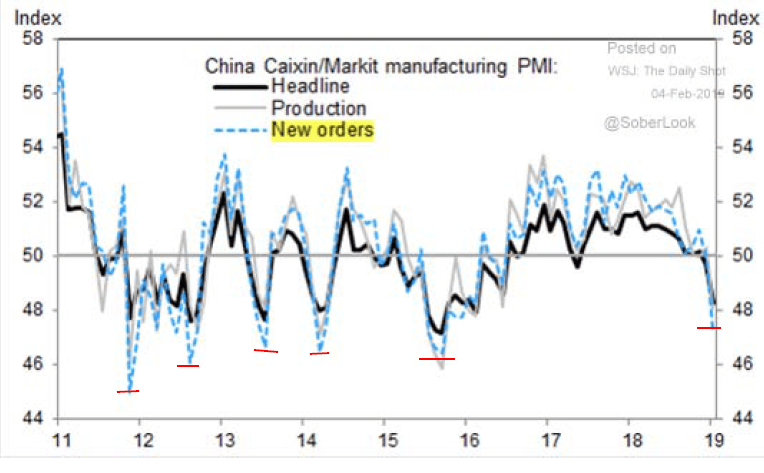
Growth of the global manufacturing sector slowed closer to stagnation in January. At 50.7, the J.P.Morgan Global Manufacturing PMI™ – a composite index1 produced by J.P.Morgan and IHS Markit in association with ISM and IFPSM – fell for the ninth straight month to its lowest reading since August 2016.
(…) if US data were excluded from the Global Manufacturing PMI calculation the reading would have been 50.0, a level signalling stagnation. The slowdown in China
manufacturing was the main drag, as the China PMI fell to a near three-year low. The euro area and Japan PMIs fell to 50- and 29-month lows respectively. (…)
This mainly reflected a near-stalling in the rate of growth in new orders, as new business rose at the weakest pace during the current six-year sequence of expansion. New export work decreased for the fifth straight month and to the greatest extent since May 2016.


What CEOs Are Saying About the Possibility of a Recession
(…) While business leaders don’t forecast a downturn, several saw the potential for recession and slowing growth on conference calls during the past week, from automakers to staffing firms. (…) Analysts surveyed by Bloomberg over the past week see a median 25 percent chance of a slump in the next 12 months, up from 20 percent in the December survey. (…)
The Conference Board CEO Business Confidence Index is as gloomy as it gets outside of recessions. These CEOs are obviously not the same as those polled by CEO Magazine nor the Business Roundtable who are more in tune with CFOs as these charts from RBC Capital illustrate:

Small businesses:
Economic confidence among CEOs continued to decline according to the Q4 2018 survey, reversing all of the gains recorded since the election of President Trump. The Vistage CEO Confidence Index was 95.4 in Q4, down from 103.0 in Q3 and last year’s fifteen-year peak of 110.3. The plunge was due to weakening evaluations of the national economy. Fewer CEOs reported that current economic conditions had improved (44%) compared to last quarter’s 64%. Even more notable is the drop in the increase of CEOs who expected the economy to weaken more than it will strengthen during the year ahead. (Tariffs were reported to have a negative impact by 38% of firms).
When asked about prospects for the national economy in the year ahead, just 14% anticipated improvement, down from 25% last quarter and 45% a year ago. (…) 33% of CEOs reported a pessimistic outlook for the economy in the coming year, which was the highest level since the start of the Great Recession. However, this negative economic outlook was still well below the 51% recorded in Q4 2007 or the 61% in the Q4 2018.
The proportion of firms who expected gains in revenues fell to its lowest level in two years, although gains were still expected by seven-in-ten firms. The slide during the past year has been large, with the proportion who expected gains falling to 70% from last quarter’s 75% and last year’s 83%. Planned investment spending also declined in the recent survey. Increased spending on fixed investments fell to 43%, down from 50% last quarter and 54% last year. Few firms, however, planned actual cutbacks — just 8%. (… )
Increases in the total workforce are planned by 65% of all firms, and while these expansion plans are down from the fifteen year peak of 75% set in the prior quarter, it was still higher than any other survey since mid-2003.(…) Profit expectations remain strong despite softening of anticipated revenues, largely due to the fact that 54% of CEOs plan to increase the prices of the products or services in the year ahead. (…)

Junk-Debt Sales Jump, Easing Credit Fears
Since Jan. 10, companies with below-investment-grade ratings, including TransDigm Group Inc. and Dun & Bradstreet Corp. , have sold around $50 billion of bonds and loans, breaking a dry spell that saw just $29 billion of speculative-grade debt sold in November and December, according to LCD, a unit of S&P Global Market Intelligence. (…)
As companies sold a hefty amount of debt in recent weeks, they have been forced in several cases to lean on one particular kind of debt—secured bonds—which is garnering more investor interest than secured loans and unsecured bonds. (…)
EARNINGS WATCH
Overall, 46% of the companies in the S&P 500 have reported earnings to date for the fourth quarter. Of these companies, 70% have reported actual EPS above the mean EPS estimate, 7% have reported actual EPS equal to the mean EPS estimate, and 23% have reported actual EPS below the mean EPS estimate. The percentage of companies reporting EPS above the mean EPS estimate is below the 1-year (77%) average and below the 5-year (71%) average.
In aggregate, companies are reporting earnings that are 3.5% above expectations. This surprise percentage is below the 1-year (+6.0%) average and below the 5-year (+4.8%) average.
The blended, year-over-year earnings growth rate for the fourth quarter is 12.4% today, which is above the earnings growth rate of 10.9% last week.
In terms of revenues, 62% of companies have reported actual sales above estimated sales and 38% have reported actual sales below estimated sales. The percentage of companies reporting sales above estimates is below the 1-year average (72%) but above the 5-year average (60%).
In aggregate, companies are reporting revenues that are 0.8% above expectations. This surprise percentage is below the 1-year (+1.4%) average but above the 5-year (+0.7%) average.
The blended, year-over-year revenue growth rate for the fourth quarter is 6.6% today, which is above the revenue growth rate of 6.2% last week.
Refinitiv’s data put Q4 earnings growth at 15.5%, pretty close to the 15.8% growth rate expected on Jan. 1 (12.9% ex-Energy). Analysts continue to trim their estimates across the board:

At this point in time, 42 companies in the index have issued EPS guidance for Q1 2019. Of these 42 companies, 33 have issued negative EPS guidance and 9 have issued positive EPS guidance. The percentage of companies issuing negative EPS guidance is 79%, which is above the 5-year average of 71%. (Factset)

As a result, Q1’19 growth estimates have slipped to +0.7% from 5.3% on Jan.1 with 5 of 11 sectors expected to show negative growth rates. Full year 2019 forecasts are now for a 4.9% earnings growth (5.6% ex-Energy), down from 7.3% on Jan. 1. Full year revenues are seen rising 5.0% (5.5% ex-E).
Trailing EPS are now $162.25, still above the full year estimate of $161.49.
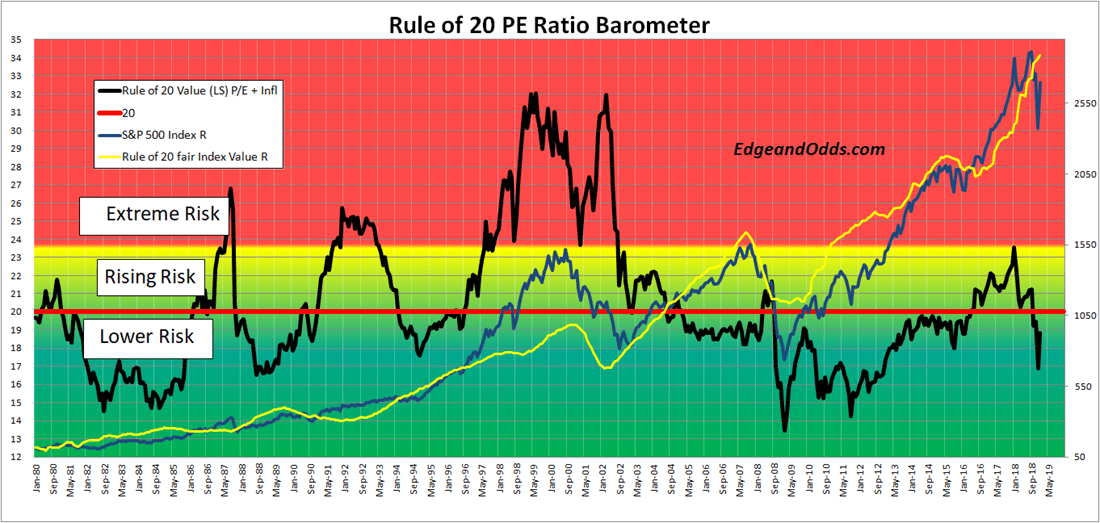
At 2700, the S&P 500 Index is trading at a 18.8 Rule of 20 P/E with Fair Value at 2888.
TECHNICALS WATCH
The S&P 500 Index is now only 1.4% below its 200-day moving average which has perked upward lately. Among other major country markets, only the TSX is showing a similar upturn in its 200dma.
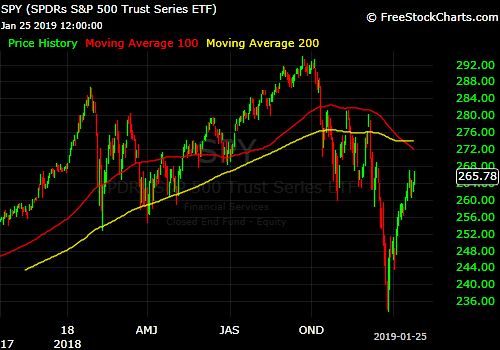
U.S. mid and small cap indices still show declining 200dma. The Nasdaq 100 Index, however, has also reversed the decline in its 200dma and its equal weight sub-index is even above the line indicating good breadth.

Lowry’s Research says that its analysis of Supply and Demand “suggests a rally even stronger than implied by the gains in price.” There has been a sharp reversal in the spread between Demand and Supply since the December lows and that spread has crossed above its 40-week m.a.. “So far in this bull market there have been three prior crosses in the spread from a depressed level – in Aug. 2009, Dec. 2012 and Nov. 2016. Each cross was followed by a sustained market rally.”
But Joe Public has ben scared:
MORAL SUASION
 Foxconn Says It Will Move Forward With Wisconsin Plant After Conversation with Trump Foxconn, a major supplier to Apple, said it has decided go ahead with the construction of a liquid-crystal display factory in Wisconsin, two days after saying building such a plant would be economically unfeasible.
 Was there also a phone call from Mr. Xi?




 We are clearly seeing the effect of minimum wage increases in the YoY industry numbers. Otherwise, overall comps are not accelerating with quarterly gains of 0.6%, 0.8% and 0.7% for civilian workers and 0.6%, 0.8% and 0.6% for private industry workers in the last 3 quarters.
