CPI for all items rises 0.8% in November; gas, food, shelter, vehicle indexes all rise
The Consumer Price Index for All Urban Consumers (CPI-U) increased 0.8 percent in November on a seasonally adjusted basis after rising 0.9 percent in October, the U.S. Bureau of Labor Statistics reported today. Over the last 12 months, the all items index increased 6.8 percent before seasonal adjustment.
The monthly all items seasonally adjusted increase was the result of broad increases in most component indexes, similar to last month. The indexes for gasoline, shelter, food, used cars and trucks, and new vehicles were among the larger contributors. The energy index rose 3.5 percent in November as the gasoline index increased 6.1 percent and the other major energy component indexes also rose. The food index increased 0.7 percent as the index for food at home rose 0.8 percent.
The index for all items less food and energy rose 0.5 percent in November following a 0.6-percent increase in October. Along with shelter, used cars and trucks, and new vehicles, the indexes for household furnishings and operations, apparel, and airline fares were among those that increased. The indexes for motor vehicle insurance, recreation, and communication all declined in November.
The all items index rose 6.8 percent for the 12 months ending October, the largest 12-month increase since the period ending June 1982. The index for all items less food and energy rose 4.9 percent over the last 12 months, while the energy index rose 33.3 percent over the last year, and the food index increased 6.1 percent. These changes are the largest 12-month increases in at least 13 years in the respective series.
Adobe Digital Price Index: Online Inflation Hits Record High Online prices increased 3.5% year-over-year
Adobe (Nasdaq:ADBE) today announced the latest online inflation data for the month of November 2021. Online prices hit a record high at a 3.5% year-over-year (YoY) increase while prices are down 2% month-over-month (MoM) due to holiday discounts. This is the highest YoY increase since Adobe first began tracking the digital economy in 2014, and it marks the 18th consecutive month of YoY online inflation.
Apparel was a standout category with prices up 17.3% YoY and down just 0.4% MoM, reaching a record high of inflation. One dollar out of every four dollars* is now spent online in the U.S., making the digital economy a significant component of the overall economy.
The [Digital Price Index] DPI covers more than 100 million products in the U.S. and is modeled after the Consumer Price Index issued by the U.S. Bureau of Labor Statistics.

- Yesterday, I received this email from my friendly AC company: “We received a notice from all the national dealers including, Carrier, Trane, Rheem, Lennox, etc., of another price increase of 10% for all Air Conditioning equipment effective January 3rd, 2022.”
Wage Growth Tracker Was 4.3 Percent in October The Atlanta Fed’s Wage Growth Tracker was 4.3 percent in November, up from 4.1 percent in October and the highest reading since 2007. The Tracker for people switching jobs was 5.2 percent in November, up from 5.1 percent in October.

- Starbucks Workers at Buffalo-Area Store Vote to Unionize Baristas voted to form the first labor union at one of the coffee giant’s own U.S. cafes in its 50-year history.
(…) In the three separate store elections overseen by the National Labor Relations Board on Thursday, the federal body said that one store voted for unionizing, one voted against it and results in the third weren’t conclusive. The labor board said it will review challenges from both sides in that store election. (…)
The union drive has preoccupied Starbucks executives for months, and captured the attention of chain workers beyond Buffalo. One Starbucks store in Mesa, Ariz., last month petitioned to unionize, with supportive baristas working with the same Workers United union and saying they drew inspiration from the Buffalo effort.
A NLRB hearing on three additional Buffalo stores that also petitioned to unionize is slated to begin Friday. (…)
Unions are rare in U.S. restaurants. Less than 2% of food-service and bar workers were union members as of last year, according to the Labor Department.
More than half of Starbucks’s 6,500 U.S. airport, grocery, casino and other licensed locations are unionized, according to the company. A Buffalo union would represent the first for a location owned by Starbucks; the company owns 9,000 of its roughly 15,500 U.S. cafes. (…)
Starbucks in October announced wage increases, saying that the average U.S. barista’s pay would rise by next summer to nearly $17 an hour from $14. (…)
- Tyson Foods Ramps Up Meat-Plant Automation Plans The poultry giant said it plans to spend about $1.3 billion to automate parts of its production lines over the next three years, as meatpackers struggle with a nationwide labor shortage.
- Google execs tell employees they won’t raise pay companywide to match inflation Google executives are acknowledging employee concerns about rising inflation, but say they have no plans to respond with a companywide pay increase.
The safety net!?
$35tn wealth surge provides solid platform for US growth
Non-financial assets – primarily real estate, but also including things such as cars, jewellery and equipment – now totals $48.6tn versus $40tn at the end of 2019. Meanwhile, financial assets total $114tn, up from $93.4tn in 2019 – an astonishing 22% increase in 21 months.
Within financial assets the largest categories are corporate equities & mutual funds ($42.6tn) pension and life funds ($32.9tn), small business equity ($14.4tn), and time and savings deposits ($10.7tn).
Household Liabilities are “just” $18tn and are primarily mortgage and consumer loans, which leaves household net worth at $144.7tn. This is equivalent to 624% of US GDP and 796% of annual disposable income. As the chart below shows, the household balance sheet, in aggregate, has never been in such a strong position.
The household balance sheet measured as a % of household disposable income
It is certain that the majority of the increases in wealth will have been experienced by higher income and already wealthy households since they will have been heavily invested in the “winning” asset classes. The biggest contribution to the financial wealth gains came from corporate equities and mutual funds due primarily to risk appetite rebounding and equity markets surging higher on unprecedented Federal Reserve and government stimulus. The same reasons led to strong performances for pension and life insurance funds. Conversely, the value of debt security holdings has actually declined as low yields prompted investors to sell.
Moreover, higher income and wealthier households spend proportionally more on services and “experiences” such as travel, eating out, theatre and the cinema – things that Covid containment measures have prevented. Consequently, we are likely to have seen a significant increase in unplanned saving amongst this grouping with the money instead put into various financial and physical assets.
There was also a substantial increase in wealth within cash, checking and savings deposits. Given such low interest rates being paid on balances we can safely say this was overwhelmingly due to people putting more and more money into these accounts – up $3tn since 1Q20 and up $3.4tn since 4Q19!
Lower income households will also have benefited to some extent with government stimulus cheques of $1200, $600 and $1400 combined with uprated and extended unemployment benefits contributing to significant increases in household incomes over the past 18 months. This can be seen in the chart below with the orange bars representing the income boost from the cheques and the grey bars representing the expanded unemployment benefits.
An NBER paper calculated that 69% of unemployment benefit recipients actually earned more money being unemployed than when they were working. The median recipient received 134% of their previous after-tax compensation. Encouragingly, we are now seeing positive income growth from higher wages and salaries and this will hopefully mean that incomes can keep rising despite the curtailment of additional unemployment benefits.
Contributions to the change in personal income levels versus February 2020 ($tn)
With employment growth looking resilient and higher income growth becoming increasingly evident as firms compete for staff, the outlook for consumer spending remains positive. Today’s evidence of further massive accumulation of wealth only adds to the potential spending ammunition of the household sector, which gives us more confidence that the US economy can expand by more than 4% in 2022.


October and November were strong retail months. The more recent weeks have been slower:

- Costco Sales Rise During Start of Holiday Season The warehouse retailer is navigating rising costs and shipping snarls that mean some toys will reach its stores after Christmas.
(…) Comparable sales, those from stores and digital channels operating for at least 12 months, rose 9.8% in the quarter ended Nov. 21 compared with the same period last year, excluding gas sales and currency fluctuations. E-commerce sales rose 13.3% during the quarter. (…) For the latest quarter the company estimates that overall year-over-year price inflation was in the 4.5% to 5% range. (…)
In late October, Costco raised its starting wage for workers to $17 an hour, eating into profit, Mr. Galanti said. (…)
Net income hit $1.3 billion in the most recent quarter, up from $1.2 billion in the same period last year. Analysts expected net income of $1.2 billion, according to FactSet. (…)
About 79% of Costco’s imports are late by an average of 51 days, Chief Financial Officer Richard Galanti said on a call Thursday. “Virtually, all departments are impacted. We’ve ordered early in many cases,” he said. (…)
Costco management now anticipates overall price inflation in the 4.5-5.0% range (ex-gas) vs
3.5-4.5% in September and 2.5-3.5% in May. The company said that supply chain pressures have remained relatively stable to the previous quarter with ~79%
of import containers arriving late by 51 days on average.
Bank of Canada Highlights Concerns Over Supply Chain, Inflation Risks The Bank of Canada on Thursday signaled its growing discomfort with high inflation and the possibility that supply chain disruptions could last longer than policy makers had anticipated.
(…) Mr. Gravelle’s comments on Thursday were “notably more hawkish than Wednesday’s policy statement,” Andrew Kelvin, chief Canada strategist with Toronto-Dominion Bank, wrote in a note to clients. (…)
[Mr. Gravelle] acknowledged, however, that the economic models the bank relies on for forecasting are having a hard time dealing with a global shock to supply and demand.
“Given that there is no historical precedent to the sudden closing and reopening of the economy, our models were not built to capture the many economic forces that arose from the pandemic,” he said.
Supply strains are peaking…but have yet to decline:
Musk, Other Insiders Are Selling Stock at Historic Levels Top executives and company leaders like the Waltons, Mark Zuckerberg and Google’s co-founders have sold $63.5 billion through November, up 50% from 2020. The sales come amid soaring market valuations and ahead of possible changes in U.S. and some state tax laws.
(…) So far this year, 48 top executives have collected more than $200 million each from stock sales, nearly four times the average number of insiders from 2016 through 2020. In November, insiders unloaded a collective $15.59 billion. (…)
Corporate insiders, particularly those in high P/E tech stocks, are increasing liquidity just before the Fed starts reducing liquidity in markets as Nordea suggests:
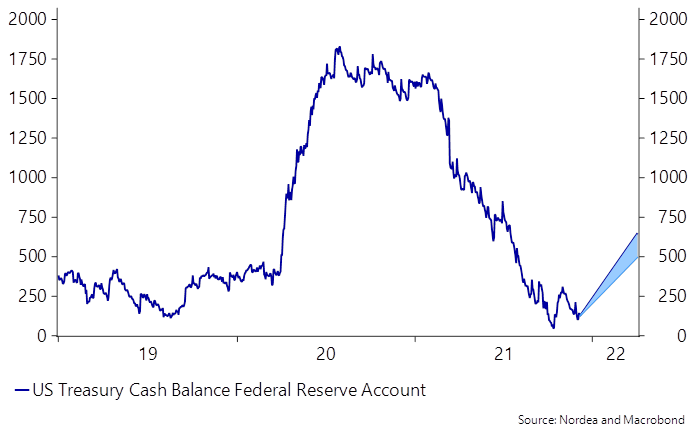
The quicker tapering and lifting of the debt ceiling will mean less liquidity to the street. The latest release from the Treasury indicates a cash balance at USD 650bn as of end-March, which from current levels implies a drain of some USD 550bn from private sector liquidity, in turn resulting in USD liquidity becoming more expensive. The rise of US STIRs has come fast, but are coming at the expense of a quicker policy reversal priced into the market.
New US Treasury cash balance scenario
Europe Sees Early Signs Latest Virus Surge Is Leveling Off
While the trend varies across countries, overall European Union numbers look to have hit a plateau. Austria and Germany have seen a dramatic shift, with the former’s seven-day case rate plunging by more than half since late last month. (…)
The spread also appears to be slowing in the Netherlands, which was another Western European hotspot last month. But cases are still rising sharply in some countries, including Switzerland, where the spread of infections is at a record high.
There’s also the big unknown of the new omicron variant, which looks to be more transmissable than the delta mutation. Germany and other countries are pushing hard to deliver booster shots after some initial research suggested lower protection in people who received just two shots. (…)
Austria is ending a three-week lockdown on Sunday but keeping restrictions on those who haven’t been inoculated. And in a controversial move, it’s also bringing in mandatory vaccinations as the continent gradually toughens its stance. (…)
In the USA:

The holidays with my family (Katelyn Jetelina) I can share my plans, what I’m thinking for my little family, and where the risks lie and don’t lie. Maybe it will help. Maybe not. Maybe I will regret this, but ‘tis the season.