French Lockdown to See Economy Plunge 4.7% in the Fourth Quarter
Japan Has Worst Day of Covid Cases Yet Amid Fears of Winter Wave
At least 1,634 cases were recorded nationwide, according to a tally by national broadcaster NHK, topping the previous high set during a surge in August. While numbers are low in absolute terms compared to many other countries, a spike in northern Japan is leading to concerns cases could spread as winter sets in. (…) Tokyo saw 393 infections, one of the heaviest days to date.
Yasutoshi Nishimura, the minister overseeing the country’s coronavirus response, said more stringent steps would be needed if infections continued to rise. That’s the strongest warning yet from the national government in a country that has largely escaped the worst of the pandemic. (…)
Covid Hot Spots Show Signs Europe’s New Wave May Be Cresting
But not in the USA:

- Cases rose over the past week in 45 states, and held steady in the other five. Not a single state saw an improvement. (Axios)
 Data: The COVID Tracking Project, state health departments. Map: Andrew Witherspoon/Axios

Covid-19 Surge Strains Hospitals Hospitals across the nation face an even bigger capacity problem from the resurgent spread of Covid-19 than they did during earlier surges, experts said, as the number of U.S. hospitalizations hit a new high.
‘Help is coming — and it’s coming soon’: Dr. Fauci outlines when COVID-19 vaccination will be available to all Americans
Fauci, director of the National Institute of Allergy and Infectious Diseases and an expert in infectious diseases for the last four decades, gave his estimate of when a vaccine will be available to all Americans: “We’re talking probably by April.” The veteran immunologist said frontline workers, those with preexisting conditions, and vulnerable members of the population will be first in line.
But for those who wish to avail of Pfizer and BioNTech’s vaccine, assuming it progresses smoothly, Fauci has a timeline. “I believe within the first quarter.” he told CNN’s Jake Tapper Wednesday. “We have a lot of people in this country who may not want to get vaccinated right away. That’s why were talking about this leading to the second or third quarter to get people convinced to get vaccinated.” (…)
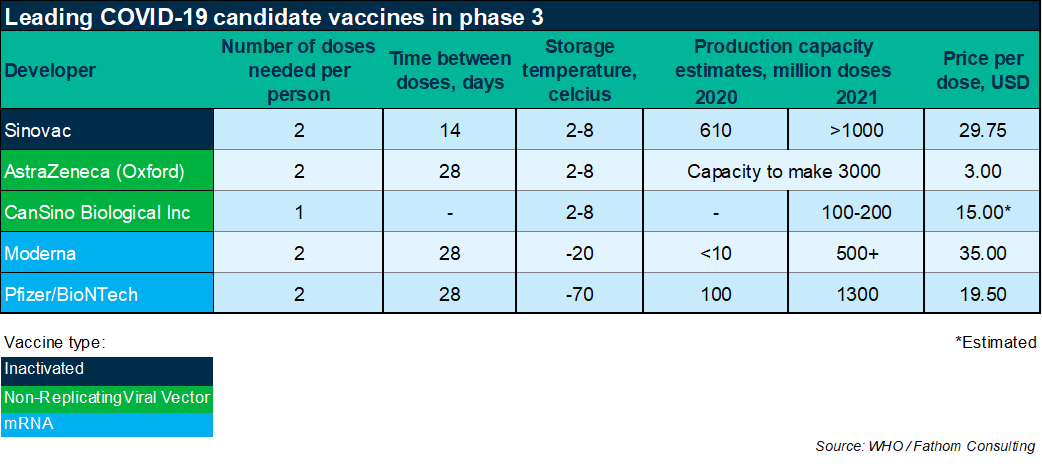
- From Fathom Consulting:
If other leading candidates prove to be successful, the world could have more than five billion doses available by the end of next year. The relative efficacy of different types may affect global rollout. The BioNTech/Pfizer vaccine is an mRNA vaccine, which must be kept at much lower temperatures than standard vaccines: -70 Celsius in its current form. That means existing distribution structures need adapting. The company also only expects to produce 100 million doses by the end of December, enough to inoculate just 50 million people.
The Chinese firm Sinovac, however, is targeting 610 million doses by the end of the year and upwards of one biIllion in 2021. Both vaccines require two doses. If all goes to plan, Sinovac may be able to inoculate six times as many people with the vaccines they produce this year – and its vaccine can safely be distributed at a normal fridge temperature of below 8 Celsius.
However, with current orders from several developed countries already close to one billion, perhaps the most highly anticipated vaccine candidate is being produced by the University of Oxford and AstraZeneca. It too needs two doses and can be kept at a similar temperature to the Sinovac vaccine. However, estimates suggest that there is the capacity to make three billion doses at around $3 each – a tenth of the price currently offered by its Chinese competitor.

Meanwhile

 One important tailwind through next year will be the substantial amount of savings that households have built up in developed markets since March. In the US, for example, aggregate personal savings over the past twelve months were $1.3 trillion higher in September than they were in February. If effective vaccines are rolled out, it appears probable that much of those savings will be unwound, with spending likely to be particularly strong in badly hit services sectors such as hospitality and tourism. Improved confidence about future demand should boost business confidence now, and business investment should react ahead of widespread vaccinations. (…) (Fathom Consuling)
- Societal shifts triggered by the pandemic could “make downtown office buildings, hotels and stores less valuable, sending losses ripping through banks and bond investors that hold $3.4 trillion in commercial real estate debt,” WashPost global economics correspondent David J. Lynch writes. “Office space, the largest single slice of the commercial real estate sector, already is seeing rents fall as vacancies rise. Property values eventually could plummet 20 to 35 percent, according to a recent Barclays report. Hotels and retail properties have been hit even harder.”
- IEA says vaccine unlikely to boost oil market until late 2021 Energy body says demand for crude will fall more than it previously expected this year
- OPEC and its allies are zeroing in on a delay to next year’s planned output increase of three to six months, according to several delegates. The group is keeping about 7.7 million barrels a day off-line right now, or 8% of global output. The presidents of both Russia and OPEC have even mentioned the option of cutting production deeper, though the idea hasn’t garnered widespread support. (Bloomberg)
TECHNICALS WATCH
13/34–Week EMA Trends (from CMG Wealth)
- Equities:

- Bonds: watch the crossing lines…


This chart from CPMS/Morningstar plots Regional Banks’ P/B and ROE vs the 10-2 yr bond spread. The thick black line marks a flat yield curve.

1 thought on “THE DAILY EDGE: 12 NOVEMBER 2020”
“OPEC and its allies are zeroing in on a delay to next year’s planned output increase of three to six months, according to several delegates. The group is keeping about 7.7 million barrels a day off-line right now, or 8% of global output. The presidents of both Russia and OPEC have even mentioned the option of cutting production deeper, though the idea hasn’t garnered widespread support. (Bloomberg)”
Maybe, maybe not happening.
With biden ‘taking over’, and given his greenwashing pledges, I read somewhere that his “plan” involves not renewing and not allowing new shale drilling permits on 100% of fed owned land in the US of A.
This would cause a collapse of production of around 3Mln Bbl/day in about a 3 years time span in the US of A, turning it from a producer to again a net importer (then buy crude tanker shipping stocks).
The intent of this cut-off approach: keep oil and natural gas expensive enough in the US of A, to give a chance to green energy sources that are deemed more expensive to build out compared to oil/gas drilling, while not increasing gas prices too much at the pump for internal combustion engine using retail consumers that are driving a lot.
The only drawback: State coffers will be drained in oil/NG producing regions: e.g. New Mexico (Democratic party governor) will “lose” around $2.5Bln in extra tax income from crashing fossil extraction if this plan is put in place.
Which will lead to an even more deficient funding for their schools and hospitals, since this tax money is used to pay for those govmint expenses.
If what I read is real (never sure in this fake news world we live in), then only one conclusion is possible: What a funny world full of second order consequences we live in, no?
Comments are closed.