Weak Retail Sales Stoke Worries U.S. retailers registered a far worse December holiday selling season than many analysts had realized, sending stocks lower and raising questions about the economy.
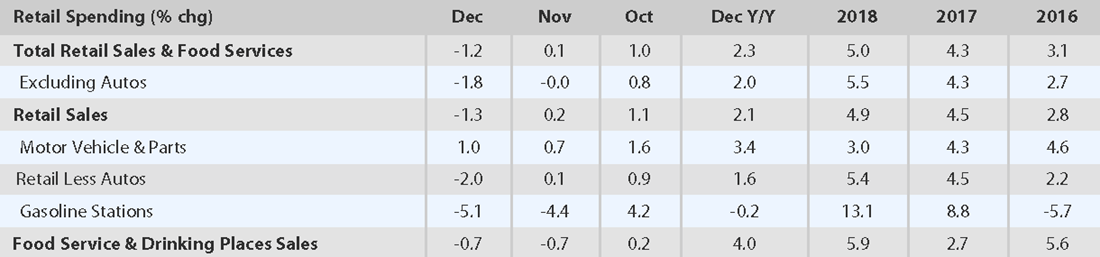
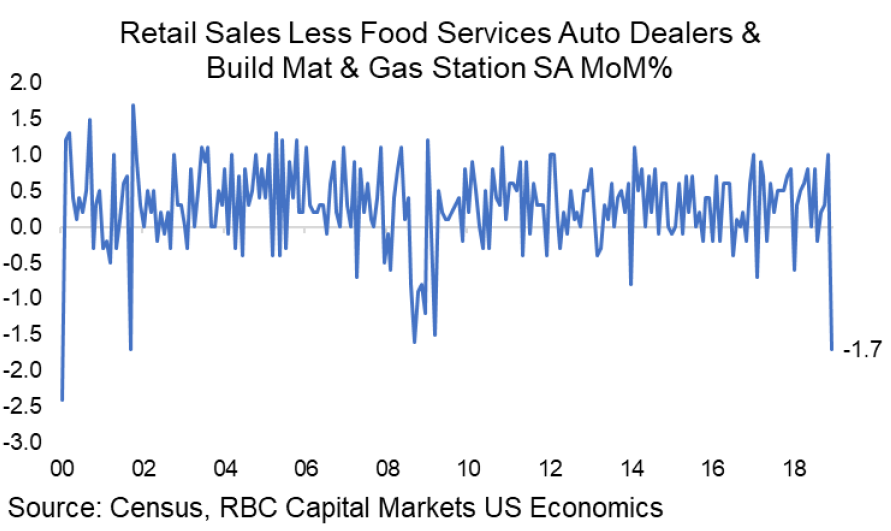
Sales at stores, restaurants and online fell a seasonally adjusted 1.2% in December from November, the retail sales report said, the biggest monthly drop since September 2009. The performance was so poor that some analysts questioned the report’s accuracy. (…)
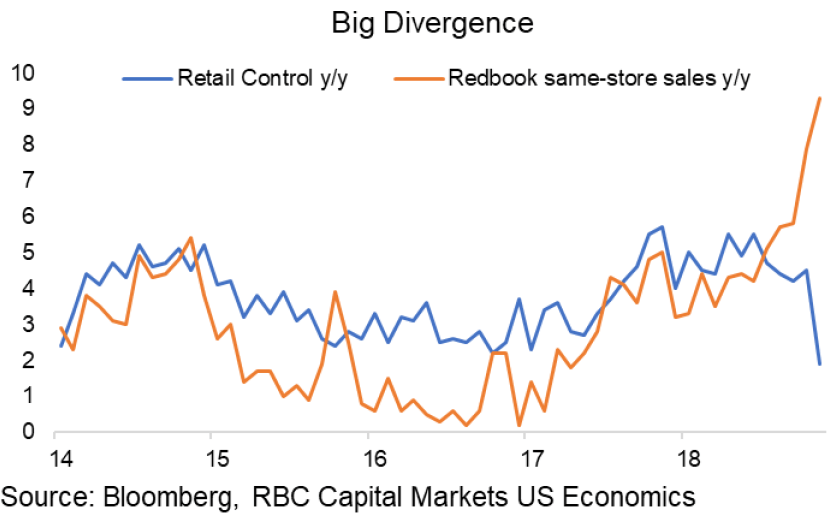
Everybody was happy to finally get a fix on consumer spending post-shutdown. Now nobody is happy with this Retail Sales report which is too weak to be believable (table from Haver Analytics)
Two relevant charts from RBC Capital Markets:
So we and our data-dependant Fed will remain in the dark for 2 more weeks as the BEA will only release Personal Income and Outlays for December 2018 and Personal Income for January 2019 on March 1.
In the meantime, the bears will use this report to boost recession odds which truly go up if this is a correct reflection of the mood of American consumers. The hopefuls will feed question marks like those from the WSJ article:
Economists were puzzled by the decline because reports from individual retailers in recent weeks, though soft, hadn’t suggested such a disappointing holiday season. Other reports on holiday shopping, such as from Mastercard, suggested solid gains. (…)
The government’s report on the performance of online retailers, such as Amazon.com Inc., was especially stunning. It said online sales fell 3.9% from November, the biggest monthly decline since November 2008, and were up just 3.7% from a year earlier. (…)
Amazon reported last month its fourth-quarter revenue was up 20% from a year earlier.
“They indicated they saw minimal impact from any consumer slowdown,” Colin Sebastian, an analyst at Robert W. Baird & Co., said of Amazon. He and other analysts said some shopping might have shifted to November, tied to promotions.
(…) department stores were down 3.3% from a month earlier, according to the government.
The department stores themselves have reported mixed though generally positive results so far. Macy’s Inc. sales for the November-December period grew 1.1% from a year earlier, while Kohl’s Corp. sales rose 1.2%, less than analysts had expected. J.C. Penney Co.’s sales fell 5.4%. Target Corp. , meantime, saw its sales grow 5.7%. (…)
A Bank of America Merrill Lynch report released this week said its credit- and debit-card data showed month-over-month retail sales, excluding autos, were flat in December and slid in January. (…)
U.S. Producer Prices Decline; Core PPI Rises
The headline Final Demand Producer Price Index edged down 0.1% for the second consecutive month in January (+2.0% year-on-year). December’s reading was revised up from -0.2%. The Action Economics Forecast Survey expected an increase of 0.1%. Producer prices excluding food & energy increased a greater-than-expected 0.3% (2.6% y/y) after an unchanged reading (was -0.1%). A 0.2% gain had been anticipated. The PPI excluding food, beverages and trade services, another measure of underlying price inflation, rose 0.2% (2.5% y/y) following a flat December. (…)
Service prices rose 0.3% (2.8% y/y) after an unchanged reading in December (was -0.1%). The cost of trade services jumped 0.8% (3.2% y/y) while transportation & warehousing costs rose 0.5% (7.0% y/y). Prices for final demand services excluding trade, transportation & warehousing was unchanged for the second consecutive month (2.0% y/y).
Goods prices fell -0.8% (+0.4% y/y), the third monthly decline. Goods prices excluding food & energy rose 0.3% (2.4% y/y) after a 0.1% reading. Core consumer goods prices increased 0.4% (2.8% y/y), while capital equipment grew 0.6% (2.8% y/y). (…) Prices for intermediate demand processed goods fell 1.4% (+0.9% y/y), the third consecutive monthly decline.


China’s Muted Inflation Likely to Spur Policy Easing
The producer-price index, a gauge of prices at the factory gate, edged up 0.1% in January, slowing from a 0.9% gain in December, the National Bureau of Statistics said. The consumer-price index rose 1.7% in January from a year earlier, compared with a 1.9% increase in December, the bureau said. (…)
January’s 0.1% rise in producer inflation was the seventh straight month of deceleration and was the slowest increase since September 2016.
Though prices of raw materials and unfinished products edged down 0.1% last month, finished products climbed 0.6%, slowing a tick from December’s 0.7% growth, said Dong Yaxiu, an analyst with the statistics bureau, in a statement. (…)


Chinese, U.S. Trade Negotiators Inch Toward an Agreement Negotiators made progress on a memorandum of understanding that could serve as the basis for a deal that President Trump and Chinese leader Xi Jinping could later finalize.
The agreement would be in the form of a memorandum of understanding and could serve as the framework for a deal that President Trump and Chinese leader Xi Jinping could later finalize at a summit, the people said. Negotiators on both sides have agreed to continue the talks next week in Washington, according to the people.
During negotiations this week in Beijing, officials on both sides have been seeking to narrow the still-substantial gap between the concessions China is willing to offer and what the Trump administration will accept.
The memorandum in the works is expected to cover issues related to Beijing’s offers to purchase more American goods and services, accelerating China’s market-opening efforts in sectors such as financial services and manufacturing, as well as improving its protection of U.S. intellectual-property rights.
Thornier issues like how to enforce a trade deal are also expected to be included in the memorandum, the people said. (…)
Throughout the talks, sharp divisions remained on items such as how Beijing can address U.S. complaints that China pressures U.S. companies to share technology and that its policies favor state-owned companies at the expense of U.S. competitors.
The memorandum likely will mention those topics as well, but so far scant progress has been made toward narrowing those differences. (…)
(…) Xi said he values the “good working relationship” with President Donald Trump very much, and is willing to keep in touch with him in various ways. He added that China was “willing to solve the bilateral economic disputes and frictions through cooperation, and push for an agreement that both sides can accept. But cooperation has principles.”
The U.S. echoed the sentiment, saying there had been progress reached, but that work remained, according to an emailed statement from the White House. (…)
“We feel we have made headway on very, very important and difficult issues,” Lighthizer said, according to the Associated Press. “We have additional work we have to do but we are hopeful.” (…)
We shall see if President Trump has principles.
Purchases With Plastic Get Costlier for Merchants—and Consumers Visa and Mastercard are hiking a range of fees that U.S. merchants will pay to process transactions starting in April, a move likely to inflame already fractious relations between many businesses and card networks.
EARNINGS WATCH
386 companies in, 70% beat rate and a lower +3.1% surprise factor. Blended estimates for Q4’18 are now +16.2%, from +16.6% yesterday.
Q1’19 estimates still at –0.3% (+0.3% ex-Energy).
Trailing EPS: $162.85.
1 thought on “THE DAILY EDGE: 15 FEBRUARY 2019”
Retail glitch is most likely stuffing channels (due to tariff fears) and thus,this is more about accounting for holiday shipments ==> not sales, hence unsold inventory will be an issue going forward — just a wild guess.
Comments are closed.