Fed Official Says Rate Cuts Could Be Needed to Prevent Overtightening The central bank must make sure “we don’t give people price stability but take away jobs,” said San Francisco Fed President Mary Daly.
(…) Daly said that if inflation continues its steady decline of recent months, the Fed’s benchmark interest rate “will still be quite restrictive even if we [cut rates] three times next year.”
Daly said she is watching the effect that restrictive policy has on the labor market. When the unemployment rate starts to rise, it tends to go up by a lot and not by only a little bit, Daly said. As a result, “we have to be forward looking and make sure that we don’t give people price stability but take away jobs.” (…)
In a notable shift, she said the Fed’s focus now needed to turn toward paying attention to both sides of its mandate. (…)
Allowing real rates to increase would create an elevated possibility “that we could overtighten quite easily, and so that’s what I’m mindful of,” said Daly, who will become a voter on the Fed’s rate-setting committee next year. (…)
While much of the initial decline in inflation this summer stemmed from supply-chain healing, more recent declines appear to have been driven by a cooling in demand-driven components, she said.
A model maintained by the San Francisco Fed suggests two thirds of the decline in core inflation had been related to changes in demand. “To me, that’s a material development,” said Daly. “That means we have monetary policy working.” (…)
The San Fran Fed report:
(…) Demand-driven categories are identified as those where an unexpected change in price moves in the same direction as the change in quantity in a given month. Supply-driven categories are identified as those where unexpected changes in price and quantity move in opposite directions. (…)
The data isolate the unexpected component of the change in prices and quantities because they are likely to represent a shift in demand or supply rather than longer-run factors such as technological improvements, cost-of-living adjustments to wages, or demographic changes. (…)
The bars for each month reflect the contributions from supply-driven (green), demand-driven (blue) inflation, and ambiguous categories.

Since 1999, the split averaged 51/49 excluding the “ambiguous”. Last 12 months: 51% demand driven on average; last 6 months: 48%; last 3 months: 46%.

Looking at the MoM annualized data, the contribution of demand-driven inflation has declined throughout and was only 15% in the last 3 months.

I am not comfortable with the methodology that “isolates the unexpected component of the change in prices and quantities”, particularly in the recent years when price behavior was really unexpected (e.g. cars, housing, air fares). There is also no measure of the effect of exchange rates which can be temporary.
I side with Jay Powell who acknowledged that much of the decline in inflation so far has come from the reversion of pandemic-related goods and labor supply issues and that “at some point we will run out of supply side help; then it comes down to demand, and that’s harder”.

Actually, all components of domestic demand accelerated as the Fed was tightening. Whither those famous lag effects?

The most interest rate sensitive sectors have yet to flinch to this rather forceful tightening:

One of the main reasons that the US doesn’t need to have a recession to bring down inflation is that China is having the recession for us. China’s property bubble has burst, and the deflationary consequences are far greater and more global than those following the bursting of similar bubbles in Japan during the late 1980s and in the US during the Great Financial Crisis of 2008. (…)
The path of sticky services inflation
- John Authers: Ghosts of Inflation Past Haunt Fed’s Pivot Party
(…) The debate over Powell’s pivot is like Ebenezer Scrooge facing the spirits on Christmas Eve, and centers on spectres from the central bank’s past, with a strong element of undigested denialism. Austan Goolsbee of the Chicago Fed said: “I thought there seemed to be some confusion about how the FOMC even works. We don’t debate specific policies speculatively about the future.” Although he’s no longer on the FOMC, Bloomberg Opinion’s own Bill Dudley, for years the governor of the New York Fed, set out why he thought a pivot was (in his words) “a pretty big gamble.”
So without specifically offering alternative rate paths, the Fed seems to be saying that the market reaction has gone too far.
The discussion has focused on the 1970s, when US inflation slipped out of control in a way that hasn’t happened before or since. Premature declarations of victory, both under Arthur Burns and later Paul Volcker early in his term, come in for much criticism. Cutting rates when inflation is trending downward but is still high proved disastrous, leading to the assumption that no Fed chief would ever want to risk being compared to Burns in their obituary.
Is it just possible that the risks of leaving rates too high for too long and taking the blame for an avoidable recession now bulk larger? (…)
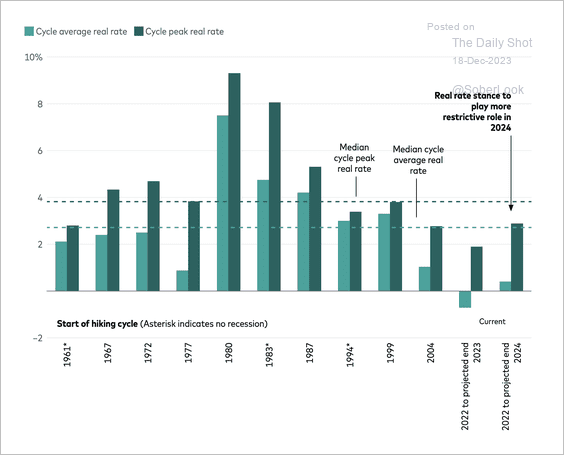
“Real, or after-inflation, interest rates have only recently turned positive and by historical standards haven’t approached levels where they would weaken the economy sufficiently to consider the inflation fight over. We expect real rates to climb in 2024 as the pace of inflation slows and eventually become restrictive enough to push inflation the last mile to the Fed’s 2% target.”
Cargo Ships Forced on a Long, Slow Detour to Avoid Red Sea Houthi militants have vowed to attack any merchant vessel with a connection to Israel.
- U.S. Says Naval Forces Will Protect Ships Passing Through Suez Canal The move is aimed at protecting merchant vessels after Houthi rebel attacks threatened the canal’s role in global trade.