Auto Supply-Chain Constraints Weighed on September’s Industrial Production Disruptions from Hurricane Ida also contributed to last month’s 1.3% decline
(…) In August, industrial output fell by a revised 0.1% from a 0.4% rise previously estimated.
Manufacturing output, the biggest component of industrial production, fell 0.7% in September compared with August. Motor vehicle and parts production decreased 7.2% amid the shortage of semiconductors.
The lingering effects of Hurricane Ida also contributed to the drop in manufacturing, by 0.3 percentage point, the Fed said.
Despite last month’s drop, industrial production rose at an annual rate of 4.3% in the third quarter, marking the fifth consecutive quarter with a gain of more than 4%.
Actually, the whole manufacturing sector is impacted by shortages as this Haver table shows:

U.S. Home Builder Index Strengthened in October
The Composite Housing Market Index from the National Association of Home Builders-Wells Fargo rose 5.3% m/m in October (-5.9% y/y) to 80, following a rise of 1.3% m/m (-8.4% y/y) to 76 in September. An unchanged level of 76 was expected in the INFORMA Global Markets survey. The seasonally-adjusted index was 11.1% below the record high reached in November 2020.
All three HMI components gained this month. The index of present sales conditions rose 6.1% m/m (-3.3% y/y) to 87 in October, after the 1.2% (-6.8% y/y) rise to 82 in September. The index measuring traffic of prospective buyers increased 6.6% m/m (-12.2% y/y) to 65 this month, following a 3.4% rise (-17.6% y/y) to 61 in September, the second monthly gain in five months, after reaching a low of 59 in August. The index is still 15.6% below the cycle high of 77 in November 2020. The index of expected sales over the next six months rose 3.7% m/m (-4.5% y/y) to 84 in October, up from 81 (-4.7% y/y) in September.
Performance was brisk in all four regions of the country. The strongest gain was in the Northeast, where the index rose 9.0% m/m (-16.0% y/y) to 73 in October after an 11.8% m/m (-17.3% y/y) decline in September to 67. The index for the West rose 6.3% m/m (-10.5% y/y) to 85 this month, following a decline of 5.9% m/m (-9.1% y/y) last month. The Midwest posted a rise of 5.8% m/m (-3.9% y/y) to 73, after a 7.8% m/m rise (-11.5% y/y) to 69 in September. The South posted a rise of 5.0% m/m (+1.2% y/y) to 84, after a rise of 3.9% m/m (-5.9% y/y) to 80 in September. These regional series begin in December 2004.

WEATHER OR NOT
- Nordea:
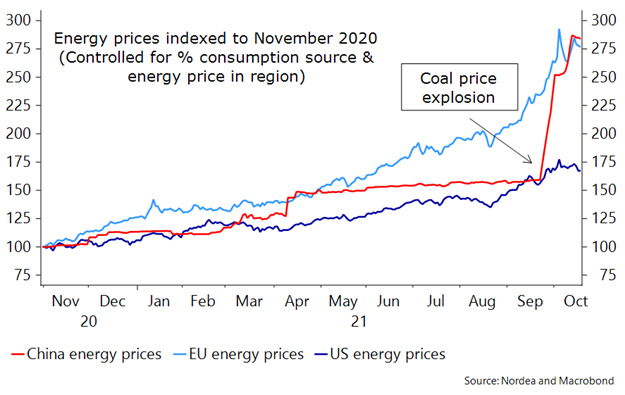
The recent energy price surge have taken markets with a storm and is unlikely to pass by before we have made it through the cold winter season. The situation is contained in the US while prices are snowballing in Europe and China. While the energy situation in Europe has deteriorated throughout much of 2021 it markedly worsened when China’s coal prices went rampage – and it is likely to continue to depend on the situation in China. (…)
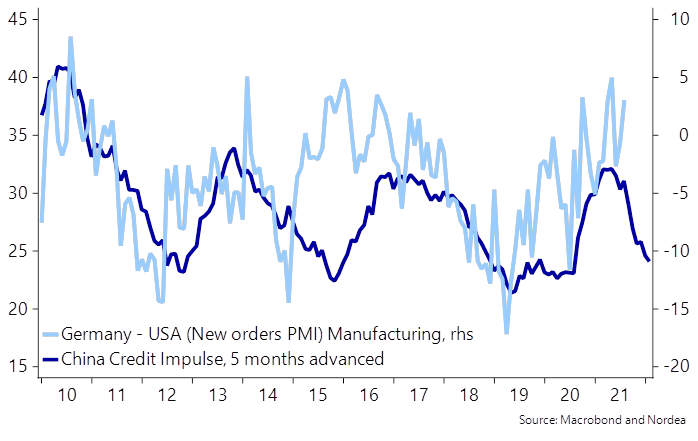
Europe (and the EUR) has more to lose from a sticky energy price crisis than the US, while China is placed somewhere in the middle. Especially German key figures will likely take a substantial beating on the combination of higher energy prices and lagged spill-overs from a slowing activity in China.
Chinas slowing economy a bigger issue for Germany than for the US
- Goldman Sachs:
In our commodity strategists’ baseline, US natural gas prices will move down over the next three months from $5.50/mmBtu to $3.65/mmBtu and oil prices should move only moderately higher (from $82/bbl to $87/bbl). But if winter is one standard deviation colder than usual, tight energy supplies could cause US natural gas prices to more than double and oil prices to rise an additional 5%.
Amazon Seeks to Hire 150,000 Seasonal U.S. Workers The push to increase workforce comes as U.S. labor market remains tight ahead of holidays.
The number of seasonal hires is more than the 100,000 Amazon announced last year and matches the number that rival Walmart Inc. said it would add this year.
The additions build on Amazon’s plans, unveiled in September, to increase its ranks of permanent employees by 125,000. The e-commerce company is also adding 40,000 people to its tech and corporate staff. (…)
Amazon had 950,000 U.S. employees and 1.3 million permanent workers world-wide as of July. (…)
Walmart said last month it is aiming to add 150,000 people to its U.S. workforce of about 1.6 million. Target Corp. wants to hire 100,000 seasonal workers and around 30,000 warehouse employees.
Shippers, whose role in holiday shopping has leapt with the rise of e-commerce, are growing, too. United Parcel Service Inc. and FedEx Corp. are planning to bring on a combined 200,000 package handlers and other workers.
In September, there were 7.7 million officially unemployed Americans, 2 million more than in February 2020. The 5 companies mentioned above seek to hire almost 800k people in the next 2 months or 40% of the apparent slack.
Vietnam Electronics, Apparel Sectors Facing 50% Worker Shortages
Electronics manufacturers nationwide are operating with a shortage of nearly 56% of workers and garment makers are facing a lack of 49.2% of employees, according to the government website, which cited labor ministry data. The leather and footwear sector reported a 51.7% worker shortage. (…)
Tens of thousands of workers began fleeing the nation’s commercial hub of Ho Chi Minh City and nearby industrial provinces of Binh Duong, Dong Nai and Long An after tough lockdowns began easing, the government said earlier this month. As many as 2.1 million workers in the industrial belt want to return to their home provinces, the government reported, citing data from the public security ministry.
The electrical equipment manufacturing sector is reporting a 44.5% shortage of employees while the textile sector says it is lacking 39.5% of needed workers, the government said.
Xi Dials Back China’s Economic Overhaul as Masses Feel Pain
(…) In recent weeks Chinese authorities have moved to soften sweeping policies designed to make the economy less dependent on debt, monopolies and fossil fuels. While Beijing’s edicts chastened China’s corporate elites, they also began showing signs of hitting ordinary citizens with higher power bills, lost savings and — if the economy continues to struggle — potentially fewer jobs.
Premier Li Keqiang expressed caution a week ago, saying China needed to rethink the pace of the country’s energy transition as a power crisis threatened to keep factories in the dark and homes without heat during the winter. (…)
The Communist Party’s Qiushi Journal on Friday published a more complete version of one of Xi’s speeches in August, which emphasized the need for “gradual and orderly progress” in achieving “common prosperity.” (…)
China Evergrande Group (3333.HK) has paid an onshore bond coupon due on Tuesday, four people with knowledge of the matter said, amid concerns about a possible offshore default by the cash-strapped developer later this week.
Hengda Real Estate Group Co, Evergrande’s flagship unit, has remitted funds to pay an onshore bond coupon of 121.8 million yuan ($19 million), the people said.
One of the people said Evergrande, China’s No. 2 developer, needs to prioritises its limited funds towards domestic market where the stakes are much higher for the country’s financial system. (…)
Sunac China (1918.HK), which has a $27.14 million payment due Tuesday, has paid its bondholders, a source with direct knowledge of the matter said. (…)
Kaisa Group (1638.HK) said on Monday it has paid a coupon due Oct. 16 and it plans to transfer funds for a coupon worth $35.85 million due Oct. 22 on Thursday. (…)
On Monday, smaller developer Sinic Holdings (2103.HK) defaulted on $246 million in bonds as expected. It had warned of the default last week, saying it did not have sufficient financial resources.
SURVEYS SAY:
An easing of Covid-19 restrictions has driven a sharp improvement in business confidence, with executives in the quarterly survey citing a strong outlook for domestic and foreign sales. A broad gauge of business sentiment reached its highest level in records going back to 2003.
Other highlights in the reports include:
- Businesses expect the supply chain issues to last until the second half of 2022
- Companies say they are likely to raise wages to address labor shortages
- Capacity pressures are widespread with a large portion of firms saying they would have difficulty meeting an unexpected spike in demand
- Canadians who accumulated savings during the pandemic expect to spend about one-third of the funds by end of 2022
- Consumer have more confidence in the labor market, with an increase in the likelihood of leaving a job voluntarily versus before the pandemic (…)


(…) CFOs rate labour shortages, the pandemic and inflation as the top risks facing their businesses. Amid growing wage and price pressures, CFO expectations for a rise in operating costs have hit a record high, with a majority of respondents also expecting a margin squeeze over the next 12 months. CFOs expect inflation to run higher for longer, with 54% expecting it to exceed 2.5% in two years’ time, well above the Bank of England’s 2.0% target rate. (…)
CFOs are also placing greater emphasis on increasing capital expenditure now than at any time in the history of the survey. The post-financial crisis period was characterised by corporate caution, with cost control and cash conservation CFOs’ primary response to economic shocks. Today, amid excess demand, and with the pandemic, the energy transition and Brexit driving change, corporates are focussing on investment, particularly in new technology. (…)
Almost six in ten CFOs reported that their businesses experienced some, significant or severe supply chain disruption over the last three months. Almost the same
proportion expect similar levels of disruption in one year’s time and meaningful improvement only in two years. (…)CFO expectations for a rise in operating costs have hit a record high. Expectations for margin growth have fallen, with CFOs, on balance, expecting margins to decrease over the next 12 months. (…)
In response to the increase in uncertainty, CFOs have sharpened their focus on defensive strategies – increasing cashflow, reducing costs and reducing leverage. (…)


If margins are contracting…who will care?
The Russell 3000 Growth Index was up 84% cumulatively over the last two years through August (more than double the return of its Value counterpart). So investors are making money on companies that make no money – never a good sign when it is done this pervasively and at these valuations. And while not common, it is also not unique. We all witnessed the same speculative behavior in the late 1990s and in the 2008 speculative bubble.
% of Russell 3000 Growth Stocks with Negative Earnings
Data through 9/30/2021 | Source: Source: GMO

Covid Cases Are Soaring in Britain Again. Why? The country’s full-speed approach to lifting restrictions has certainly contributed to a spike in infections. But that’s only part of the picture.
Once again Britain has one of the highest rates of Covid infection anywhere. The U.K. just reported its biggest single day Covid case increase in three months and a 16% increase in confirmed cases in the week to Oct. 18. The government has warned of a bad winter. (…)
Rates of hospitalization and even death are several times higher in the U.K. than in comparable European countries.
Part of the answer seems obvious: Britain reopened in July without guard rails in place. Prime Minister Boris Johnson encouraged the public to get off the pause button and hit “play.” The response was robust. During a recent commute on the London Underground during rush hour, I entered a packed rail car where hardly anyone wore a mask. Ditto for a trip to a full cinema. In Berlin, it’s routine to wear a medical grade N95 equivalent mask. You see them only seldom in London. (…)
And yet it’s too simplistic to say that Britain’s case numbers are entirely due to the government’s approach in lifting lockdown restrictions. Other countries with lax policies (Scandinavian ones, for example) didn’t experience such a spike in cases. Scotland kept a mask mandate in many indoor settings (including schools) and still struggled with a higher infection rate than England in September. This doesn’t mean masks don’t help, but it suggests they aren’t sufficient. Like in England, Scots did a lot of mixing in large groups in crowded places; Scotland saw a spike in cases when its team was still playing the Euro 2020 soccer championship and a drop when they were knocked out, while the revelry continued in England all the way to the finals.
(…) there is also the new delta variant subtype, known as AY.4.2., which began showing up around July and now accounts for about 8% of genomically sequenced cases in the U.K. Scott Gottlieb, head of the U.S. Food and Drug Administration, tweeted about the need for “urgent research” into the subtype, which is not common in the U.S. at present and is considered about 10% more transmissible than delta. (…)

Charts from NBF:


Tether’s bitcoin-backed lending clashes with dollar promise Stablecoin operator accepts crypto in return for some loans, big customer says
Alibaba Unveils One of China’s Most Advanced Chips
Alibaba Group Holding Ltd. unveiled a new server chip that’s based on advanced 5-nanometer technology, marking a milestone in China’s pursuit of semiconductor self-sufficiency.
The Chinese tech giant’s newest chip is based on micro-architecture provided by the SoftBank Group Corp.-owned Arm Ltd., according to a statement Tuesday. Alibaba, which is holding its annual cloud summit in Hangzhou, said the silicon will be put to use in its own data centers in the “near future” and will not be sold commercially, at least for now. (…)
Alibaba’s server chip is one of the most advanced by a Chinese firm yet, as it joins global rivals like Amazon.com Inc. and Google in gradually replacing silicon from traditional chipmakers like Intel Corp. and Advanced Micro Devices Inc. with products custom-designed for their data centers and workloads.
The development signals how China’s effort to build a homegrown semiconductor industry is bearing fruit. Xi Jinping’s government has made tech self-sufficiency a top national priority, setting aside billions in government funding and offering a wide range of policy support to help local firms overcome U.S. sanctions on the industry.
Alibaba is one of a number of Chinese firms that has answered Beijing’s call to invest in the development of cutting-edge technologies and manufacturing capacities. Known as Yitian 710, the Arm-based server chip is the third semiconductor introduced by the e-commerce giant since 2019, following an artificial intelligence chip as well as one used for internet-of-things. (…)