U.S. Light Vehicle Sales Turn Sharply Downward
The motor vehicle weakened significantly last month. The Autodata Corporation reported that sales of light vehicles during April declined 6.1% (-4.3% y/y) to 16.39 million units (SAAR). It reversed a 5.3% March increase and left sales at the lowest level since October 2014. (…)

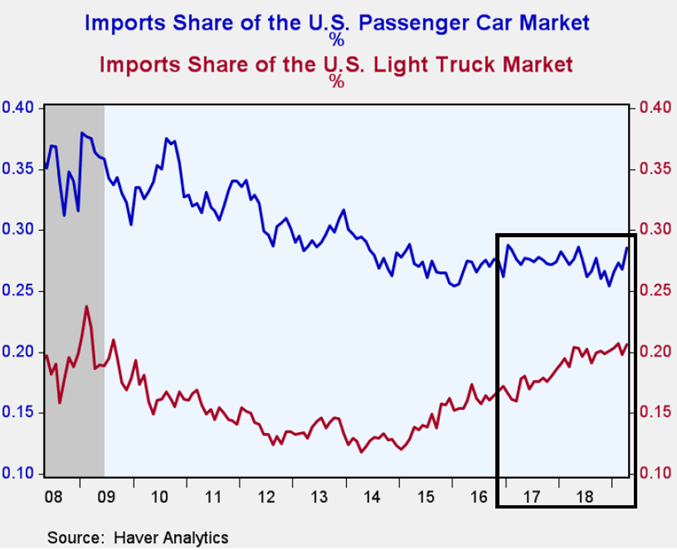
Imports share of the U.S. vehicle market rose last month to 23.0% and has been trending upward since 2015. Imports’ share of the passenger car market increased to 28.5%, an 11-month high. Imports share of the light truck market improved to 20.6%, up from a low of 13.8% in 2012.
U.S. Construction Spending Fell in March


 Public construction has spiked recently while private non-resid. has been rising at a 8.5% annualized rate in Q1.

Fed Signals Concern Over Low Inflation
Fed Chairman Jerome Powell, speaking at a news conference Wednesday, played down concerns that recent soft inflation might hint at broader economic weakness. He repeatedly highlighted individual price declines that could prove transitory and, in doing so, pushed back against some market hopes the Fed might be preparing to lower interest rates later this year.
“Overall the economy continues on a healthy path, and the committee believes that the current stance of policy is appropriate,†Mr. Powell said after officials ended their two-day policy-setting meeting. For now, “we don’t see a strong case for moving [rates] in either direction,†he said. (…)
After the officials last met in March, Mr. Powell signaled greater frustration that inflation had struggled to stay on target. But Wednesday, despite evidence that core inflation had slipped even lower, he kept a calm bearing and pointed to idiosyncratic price declines in clothing, due to methodological changes, as well as in investment-management services.
“There’s reason to think that these will be transient,†Mr. Powell said. “We of course will be watching very carefully to see that that is the case.†(…)
Mr. Powell noted that most of the central bank’s forecasting errors on inflation “are on the downside.†This creates a risk that “inflation expectations over time could be pulled down,†he added. (…)
This chart supports the “transient†case:
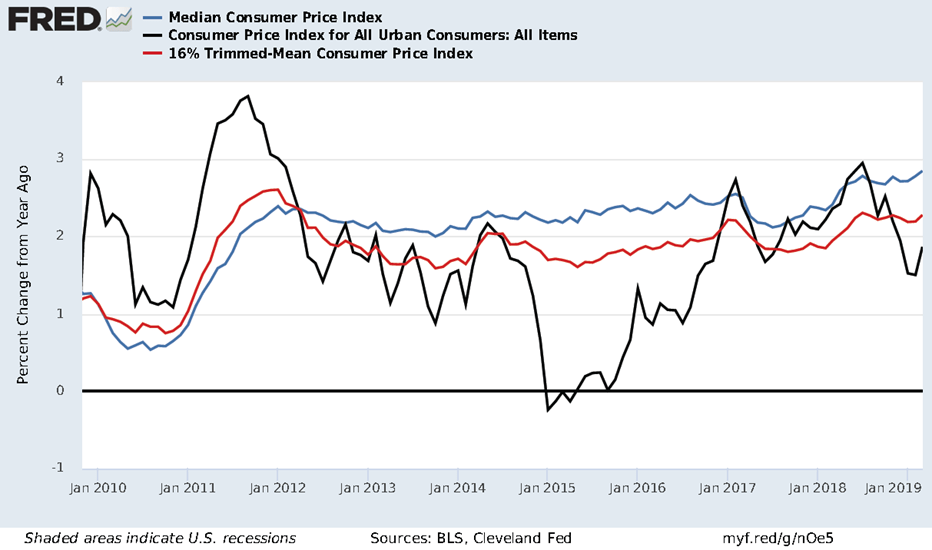
The WSJ’s Greg Ip suggests that this time may be different:
(…) The problem with this rationale is that these are only the latest of several such transient, technical surprises, all of which go in the same direction: downward. In 2017, cellphone-plan prices fell sharply because the Bureau of Labor Statistics revamped how it measures the plans’ quality and carriers began offering unlimited data. Prescription-drug prices also plummeted. Indeed, overall health care has become a less persistent source of inflation pressure, which might reflect restraint on government payments and the Food and Drug Administration’s stepped-up generic-drug approvals. (…) in March, the adoption of a new data source led to a sizable drop in clothing prices. (…)
But it might be the early signs of an innovation-driven supply-side upswing, in which innovation leads to less inflation pressure and higher output—as happened during the 1990s dot-com boom. (…)
U.S. First-Quarter Productivity Rises 3.6%, Fastest Since 2014 Productivity gains in the U.S. accelerated by more than expected last quarter.

U.S. PMI: Solid rise in new orders drives further improvement in operating conditions
Markit’s headline masks a fairly weak report.
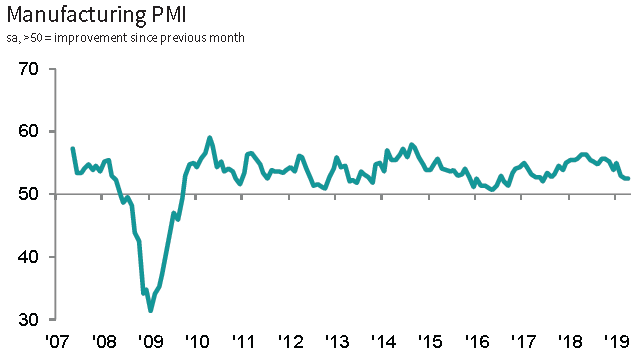
U.S. manufacturing firms registered a moderate improvement in operating conditions in April. Expansions in output and new orders picked up from March’s recent lows, with new business growth the fastest for three months. Despite a further rise in backlogs of work, the rate of job creation was the slowest since June 2017 and only moderate overall, in part reflecting skill shortages. Expectations towards the coming year were relatively subdued and down to the lowest seen so far this year. Meanwhile, inflationary pressures continued to soften for a sixth month running.
The seasonally adjusted IHS Markit final U.S. Manufacturing Purchasing Managers’ Indexâ„¢ (PMIâ„¢) posted 52.6, up slightly from March’s recent low of 52.4. This signalled that the latest improvement in the health of the U.S. manufacturing sector was the second-slowest since June 2017.
Although faster than that seen in March, the latest upturn in production across the goods producing sector was among the softest seen in the last two years and below the series trend. Nonetheless, panellists linked the sustained rise in output to a further increase in new orders and efforts to clear backlogs.
New business growth also quickened from March’s recent low in April. The solid expansion was the fastest for three months, albeit notably slower than the 2018 average. Anecdotal evidence suggested the rise in new orders was due to greater marketing activity and new product launches. Foreign client demand remained subdued, however. The marginal upturn in export sales was linked to the acquisition of new clients, but many highlighted global trade tensions and slowing foreign demand as factors dampening growth.
Although new business grew at a faster pace, the rate of job creation eased in April. The rise in payroll numbers was the softest since June 2017, in part because firms struggled to find staff and replace leavers. The slower jobs growth also reflected subdued confidence among manufacturers. Output expectations dipped to a four-month low, with panellists expressing concerns surrounding less robust demand conditions in 2019 so far.
Meanwhile, manufacturing firms registered a rise in backlogs in April. The rate of accumulation was the fastest since last November as new order growth outpaced the increase in output.
On the price front, input price inflation eased for the sixth successive month and signalled the slowest rise in cost burdens since July 2017. Subsequently, firms increased their factory gate charges at a softer pace.
Finally, both pre- and post-production inventories continued to rise in April. Manufacturing firms reportedly increased their stock holdings amid forecasts of further new order growth. At the same time, lead times for inputs lengthened to the smallest extent since June 2017 as purchasing activity increased only moderately.
From the ISM:


Meanwhile, at the U.S. main trading “partner†both domestic and export demand are weak:
(…) Manufacturing production declined for the first time in two-and-a-half years, although the rate of contraction was only modest. Reports from survey respondents suggested that the fall in output reflected a realignment of production schedules with softer client demand.
New work decreased for the second month running in April, which marked the first back-to-back fall in manufacturing sales since the beginning of 2016. Companies noted that less favourable economic conditions in both domestic and external markets had acted as a brake on new business volumes. Export orders have now decreased in four of the past five months, although the rate of decline eased since March. Manufacturers continued to suggest that a general slowdown in global trade and heightened business uncertainty had dampened customer demand. (…)
Eurozone manufacturing sector continues to contract during April
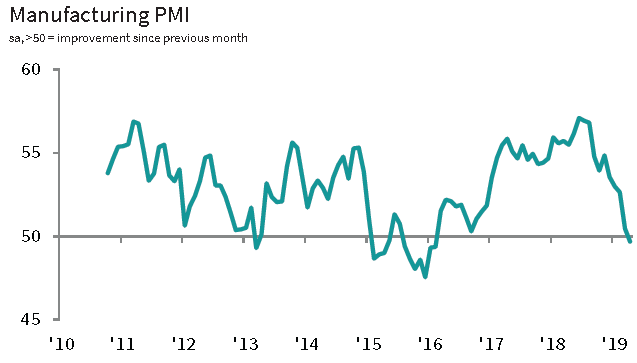
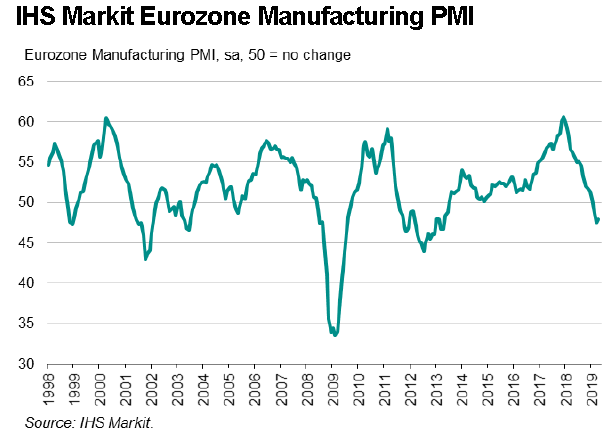
The eurozone’s manufacturing sector remained firmly in contraction territory during April. After accounting for seasonal factors, the IHS Markit Eurozone Manufacturing PMI® recorded a level of 47.9, up only marginally on March’s near six-year low of 47.5 (and little changed on the earlier flash PMI reading). The PMI has now posted below the 50.0 no-change mark for three months in succession.
In line with recent trends, the capital and intermediate goods sectors remained the principal areas of weakness in April. Both sectors remained firmly inside contraction territory, despite registering slight improvements in their respective PMI numbers. In contrast, the consumer goods sub-category continued to expand, with growth here rising to a modest level.
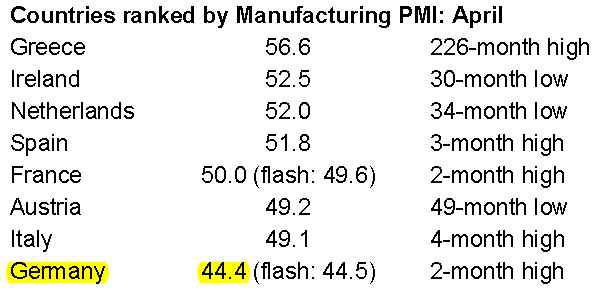
By country, it was in Germany where manufacturing operating conditions continued to deteriorate the most – and by a notable margin. Although Austria and Italy also recorded sub-50.0 PMI readings, the rates of contraction signalled were marginal and much weaker than Germany’s sharp decline. (…) Meanwhile, solid manufacturing gains were seen in Ireland, the Netherlands and Spain, whilst no change was indicated in France.
The volume of new orders received by eurozone manufacturers continued to fall in April. Whilst not deteriorating to the same degree as in March (a 75-month record), the contraction in new work was again sharp. Moreover, export orders remained a source of demand weakness. Latest data showed export orders falling at a similarly marked rate to that of total new order books.
A third successive monthly fall in production was signalled by April’s data. With the rate of contraction only modest, however, manufacturers were again able to make noticeable inroads into their backlogs of work outstanding. April’s survey showed that backlogs were reduced to the greatest degree since November 2012.
Purchasing activity was also reduced in April for a fifth successive month, with the rate of contraction matching March’s near six-year record. This helped to further alleviate pressure on vendors, which was reflected by a second consecutive monthly shortening of average delivery times. The improvement in supplier performance was also the strongest seen since August 2012.
Despite the ongoing reductions in production, orders, purchasing and work outstanding, a net increase in employment was recorded during April. Growth was, however, only marginal and trends varied by country. Whilst jobs were added at a 20-year survey record pace in Greece, there was a further net marginal fall in German manufacturing sector employment.
Input price inflation strengthened a little during April, though remained much weaker than rates seen during much of 2017 and 2018. With demand waning and competitive pressures persisting, manufacturers’ pricing power was limited. Although output charges increased over the month, they did so only modestly and at the slowest rate for nearly two-and-a-half years.
Finally, looking ahead to the forthcoming 12 months, manufacturers remained confident of a return to output growth. However, the level of optimism remained historically weak and was only slightly higher than March’s 75-month low. Notably, confidence amongst German manufacturers remained inside negative territory.
(…) The survey’s output index is indicative of factory production falling at a quarterly rate of approximately 1%, setting the scene for the goods producing sector to act as a major drag on the economy in the second quarter. (…)
Iran Oil Sanctions Set Stage for U.S.-Saudi Showdown Riyadh and Washington face a potentially weekslong showdown over the number of extra barrels the kingdom would supply to global markets to keep crude prices stable.
 Here is the US output as a percentage of the global supply. (The Daily Shot)

Source: @WSJ; Read full article
EARNINGS WATCH
We now have 305 reports in and a 76% beat rate and a significant +6.5% surprise factor with all sectors but Energy (-0.7%) contributing. Thirty of the 63 Consumer Discretionary companies have reported: beat rate 80%, surprise factor +21.4%. Twenty of the 33 Consumer Staples companies have reported: beat rate 80%, surprise factor +4.3%.
The blended growth rate is now +0.5% (+2.0% ex-E), from –2.0% on April 1. Q2e is now +1.6% (+1.7%), from +2.8%. So much for the earnings recession.
Trailing EPS are now $163.30 from $161.93 for all of 2018.
At today’s opening of 2915, the Rule of 20 P/E is 19.85.
AMERICA CURSED
Apple’s iPhone Revenue Drops 17%
(…) Profit dropped 16% to $11.56 billion for the three months through March 30, while revenue slid 5% to $58.02 billion, Apple said Tuesday.
Sales of the iPhone, long the biggest driver of its business, fell 17% to about $31 billion—an accelerated decline for a product that has been hobbled by smartphone owners holding on to devices longer and by competition from rivals in China offering lower-price, feature-rich handsets. (…)
Mr. Cook also highlighted success—especially in China—of trade-in programs added to revive iPhone sales. The company is offering customers with older iPhone models above-average prices for those devices if they exchange them for new iPhones, he said. (…)
Apple recently reduced iPhone prices in China to be more competitive with lower-price handsets from rivals like Huawei Technologies Co. and Xiaomi Corp. That bolstered sales in China during the quarter, analysts said, but iPhone shipments still fell 30% to an estimated 6.5 million units, according to Canalys, a market research firm. (…)
Operating profits down 16% is serious stuff, even more so when it means a $2.5 billion drop for the second largest weight (3.7%) in the S&P 500 Index. Apple’s sales problems in China will have an even more serious impact in the second half of the year when iPhone volume swells. Sales in China declined 21.5% YoY, “improved†from –26.7% the previous quarter but still down big time in the fastest growing market on the planet.
Apple’s gross profits declined 6.8% as margins shrank 70 bps. Raymond James analyst estimates that implied iPhone gross margins are down 500 bps since December.
Neil Shah, research director at Counterpoint Research, told CNBC
“The China market has become a zero sum game with replacement rates becoming slower in the premium end of the market and most folks are not upgrading their expensive and durable smartphones. Most of the growth is coming from mid-tier of the market where Huawei’s Honor brand, Nova series, and Oppo’s A series is doing quite well and affecting Xiaomi [and Apple],†he added.
In response to an inquiry from CNBC, Xiaomi said it had “updated its multi-brand strategy in January,†and that its “shipments of Redmi Note 7, the first product launched following the new strategy, exceeded 1 million units within one month, consolidating our leading position in the smartphone markets.â€
Dalio Says Something Like MMT Is Coming, Whether We Like It Or Not Central banking as we know it is on the way out, the investor said.
(…) Dalio, the founder of Bridgewater Associates, the world’s biggest hedge fund, said policy makers will have little choice but to embrace it.
Their challenge will be “to produce economic well-being for most people when monetary policy does not work,†Dalio said in his latest LinkedIn post. Over the past four decades, the era of central-bank dominance, income and wealth inequality has surged in most developed nations. (…)
Read the full essay here.
6 thoughts on “THE DAILY EDGE: 2 MAY 2019”
Here’s a beauty:
https://fred.stlouisfed.org/graph/?g=nOQd
FYI:
In the first place, there actually isn’t any inflation deficiency—even if the vaunted 2.00% level where an appropriate policy target, which it isn’t.
Thus, since 2012 when the Fed formally adopted the 2.00% target, the 16% trimmed-mean CPI (which eliminates the most volatile high and low change items each month) has hugged almost on top of the 2.00% line, while in all years except 2015 the PCE deflator ex-food and energy hovered between 1.5% and 2.0%.
During 2018, in fact, the trimmed-mean CPI posted at 2.132% versus prior year and the PCE deflator less food and energy came in at 1.895% over prior year. If you are keeping score at three decimal places (absurd) and average the two, the number comes in about as close as you please to target at 2.014% versus 2017.
Now, either the monetary monks at in the Eccles Tower aver that the PCE-deflator is the one and only index that can be used—among the dozens of arbitrarily measured and weighted general inflation indices that are available from the government statistical mills—or they are just forum shopping looking for an excuse to keep interest rates pressed to the floorboards.
Likewise, they already admit that monetary policy works with a 6-12 month lag (we doubt it “works” at all). So surely the annual rates of change shown below give no indication whatever that the slight, statistical misses from the 2.00% target have had any systematic trend toward the down side.
Actually, when it comes to the numerate mumbo-jumbo the Eccles Building seems to favor, the annual PCE deflator (ex-food and energy) in 2012 was 1.8966% higher than prior year and in 2018 it was 1.8945% higher. That’s four decimal places of the same thing, meaning that you really do need a magnifying glass to see any trend at all.
Finally, when you don’t have an inflation trend to the downside—even using the Fed’s preferred measures as below—the issue is reduced to the proposition that the difference between 1.5% and 2.0% of annual goods and services inflation matters, and that the central bankers are justified in leaning hard on pricing in the money and capital markets to remedy fractional shortfalls.
Except, of course, there is not a shred of proof anywhere that the tiny so-called inflation “shortfalls” shown below make any difference whatsoever when it comes to GDP growth, jobs, real incomes and wealth creation. It’s all academic gibberish and make-believe—-the modern equivalent of medieval scholars debating the number of angels that can fit on the head of a pin.
Still, that is exactly what the monetary priesthood at the Fed is doing. As we have frequently pointed out, during the entire 123 month stretch between April 2008 and November 2018, the inflation-adjusted Federal funds rate was zero or negative. …
https://www.contracorner.co/stockmans-corner/dont-cry-for-the-argentine-bond-holders-just-shackle-the-fed/
The Consumer Price Index for All Urban Consumers: All Items, Index 1982-1984=100, Seasonally Adjusted (CPIAUCSL) ==> distorts the “transient” case by adding 1982-1984 @100
IMHO, better to use all apples and not mix in oranges:
https://fred.stlouisfed.org/graph/?g=nOGp
Just wondering, do you know why the trailing EPS from Refinitiv IBES you are referring to in your post is so relatively much higher than the trailing EPS that S&P show on their website? 162ish vs 152ish?
On the S&P spreadsheet from https://us.spindices.com/documents/additional-material/sp-500-eps-est.xlsx
is currently says trailing operating earnings for 3/31/2019 is $152,24
There are many data aggregators each having their own method to account for “unusual” or non-operating profits or losses. S&P is the most conservative while Factset is the most liberal (from my viewpoint). Refinitiv/IBES is in between and has been very consistent over time. It also publishes its data almost daily. The discrepancy between S&P and IBES is mainly from “unusual” items such as writedowns/writeoffs. Both services had fairly similar numbers until 2015 when S&P treated O&G asset writedowns as operating while IBES considered them “oneoffs” like most analysts did. The gap was widest in mid-2016. It had been narrowing during 2018 but widened again in Q4 when S&P treated large pension expenses due to the market decline (mark-to-market) as operating (e.g.: AT&T, Verizon, Ford). Looking at current 2019 data, the gap will have almost closed by the end of 2019 (S&P $165.07, Refinitiv/IBES $167.10). Nothing is perfect but the middle guy seems more appropriate.
Thanks for the detailed detailed explanation 🙂
I was trying to reproduce the rule of 20 graphs for myself, and the S&P excel spreadsheet was the most easily consumable source of data for quarterly operating earnings I could find.
Comments are closed.