U.S. Light Vehicle Sales Reach New High
Total sales of light vehicles during October increased 3.0% (0.6% y/y) to 18.29 million units (SAAR), and added to September’s 4.5% gain. The latest level was the strongest since July 2005.
Pacing the increase was a 4.9% rise (7.4% y/y) in sales of light trucks to 11.02 million units after a 2.9% gain. Sales of imported light trucks increased 5.6% (10.3% y/y) to 1.76 million units following a 2.0% decline. Domestic light truck sales gained 4.7% (6.9% y/y) to 9.27 million units after a 3.8% rise. Truck sales increased m/m to 60.2% of the light vehicle market, up from 55.6% during all of last year.
Auto sales nudged 0.3% higher to 7.27 million units (-8.2% y/y) following a 6.9% jump. Imported car sales rose 0.8% (-6.8% y/y) to 1.96 million units, adding to September’s 4.4% improvement. Domestic car sales gained 0.1% (-8.7% y/y) to 5.31 million units, following the prior month’s 7.9% jump.
Imports share of the light vehicle market of 20.3% compared to 19.8% during all of last year. Imports share of the passenger car market of 27.0% compared to 27.1% during all of 2015. Imports share of the light truck market rose to 15.9% from 14.0% last year, though that was lower than the 17.5% peak in May.
Wow! 18.3 million annual rate! But Ward’s puts the total at 17.9 million as Ford’s sales had to be estimated because a fire at their headquarter delayed the release of their number. Whatever, there has been a nice recovery since the March low. A new upward trend or still plateauing? First ten months sales are up marginally. (Charts from CalculatedRisk)


Light trucks sales are particularly strong at 9.3 million, likely reflecting the renewed strength in manufacturing as yesterday’s PMI surveys revealed.

(…) Repossessions in the US hit 1.6m in 2015, the third highest level on record for data going back 20 years, falling short of the 1.8m and 1.9m peaks seen in 2008 and 2009, respectively.
That number is predicted to rise to 1.7m this year, according to Tom Webb, chief economist at Cox’s Automotive. (…)
A year ago most of the cars that Mr Neglia repossessed were from fraudulent schemes — people renting cars under a fake name and not returning them, for example. Today, he sees a larger number of individuals simply unable to repay on their loans. (…)

But so far, the risks have not turned to reality in the ABS market. Wells Fargo notes in a recent report that there have been 435 ratings upgrades across the subprime auto sector this year, and no downgrades. Borrowing costs for issuers across the subprime spectrum have also reduced through 2016 as investors continue to clamour for the relatively high returns offered by the products. (…)
U.S. Construction Activity Declines Again
(…) The value of construction put-in-place fell 0.4% (-0.2% y/y) during September following a 0.5% August dip, revised from -0.7%. The value of construction spending has been moving sideways since the middle of last year, following strong gains from 2012 through 2015. (…)


EARNINGS WATCH
- 346 companies (76.7% of the S&P 500’s market cap) have reported. Earnings are beating by 5.9% while revenues are meeting expectations.
- Expectations are for revenue, earnings, and EPS growth of 2.3%, 1.4%, and 3.5%, respectively.
- EPS is on pace for +4.9%, assuming the current beat rate for the remainder of the season. This would be +8.4% excluding Energy.
This is from RBC Capital. Thomson Reuters’ tally says EPS will rise 3.2%. Forecasts for Q4 are being trimmed almost daily. TR now sees Q4 EPS up 7.1%, down from +8.3% on Oct. 1.
Still, trailing EP are rising, reaching $116.93 yesterday (per TR), up 0.9% from Sep. 30. The Rule of 20 P/E is back to its 20.0 fair value level.

BofA Institutional Clients Sell Stocks For A Record 21 Straight Weeks Due To Soaring Redemptions
(…) According to BofA, last week, during which the S&P 500 fell 0.7%, BofAML clients were net sellers of US equities for the third consecutive week (-$0.9bn vs. -$0.4bn the prior week). Of these, institutional clients continued to lead the selling; this group has now sold US stocks for the last 21 weeks.
The reason for the relentless selling? They have no choice, as they continue to be bombarded with redemption requests by clients who can’t wait to shift from active to passive – and much cheaper – funds:
Record outflows this year from active funds—a large sub-set of the institutional client grouping—have likely been a big contributor here. (Meanwhile, passive funds have seen slowing but continued inflows this year, and we’ve seen a similar trend in BofAML clients’ purchases of ETFs—see Table 1). Hedge funds also sold stocks (for the second consecutive week), while private clients were small net sellers after three weeks of buying. Clients continued to sell both large and small caps but buy mid-caps, which are the most expensive size segment. Buybacks by corporate clients slowed slightly vs. the prior week, and month-to-date are tracking the lowest of any Oct. since 2010.
(…) Finally, putting the “smart money” selling in context, both YTD and since the start of the Second Great Depression, it almost seems like “greater fool” retail investors are still deserpately needed for the final paper-to-cash handoff.

So, the so-called “smart money” is selling but not for the smartest reasons.
Clinton Narrowly Leads Trump With Independents in New Bloomberg Poll
Face reality: Facebook’s controversies
The social-networking giant is expected to announce strong growth in its quarterly profits and sales today. Its advertising business has been on a winning streak, and its share price has risen by more than a quarter this year. Facebook now controls more than 13% of the worldwide digital-ad business (second only to Google, with 32%). But it has been dogged by a succession of controversies. In September the firm revealed that it had been overstating how much time people spent watching videos on its properties. Its policing of inappropriate content was ridiculed when one of photojournalism’s most famous shots—a naked young napalm victim from the Vietnam War—was removed. And it came under fire after revelations that advertisers can choose to exclude certain racial groups from targeted messages. All this attention just serves as a distraction for executives who are trying to build a business that will ultimately rival Google in size. (The Economist)
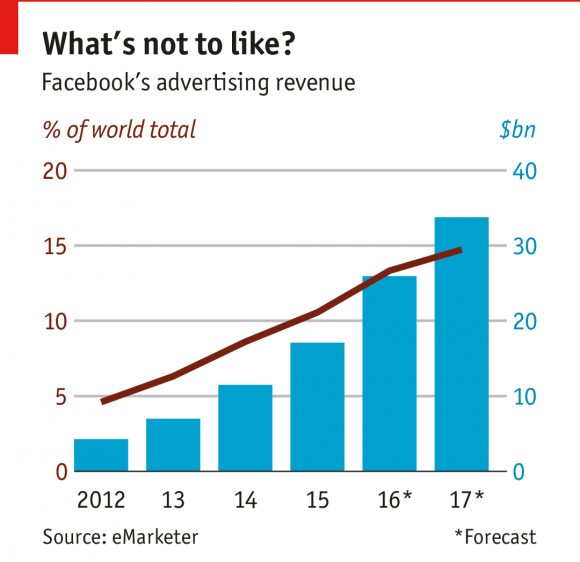
Fascinating that FB and GOOG together control 45% of the digital ad market.