U.S. Growth Slowed in Recent Months Amid Elevated Prices, Fed’s Beige Book Says Companies were burdened with supply-chain disruptions and higher costs, report shows
Many businesses said they expected higher prices and supply shortages to last another year or so. (…)
“Outlooks for near-term economic activity remained positive, overall, but some districts noted increased uncertainty and more cautious optimism than in previous months,” the report said.
One bright spot in the report was the continued rise in consumer spending, which grew in most parts of the country. Manufacturing activity also increased and residential real estate spending was flat. (…)
Employers continued to struggle finding workers, the report said, with many offering bonuses, higher wages and more training. One retailer in the St. Louis area has started raffling off a car to employees with good attendance.
Other firms have had to automate more tasks or reduce hours due to a lack of available workers. (…)
In the Philadelphia area, the end of enhanced unemployment benefits and the return to in-person schooling only produced, “at best,” a slight increase in job applicants. Many of those applicants were already considering another job offer. (…)
One Boston area furniture seller has raised prices more than 30% since February. And manufacturers there said they were seeing 10%-to-30% price increases for their inputs. Most said they raised their own prices as a result.
In the New York district “more retailers than at any time in recent years indicated that they have raised prices,” the report said. “A sizable proportion of contacts in most sectors plan to hike prices in the months ahead.”
Also in the Beige Book:
The majority of Districts reported robust wage growth. Firms reported increasing starting wages to attract talent and increasing wages for existing workers to retain them. Many also offered signing and retention bonuses, flexible work schedules, or increased vacation time to incentivize workers to remain in their positions.
This from the NY Fed: Severe Supply Disruptions Are Impeding Business Activity in the Region
Difficulty obtaining supplies was nearly universal among survey respondents, affecting about 80 percent of service firms and 95 percent of manufacturers. A large share of businesses in the region have responded to the disruptions by increasing their selling prices and scaling back their operations. (…) Of note, one in three service firms and nearly half of manufacturers characterized these difficulties as “substantial.” (…)
Almost no firms indicated any improvement in supply chain issues over the past month, while close to half of service firms and nearly two-thirds of manufacturers reported that conditions had gotten worse. When asked about their expectations for the month ahead, only around 5-7 percent said they expect the availability of supplies to improve, and about one-third of service firms and nearly half of manufacturers expect things to worsen further.
(…) among the businesses experiencing disruptions, half of service firms and two-thirds of manufacturers increased their selling prices, with more than one in ten service firms and about one in five manufacturers characterizing such increases as substantial. Price hikes were particularly widespread among construction firms, wholesalers, retailers, and transportation and warehousing firms.
More than 60 percent of affected manufacturers also said they had scaled back output, and about 30 percent of affected service firms reported reductions in business operations, with an especially large share of leisure and hospitality firms reporting reduced operations. (…)
In open-ended comments, a number of firms said they were responding to ongoing supply disruptions by building more inventories and ordering further in advance; some also indicated that they were making do with materials they were able to procure, and some found new or backup suppliers.
- Fed Official Says Lingering Inflation Could Change Interest-Rate Outlook Fed Governor Randal Quarles says he is watching for signs that higher demand will keep prices elevated even after bottlenecks abate
- Unilever warns of even higher inflation next year
(…) The maker of Dove soap and Knorr soup beat third-quarter sales growth forecasts on Thursday and kept its full-year profit margin guidance, defying some analysts’ fears of a cut. (…) a 4.1% increase in prices more than offset a 1.5% decline in volumes.
However, finance chief Graeme Pitkethly saw little let up in inflationary pressures, in a potential blow to central bankers who are hoping the current spike in prices will be transitory.
“We expect inflation could be higher next year than this year,” he said on a media call, adding it was likely to peak in the first half of 2022. (…)
Meanwhile,
Inflation Hits 4.4% in Canada, Deepening Central Bank Challenge
That’s the highest reading since February 2003, exceeding consensus expectations of 4.3% in a Bloomberg survey of economists.
On a monthly basis, inflation was up 0.2% in September. Higher food, shelter and transport prices were the main contributors. The average of the central bank’s core measures — often seen as a better gauge of underlying price pressures — ticked up to 2.67% from 2.6% in August. (…)

ING:
There is a growing risk that these price pressures become entrenched with the recent Bank of Canada quarterly business outlook survey showing 45% of businesses expecting CPI to average more than 3% in two years’ time (above the 1-3% control range where 2% is the midpoint target) while household expectations are at 3% for the same time frame. Rising energy prices are likely to keep inflation expectations elevated. (…)
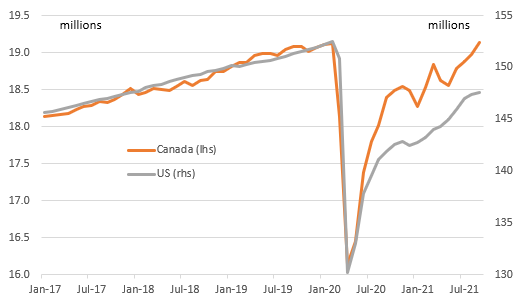
Significantly, employment is already at an all-time high with 900 more people in work in September 2021 than in February 2020 while business surveys suggest a strong appetite to continue hiring. Labour shortages are an increasing problem with 36% of companies experiencing them to such an extent that they are restricting their ability to meet demand with a net 64% of firms suggesting that labour shortages are intensifying – a record high. In an environment of vibrant demand this runs the risk that wage inflation builds and contributes to more prolonged price inflation in the economy.
Canadian jobs market has outperformed the US’
Canadian Covid cases and vaccination rates
Macrobond, ING
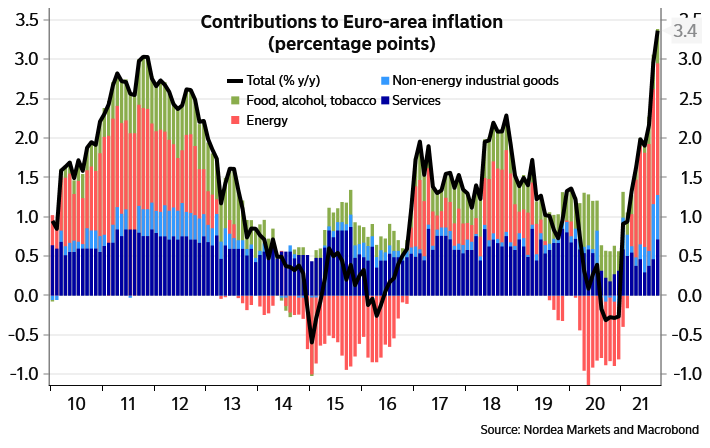
- EMU HICP Finalizes with the HICP Up 0.2% in September and by 3.5% Y/Y Inflation firing on nearly all cylinders in Europe


Nordea is more tempered:
Energy contributed almost 50% of Euro-area inflation in September
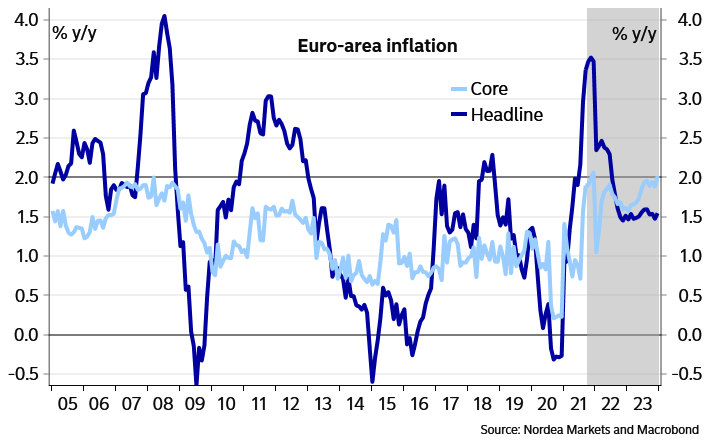
Our new core inflation forecast foresees a gradual rise towards the end of the forecast horizon
China coal futures slump as gov’t signals intervention to ease power crisis
China’s thermal coal futures fell the maximum permitted 11% on Thursday, extending losses since Tuesday when Beijing signalled it might intervene to cool surging prices that have led to a power crunch across much of the country.
China is pushing miners to ramp up coal production and is increasing imports so that power stations can rebuild stockpiles before the winter heating season, but analysts say shortages are likely to persist for at least another few months.
The state planner, the National Development and Reform Commission (NDRC), said on Tuesday it was studying ways of intervening to lower coal prices and would take all necessary steps to bring them into a reasonable range. (…)
In late October, temperatures in central and eastern regions are expected to be “significantly lower than normal,” the National Meteorological Center forecast on Thursday, adding that temperatures in some western and southern regions of the country will fall by 4 to 10 degree Celsius within the next day.

BTW:
While the expectation is that the shortfall of chips will continue to plague the [vehicle] sector into 2022, there is a new threat on the horizon —knock-on effects from China’s energy issues, which has already sent aluminum prices skyrocketing, are limiting magnesium production which is a key material that is needed for aluminum (used to increase the overall strength of the metal). Indeed, according to reporting from the FT (see China’s magnesium shortage threatens global car industry), about 85% of the world’s magnesium comes from China so shortfalls have resulted in many metal producers warning that stockpiles of the input could be depleted by the end of the year (German companies have warned that it could be even earlier… as of the end of November)
Meanwhile, John Authers looks at China’s slowing growth rates:
If we look at annualized two-year changes, to try to get around the base effects created by the Covid shutdown, the pattern of declining growth grows clearer, for both the consumer and manufacturing sectors. This chart from BCA Research Inc. shows two-year annualized growth in retail sales and industrial production:
As this chart from SocGen’s Yao shows, the property sector is unambiguously slowing — and again, to avoid base effects, this chart is on a two-year annualized basis:


EARNINGS WATCH
We now have 69 companies in (25 Financials), a beat rate of 86% (96% in Financials) and a surprise factor of +13.8% (+21.5% in Financials).
Q3 EPS are now seen up 33.0% vs 29.4% on Oct.1. Revenues seen up 14.1%, unchanged.
Q4 EPS are now seen up 22.8% vs 21.7% on Oct.1.
Trailing EPS: $194.32. 2021e: $201.35. 2022e: $220.76.
FYI: From Callum Thomas, Head of Research & Founder at Topdown Charts

Evergrande Is Struggling to Sell Homes—and Its Assets Evergrande’s difficulty in unloading even some of its best assets shows how long and painful a restructuring process could ultimately be
Barring a last-minute change of heart from the government, a formal default now seems unavoidable. Unraveling the complex web of financial links between different Evergrande assets could also further delay the company’s reorganization and add to headwinds for China’s property market. (…)
The company’s contract sales from Sept. 1 to Oct. 20 were only 3.65 billion yuan, equivalent to about $571 million, it said Wednesday. This includes the value of apartments it delivered to suppliers and contractors in lieu of repayment. That represents at least a 97% drop from last year, when its contract sales for Sept. 1 to Oct. 8 were 141.6 billion yuan.
Evergrande’s other asset-sale plans are seemingly going nowhere too. That includes its plan to sell its office building in Hong Kong [and its electric-vehicle subsidiary]. (…)
The 30-day grace period for its $83.5 million missed coupon payment of its dollar bonds last month will be up this Saturday. The government doesn’t seem likely to step in, but it may have to later if Evergrande is finding it difficult to deliver apartments it has already sold. (…)
Evergrande has won a more than three-month extension to the maturity of a $260 million bond, issued by joint venture Jumbo Fortune Enterprises and guaranteed by Evergrande, beyond Oct. 3 after agreeing to provide extra collateral, REDD reported, citing holders of the bond.
A source familiar with the matter said that Evergrande Chairman Hui Ka Yan had agreed to pump in personal wealth into a Chinese residential project tied to the bond to ensure it gets completed, paving the way for bondholders to get their dues. (…)
Statements from other property developers on Thursday exacerbated investor concerns of contagion.
Chinese Estates Holdings Ltd (0127.HK) said it would book a loss of $29 million in its current fiscal year from the sale of bonds issued by property developer Kaisa Group Holdings Ltd (1638.HK).
And Modern Land (China) Co Ltd (1107.HK) said it had ceased seeking consent from investors to extend the maturity date of a dollar bond due on Oct. 25 .
It said it plans to engage a financial adviser to come up with a solution to its liquidity issues. (…)
Investor concerns were not confined to offshore markets.
A Sept. 2023 bond from developer Aoyuan Group Co was the biggest loser of the day among corporate bonds on the Shanghai Stock Exchange, according to exchange data, falling 10% to trade at 88.65 yuan.