US Freight Railroads Reach Tentative Deals With Three Unions
(…) Railroads including BNSF Railway Co. and Union Pacific Corp. said the terms reflect the [White House appointed] mediation board’s recommendations, including a 24% wage increase through 2024, with a 14.1% increase effective immediately, according to a statement Monday by the National Carriers’ Conference Committee. (…)
After the National Mediation Board failed to carve out an agreement earlier this summer, the Biden administration formed a presidential emergency board in July to keep 115,000 rail workers across the US from striking. (…)
I bet Kashkari and other FOMC members are not happy about this labor contract. Could well railroad the Fed into higher for longer…
- U.S. Approval of Labor Unions at Highest Point Since 1965 Seventy-one percent of Americans now approve of labor unions, up from 64% before the pandemic and is the highest Gallup has recorded on this measure since 1965. The National Labor Relations Board reported a 57% increase in union election petitions filed during the first six months of fiscal year 2021.
US Rents Hit New Record as Parts of NYC Soar Past $4,000 for August
The Zumper National Rent Index shows the median national one-bedroom rent for a newly listed one-bedroom now at $1,486, up 11.8% over August 2021 — beating last month’s record high. More than half of US cities are showing double-digit rent hikes, with some over 30%.
New York City continues to be the priciest place to be a tenant, with median one-bedroom rent up 39.9% year-over-year; those with two-bedroom apartments are paying 46.7% more. Manhattan leads the boroughs, with monthly rent climbing to $4,212, up 27% over last year. In contrast, nearby Staten Island’s median one-bedroom rent is up only 5%, at $1,582. (…)
- Pace of Rent Increases Continues to Slow Higher Rents will continue to impact measures of inflation in 2022


Fed’s QT to Hit ‘Full Stride’ With Central Bank Shrinking $9 Trillion Portfolio “QT is hitting its full stride.”
The Federal Reserve’s balance-sheet unwind is set to ramp up this week, which means the central bank will finally begin unloading the Treasury bills it started amassing almost three years ago.
As part of its broader plan to reduce its $9 trillion portfolio, the Fed will boost its monthly caps for the amount of Treasuries and holdings of mortgage-backed securities that it will let mature to $60 billion and $35 billion, respectively, while using its $326 billion stash of T-bills as filler when coupons run below the monthly level. September will be the first month that bills will be redeemed since coupons will fall below the monetary authority’s new cap.
The Fed’s portfolio has $43.6 billion of Treasury coupons maturing in September, which means that officials will need to let go of $16.4 billion of bills as well. It will also need to let another $13.6 billion run off in October. These will be the largest declines for the bill portfolio until September 2023. (…)
From Almost Daily Grant’s
(…) “Shrinkage of the central bank balance sheet is not likely to be an entirely benign process,” warned a paper released at Saturday’s Jackson Hole conclave by NYU economics professor Viral Acharya, the University of Chicago’s Raghuram Rajan and Rahul Chauhan as well as Sascha Steffen of the Frankfurt School of Business.
Indeed, the aftermath of the virus-era stimulus bonanza could make for fraught trading conditions. “What I find most difficult to talk about is if you go back to last summer when the Fed insisted on doing QE, they kept talking about market liquidity as the reason to do [it],” Peter Tchir, head of macro strategy at Academy Securities, told Bloomberg Television today. “I can guarantee you that market liquidity, especially in Treasurys, is [now] way worse than last summer.” (…)
- For some investors, the withdrawal of support is a good reason to be pessimistic on this market. Greg Jensen, co-chief investment officer of Bridgewater Associates, is in that bear camp. In an interview with Bloomberg Television, he predicted that rate hikes will drive down both inflation and economic growth, sending asset markets to declines on the scale of 20% to 25%. (Bloomberg)
UK services sector downbeat in face of record costs – CBI
(…) British consumer price inflation hit 10.1% in July and the Bank of England forecasts it will peak above 13% in October, when regulated household energy bills are due to rise by 80% to an annual average of 3,549 pounds ($4,169).
Businesses sharply raised the prices they charged customers, by the most since 2006 in the consumer sector and by the most in more than 20 years for business and professional services companies, but profit margins still shrank, the CBI said.
- Goldman Warns UK Inflation Could Top 20% As Recession Nears – RTRS
- Spanish inflation slows but the retreat isn’t expected to last https://bloomberg.com/news/articles/2022-08-30/spanish-inflation-slows-but-retreat-isn-t-expected-to-last… via @alonsosotoj

Russia Curbs Gas Supply to France’s Engie as Squeeze Worsens
Europe faced a further squeeze in Russian energy supplies as Gazprom PJSC told French utility Engie SA it will reduce gas deliveries starting Tuesday because of disagreements over some contracts.
Moscow has progressively choked supplies of the fuel to Europe in retaliation for sanctions related to its invasion of Ukraine. The cutbacks, which have so far mostly targeted Germany and eastern Europe, have plunged the continent in its worst energy crisis in 50 years, sending prices soaring amid concerns about shortages during the coming winter.
The announcement follows Monday’s call from French Prime Minister Elisabeth Borne for businesses to cut energy use or face possible rationing this winter if Russia halts gas deliveries. A much higher than usual number of outages at Electricite de France SA’s aging nuclear reactors is also straining the energy market, sending gas and electricity prices in Europe to records. (…)
With more than 90% of its gas storage full, France should have enough fuel to cope with a winter with average temperatures, Engie Executive Vice President Claire Waysand said Monday. However, the situation could be tight during potential cold snaps, she added.
Reserves in the European Union were filled up to 79.4% of capacity as of Aug. 27 compared with the target of 80% by Nov. 1, according to Gas Infrastructure Europe inventory data. (…)
- Eurozone inflation forecast to stay higher for longer as gas prices surge Economists predict consumer prices will exceed 10% this year, and recession will hit bloc in 2023
Young and out of a job in China: how Covid-19 is creating an unemployment crisis Youth unemployment rate rose from 15.3 per cent in January to 19.9 per cent in July as a record 10 million university graduates entered the job market
- U.S. Business Confidence in China Falls to Record Low, Survey Says Country’s Covid-19 strategy has supplanted U.S.-China tensions as the top challenge for U.S. companies
The poll of member companies by the U.S.-China Business Council found American multinationals increasingly losing confidence in the near-term prospects for their China ventures, according to results published Monday. This year, 21% of respondents said they were pessimistic or somewhat pessimistic about their five-year business outlook in the world’s second-largest economy, compared with 9% last year.
Only around half of 117 companies polled said they were optimistic or somewhat optimistic about their own outlook in China, down 18 percentage points from the year before and the lowest since the survey began more than 16 years ago. (…)
Much of China’s stimulus spending would likely be directed toward infrastructure spending, but the concern for businesses right now is consumer sentiment in China, he added.
“Because of the zero-Covid policy, the Chinese consumer is saving more and spending less,” Mr. Allen said. “Until Chinese consumer sentiment picks up, we’re going to remain somewhat skeptical.” (…)
Almost 90% of respondents reported being profitable in 2022, and four in five members said their Chinese profit margins were the same or better than overall operations last year, according to the poll. (…)
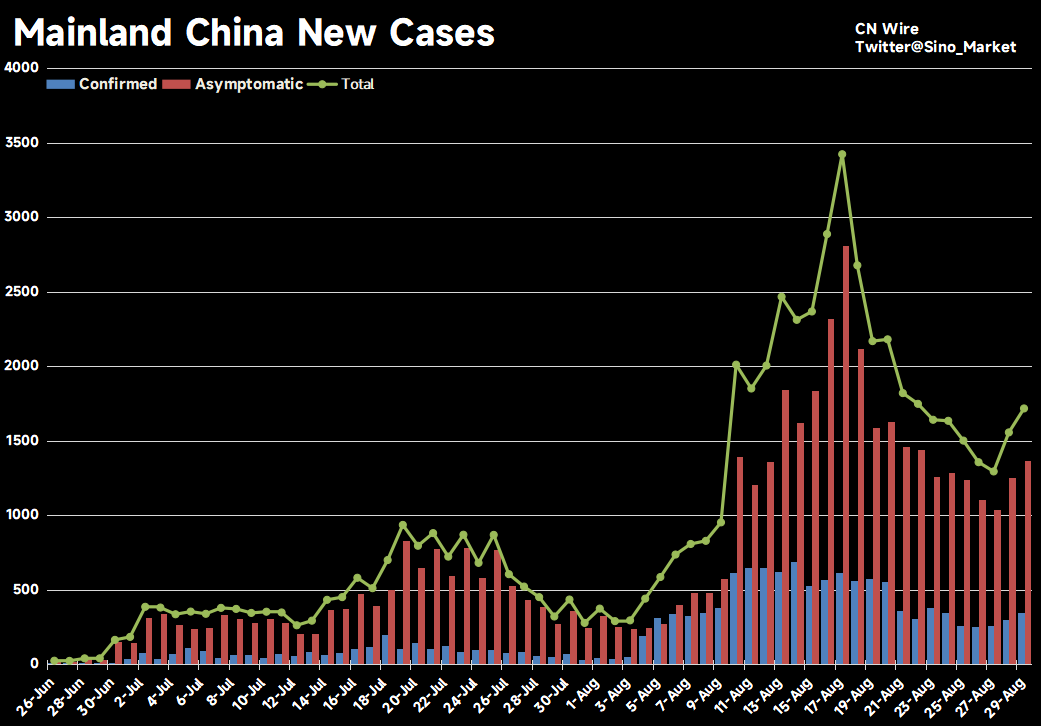
All 31 mainland provinces recorded at least one local Covid case over the past ten days, reflecting the broadest exposure to the virus since at least February 2021, when national health authorities began disclosing detailed records on where asymptomatic infections were occurring daily. (…)
“Despite a decline in headline Covid cases, the actual Covid situation in China might be worsening, as omicron has once again spread to large cities,” Ting Lu, chief China economist at Nomura Holdings Inc. wrote in a note on Monday. “Markets could once again be hit in the next couple of weeks, likely triggering another round of cuts by economists on the street,” if the cities step up their containment measures, he said. (…)
The southern technology hub of Shenzhen locked down at least six neighborhoods in two major districts, and Chengdu, one of the biggest cities in western China, closed major public venues and postponed school reopening. In the northeast, the port city of Dalian is strictly limiting movement in a handful of downtown districts for five days, with buses, subways and in-person classes halted after 15 local cases were reported for Sunday.
Restrictions are also increasing in areas around Beijing, with mass testing for the nearby port city of Tianjin, ahead of a key meeting of the Communist Party’s top leaders. (…)
@Sino_Market
Country Garden Holdings Co. said first-half earnings plunged 96%, the most since its 2007 listing in Hong Kong, as China’s property crisis engulfed the nation’s largest developer by sales.
Unaudited net profit slumped to 612 million yuan ($88 million) in the six months ended June, a filing by the Foshan-based company showed Tuesday. Core net profit, which adjusts for items including property revaluations, dropped 68%. (…)
Unlike its largest peers, Country Garden focuses on the lower end of the market, making it more vulnerable to weakening demand from homebuyers during an economic slowdown. (…)
- China’s Biggest Developer Says Property Crisis Has Yet to Bottom “The home market hasn’t entirely bottomed out, and the sector’s consolidation isn’t over,” Country Garden Holdings Co. Chief Financial Officer Wu Bijun said at an earnings briefing on Tuesday afternoon. “Property sales nationwide still haven’t stabilized.”
- Frustrated Evergrande bondholders push own plan for debt restructuring Foreign creditors say chair Hui Ka Yan should repay some of $20bn of offshore liabilities from his fortune