When Are Stimulus Checks Coming?
A House vote is expected Tuesday, to be followed shortly afterward by Mr. Biden’s signature. Here are the details on this third round of direct stimulus payments to households, which at more than $400 billion total is the largest set yet. (…)
Last year, when former President Donald Trump signed the first big relief bill in March, the bulk of direct deposits arrived within about two weeks. The second round of payments, approved in December, hit bank accounts within a few days after Mr. Trump signed them into law.
The latest payments are $1,400 per household member, including adults, children and adult dependents such as college students and elderly relatives. Adult dependents were ineligible for prior rounds of payments.
The $1,400 comes on top of the $600 approved in December, so people will be receiving a total of $2,000 between the two rounds of payments, fulfilling a Democratic promise.
A married couple with two children will receive up to $5,600. That is more than the $3,400 maximum payment in last year’s first round for that household and the $2,400 maximum from the second round. (…)
Individuals with adjusted gross income up to $75,000, heads of household with AGI up to $112,500 and married couples with AGI up to $150,000 will get the full payments. Above that, the payments phase out. (…)
Also coming shortly:
Tax Forgiveness for Student Loan Forgiveness Democrats grease the budget wheels for writing off debt by Biden decree.
(…) A Senate revision to the original House bill exempts student loans discharged through 2025 from federal income taxes. The IRS treats most cancelled debt as taxable income that must be reported in the year the discharge occurs, and this is a major obstacle to the left’s plans to issue blanket loan forgiveness by executive decree.
President Biden last year promised to cancel $10,000 per borrower. Senate Democrats are urging him to forgive $50,000 apiece, and some progressives want to cancel all $1.6 trillion in outstanding federal student debt. (…)
Biden stimulus will boost global recovery from Covid, says OECD US spending package forecast to add 1 percentage point to world’s economic growth this year

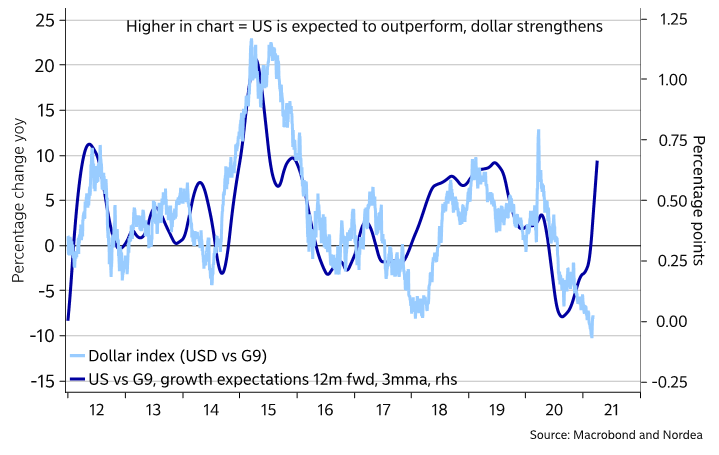
The USD is gaining momentum against most peers and we see more USD strength coming. (Nordea)
(…) And no, we do not think the liquidity trsunami unleashed by Jay and Jay-net will be enough to prevent the dollar from gaining further. For instance, the liquidity tsunami could trigger sales of US Treasuries, which would boost yields and probably be dollar-positive – even more so if higher yields crash equity markets and pop the bubble.
US growth expectations moving strongly to the USD’s advantage
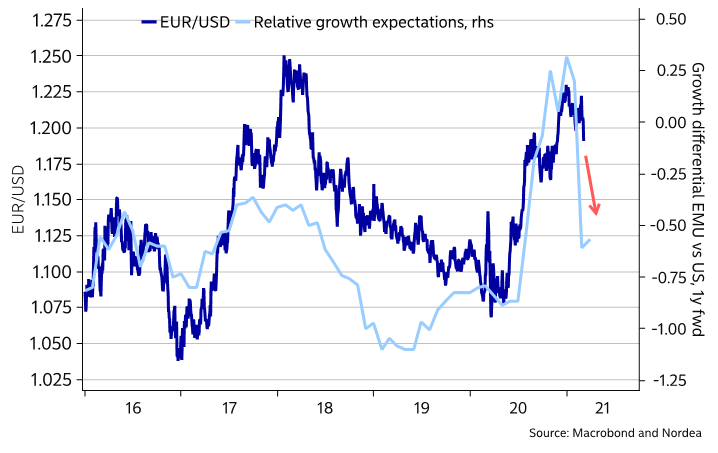
EUR/USD vs relative growth expectations – 1.13 more fair than 1.19?
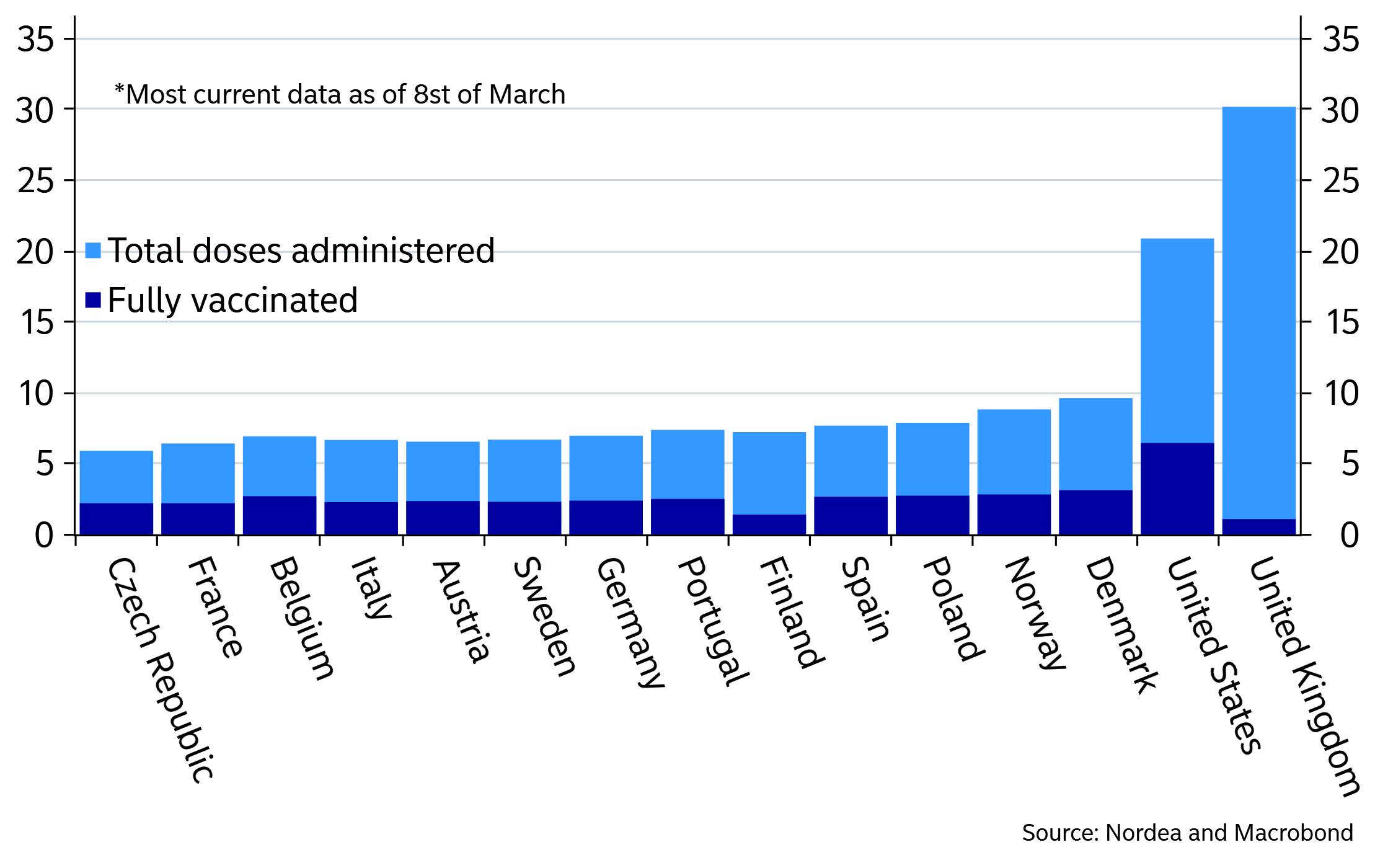
Doses administered and fully vaccinated people as percent of population
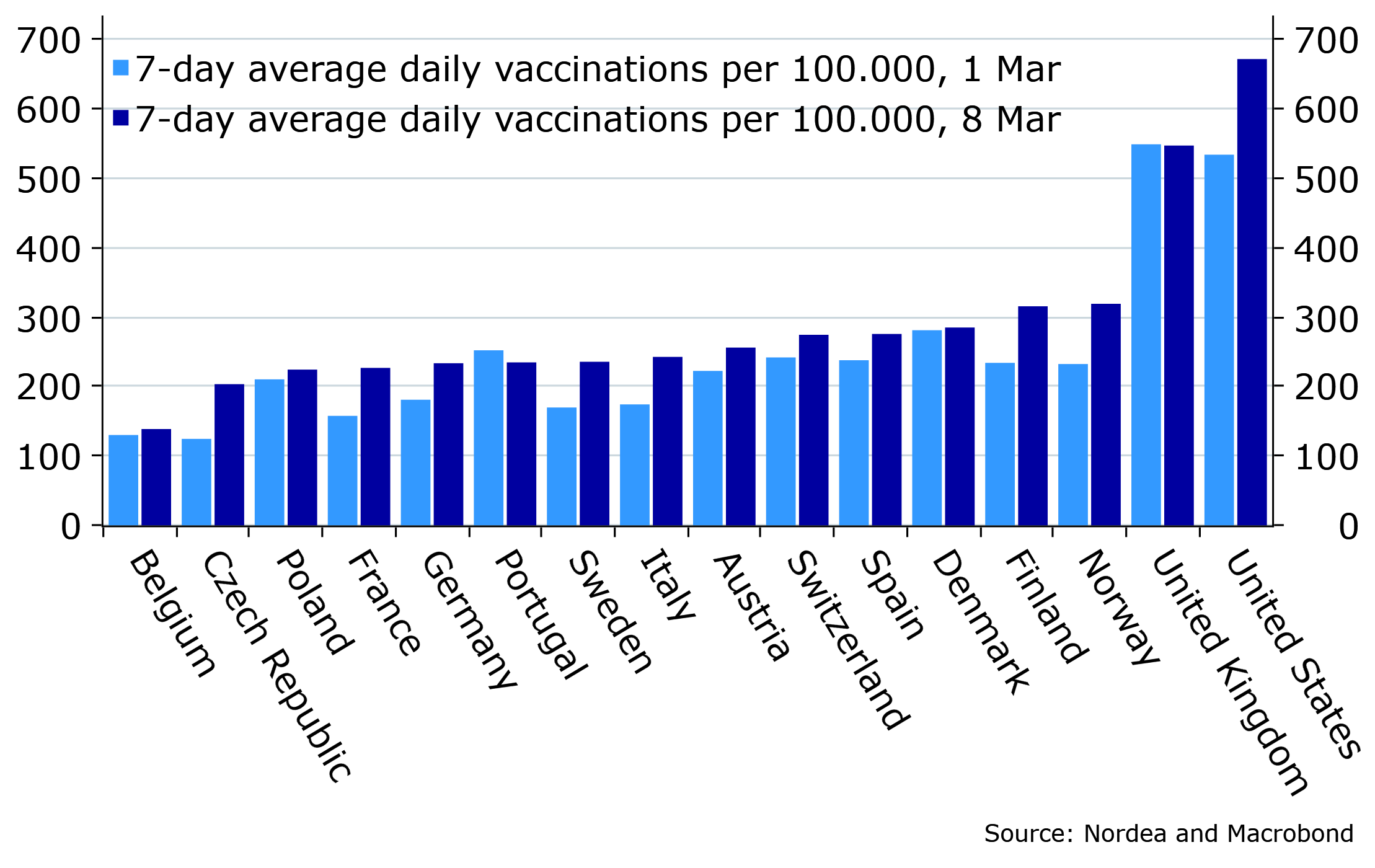
Vaccination pace

Data: CDC, Census Bureau. Chart: Andrew Witherspoon/Axios
- It looks like Pfizer and BioNTech’s Covid shot stands up to those pesky new variants. It showed a high ability to neutralize strains first detected in Brazil, the U.K. and South Africa. While the lab study needs to be validated with real-world data, it offers reason for optimism that vaccines are generally performing well against variations. (Bloomberg)
China’s Car Sales More Than Quadrupled in February Sales plunged in early 2020 when the country was in the grip of the Covid-19 pandemic.
(…) Sales plummeted 79% in February 2020 as many cities were locked down and factories and dealerships were shut.
In February, 97,000 electric cars were sold, CPCA said. That is a more-than-sevenfold increase from a year earlier, but represents a 38% decline on month. Tesla Inc. sold 18,318 Shanghai-made Model 3s and Model Ys last month, the group’s data showed.
CONSUMER WATCH
Consumers Anticipate Higher Price Growth for Rent and Gas
The February 2021 [NY Fed] Survey of Consumer Expectations shows sharp increases in the outlook for growth in the cost of rent and gas, with both series reaching new highs. The median expectation regarding changes in the cost of rent increased to 9.0 percent in February from 6.4 percent in January. Similarly, the median year-ahead expected change in gas prices jumped to 9.6 percent from 6.2 percent over the month. The short-term inflation expectation edged up to 3.1 percent, its highest level since July 2014.
Yet, spending growth expectations at 4.6% are the highest since December 2014, even though income growth is only expected at +2.4%.

MARKETS
Investors fear new Treasury auctions will set off repeat bout of selling Painful sale of 7-year debt last month sent quake through US debt market
There are $38 billion of 10-year bonds slated for sale tomorrow and $24 billion of the 30-year instrument on Thursday.
Morgan Stanley: “the Fed did expand its balance sheet by US$180 billion in February, 50% greater than its target. Yet, rates surged higher. Markets lead the Fed, not the other way around, and we are now at that moment of recognition.”
Copper/gold ratio has surged and continues to hold “up here”. One of Gundlach’s “top indicators” sees yields moving even higher.

Refinitiv (via The Market Ear)
This is a smart indicator: copper as a growth proxy, gold as an inflation proxy against LT yields:

- Not a slam dunk however:

Nasdaq Enters Correction Territory The Nasdaq dropped 310.99 points, or 2.4%, to 12609.16, extending the declines from its Feb. 12 record to more than 10%.
(…) The S&P 500 fell 20.59 points, or 0.5%, to 3821.35, pulled lower by losses in the tech, communication services and healthcare groups. In the bond market, the yield on benchmark 10-year U.S. Treasurys ticked up for the fourth consecutive session to 1.594%, its highest since February 2020, from 1.551% Friday. (…)
- Cathie Wood’s ARK Faces Test as Tech Rally Cools Big bets on unprofitable companies are causing trouble for the star stock picker’s funds
The firm’s five exchange-traded funds all have declined more than 23% since early February, stung by a sharp rise in government-bond yields. The flagship ARK Innovation ETF has suffered the steepest declines, falling 31% from its Feb. 16 high. In comparison, the Nasdaq Composite Index has dropped more than 10% over the same period. (…)
Among the factors compounding the pain for ARK are a series of highly concentrated positions, including small companies in which Ms. Wood’s firm owns a significant chunk of the stock. Bearish investors also are taking short positions to bet that ARK’s funds and some of its holdings will decline further. (…)
When investors short an ETF, shares are created by specialized investment firms known as authorized participants solely for the purpose of lending. That process involves authorized participants shorting the fund’s underlying stocks, which could be adding to the short interest in some of ARK’s holdings, Mr. Kartholl said. That can lead to increased volatility of the individual shares, he added. (…)
Bloomberg says that
Data show that Wood’s main fund recorded a small inflow on both Thursday and Friday, even as it retreated and other funds like the Ark Next Generation Internet ETF (ARKW) and the Ark Genomic Revolution ETF (ARKG) posted outflows.
Tech’s (relative) earnings problem
Tech has strongly outperformed, supported by the collapse in bond yields, as well as the relative earnings tailwind from COVID-19. A large gap has opened up between Tech price and EPS relative; with the sector’s relative performance likely to stall. Chart shows US Tech +ve to -ve EPS revisions and performance
JPM Equity strategy (via The Market Ear)

A split market, with a difference
Thanks to a big split between winning and losing securities, the HiLo Logic indexes on both the NYSE and Nasdaq have spiked to worrying degrees.
A quick correction: The Nasdaq Composite closed more than 10% from its all-time high on Monday. It took only 15 days for the index to cycle from all-time high to a correction, the 9th-fastest cycle in its history, dating to 1971. (…) the Nasdaq’s forward returns after it first fell into a correction following an all-time high was pretty mixed over the next 2-3 months.
A few times last week, we looked at the “split” in the market between winners and losers. To one of the greatest degrees in history, we’re seeing a large number of securities at 52-week highs and a large number at 52-week lows at the same time.
There is no doubt this is being heavily influenced by the sudden drop in SPACs, which have been distorting the breadth numbers for months. Whenever there is a split like this, there’s always an excuse. In prior years, the split was “only” because of bank stocks, or energy stocks, or rate-sensitive issues. The vast majority of the time, that doesn’t matter. It is what it is.
Does the influence of SPACs this time mean we should ignore the warnings? I dunno. Maybe? Trying to outsmart the indicators and guess when they matter and when they don’t has never been consistently successful.
Last week, Jay noted that this kind of split is what makes the HiLo Logic Index spike higher. The indicator is simply the lesser of 52-week highs and 52-week lows. Bull markets are typically preceded by very low readings, when everything is in gear one way or the other. Bear markets, or at least tough market conditions, tend to be preceded by times when markets are split between winners and losers. Like now.
Over the past 5 days, the HiLo Logic Indexes on both the NYSE and Nasdaq have averaged a very high reading. In recent years, this has had a mixed record, roughly preceding 3 rallies and 4 declines. Generally, if it was going to matter, then it mattered right away.
Over a long time frame, the Backtest Engine shows that anytime the NYSE figure averaged more than 2.5 over a week, forward returns were very poor. The test includes only those times when the S&P 500 was above a rising 200-day moving average at the time. The same can be said for the Nasdaq.
One of the saving graces this time is that leading up to the last week, the HiLo Logic has been extremely low. That’s because 52-week highs had overwhelmed 52-week lows, once again thanks in large part to the roaring performance of SPACs. Other times the HiLo index was very low and then spiked higher, the declines tended to be more muted.
We rate these splits as a negative, with the modest caveats that it’s being heavily influenced by one particular corner of the market, and it was preceded by very healthy internal conditions.


Chinese Stocks Slide, With a Major Index in Correction Territory China’s main stock benchmarks tumbled, erasing all of this year’s gains, as investors grappled with signs that policy makers in Beijing will take more action to rein in debt and prevent asset bubbles from forming.
(…) Top Chinese financial regulators recently warned about the risk of asset bubbles forming in domestic real-estate prices and global financial markets. Last week, Chinese leaders also indicated they could renew their focus on curbing debt levels now that the economy is on firmer footing. (…)
The CSI 300 Index closed about 2.2% lower despite evidence that state-backed funds had intervened to shore up the market in morning trading. The news earlier helped the gauge erase losses of as much as 3.2%, before declines resumed in the afternoon. (…)
The funds, known as China’s “national team,” had stepped in order to ensure stability during the National People’s Congress in Beijing, according to people familiar with the matter. A Hong Kong-based trader, who declined to be identified discussing client business, said entities linked to mainland funds were actively buying shares through stock links with Hong Kong Tuesday morning.
The CSI 300 has now plunged more than 14% from its Feb. 10 high in the biggest loss among global benchmarks tracked by Bloomberg. Declines have been led by the champions of the recent rally such as Moutai, which has fallen 26%. (…)

Japan Risks Resuming Global Economic Irrelevance After its most promising economic expansion since the early 1990s, Japan no longer seems to have a strategy to beat stagnation.
(…) Reducing interest rates any further into negative territory is pretty much a no-go, because of the deleterious effect on the profits of banks, and regional banks in particular. Having reached the end of its rope with conventional monetary policy by the time of the global financial crisis, the BOJ seems to have reached the limits of its own comfort with unconventional policy too. (…)
The missing component was fiscal support, rather than further monetary expansion. Contrary to perceptions, Japan’s budget deficit declined almost continually as a proportion of GDP through former Prime Minister Shinzo Abe’s time in office. Two poorly considered sales-tax increases worked directly against reflation efforts.
Most of the responsibility for preventing Japan from returning to the morass of nominal stagnation therefore belongs to politicians. But Japan’s central bankers need to admit that, rather than saying yet again that they believe they have the tools they need themselves. Options such as helicopter money—giving cash directly to citizens, rather than simply swapping assets with them—are of uncertain legality and would require clear cooperation from the government.
The best element of Abenomics, despite its flaws, was a degree of consensus between the Bank of Japan and the prime minister’s office on economic ambition. Without similar coordination and an honest acceptance of the limits to what the BOJ can do alone, Japan’s stagnation is likely to resume.
Lost decades you say?

This chart plots real GDP growth rates, Japan minus USA:

The growth of Japan’s economy, the globe’s third largest as measured by nominal GDP, is limited by demographic headwinds, namely a projected 30% decline in the working-age population over the 2020–2030 period. This decline can be offset to some extent by increasing labor force participation. Increased immigration would also help but is not favored thus far. Chronically weak demand, worsened by pandemic restrictions, has also been a limiting factor. (Cumberland Advisors)
From Ed Yardeni:

