December Jobs Report: Deteriorating Trend Continues
Nonfarm payroll growth registered 50K in December, a bit weaker than the consensus forecast, while revisions to job growth in the prior two months were a combined -76K. (…)
The cooling in the labor market still appears to be proceeding, but at a gradual and orderly pace. This likely will leave the FOMC on hold at its upcoming meeting on January 28. (…)
Source: U.S. Department of Labor and Wells Fargo Economics
The three-month average pace of net new job creation was -22K in December after incorporating revisions. (…)
Source: U.S. Department of Labor and Wells Fargo Economics
Wage growth finished 2025 up 3.8%, a reading that is in the “sweet spot” in our view. Average hourly earning growth is running about a percentage point faster than inflation, helping to propel growth in consumer spending, but it is not so strong that we view it as an upside risk to inflation. The solid pace of labor productivity growth over the past few years is a major help. (…)


Employers added 584,000 new jobs in 2025, about 49,000 jobs a month, on average vs 168,000 in 2024.
Private sector job gains over the past three months averaged 29k vs the 6 month average of 43k, the 2025 average of 61k and vs the 2024 average of 130k. The pre-Covid average was 177k per month. Manufacturing employment logged its eighth straight month of declines, meaning the U.S. has steadily lost 72,000 manufacturing jobs since Trump announced “Liberation Day” tariffs.

Over the three-year period since January 2023, private education and healthcare services, leisure and hospitality and government together accounted for 93% of the 5.2m jobs added in the US economy.
All other sectors, (tech, construction, manufacturing, business services, financial services, retail, transport and logistics, nearly 60% of all employment and generally the most dynamic sectors) created only 7% of the jobs during that period. In December, this group actually lost 51k jobs and has only seen one up month out of the past eight.
Private employers’ so called “no hiring-no firing” policy is making them cut the average workweek to its historical low ex-recession. Worryingly, the only two job creating private groups in 2025 significantly cut average hours since 2024 well below historical levels, actually reaching the depth of the 2009-09 recession.

Labor demand (jobs x hours) for these two groups is slowing rapidly, from +2.9% in 2024 to +2.1% in H1’25 to +1.8% in Q4’25. Hiring while reducing hours can only go so far.
The BLS revised the previous 2 months down 76k, validating Powell’s estimate that the Bureau is overestimating payrolls growth by around 60k per month. Looking over the past six months, non-farm payrolls growth has averaged just 14,500, so adjusting for Chair Powell’s assessment on the measurement error, this implies the US is losing more than 45,000 jobs per month.
This economy is not as solid as the GDP numbers suggest. Thank the 76 million baby boomers for aging…

… and spending as Ed Yardeni says that this large and growing cohort is helping bring the US savings rate down.
But a recent study by the Teachers Insurance and Annuity Association of America suggests caution on this belief:
The study finds that contrary to standard economic life-cycle theoretical models that predict gradual asset decumulation to support consumption in retirement, many retirees retain substantial financial wealth in later life.
The median retiree retains approximately 68% of their age-65 wealth by age 72, and 40% of 65-year olds increase their wealth holdings by age 72.
Financial literacy emerges as a crucial factor, with highly literate retirees beginning retirement with more wealth, decumulating more slowly, and being significantly more likely to accumulate additional assets during retirement.
Asset type matters more than overall wealth level in determining decumulation speed and patterns.
From a consumer spending viewpoint, job growth, looked at quarterly, has disappeared, and even turned negative in Q4, leaving only wages to keep labor income growth near 4.0% annualized.

Labor income growth has slowed from 5.3% YoY in the spring of 2025 to 4.3% in Q4 while inflation has crept up from 2.3% to 2.8%. Real consumer spending is thus likely slowing below 1.5% entering 2026.

In fact, wage growth could slow to or below 3% in 2026 per this KKR chart:

Three percent wage growth, stable hours and zero job gains would likely slow consumer spending near stall speed unless inflation recedes meaningfully.
Trump’s efforts to increase affordability for the mid to low classes may be politically motivated but the economy actually needs it more than most people think. Not that the measures are all smart though…
-
Trump’s $200 Billion MBS Order Asserts New Power Over Markets The purchases could exert meaningful pressure on mortgage rates.
-
Trump Blindsides Wall Street Allies With Crackdown on Housing Investors
-
The president said he would unveil more details on housing
-
The US ended the year with an effective tariff rate of more than 10% — the highest since WW2 (Financial Times)
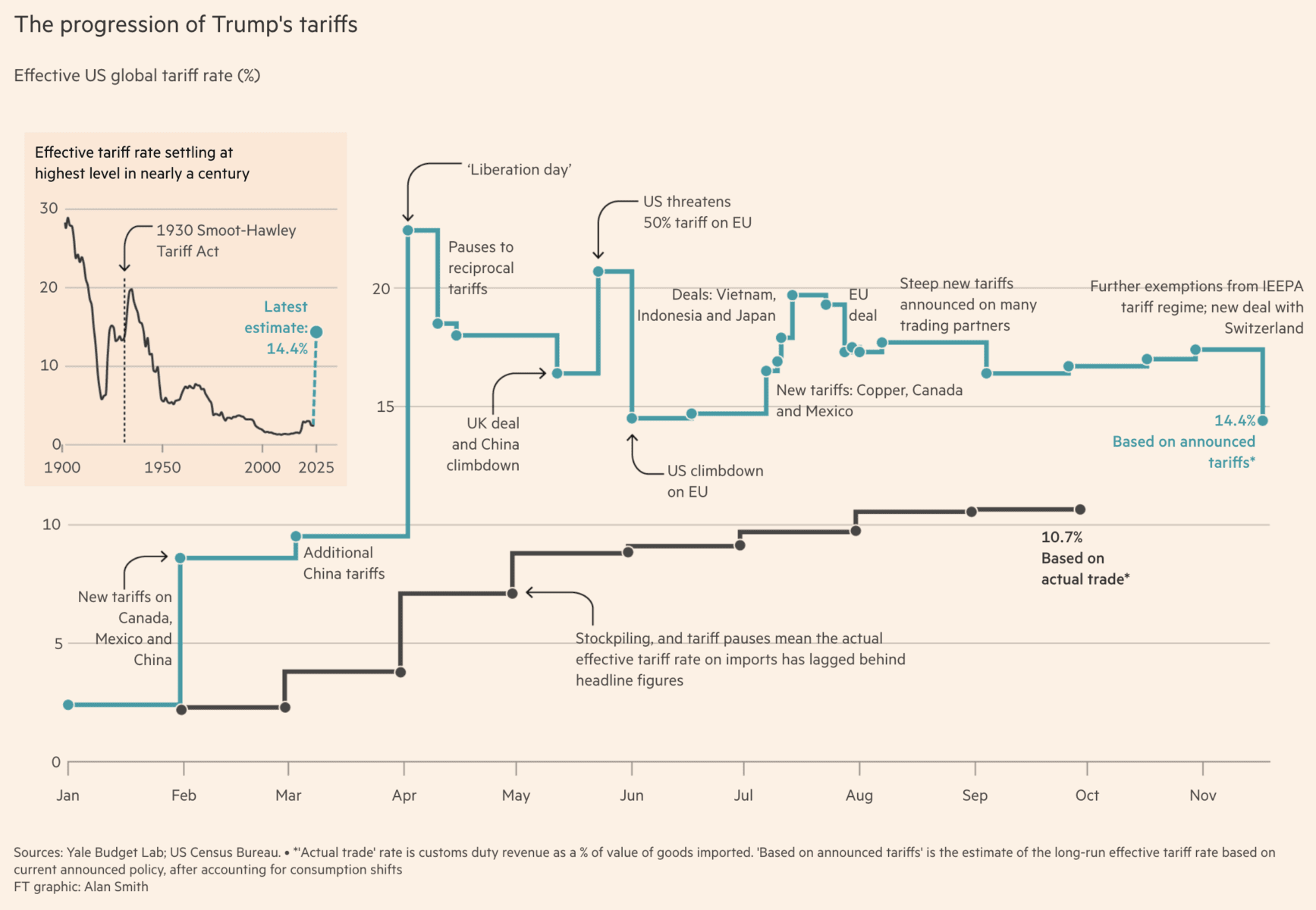
… nor usual for a truly capitalistic country.
BTW, “The US government hasn’t taken a direct stake in a healthy commercial firm since at least the 1950s. This year, it’s taken FOURTEEN, and more are on the way.” (@scottlincicome)

Trump’s Investigation of Powell Is Also a Warning to the Next Fed Chair The investigation reflects the lengths to which the president will go to control the central bank
The criminal investigation into Federal Reserve Chair Jerome Powell isn’t ultimately about the Fed’s headquarters, or Powell, or even interest rates. It’s about power. President Trump intends to take control of the central bank, no matter what the law or the courts say.
In that sense, the investigation is also a message to whoever succeeds Powell, likely either Trump adviser Kevin Hassett or former Fed governor Kevin Warsh. Both claim they will be independent. But if either sets interest rates contrary to Trump’s desires, they can expect the same treatment as Powell. That’s a powerful incentive to stay in line.
Since returning to power a year ago, Trump has steadily obliterated the lines that once separated the president from other sources of federal authority. He fired Democratic members of agencies such as the Federal Trade Commission contrary to law, sacked career officials in justice, defense and law enforcement deemed insufficiently loyal, and trampled on Congress’ authority over spending and revenue.
The Fed was an exception. Because politicians always want lower interest rates, which can lead to inflation, the Fed, by law and tradition, operates independently from the president and Congress. Presidents have pressured the Fed anyway, but usually behind closed doors, while publicly claiming to respect its independence.
Not Trump. He insists he should have some say over interest rates, and many in his administration consider independence antithetical to the president’s supreme authority over the executive branch. (…)
The Supreme Court signaled it wouldn’t allow Trump to fire Powell or any of the other six governors without cause.
Undeterred, Trump has simply sought to engineer a cause. In August he tried to fire governor Lisa Cook for alleged mortgage application misrepresentations. Cook denied the allegations and has remained on the Fed while awaiting the Supreme Court to rule on the legality of Trump’s action.
Trump made it clear his goal was to replace Cook with a loyalist in order to get control of the seven-member board of governors, who, along with five of 12 reserve bank presidents, vote on interest rates. “Once we have a majority, housing is gonna swing and it’s gonna be great,” he said at the time.
This latest attack looks similar in design and intent. “Trump wants not just lower rates, but control of the board,” Mark Spindel, a Fed historian, said Sunday. Treasury Secretary Scott “Bessent and Trump want their hands on the institution” to make more sweeping changes, such as to how the Fed supervises banks or uses its balance sheet to intervene in markets, he said.
Bill Pulte, director of the Federal Housing Finance Agency and one of Trump’s most partisan officials, kicked off the campaign attacking Powell for cost overruns on renovations to the Fed’s headquarters. The DOJ is scrutinizing Powell’s testimony to Congress on the project.
Powell said this is a pretext for his refusal to bend to Trump’s wishes. Trump denied that to NBC News Sunday. Still, it is hard to explain the ferocity with which the administration has attacked Powell any other way.
Federal projects, including Trump’s, routinely go over budget, without comparable recriminations. The price tag on Trump’s White House ballroom has already doubled, to up to $400 million from $200 million (albeit to be paid by private donors). He said before his first term that a border wall would cost $8 billion to $12 billion and Mexico would pay. Mexico didn’t pay, and more than $60 billion has now been earmarked for the project.
Legislators often complain that witnesses lie or mislead. Yet that seldom results in prosecution—especially of the administration’s own appointees.
To secure conviction, prosecutors must prove a falsehood was made “knowingly and willfully” and be “materially” false, fictitious or fraudulent.
Two former allies of Trump were accused of lying to Congress during his first term. Last year Trump pressured the Justice Department to indict former Federal Bureau of Investigation director James Comey, a Trump adversary, for lying to Congress. A federal judge dismissed the charges, ruling that the prosecutor Trump chose to bring the cases was unlawfully appointed.
It is unclear whether Powell will ultimately be indicted, much less convicted. Powell’s statement Sunday signaled he is refusing to be cowed, which means, for now, interest-rate policy shouldn’t change.
That Trump officials are going after Powell without awaiting the Supreme Court’s decision on Cook’s removal reflects their determination to break the Fed’s independence. They may succeed, even if they fail in court. The message to all Fed officials is that defying Trump is an invitation to have their backgrounds and public statements investigated for a pretext for removal. Given that, who would wish to serve? Presumably, only someone ready to deliver what Trump wants.
Bloomberg:
President Donald Trump faced immediate bipartisan pushback Sunday night after Federal Reserve Chair Jerome Powell accused the Department of Justice of launching a grand jury investigation as a pretext to pressure and intimidate the central bank.
Senator Thom Tillis, a key Republican on the Banking Committee who isn’t running for reelection, vowed to oppose any Trump nominees to the Fed until the matter is resolved.
“If there were any remaining doubt whether advisers within the Trump Administration are actively pushing to end the independence of the Federal Reserve, there should now be none,” Tillis said in a statement. “It is now the independence and credibility of the Department of Justice that are in question.”
“I will oppose the confirmation of any nominee for the Fed — including the upcoming Fed Chair vacancy — until this legal matter is fully resolved,” said Tillis, who also sits on the Judiciary Committee, which has oversight over the Justice Department.
Iran Edges Closer to a Revolution That Would Reshape the World If the uprising succeeds in toppling the Islamic Republic, it would upend global geopolitics and energy markets — with the risk of widespread chaos.
As protesters pour into the streets of Iran night after night, leaders across the region and around the world are grappling with the possibility that the Islamic Republic could be overthrown — a seminal event that would transform global geopolitics and energy markets.
The regime of Supreme Leader Ayatollah Ali Khamenei has weathered bouts of protests many times, but demonstrations that began two weeks ago are spreading — by some accounts, hundreds of thousands of people defied authorities’ threats and a brutal crackdown to take to the streets over the weekend, from the capital Tehran to dozens of other cities across the nation of 90 million.
They are being cheered on by President Donald Trump, fresh off the capture of Venezuela’s Nicolas Maduro, and the US leader has in recent days repeatedly threatened to strike Iran, suggesting that America is back in the regime change business. (…)
Brent crude surged more than 5% on Thursday and Friday to over $63 a barrel as investors priced in the possibility of supply disruptions in OPEC’s fourth-biggest producer. (…)
More than 500 protesters have been killed in the past two weeks, according to the AP, citing the US-based Human Rights Activists News Agency, and more than 10,000 have been arrested in demonstrations triggered by a currency crisis and economic collapse, but now also focused on the regime.
Authorities have tried to block the internet and telephone networks since Thursday, as they seek to quell Iranians’ growing outrage over government corruption, economic mismanagement and repression. Foreign airlines have canceled flights to the country.
Trump’s repeated warnings to Iran that the US will strike if it kills peaceful protesters come as the president escalates his assault on the post-World War II global order in a stunning assertion of American power that’s included claiming Venezuela’s oil after seizing Maduro, and threatening to take over Greenland from NATO ally Denmark.
Israel, which battered Iran during a US-assisted 12-day air war in June, is liaising closely with European governments about the situation on the ground, according to a senior European official, who asked not to be named discussing private talks.
If the regime does fall, it would be a blow to Russian President Vladimir Putin, who would lose another foreign ally after Maduro this month and the overthrow of Syria’s Bashar al-Assad just over a year ago, the official added. (…)
On Saturday, Reza Pahlavi, the son of the former shah who’s exiled in the US and positioning himself as an opposition leader, urged petroleum workers to strike. Oil strikes in 1978 were one of the death knells of his father’s monarchy because of how they immediately hit the economy. (…)
Trump may well be tempted, for all the risks, to try to topple a government that’s been an archenemy to the US and Israel for over 45 years.
“The balance of power would change dramatically,” Mark Mobius, the veteran emerging markets investor, said of the downfall of the Islamic Republic. “The best outcome would be a complete change in the government. The worst outcome would be continued internal conflict and a continuing rule by the current regime.” (…)
Iran has warned that if it’s attacked, American assets in the region — where it has deep commercial ties and tens of thousands of troops stationed — and Israel will be “legitimate targets for us.”
The Islamic Republic has been severely weakened in the past two years, thanks to its stagnating economy, rampant inflation and Israel striking both it and its proxies. But it retains a large and sophisticated arsenal of ballistic missiles able to hit targets across the Middle East, from military bases to oil installations, and the regime still has the backing of the country’s myriad security forces, including the all-important Islamic Revolutionary Guard Corps.
For the GCC and the likes of Turkey and Pakistan, the worst outcome would be chaos in Iran, said Ellie Geranmayeh, deputy program director for the Middle East and North Africa at the European Council on Foreign Relations. It’s an eventuality made more possible by the sheer diversity of Iranian protesters, who include everyone from urban, secular elites to religious conservatives and lack a unifying leader. (…)
US and Israeli strikes might even strengthen the government and reduce the appeal of the protest movement. In June, there was a surge in nationalism as the Jewish state and Washington rained down bombs.
The Islamic Republic probably won’t survive in its current form by the end of 2026, according to Dina Esfandiary, a Middle East analyst at Bloomberg Economics. The most likely scenario, she said, is a leadership reshuffle that largely preserves the system or a coup by the IRGC, which could mean greater social freedom — the organization is run by generals rather than clerics — but less political liberty and a more militaristic foreign policy.
The chances of a revolution are still fairly low, she said.
“A collapse appears unlikely for now,” she said. “Iranians are frightened of chaos, having seen it wreak havoc in neighboring Iraq and Syria. More importantly, the government is cracking down hard.”
“I don’t think a collapse of the regime would be pretty,” said Usher, the former CIA analyst. “Short-term, I could imagine some fracturing of the country as ethnic minority groups and some provinces pursue autonomy from Tehran. The IRGC will fight vigorously to save the regime so I think there’d be strong possibility for large-scale violence.”

Meanwhile in the US of A,
- Trump to The New York Times, when asked if there are any checks on his global ambitions: “Yeah, there is one thing. My own morality. My own mind. It’s the only thing that can stop me.”
- Stephen Miller to CNN’s Jake Tapper: “[Y]ou can talk all you want about international niceties and everything else. But we live in a world, in the real world, Jake, that is governed by strength, that is governed by force, that is governed by power.”
A while ago, upon the foundation of the Republic:
- “the very definition of a Republic, is ‘an Empire of Laws, and not of men.’”
- “the best republican design is the one that secures an impartial and exact execution of the laws.”
- “disorder tends to rise with despotism, where the will of one man, is the only law.”
(John Adams in in Thoughts on Government in 1776).
Abraham Lincoln took this further by proposing that “reverence for the laws” should become the “political religion” of the nation. In his Lyceum Address, he urged that this respect for law be:
-
“Breathed by every American mother to the lisping babe”
-
“Preached from the pulpit”
-
“Proclaimed in legislative halls, and enforced in courts of justice”
Lincoln warned that if the laws are ignored, the people will lose their attachment to the government, eventually welcoming a dictator who promises order.
‘Ho-Hum’ Canada Jobs Report Shows Unemployment Reverting to 6.8%
Employment rose by 8,200 in December, bringing cumulative job gains to 188,800 over the past four months, Statistics Canada reported Friday. The jobless rate, however, jumped 0.3 percentage points to 6.8%, mostly reversing a decrease the previous month.
An influx of 81,000 people into the labor force in December, the biggest jump since late 2024 and concentrated in Ontario and Quebec, helped push unemployment higher. The participation rate rose to 65.4%.
Most of the people who joined the labor force last month didn’t find jobs, pushing unemployment up by 72,900, the biggest monthly increase since August 2022.
The relatively weak report comes after three straight months of surprisingly strong job gains, which reversed steep losses over Canada’s summer months. Taken together, the data point to an economy clearly feeling the strain of the trade dispute with the US.
In total, Canada added 226,300 jobs in 2025, a 1.1% gain that was the weakest annual pace for a calendar year since 2016, excluding the pandemic. Job vacancies also fell through most of the year, pointing to softer hiring demand, the statistics agency said.
Yearly wage growth for permanent employees decelerated to 3.7%.