The Summer Sales Turned Pretty
Retail sales shot up 0.6% in August, an out-turn that handily exceeded the 0.2% increase expected by the consensus forecast. There were a few surprises in the underlying details and some reasons to take the brisk pace of spending with a grain of salt; but the bottom line is that consumer spending remains resilient in the face of tariffs and a softening labor market.
Retail sales are reported nominally or not adjusted for inflation. Consumer goods prices rose 0.5% in August, and 0.3% when excluding food and energy, suggesting a big part of the gain in sales actually stems from consumers paying higher prices rather than buying more goods last month.
Adjusting for these price effects we estimate “real” retail sales rose more like 0.2% in August, which is still good but not as strong as the nominal figures imply.
Online spending dominated the growth story in August with non-store retailers flexing a 2.0% monthly gain. In both dollar and percentage terms, online shopping grew at least twice as fast as the second place finishers in each category. E-commerce is the second-largest category of spending and recall that Prime Day fell in July which makes the August gain all the more impressive.
This all can’t be explained by an extra-strong back-to-school shopping environment either. Seasonal adjustment should account for that and the undeniable resilience of online sales likely speaks more to the fact that households may be on the hunt for value today, which could be driving more sales online rather than in store. While overall retail sales have been volatile month-to-month, online sales have now risen the past seven-straight months and are up in eleven of the past twelve months.
Auto sales were expected to come back down to earth after back-to-back monthly increases in June (+1.7%) and July (+1.2%). Instead, auto dealers saw another 0.5% monthly increase. As was the case overall, part of the gain here is explained by prices. According to the already-released CPI report new vehicle prices rose 0.3% in August. That might take some of the exuberance out of it, but even after adjusting for inflation auto sales edged higher.
We had thought the July pop in auto sales may have been a pull-forward due to tariffs, but that story does not fit so well against the reality of three consecutive monthly gains in auto sales. So while recognizing some of our concern was misplaced, the case for a fourth monthly increase in September takes more courage than we can muster.
Continuing on the theme of prices, some of the highest price gains were in gasoline (motor fuel prices up 1.8%) and building materials (tools, hardware, outdoor equipment up 0.8%). Since these two components are excluded from the control group measure (which also excludes autos and food services), we expected control group sales to come in a touch softer than the headline. In reality, control group sales came in even stronger, up 0.7% last month likely due to that outsized jump in online spending.
Source: U.S. Department of Commerce and Wells Fargo Economics
Recent consumer momentum remains intact. Our latest economic projections have real personal consumption expenditures rising at a 1.5% annualized clip in the third quarter, and detailed service-sector revenue and expense data suggest we may see some upward revisions to Q2 consumer spending.
Even as inflation remains a frustration for households, and they have grown more uneasy about the jobs market, wage growth remains supportive of spending today. The no hire, but no fire environment we’re in allows consumers to keep spending, but with questions around how steady this jobs market really is and how big tariff-induced price effects will actually be, consumers means and willingness to spend are on shaky footing. We still expect households to slow their roll in the coming months.

Nominal retail sales growth rate is back along that for labor income and total expenditures, all in the 4-5% YoY range. Back-to-school sales seem solid auguring well for the coming holidays. Note that June and July growth was revised up to +1.0% and +0.6% respectively. Total nominal sales rose 9.1% annualized rate in the last 3 months vs +2.5% in the previous 3 months.

My proxy for retail inflation jumped to +0.5% MoM in August, suggesting +0.1% real growth in total sales and +0.2% in control sales.

Strong consumer demand!!!
Yet:
NY Fed’s survey of service firms in New York, northern New Jersey, and southwestern Connecticut
Business activity fell for a seventh consecutive month in the New York-Northern New Jersey region, according to the September survey. The headline business activity index moved down eight points to -19.4, its lowest level since April.
Eighteen percent of respondents reported that conditions improved over the month while 37 percent said that conditions worsened. The business climate index remained negative at -40.7, with over half of respondents saying that the business climate was worse than normal.
The index for future business activity remained negative at –5.8, and the index for future business climate held well below zero, suggesting firms continued to be pessimistic about the outlook.
The index for future prices paid remained elevated, and the index for future prices received edged up again this month, reaching its highest level in more than three years, suggesting firms expect widespread price increases in the months ahead.

Is this NY area-specific?
US Homebuilder Sentiment Stays Low Despite Mortgage-Rate Drop
(…) This month, 39% of builders reported cutting prices, a new post-pandemic high, according to the NAHB. Meantime, a still-high 65% of builders reported using sales incentives this month. (…)
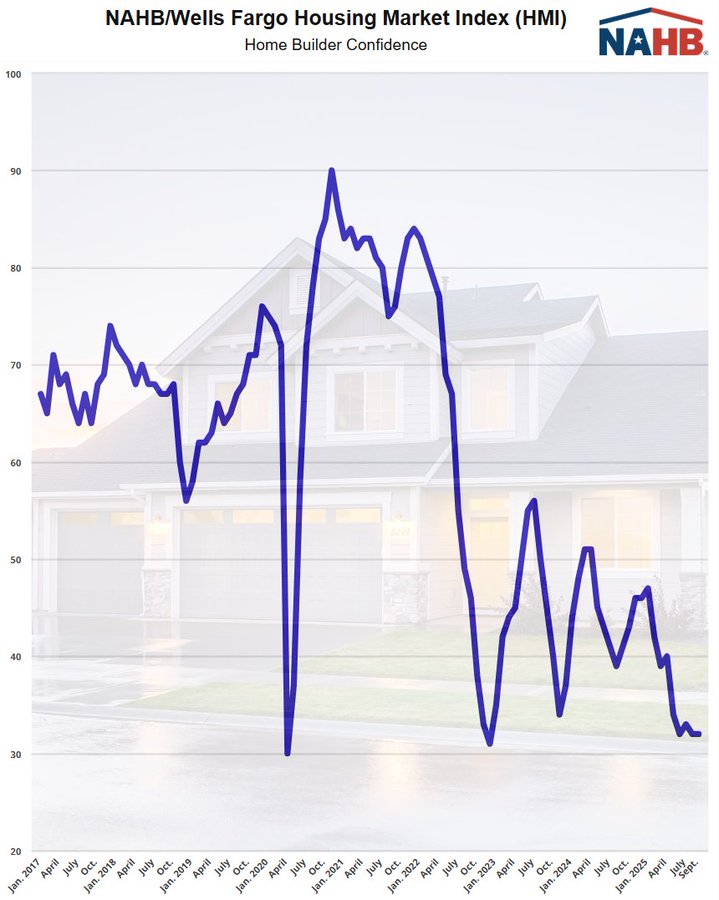
Never mind builders’ sentiment, look at the red line below. Americans are not even looking for new homes…

Import Prices Rose Unexpectedly in August Higher prices for nonfuel imports more than offset lower prices for fuel imports
Import prices were 0.3% higher on month in August after a downwardly revised 0.2% rise in July, according to the data. Economists polled by The Wall Street Journal had instead expected prices to fall 0.2%.
Import prices exclude duties, such as tariffs imposed on imports by the Trump administration, as well as transportation costs. (…)
Nonfuel import prices increased 0.4%, the largest increase since April, after being flat in July. Higher prices in August for consumer goods, nonfuel industrial supplies and materials, capital goods and automotive vehicles more than offset lower prices for foods, feeds and beverages, the report said. (…)

Meanwhile:
Nonagricultural export prices increased 0.3 percent in August, after rising 0.3 percent in July and advancing 0.6 percent in June. Higher prices for consumer goods, nonagricultural industrial supplies and materials, capital goods, and automotive vehicles drove the increase.
Nonagricultural export prices increased 3.2 percent from August 2024 to August 2025, the largest over-the-year increase since the index rose 3.9 percent for the year ended December 2022. The 12-month increase in prices for nonagricultural exports was driven by higher prices for nonagricultural industrial supplies and materials, capital goods, and consumer goods.
+4.9% annualized in the last 3 months. Demand pull or cost push?
Euro-Zone Wage Growth to Hold Below 2% Into Next Year, ECB Says
The ECB’s wage tracker, published Wednesday, predicts salaries will rise by an annual 1.8% in the second quarter of 2026 after advancing by 1.7% in the first. That’s well down on the 5.2% peak recorded at the end of 2024 and in line with the 1.8% that’s likely in the final three months of this year.
“Forward-looking information continues to indicate easing of negotiated wage growth,” the ECB said in a statement. The data suggest “lower and more stable wage growth in first half of 2026.” (…)

The Atlanta Fed Wage Growth Tracker for the US seems stuck at 4%.

Japan’s Exports Struggle Under Weight of Tariffs Exports to the U.S. fell nearly 14% from a year earlier due to weak demand for autos and chip-making machines
Exports to the U.S. fell nearly 14% from a year earlier due to weak demand for autos and chip-making machines, finance ministry data showed Wednesday. That compared with July’s 10.1% fall and marked a fifth straight month of decline
Japan’s trade surplus with the U.S. also contracted, tumbling 50.5% from a year ago.
Japanese companies have been slashing prices on cars sold in the U.S. to ease the impact of tariffs, but the shrinking volume of vehicle exports is a worrying sign that higher duties are eroding carmakers’ competitiveness in the American market.
After months of trade talks, Japan managed to get Washington to lower auto tariffs to a reduced rate that took effect Tuesday. However, automakers are still facing a much heavier burden than under the pre-Trump era.
“While auto tariffs were lowered from 27.5% to 15%, they are still a significant increase compared to the previous 2.5%. U.S.-bound auto exports will likely continue to decline in terms of volume, primarily due to a loss of price competitiveness,” said NLI Research Institute economist Taro Saito.
The volume of U.S.-bound car shipments dropped 9.5% in August from a year earlier, while the value dropped 28.4%.
Overall, Japan’s exports shrank 0.1% from a year earlier. That marked a fourth consecutive month of decline but was better than July’s 2.6% drop and economists’ expectations for a 1.9% contraction. (…)
US Industrial Production Edges Up After Falling in Prior Month
The 0.1% increase in production at factories, mines and utilities followed a downwardly revised 0.4% decline a month earlier, Federal Reserve data showed Tuesday.
Manufacturing output, which accounts for three-fourths of total industrial production, rose a better-than-expected 0.2% after edging lower in July. Excluding autos, factory production ticked up 0.1%. Mining and energy extraction climbed 0.9%, while output at utilities dropped 2% — the biggest decline since March. (…)

Drugmakers Have Pledged to Invest $350 Billion in U.S. After Tariff Threat GSK and Eli Lilly are the latest to unveil plans to add to manufacturing and increase other operations in America
GSK and Eli Lilly on Tuesday were the latest multinational drugmakers to unveil plans to build new U.S. manufacturing plants and other operations, moves aimed partly at mitigating the threat of tariffs on imported medicines by the Trump administration.
So far this year, more than a dozen drugmakers have pledged to spend more than $350 billion collectively by the end of this decade on manufacturing, research and development and other functions in the U.S., a Wall Street Journal tally of company announcements showed. (…)
Lilly said Tuesday it will build a $5 billion manufacturing plant west of Richmond, Va., to make complex types of medicines known as monoclonal antibodies and bioconjugates.
These come on top of pledges from several other big drugmakers this year. Johnson & Johnson has committed to spending $55 billion over the next four years on manufacturing, research and technology in the U.S. AstraZeneca of the U.K. pledged to spend $50 billion by 2030 on new manufacturing and research capacity in the U.S.
Some of the projects were in the works before this year, aimed at bolstering domestic supply chains to mitigate the kind of cross-border disruptions drugmakers experienced during the Covid-19 pandemic.
And some of the large investment amounts drugmakers have pledged include spending on nonmanufacturing endeavors such as drug research and routine capital spending. (…)
Drugmakers hope the new U.S. spending pledges will either persuade Trump to drop potential additional tariffs on medicines, or at least limit their impact by rolling out more production in the U.S.
The U.K.’s GSK, formerly known as GlaxoSmithKline, said its plans include $1.2 billion for the construction of a new factory outside Philadelphia to make drugs for respiratory diseases and cancer, as well as technology upgrades at five existing U.S. plants. (…)
Lilly’s Virginia plant is one of four new manufacturing sites that Lilly is planning in the U.S. and part of $27 billion in new capital spending that Lilly unveiled in February. (…)
Historically, medicines have been excluded from tariffs because they are essential.
The Trump administration is conducting an investigation that could clear the way for pharmaceutical-specific tariffs. Trump has said the rates could rise over about 18 months to as much as 250%, to give companies time to reshore manufacturing.
But drugmakers have told the Trump administration they would need more time than that because it can take about five years to build a new manufacturing plant and get regulatory signoff.
Some companies have made contingency plans to mitigate the potential near-term tariff impact by stockpiling in the U.S. the main ingredients of drugs that are made elsewhere, including for popular weight-loss drugs.
By relocating manufacturing to the U.S., large drugmakers will likely mitigate the hit to their profits, analysts say.
Morningstar analysts estimated large drugmakers would see a 4% reduction in profits if they relocated some manufacturing to the U.S., versus a 7% cut if they didn’t. European-based drugmakers are more exposed because they generally have smaller U.S. manufacturing footprints, but several European companies have announced large expansions.
None of the projects mentioned by the WSJ are “relocations”. It’s nice to learn about these investment plans but we don’t know which, if any, are actually tariff related or normal capex announced for effects.
We’ll FOM See How Long the Risks Can Be Ignored Investors say stocks are overvalued and expect inflation. Yet they can’t stop buying.
(…) The latest survey of global fund managers by Bank of America Corp. shows the biggest gap between rate and inflation expectations ever:
A record 58% of those surveyed also now believe that global equities are overvalued. It’s not so long since an over-juiced stock market was reason for the Fed to hike — most famously after Alan Greenspan warned of “irrational exuberance” in late 1996 — but this time the Fed can go right ahead and cut:
Fund managers are, to be clear, fully mindful of the dangers. They now perceive a “second wave of inflation” as the biggest tail risk to the rosy scenario, followed by dollar debasement and a disorderly rise in bond yields — all of which are more likely if this rate cut proves irresponsible. A potentially damaging trade war seems to have vanished from the equation:
If this were to happen — and it’s not a base case yet — then there is still much room for capital to flow out of the US. Contrary to perception at the time, foreign investors increased their holdings of US stocks in the second quarter, according to Deutsche Bank AG. With foreign ownership at a record, the scope for a big run on the dollar if inflation were to return in full force is real:
BofA’s research suggests that the fun on the dollar earlier this year was driven more by foreigners hedging the risk of a weaker greenback, which can be a self-fulfilling prophecy, rather than full-blown capital flight. Almost nobody now sees any reason to hedge against a stronger dollar, even with the currency at its weakest in almost four years:
In the shorter term, there’s a chance of a dollar rebound, particularly if the Fed is more hawkish in its projections than expected. Longer term, rate cuts when inflation is not beaten and equities look too expensive is a hazardous proposition. People seem wide awake to those dangers, but for now they’re still filling their boots with stocks.


- The ‘Smart Money’ Is Flashing a Warning for Stocks Institutional investors may again be mistiming their full-throated support of equities.
(…) The chart’s highest stock allocation, at around 60%, was at the peak of the dot-com bubble in 2000. It dipped below 45% at the bottom of the crash in 2002, recovered to about 57% just before the 2008 financial crisis, then plunged again below 40% in the ensuing meltdown.
Most astonishing, after nearly two decades and one of the longest, nearly uninterrupted bull markets on record, institutional investors’ stock allocation is just now approaching its pre-financial crisis level. That unfortunate record makes one wonder if they’re too late again. (…)
Wall Street likes to joke that the stock market party ends when retail investors pile in, but institutional investors may be the better foil. Their peak equity allocations have coincided with the start of bear markets. They also tend to own the biggest companies because only those stocks have the capacity and liquidity to absorb large pools of capital. Perhaps it’s no coincidence that large companies are now the most expensive segment of the market. (…)

I insert the BofA chart plotting the “smart money”’s views of equity valuations during the same time frame. Who’s smart and who’s dumb?

Nir Kaissar continues:
If institutional investors have been sheepish about owning stocks in recent years, retail investors in the US certainly have not. They were net buyers of stocks during the pandemic, even during the vicious selloff in March 2020. They also bought aggressively during the tariff-induced panic in April.
“Institutions were completely on the sidelines, very conservatively positioned, and the retail investor was aggressively buying dips,” Mark Hackett, chief market strategist at Nationwide’s Investment Management Group, told MarketWatch recently.
Retail investors showed increasing savvy even before then. Morningstar’s annual Mind the Gap report measures the difference between the return mutual funds and exchange-traded funds achieve and what investors in those funds manage to capture. The 2019 report, which looked at the period from 2005 to 2018, showed that investors captured roughly 92% of the return from US stock funds.
In the latest report, which covers the 10 years through 2024, that number rose to 96%, presumably because investors were better able to hang on to their stocks through ups and downs. By the looks of it, the same can’t be said about institutional investors. Their equity allocations dropped significantly during the near-bear market in 2011 and the Covid pandemic in 2020, as they had in previous market declines.
Wall Street likes to joke that the stock market party ends when retail investors pile in, but institutional investors may be the better foil. Their peak equity allocations have coincided with the start of bear markets. (…)
Stop Worrying About AI’s Return on Investment Tech leaders at WSJ’s Technology Council Summit said it’s nearly impossible to measure the impact of AI on business productivity. And when we try, we’re measuring it wrong.
(…) Tech leaders at the WSJ Leadership Institute’s Technology Council Summit on Tuesday said racking up a few minutes of efficiency here and there don’t add up to a meaningful way of measuring ROI.
It’s nearly impossible to measure general productivity gains from using AI tools, some event participants said, who preferred to put their efforts on keenly tracking a few critical AI projects, or focusing on innovation.
“For the most impactful business opportunity or products, you have to use AI to really double down on innovation versus productivity,” Sophia Velastegui, board director of BlackLine and former chief AI technology officer at Microsoft, said at the event.
Even in software engineering—where productivity gains are generally considered more straightforward—measurements like the amount of code written by AI don’t necessarily equal a more efficient workforce, tech leaders said.
“Everything you can measure is kind of a proxy, but not the real thing, and anything you actually care about you can’t measure,” Severin Hacker, co-founder and chief technology officer of language-learning app Duolingo, said at the event.
Plus, most AI projects are still in the proof-of-concept stage, which is designed to explore what’s possible, not drive a return on investment. Few of those projects will make it past that stage, which is to be expected from a process designed to winnow out all but the best ideas.
“One cannot expect significant productivity gains at the pilot level or even at the company unit level. Significant productivity improvements require achieving scale,” Lareina Yee, senior partner and director at the McKinsey Global Institute, said in April.
Instead of worrying about driving ROI off AI pilots, companies should focus on identifying a handful of the most promising AI projects, and make sure that their organizational structures, talent, governance and data infrastructure are up to the task of scaling them.
Only after an AI project scales, or expands across an entire organization, will most corporate technology leaders be able to determine the technology’s true ROI, some experts say.
The other way of measuring AI’s return on investment is to use a top-down method, asking technology leaders to set business goals for the technology from the start, and then determining if AI—or some other technology—can help reach them.
In line with that approach, corporate tech leaders are starting to centralize management of their AI initiatives at the top level rather than letting all employees freely experiment with the technology, some participants at Tuesday’s event said.
Mandating or forcing too much AI experimentation across a company can lead to “using AI for AI’s sake,” Hacker, Duolingo’s CTO said.
But getting rid of AI experimentation—especially while the technology is still developing—can come at the cost of encouraging innovation from all parts of a company, said Bryan Goodman, Ford’s director of AI.
“It’s really important to balance the focus on a few key areas with experimentation and learning, and even taking some risks at times,” Goodman said at the event. “At the end of the day, that’s where value is created.”
“China tech leaders are visibly re-accelerating AI spend and product rollouts — models, robotaxis, in-house chips — while also proving they can monetize AI faster than many expected,” said Charu Chanana, chief investment strategist at Saxo Markets. (…)
China’s biggest tech companies are in the middle of a spending spree on AI, as they race against one another and against US firms to conquer a market widely expected to revolutionize how people live and work.
Total capital expenditure from major Chinese internet firms such as Alibaba, Tencent Holdings Ltd., Baidu and JD.com is set to hit $32 billion in 2025, more than doubling from $13 billion in 2023, according to a Bloomberg Intelligence report. (…)
The latest news fueling optimism was a state television report Tuesday night that China Unicom’s Sanjiangyuan data center has signed contracts to deploy AI chips from local firms including Alibaba’s chip unit T-Head. (…)
Separately, Chinese foundry SMIC’s shares jumped over 7% following a report that it is running trials on China’s first domestically produced advanced chipmaking equipment.
Encouraging signs in the US-China relationship are also helping investor sentiment. President Donald Trump said this week he will talk to Chinese leader Xi Jinping on Friday, and US and Chinese officials have reached a framework deal on keeping the TikTok app running in the US.
Investors are now looking ahead to a conference held by Alibaba Cloud later this month, where the company could offer fresh signs of how far it is progressing with AI development.
- China trials its first advanced tools for AI chipmaking SMIC tests domestically made machinery as Beijing seeks to rival US-made processors
Semiconductor Manufacturing International Corporation (SMIC) is testing a deep-ultraviolet (DUV) lithography machine made by Yuliangsheng, a Shanghai-based start-up, said two people with knowledge of the development.
The ability to produce advanced DUV machines would represent a big victory in China’s ability to overcome US controls on chip export, reduce reliance on western technology and increase the production capacity of advanced AI processors. (…)
To date, SMIC and Chinese chipmakers have relied on devices built by ASML, the dominant Dutch maker of advanced lithographic equipment, but access to new machines has been limited by US export controls over recent years. Chinese chip equipment maker Shanghai Micro Electronics Equipment makes less-advanced DUV machines.
China also continues to lack access to the best available chipmaking tools — extreme ultraviolet photolithography machines (EUV) used to make the most cutting-edge chips for companies such as Nvidia. ASML is banned from selling EUV equipment to China. (…)
The machines being tested use so-called immersion technology, similar to that employed by ASML, said people with knowledge of the effort. Chinese chipmakers rely on ASML’s DUV machines, most of them bought before the US-led export controls or second hand from other countries, to produce the country’s most advanced processors such as Huawei’s Ascend series.
SMIC is testing a 28 nanometre (nm) Chinese-made DUV lithography machine and then utilising so-called “multi-patterning techniques” to produce 7nm chips, said two people with knowledge of the development. In industry parlance, “nanometres” refer to each new generation of chip, rather than a semiconductor’s physical dimensions.
Machines such as the ones SMIC is trialling could also be pushed to produce 5nm processors at a lower yield, but not any more advanced products.
By contrast, Taiwan Semiconductor Manufacturing Corporation (TSMC) will start mass-producing cutting-edge 2nm chips using ASML’s latest EUV equipment later this year. EUV remains the more challenging bottleneck to overcome in order to produce the chips that can take on market leader Nvidia.
Shenzhen-based SiCarrier, listed as Yuliangsheng’s shareholder on company registry, is among companies dedicating resources to making EUV machines, but these efforts remains in the early stages, according to the people. (…)
The EUV project has an internal code name of “Mount Everest”, people with knowledge of their efforts said.
Chinese chipmakers, led by SMIC, are seeking to triple their output in 2026, the FT reported last month. Most of this capacity increase will still use earlier stocked up DUV machines from ASML, while the domestic tools are being tested to start mass production as early as 2027, the people said.
“It is one thing to have a prototype of a lithography machine, it is another thing to put it into volume production and make it compete with ASML.,” said Bernstein’s Lin. “This could take another few years.”
China Orders Firms to Stop Buying Nvidia AI Chip, FT Says
China’s internet watchdog has instructed companies including Alibaba Group Holding Ltd. and ByteDance Ltd. to terminate orders for Nvidia Corp.’s RTX Pro 6000D, the Financial Times reported, citing people with knowledge of the matter.
The Cyberspace Administration of China told companies this week to stop testing the chip and cancel existing orders, the FT reported. Before that diktat, several companies indicated they would order tens of thousands of the product, which Nvidia introduced to get around restrictions on the shipment of advanced AI chips to China, the FT said.
Such a move would mark an escalation of Beijing’s campaign against the use of Nvidia’s accelerators, essential to AI development but largely banned from the world’s largest semiconductor arena. It would follow instructions handed down over the summer pushing firms to avoid using the H20, the lower-end chip that the Trump administration this year decided to allow Nvidia to ship to China. (…)
The RTX6000 series chip isn’t regarded as among Nvidia’s marquee products, more of a high-end card designed specifically for the restricted Chinese market. (…)
Companies like Alibaba and Baidu Inc., keen to reduce their reliance on foreign chips, are developing their own homegrown alternatives. Alibaba has secured a high-profile customer in China’s No. 2 wireless carrier for its “T-Head” AI chips, suggesting the Chinese tech leader’s nascent semiconductor efforts are gaining traction in its home market.
Obviously, if Beijing bans certain chip imports it’s because its companies no longer need them.
Alibaba Group Holding Ltd. has secured a high-profile customer in China Unicom for its AI chips, suggesting the Chinese tech leader’s nascent semiconductor efforts are gaining traction in its home market.
China’s e-commerce leader has signed a contract with the country’s No. 2 wireless carrier to deploy its Pingtouge or “T-Head” AI accelerators, according to a video posted late Tuesday by state broadcaster CCTV.
The chips will go into the mobile operator’s big new data center in northwestern China, alongside accelerators provided by rivals MetaX and Biren Technology Co. Alibaba’s shares gained 5.3% Wednesday to their highest level since 2021, joining a broad Chinese tech stock rally as investors piled into major AI-related names.
It’s unclear to what extent Unicom is deploying Alibaba chips. But the report suggests growing adoption of products emerging from its semiconductor unit T-Head, designed to compete with Huawei Technologies Co.’s Ascend series and Cambricon Technologies Corp. Alibaba, which is setting aside some 380 billion yuan ($53.5 billion) over three years on AI infrastructure, is considered a newer entrant to the field but is investing in the technology in part to wean itself off a reliance on Nvidia Corp. designs. (…)
Alibaba just released an open-source Tongyi Deep Research model — part of a panoply of AI platforms that the company has trotted out in past months to compete globally with OpenAI and DeepSeek. (…)
Unicom revealed in a separate presentation that Alibaba’s AI chip sported superior hardware specifications to Huawei’s Ascend 910B, including more advanced memory, according to CCTV. Still, Huawei is now moving to market the more powerful 910C. The Wall Street Journal reported last month that Alibaba has created its own AI chip, capable of operating AI services like DeepSeek’s R1 and its own Qwen models. (…)
Alibaba’s chip endeavor mirrors projects underway at major Chinese tech firms, which are exploring their own AI silicon with most advanced Nvidia chips banned from the country. Nvidia’s AI accelerators are considered the gold standard in training cutting-edge models from OpenAI and Anthropic. In August, Baidu Inc. said it won a 1 billion yuan contract to provide China Mobile, Unicom’s larger rival, with servers powered by its Kunlun chips.
FYI:
In July, AI startup Thinking Machines raised $2 billion in seed funding at a $12 billion valuation. Founded by OpenAI’s former chief technology officer Mira Murati, the seven-month-old outfit “has yet to reveal what it’s working on” as TechCrunch puts it. (ADG)
Thinking about it!