 Note: I am travelling until mid-May. Postings will be irregular.
Wall Street Is Watching This Shipping Data to Gauge Tariff Impact Ships, trucks and railroads are helping measure the economic blow from tariffs
(…) U.S. retailers and manufacturers have been stocking up on furniture, clothing, electronics and everything else that comes into the country by containership. That has caused a wave of containers to wash over the neighboring ports of Los Angeles and Long Beach, the main gateway for imports from China.
The pull-forward indicates that some U.S. businesses have enough inventory to last weeks or longer before having to refresh orders. Southern California port officials expect imports to fall steeply in May.
(…) China-to-U.S. bookings have declined 60% since April 9. (…)
And ocean carriers have been canceling sailings across the Pacific Ocean to the U.S. Almost 30% of such journeys were canceled for the week ended May 4, according to Flexport. At the Port of Los Angeles, imports are expected to fall 35% this week compared with a year ago. (…)
Net orders for heavy-duty trucks in North America tumbled to 16,500 vehicles in March, down 5.9% from the same month in 2024, with the highest order-cancellation rate in almost two years, according to ACT Research. (…)
ACT Research President Ken Vieth said dealer inventory levels in March hit a record 91,600 vehicles as truckers were “flirting with global financial-crisis profitability levels.” (…)
In the real world:
The Bubble Blasters and Other Chinese Goods That Are Paralyzed by Trade Chaos American importers cancel orders and scramble for alternatives, while Chinese factories cut staff and offload goods
(…) China is the source of 74% of the U.S.’s imported toys and games, 87% of its Christmas decorations, excluding candles, electric lighting and natural Christmas trees, and 97% of its fireworks, according to 2024 data from the International Trade Centre, an agency of the United Nations and the World Trade Organization.
Americans imported a total of $439 billion of goods from China last year, according to Census Bureau data. (…)
For Robert Bohrer, a California-based importer of drill press vises, calipers and other industrial metalworking products from China, the chaos started soon after Trump’s “Liberation Day” on April 2, when the president put his tariff campaign into overdrive. (…)
As his inventory dwindles, Bohrer is seeing shortages and price increases. While he and his partner used to import about one container a week, with around $100,000 worth of merchandise per container, he doesn’t have any shipments from China on the water now. On May 1, he finally had to send the email to his customers he had been hoping to avoid, telling them prices would be going up effective May 19. (…)
He has spent the past few weeks calling up contacts and trying to order goods from places such as India and Taiwan. But many products that he imports are exclusively available in China, or are significantly more expensive elsewhere, he said. (…)
“Everybody’s pretty much trying to move out of China ASAP,” said Jim Kennemer, who runs a sourcing company, Cosmo Sourcing, in Madison, Wis., that helps American companies find producers in Asia. (…)
But many are finding that non-Chinese factories are overwhelmed, or otherwise unable to handle their orders. (…)
Some products are best and most cheaply sourced from China, where many counties and cities specialize in particular categories—such as fireworks—and authorities have supported the development of exporters with policies and infrastructure. (…)
“In China, you have an entire ecosystem, from the factories, the suppliers of raw materials, the employees, infrastructure such as trains and ports all within that same region,” said Alex Armas, a Puerto Rico-based importer and manufacturer’s representative who sources seasonal decorations for U.S. and Latin American clients. He said he had seven containers-worth of orders canceled by U.S. buyers in a single day.
“People say, look for other places. I have been looking for other alternatives too for several years,” he said. Shifting to other countries takes time, and finding alternatives for some products is difficult.
George Balanchi knows all of that well. As a college student in the early 2000s, he helped his father develop a magnetic construction toy. On Yahoo, he found a Chinese factory that was able to produce the toys for a quarter the price that it cost to make them in the U.S. He started a company called Mindscope Products, and soon was also selling remote-control stunt cars and other toys to QVC. (…)
But once Trump’s China tariffs reached 54%, Balanchi had to freeze everything, not just with Chau, but also with other Chinese suppliers. He estimated that he has lost about $1 million worth of new business as customers such as QVC stop placing orders. He figured he’ll also likely lose much of the roughly $500,000 in deposits he has paid to his Chinese suppliers, including Chau. (…)
He said he would love to make his products elsewhere and even looked into moving production to Mexico a couple of years ago. But the quoted price was four times the cost of producing in China.
“My world, and everyone in my industry, whoever’s moving product, everyone’s world has been just halted,” Balanchi said. (…)
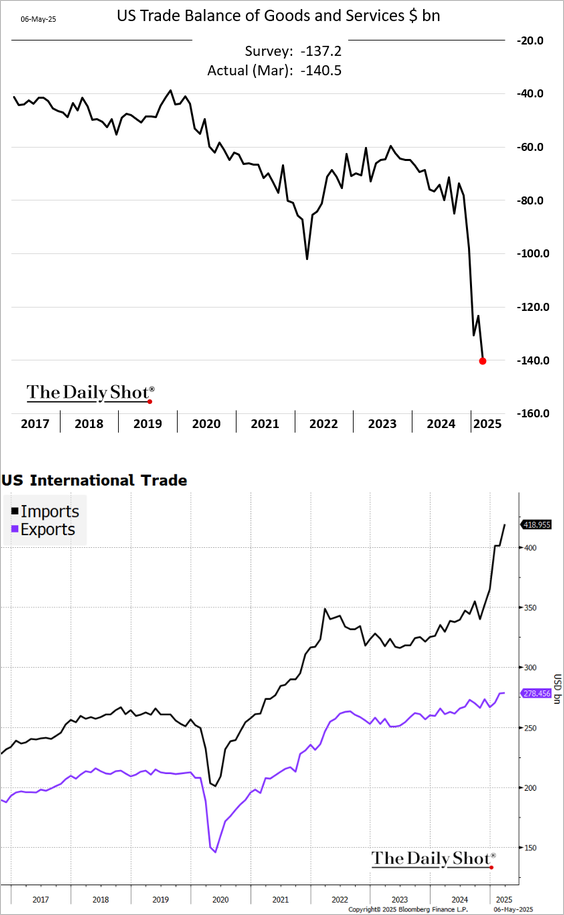
- The total US trade deficit reached a record $140.5 billion in March, driven by tariff frontrunning and weaker service exports. (The Daily Shot)
Source: @TheTerminal, Bloomberg Finance L.P.

The March international trade data released this morning in the United States certainly attracted attention, if only because the deficit reached a record high of $140.5 billion in the month.
The deterioration was driven by a sharp rise in goods imports (+5.4%), which was linked to businesses bringing forward orders to avoid the imposition of tariffs.
But another element of the report caught our attention: the sharp decline in travel services exports, which include accommodations, meals, and travel agency and education fees paid by foreign visitors to the United States. As today’s Hot Chart shows, these fell by no less than 7.1% over the month, the worst decline in nearly a quarter of a century, with the exception of the months of pandemic lockdown.
Over the last three months, the decline has been a whopping 10%. These figures confirm what airline ticket sales data had already suggested in recent weeks, namely that some travelers are now shunning the United States.
We expect this new reality to have a negative impact on production and employment in tourism-related sectors, as well as on the financial results of companies that depend on foreign visitors.

(…) Calculations from FactSet’s Geographic Revenue Exposure Database show that China makes up about 7% of total annual revenue in S&P 500 companies. Comparing the magnitude of the trade deficit with the revenue generated by S&P 500 companies in China shows that US companies made $1.2 trillion in revenue selling to Chinese consumers—about four times more than the size of the trade deficit in goods between China and the US, see chart below.
The bottom line is that if the US has to decouple completely from China, it would result in a significant decline in earnings for S&P 500 companies no longer selling products to Chinese consumers.

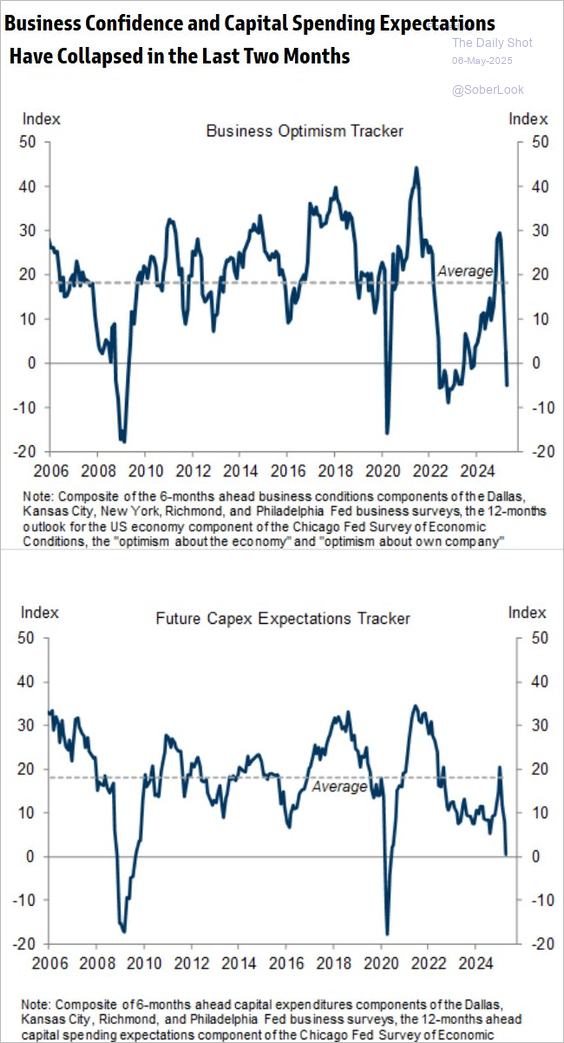
- Both business optimism and capital spending expectations have plunged, marking one of the steepest two-month declines since the pandemic. (The Daily Shot)
 Source: Goldman Sachs; @GunjanJS
Trump Downplays Trade Negotiations, Says He’ll Dictate Terms
US President Donald Trump said he would prescribe tariff levels and trade concessions for partners looking to avoid higher duties, appearing to move away from the idea that he would engage in back-and-forth negotiations.
“We’re going to put very fair numbers down, and we’re going to say, here’s — what this country, what we want. And congratulations, we have a deal. And they’ll either say ‘great,’ and they’ll start shopping, or they’ll say, ‘not good,’” Trump said Tuesday at the White House as he met with Canadian Prime Minister Mark Carney.
“It’s going to be a very fair number, it’ll be a low number. We’re not looking to hurt countries,” he added. (…)
Wage Growth Tracker Was 4.3 Percent in April
The Atlanta Fed’s Wage Growth Tracker held steady in April at 4.3 percent. For people who changed jobs the tracker increased to 4.3 percent, up slightly from 4.2 percent in March. For those not changing jobs, the Tracker held steady at 4.4 percent.

Ford Increases Prices for Certain Vehicles Amid Tariff Uncertainty Higher prices will apply to 2025 models of the Maverick, Bronco Sport and Mach-E built after May 2
(…) The carmaker said the manufacturer’s suggested retail price, which is commonly known as the sticker price, would increase between $600 and $2,000 a vehicle, depending on features, according to the memo.
Ford isn’t changing the price of any of its existing inventory or vehicles currently in transit, the memo said. (…)
Fed Warns of Rising Economic Risks as It Leaves Rates Steady Officials are puzzling over whether to focus on the risks of higher prices or weaker hiring
(…) Expectations of a rate cut at the Fed’s next meeting in mid-June declined Wednesday. Powell said officials felt like the costs of waiting to learn more about the economy were “fairly low.” He used the term “wait and see” 11 times on Wednesday.
“We don’t feel like we need to be in a hurry. We feel like it’s appropriate to be patient,” he said. “And when things develop, of course, we have a record of—we can move quickly when that’s appropriate.”
Investors broadly expect the Fed to cut interest rates by the second half of the year. (…)
“It’s not a situation where we can be pre-emptive because we actually don’t know what the right response to the data will be until we see more data,” he said. (…)
Powell repeatedly described the economy as solid. But he also offered a candid assessment when he said last year’s rate cuts were “a little late.” (…)
Eurozone Shoppers Spend Less as Tariffs Weigh on Mood March’s backslide in retail consumption came amid worsening consumer confidence across Europe
Retail trade slipped by 0.1% across the 20 nations that share the euro, defying economists’ expectations for an increase that would have built on February’s growth in sales, figures from the European Union statistics agency showed Wednesday. February remains the only month in the last six in which trade has increased.
March’s backslide in retail consumption came amid worsening consumer confidence across Europe, a result of looming U.S. trade tariffs that have spread uncertainty and pessimism across households and businesses alike. President Trump at the start of April set out a sweeping package of tariffs that included a 20% duty on all EU goods. The president later paused those levies on the EU, which he claims are reciprocal, though a 10% baseline tariff remains in place, as do sector-specific import duties on cars and some metals. Eurozone consumers’ mood fell in April to its lowest point since the end of 2023, according to an EU gauge compiled following the tariff announcement.
Weakening sales at eurozone retailers come despite lower inflation and a robust jobs market that have boosted real incomes in recent months. Annual price inflation eased to 2.2% in March and held steady in April, keeping close to the European Central Bank’s 2% target.
Sales were up 1.5% YoY.
Trump plans nuclear power push
The White House is planning executive action soon to try to speed nuclear reactors’ deployment, Daniel Moore scoops in Axios Pro: Energy Policy ($). One or more orders will likely lean heavily on the Defense and Energy Departments as a way to meet soaring energy demand.
The administration views the Pentagon — with its deep pockets, massive energy demand, and ability to absorb risks in ways the private sector can’t — as a “key enabler” for nuclear.
The plans have been in the works for weeks and could drop any day, sources said.
FYI:
- The S&P 500’s recent trajectory has converged with the historical median for 10% corrections, but the path forward increasingly hinges on recession risk. Historically, markets recover sharply in the absence of a downturn, while recession-linked corrections tend to deepen and persist. (The Daily Shot)

Source: Goldman Sachs; @WallStJesus
- GS: On the Precipice
Despite some tariff relief, resilient hard data, and easier financial conditions, our 12-month US recession risk estimate remains 45%, in part because of a big weakening in the soft data.
Our baseline is three consecutive 25bp Fed cuts, now starting in July. We are dovish on the ECB and especially the BoE, and have pushed back the next BoJ hike to January.
We have softened our assumptions on China policy stimulus, in part because growth has held up better than expected under the tariff onslaught so far.
