Gilead CEO Says Over 50,000 Remdesivir Courses Ready to Ship
Gilead Sciences Inc. Chief Executive Officer Daniel O’Day said there are more than 50,000 courses of the company’s experimental Covid-19 therapy, packed in vials and ready to ship as soon as the drug is authorized for emergency use by U.S. regulators.
He made the comments in an interview hours after the National Institute of Allergy and Infectious Diseases director Anthony Fauci said a U.S.-run trial of the drug, remdesivir, met its overall target, helping patients recover faster. The potential for the first effective coronavirus treatment sent stock markets soaring on Wednesday. (…)
The Foster City, California-based company has been working for months to increase the supply of the hard-to-manufacture drug, and has said it hopes to make enough for at least a million patients by the end of the year.
The company also shared results from a trial Wednesday showing that treating severe Covid patients for five days with remdesivir was as good as a 10-day course. The shorter course would be easier on patients and should allow the company to stretch the supply further.
The current version of the drug is infused, which would make it less convenient to use in milder patients who are not hospitalized. O’Day said Gilead scientists are devising an inhaled formulation of the drug that would allow patients to breathe the medicine directly into their lungs.
Despite the excitement, the remdesivir data is still highly preliminary. Data from the U.S.-run trial has only been shown in a press release, and none of the details have been published in a scientific journal.
And confusingly, also on Wednesday, a second smaller trial from China was published in The Lancet, showing remdesivir didn’t help patients get better, faster. That trial was stopped early after it failed to enroll enough patients. (Bloomberg)
More on this in the open FT:
-
Remdesivir: Five things to know about the antiviral drug Gilead’s potential coronavirus treatment stirs investor hopes but evidence on effectiveness is mixed
(…) Anthony Fauci, director of the NIAID, told reporters remdesivir was not a “knockout†but that he was “very optimisticâ€. Establishing that a drug can target a replication mechanism inside the virus can lead to other breakthroughs, he said. (…)
- AstraZeneca Plc agreed to make and distribute the a potential vaccine against the coronavirus pandemic that Oxford University scientists are working on. The experimental shot is already in early clinical tests and could reach late-stage trials by the middle of the year, ranking as one of the most advanced vaccine projects. Astra said in an email on Thursday it would pick up the development as well as manufacture and distribute the product.
The FT adds this: Partnership aims to build capacity to produce 100m doses by the end of the year and prioritise UK supply
1 in 6 nursing homes across nation report an outbreak The number of nursing homes publicly reporting cases of covid-19 has doubled in the past week, with more than 1 in 6 acknowledging infections among residents or staff, a Washington Post analysis found.
U.S. Social-Distancing Guidelines Set to Expire After 45 days, the federal campaign to slow the spread of the coronavirus is expected to fade away.
What if immunity to covid-19 doesn’t last? Researchers say people can catch mild, cold-causing coronaviruses twice in the same year.
(…) What the Columbia researchers now describe in a preliminary report is cause for concern. They found that people frequently got reinfected with the same coronavirus, even in the same year, and sometimes more than once. Over a year and a half, a dozen of the volunteers tested positive two or three times for the same virus, in one case with just four weeks between positive results. (…)
For the coronaviruses “immunity seems to wane quickly,†says Jeffrey Shaman, who carried out the research with Marta Galanti, a postdoctoral researcher.
Whether covid-19 will follow the same pattern is unknown, but the Columbia results suggest one way that much of the public discussion about the pandemic could be misleading. (…)
“We really don’t understand whether it is a change in the virus over time or antibodies that don’t protect from infection,†he says. (…)
Early evidence points to at least temporary protection against reinfection. Since the first cases were described in China in December, there has been no cut-and-dried case of someone being infected twice. While some people, including in South Korea, have tested positive a second time, that could be due to testing errors or persistence of the virus in their bodies. (…)
Researchers in China also tested directly whether macaque monkeys resisted a second exposure to the new coronavirus. They infected the monkeys with the virus, and then four weeks later, after they recovered, tried again. The second time, the monkeys didn’t develop symptoms, and researchers couldn’t find any virus in their throats.
What’s unknown is how long immunity lasts—and only five months into the outbreak, there is no way to know. If it’s for life, then every survivor will add to a permanent bulwark against the pathogen’s spread. But if immunity is short, as it is for the common coronaviruses, covid-19 could set itself up as a seasonal superflu with a high fatality rate—one that emerges in a nasty wave winter after winter. (…)
Big studies of immunity are already under way to try to answer those questions. Germany has plans to survey its population for antibodies to the virus, and in North America, 10,000 players and other employees of Major League Baseball are giving pinprick blood samples for study. In April, the US National Institutes of Health launched the COVID-19 Pandemic Serum Sampling Study, which it says will collect blood from 10,000 people, too. (…)
To Frieman, at the University of Maryland, all this uncertainty about immune response to coronaviruses means there’s still little chance of predicting when, or how, the outbreak ends. “I don’t know when this goes away, and if anyone says they know, they don’t know what they are talking about,†he says.
Children Don’t Pass Covid-19 to Adults, Report Indicates
Children contract the coronavirus less often and with less severity than the general population, and there doesn’t appear to be cases of a child passing Covid-19 to an adult, according to a new report.
Many infected children may stay asymptomatic, but cases of them becoming critically ill with Covid-19 remain rare, according to an analysis of global virus studies compiled by the Don’t Forget the Bubbles pediatric blog.
- A China/World Health Organization joint commission couldn’t find a single case of a child passing the virus to an adult.
- Low case rates among children may be due more to higher numbers remaining asymptomatic, rather than a lower infection rate.
- Analysis of Chinese data in confirmed and suspected cases showed that 32% of affected children aged 6-10 years were asymptomatic. (…)
- German officials signaled there won’t be a significant further easing of restrictions on public life for at least another week as data showed coronavirus infections in Europe’s biggest economy rose the most in four days.
- About a third of patients in U.K. hospitals with Covid-19 died from the disease, according to the findings of a study of more than 16,000 people with the virus. The research, which hasn’t been peer-reviewed and has yet to appear in a scientific journal, is an early insight into the deadliness of the virus in the U.K., which has one of the highest tolls from the pandemic in Europe
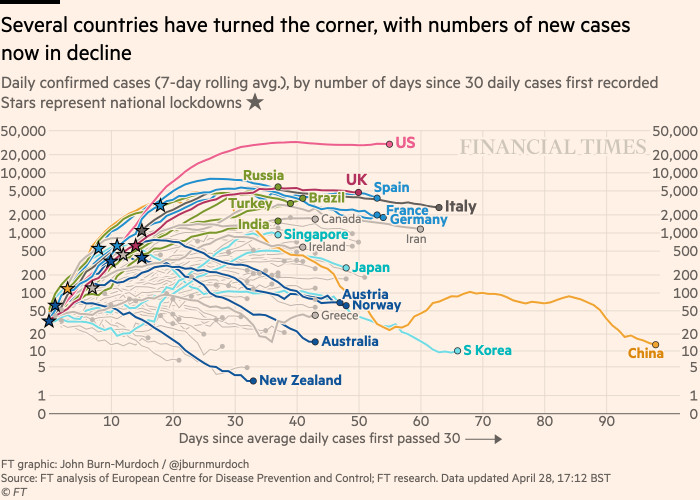
- South Korea reports no new local coronavirus cases
- Singapore struggles to slash coronavirus infections
- In Russia, the number of confirmed cases rose by 7,099, the largest single-day increase to date, to 106,498. The pace of increase quickened to 7.1% from 6.2% on Wednesday.
- Los Angeles will offer free Covid-19 tests to all residents of the county regardless of their symptoms, becoming the first major U.S. city to make wide-scale tests available.
- Doctors Investigate Link Between Rare Childhood Disease and Covid-19 Doctors in Italy and the U.K. have raised the alarm over a small but growing number of children displaying symptoms of a rare blood-vessel condition known as Kawasaki disease that may be linked to Covid-19.
PANDENOMICS
China Manufacturing PMI: Operating conditions deteriorate slightly as COVID-19 pandemic weighs on demand
After broadly stabilising in March, operating conditions across China’s manufacturing sector weakened slightly in April. The recent easing of measures to halt the spread of the coronavirus disease 2019 (COVID-19) pandemic underpinned a further rise in output. However, the impact of the virus globally led to a substantial drop in export sales, which drove a further decline in total new work.
Weaker demand conditions prompted firms to reduce their staff numbers and input buying. At the same time, companies reported moderate falls in both input costs and selling prices.
The headline seasonally adjusted Purchasing Managers’ Index™ (PMI™) slipped from 50.1 in March to 49.4 in April, to indicate a renewed deterioration in operating conditions. That said, the decline was marginal and much softer than the record pace seen in February when many firms closed down to stem the spread of the virus.
Chinese manufacturers signalled a back-to-back monthly rise in production after a record decline in February, as more firms reopened and were able to increase capacity. That said, the rate of expansion remained marginal overall.
Meanwhile, total new orders fell for the third month running at the start of the second quarter. The modest drop in overall new business was largely driven by weaker foreign demand, according to underlying data. New export business fell at the steepest rate since December 2008, as the COVID-19 pandemic led to temporary lockdowns and business closures across the globe.
The gauge for new export orders dropped back sharply to a level lower than that in February, pointing to a sharp contraction in foreign demand amid the coronavirus pandemic. The subindex for total new orders worsened slightly from a relatively low level the previous month, amid shrinking overseas demand compounded by limited recovery in domestic consumption.
Reduced amounts of new work led firms to cut their staff numbers again in April. Furthermore, the rate of job shedding quickened from March. Backlogs of work meanwhile rose further as firms continued to process orders from previous months, though the rate of accumulation eased for the second month in a row.
The weaker order book trend also prompted firms to reduce their purchasing activity. Greater usage of current stocks meanwhile led to a further decline in inventories of inputs, though the rate of contraction was only fractional.
Although the time taken for inputs to be delivered to manufacturers continued to lengthen in April, the rate at which vendor performance deteriorated was only modest. Where delays were recorded, they were generally attributed to shortages at suppliers and virus-related travel restrictions.
A combination of increased production and difficulties in delivering products to clients led to a further rise in stocks of finished goods. That said, the rate of expansion remained marginal.
Average input costs fell at the quickest rate in over four years in April amid reports of lower raw material prices. Output charges also declined as firms sought to remain competitive and attract sales. (…)
Optimism regarding the 12-month outlook for output dipped to a four-month low in April. The economic shock may be greater than previously
thought, and it may take longer for the economy to recover.


U.S. Economy Shrank at 4.8% Pace in First Quarter The U.S. economy shrank at a 4.8% pace in the first quarter as the coronavirus spread, the steepest contraction since the last recession.
(…) Personal consumption, the economy’s bulwark, fell at a 7.6% rate, the steepest drop since the second quarter of 1980. Spending on services—from haircuts to legal advice—accounts for nearly half of total GDP. It fell at a seasonally adjusted annual rate of 10.2%, the largest decline since the agency began compiling quarterly statistics in 1947, led by a decrease in health care services.
Goods spending fell by 1.3%, as lower spending on new cars was offset by stockpiling on items such as food and household essentials as people stocked up for the pandemic.
In a sign of consumer caution, the personal saving rate was 9.6% in the first quarter, up from 7.6% in the fourth quarter.
Business spending on software, research and development, equipment and structures fell at an 8.6% annual rate.
(…) Federal Chairman Jerome Powell said the U.S. economy would need additional spending from Congress and the White House to ensure that a robust recovery could take hold following a broad and deep deterioration from the pandemic. (…)
Data company IHS Markit expects GDP to decline at a 37% annual rate from April to June, which would represent the biggest drop since quarterly records began in 1947. (…)
Why the Economy Was Even Worse Than the GDP Report
(…) Earlier Commerce Department data showed that through February consumer spending was up an annualized 1.1% from its fourth-quarter levels. But the GDP report showed spending declined at a 7.6% rate in the first quarter. That implies that spending fell 6.7% in March alone. (…)
Also, net exports added 1.3 percentage points to growth as an 8.7% decline (-2.9% YoY) in exports was outpaced by a 15.3% drop (-5.8% YoY) in imports.
- In the US, we [GS] expect -34% qoq annualized real GDP growth in Q2 before a gradual recovery in H2 in which a bit more than half the near-term output decline is made up by year end, leaving full-year 2020 growth at -6%. We see unemployment reaching 15% in Q3 and expect a decline in core PCE inflation to 1¼% by year-end 2020.
- In the Euro area, we [GS] expect that the coronavirus outbreak will lead to a 9% yoy decline in real GDP in 2020 owing to a large H1 contraction, and see risks to this forecast as tilted to the downside. Looking across countries, we expect larger contractions, higher unemployment rates, and slower normalizations of activity in Italy and Spain than in northern Europe. We expect deficits of more than 11% of GDP in Italy and Spain, and roughly 8% in France and Germany this year.
- In China, after a 6.8% yoy decline in real GDP growth in Q1, we [GS] expect a rebound in the remainder of the year driven by easing of virus restrictions and robust policy stimulus. Our full-year real GDP growth estimate of 3% for 2020 assumes the virus comes broadly under control in most major economies by Q3 and accommodative monetary and fiscal policies generate positive growth impulses globally.
Elsewhere
- Across the 19 countries that use the euro as their currency, gross domestic product was 3.8% lower than in the final three months of 2019. On an annualized basis, the economy shrank by 14.4%, exceeding the 4.8% contraction in the U.S. economy over the same period. That largely reflects the fact that Europe’s lockdown started earlier and has been more widespread.
- On an annualized basis, the French economy contracted 21%.
- German businesses could soon furlough more than 10 million workers, or almost a quarter of the nation’s entire workforce, the labor agency said, as firms slash costs to survive the coronavirus pandemic. Three-quarters of a million businesses have so far signaled that they will place 10.1 million workers on state-subsidized short-time work schemes, Germany’s labor agency said Thursday. That is three times the number of workers that were furloughed at the depths of the financial crisis in 2009, when 3.3 million workers were furloughed, the agency said.
- China and South Korea agreed to ease quarantine requirements for some business travelers, Beijing’s first such move to revive essential economic activities disrupted by the coronavirus pandemic.
‘W-shaped’ recovery may be too optimistic, Fed’s Powell suggests
Federal Reserve Chair Jerome Powell has sketched out an altogether bumpier ride for the U.S. economy than many are predicting – one that sees business activity stop and start for months to come, until an effective treatment or vaccine for the novel coronavirus can be found. (…)
Just under half of 45 economists responding to a Reuters poll earlier this month said the U.S. economic recovery would be “U†shaped. Ten of those polled said it would be “V†shaped, and five said it would be “W†shaped.
In comments on Wednesday, Powell indicated he sees even more disruption than the “W†camp. (…)
- Hertz Misses Lease Payment, Prepares for Potential Bankruptcy
- Half of all Americans are canceling their summer vacations
Aviation’s Crisis Just Became Permanent The airline industry has moved from temporary freezes to long-term downsizing as years of depressed demand loom
(…) Boeing said Monday that it would reopen its North Charleston, South Carolina 787 Dreamliner facility next week. However, on Wednesday it gave a longer-term picture: The 787’s production rate will be gradually reduced to seven a month by 2022, from 14 now. Rates for the 777 will also be cut, and the 737 MAX ramp-up will be slower than previously expected—adding an extra $1 billion to expected production costs.
Airbus didn’t provide new details, but has said rates would be cut by about a third across its aircraft portfolio. (…)
For engine manufacturers and companies that make money repairing aircraft, history suggests that the trough will be even deeper. General Electric said Wednesday that it would need to cut $2 billion in costs after reporting a whopping 40% drop in profits for its aviation division. (…)
- U.S. Borders to Remain Shut to Foreign Travelers as States Reopen The Trump administration has no immediate plans to reopen the country’s borders after imposing a ban on foreign travelers from the European Union and the U.K. last month to slow the spread of the coronavirus, Secretary of State Mike Pompeo said.
- Norway has for the first time in almost two decades joined international efforts to cut oil production, in the context of the historic oversupply and price plunge that is taking place. Europe’s biggest oil producer said it would cut production by 250,000 barrels a day in June and 134,000 barrels in H2.
CHANGE TO THE RULE OF 20 STRATEGY
At yesterday’s close of 2957, the Rule of 20 P/E was 20.8 on trailing EPS of $158.01 and 2.1% inflation. As a result, the Rule of 20 Strategy dictates a 30% cash level. However, this is doubled to 60% because the Rule of 20 Fair Value (yellow line), currently 2828, is in free fall as profits are collapsing.

Never before has the R20 P/E been so volatile: the swing was from 22.9 to 15.9 back to 20.8, all within 10 weeks.
The same can be said of the conventional P/E which, on trailing EPS, peaked at 20.6 in February, cratered to 13.5 in March and bounced back to 18.7 yesterday.

On forward earnings, for the forecaster in you, the P/E peaked at 19.3 in February, dropped to 13.9 in March and is now 21.7.

Forward EPS are currently $136.17 per Refinitiv/IBES, down 22.3% from their February level and still in free fall. Using 2021 full year estimates of $168.62, the P/E is 17.4, where the red line above stands.
- Facebook Shares Soar as Ad Sales Stabilize Facebook said ad sales stabilized in recent weeks, part of a strong earnings report that sent shares soaring as the social-media giant benefits from a swell in homebound users.
- Shell Cuts Dividend for First Time Since World War II Royal Dutch Shell cut its dividend after first-quarter profit fell by nearly half as nationwide lockdowns caused by the coronavirus restrict travel and hit economic growth.
- WeWork Troubles Take Deeper Bite Out of SoftBank SoftBank said steeper-than-expected losses on office-share firm WeWork pushed its net loss for the latest fiscal year to around $8.4 billion—$1.4 billion more than it announced just two weeks ago.
- Oil and gas giant Chesapeake Energy has held discussions with creditors about a possible $1 billion loan while it prepares a potential bankruptcy filing. (Reuters)
TECHNICALS WATCH
13/34–Week EMA Trend Chart (CMG Wealth)

The 50-d m.a. was put behind yesterday, 2 more to go…

All clear?

- TD Ameritrade said last week that retail clients opened a record 608,000 new funded accounts in the quarter ended March 31, with more than two-thirds of those opened in March. E*Trade saw a net gain of 363,000 accounts in the quarter—a company record—around 90% of which were retail. Charles Schwab Corp. reported a record 609,000 new brokerage accounts in the quarter, including individuals’ self-directed accounts and those managed by financial advisers. (WSJ)
Axios explains
Retail traders, especially those using the stock trading app Robinhood, have shown unusual buying patterns, pursuing cheap and particularly volatile stocks, DataTrek Research co-founder Jessica Rabe points out in a note to clients.
- “The rush of retail investors into U.S. equities is at least partly a function of a world with no casinos, no sports betting to speak of (horses and ping-pong aside), and little to do outside the home.”
Aides present Trump with grim internal polling showing a loss to Biden Advisers showed the data to the president in hopes of curtailing his reliance on contentious daily coronavirus briefings.
Trump says China wants him to lose his bid for re-election
President Donald Trump said on Wednesday he believes China’s handling of the coronavirus is proof that Beijing “will do anything they can†to make him lose his re-election bid in November.
In an interview with Reuters in the Oval Office, Trump talked tough on China and said he was looking at different options in terms of consequences for Beijing over the virus. “I can do a lot,†he said. (…)



 Data:
Data: