Virus Update




-
New Cases of COVID-19 In World Countries
- Global cases top 874,000; deaths pass 42,200
- U.S. Officials Project 100,000 to 240,000 Coronavirus Deaths President Trump gave his starkest warning to date about the pandemic that is coursing its way across the country, with a peak of infections in the U.S. still projected to be at least two weeks away.
- ‘This could be a hell of a bad two weeks,’ Trump warns. “This is going to be three weeks like we’ve never seen before.â€
- QUOTE OF THE PANDEMIC: “For whatever reason, New York got off to a very late start, and we see what happens,†Trump said
- China reported 130 people over the past day who were infected with the virus but didn’t have symptoms, signaling that the group of people who can spread the illness without being detected is sizable. The tally was the first daily count of so-called asymptomatic patients and established a new benchmark to measure the scope of the outbreak amid domestic and international criticism of official Chinese data.
- China also reported 36 additional cases by the end of March 31, with all but one from abroad, according to the National Health Commission. Two had earlier been classified as asymptomatic. The country now has 81,554 confirmed coronavirus cases and a death toll of 3,312.
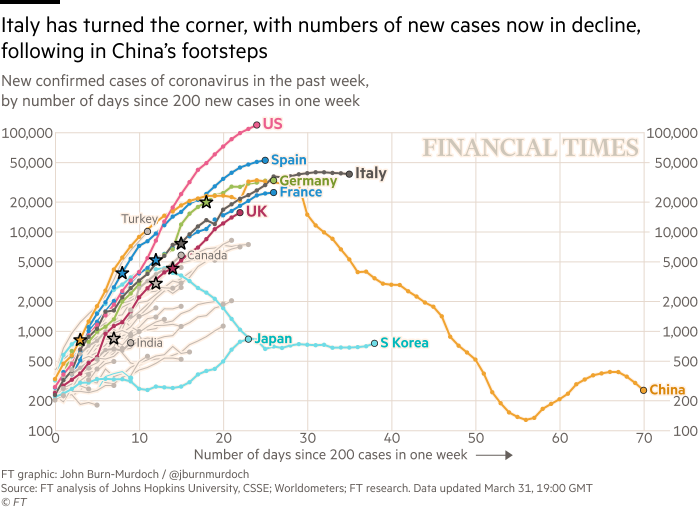
- South Korea brought its new case numbers down sharply through rapid and strict measures, but neighbouring Japan is seeing its first marked increase in new infections as weeks of minimal restrictions begin to take their toll.
- Italy Hopeful That Coronavirus Pandemic Is Slowing Down But authorities say it will take until after Easter to cut new infections enough to begin loosening the lockdown
- Italian scientists tracing almost 6,000 infections around Lombardy, for instance, found nasal swabs of asymptomatic carriers had similar amounts of virus as those with symptoms, which could make them as contagious, according to a prepublication draft of their research. But they also said the small number of asymptomatic cases turned up in contact tracing may mean such carriers played a limited role in spreading the virus.
- With Medical Equipment in Short Supply, 3-D Printing Steps Up in Coronavirus Crisis Health-care workers are 3-D printing face masks and nasal swabs needed for Covid-19 testing
-
(…) health officials and 3-D printing companies are sharing digital files
which can be “printed†into potentially lifesaving equipment in a fraction of
the time. (…) In Tampa, a team of radiologists, infectious disease experts and
ear, nose and throat physicians finalized the design for the nasal swabs,
printed samples and confirmed that they were safe to use in about a week, Dr.
Decker said. It could typically take as long as a year to get a new medical
product to that stage, she added.
(…)
- France proposes EU coronavirus rescue fund
- Trump to suspend some tariffs for 90 days President to lift levies on apparel and light trucks but not on high-profile China imports
- China ‘outflanks the US with its coronavirus-era diplomacy’
PANDENOMICS
Markit’s March Manufacturing PMIs are out today. Only China’s report is provided fully here. You can use the links to access reports from other regions/countries. I find them of lesser interest at this time. The US PMI will be out later this morning and linked here tomorrow.
The survey was conducted from March 12 to March 23.
After deteriorating at the quickest pace on record in February, business conditions faced by Chinese manufacturers were broadly stable in March. Production rose slightly as more firms reopened following widespread company shutdowns and travel restrictions in February amid the Coronavirus diseases 2019 (COVID-19) outbreak. However, the pandemic continued to weigh on demand conditions and supply chains, with total new work falling for the second month running and delivery times lengthening sharply.
Firms remained upbeat that production would increase over the next year, however, as a number of manufacturers expect demand to recover once the COVID-19 outbreak subsides.
The headline seasonally adjusted Purchasing Managers’ Index™ (PMI™) rose from a record low of 40.3 in February to 50.1 in March, to signal a broad stabilisation of business conditions. This marked a strong improvement from the previous month when the nation imposed strict measures to stem the spread of COVID-19.
After widespread company closures and travel restrictions led to a record drop in production in February, an easing of some measures led to a tentative rise in output at the end of the first quarter. However, demand conditions remained fragile, as highlighted by a second monthly fall in total new business. A number of panel members mentioned that firms had delayed or cancelled orders due to the ongoing COVID-19 pandemic. Furthermore, new export work declined solidly during March as nations around the world grapple with containing the spread of the virus.


- China is moving more quickly to open up. It has pushed to resume activities that were stalled nationwide since the end of January, reopening factories, malls and other public amenities as new cases of infection slowed sharply in recent weeks.
- More than 95% of industrial companies in Hubei province with annual revenue of at least 20 million yuan ($2.8 million) have resumed work, Xin Guobin, a deputy minister at the Ministry of Industry and Information Technology, said Monday at a briefing. On average, 70% of these companies’ staff have returned to work. However, Xin said that besides persistent logistical problems posed by travel restrictions, industrial chains have been disrupted as some companies resume work later than others. (Caixin)
-
China’s housing market rebounds as sales triple on pent-up demand
(…) Transactions in at least eight large cities – Shenzhen, Chengdu, Fuzhou, Hangzhou, Huaian, Yangzhou, Jiaxing, Shantou – indicated buyers have returned in recent weeks, with volume surpassing the average levels in the final quarter of 2019, according to China Real Estate Information Corporation (CRIC).
The rebound comes as a relief to the industry after measures to contain the coronavirus outbreak kept buyers away and almost froze the market. Developers have since offered discounts to boost sales and avert a liquidity crunch as factories resumed production and lockdowns eased in signs the health crisis is abating. (…)
In the week to March 22, sales in tier-1 and tier-2 cities were still 50 per cent and 24 per cent below their year-ago levels, according to the consultancy, despite developers resorting to price discounting and a record number of supporting policies. (…)
Mr. Trump called Tuesday for a possible fourth congressional coronavirus relief package to include significant investment in infrastructure, citing an opportunity in low interest rates.
Economists Are Losing Hope in a ‘V-Shaped’ Post-Virus Recovery
Here’s what a team of Citi analysts say will save the global economy
Citi’s global health-care, strategy and economics teams say governments and health-care providers will be able to supply 60% of U.S. individuals of working age with antibody tests by the end of April, and 95% by the end of May.
Individuals with elevated antibody levels will then be able to return to the workforce with minimal risk of reinfection or transmission, they say. How many? Such tests could enable between 20,000 and 400,000 of sidelined U.S. workers with previous exposure to COVID-19 to cease lockdown and immediately and safely return to work. Soon after, 90 million workers, representing 60% of the U.S. workforce, could return.
“While potential therapeutic strategies for COVID-19 seize headlines, we believe diagnostics rather than therapeutics are far better positioned to materially change the economic and even medical outlook for the current COVID-19 pandemic,†say the analysts.
There are, of course, important caveats, such as the false positives that the tests produce, and that having detectable antibodies doesn’t guarantee a person is immune.
Força Brazil?
Geopolitical Futures questions the Brazilian president’s economy-first approach:
Known for his contrarian and uncouth behavior, Brazilian President Jair Bolsonaro frequently comes under intense scrutiny for his decisions. The latest controversy stems from his refusal to shut down economic activity in response to the coronavirus outbreak. Many governments face this decision but few have opted for Bolsonaro’s economy-first approach. The policy hasn’t been well received at home: Governors have lined up against him, media outlets have raised the idea of removing him from office, and even Facebook removed a video of Bolsonaro speaking to street vendors on the grounds that the content violated misinformation standards related to the virus. But however controversial it may be, there is a method to Bolsonaro’s apparent madness. Brazil’s economy is simply too weak to deliberately close down for a prolonged period of time. (…)
Under these circumstances, Bolsonaro’s effort to preserve what’s left of Brazil’s economy at any cost does not seem unfounded. At present, the economic pause in parts of Brazil has been in place for only a couple of weeks. During this time, the government has worked to better position the economy to stay afloat. The calls for vertical isolation demonstrate that the government believes it is reaching the limits of its ability to save the economy from severe recession if more economic activity is not restored soon. Bolsonaro, of course, is not alone in being trapped between two bad policy options, and many leaders will soon have to decide when measures to protect public health no longer outweigh the economic cost. When this shift will occur depends on the economic resilience of the country in question, and Brazil came in with a weak hand already half-played.
Pain in the Oil Patch Borrowing from the Fed is the best of mostly bad rescue ideas.
The WSJ editorial board reviews available options:
(…) A better response is diplomacy to convince Saudi Crown Prince Mohammed bin Salman to stop his game of chicken with Russia, which is also undermining national oil producer Aramco and his strategy to modernize the Kingdom’s economy. Secretary of State Mike Pompeo has tried but so far failed.
An especially bad idea would have the Texas Railroad Commission impose production quotas, which the state last did in the 1970s. But this would punish the most efficient producers and prop up the weaklings. Quotas would be hard to enforce and violate the property rights of producers, leaseholders and mineral-rights owners. Texas can’t control global oil prices in any case, and state quotas would encourage higher production in other regions like the Bakken. Quotas would also signal to Saudi Arabia and Russia they are winning the price war. (…)
A better idea is to let producers that were solvent before the virus borrow against good collateral from the Federal Reserve’s new liquidity vehicles that are open to all comers. This would ensure some market accountability as companies with higher-valued assets and better balance sheets could ride out the Covid-19 shock. U.S. producers have shown they are resilient and should rebound once the coronavirus passes.
(…) Shale wells’ high initial pressure means that there is a strong likelihood that companies can shut them in and later resume production with limited lost capacity, Courvalin said. That’s not the case for many more mature wells that face being shut-in amid low prices and storage and logistics constraints, with production being potentially lost forever, he said. (…)
Russia doesn’t plan to increase crude production given the huge oversupply in the global market, according to a government official, a potentially dovish signal in the price war with Saudi Arabia.
But Russia isn’t yet holding talks with Saudi Arabia on the situation, he said, speaking on condition of anonymity to discuss matters that aren’t yet public. (…)
The Russian official said it made no sense for producers to boost output in the current situation. (…)
On Tuesday evening in Washington, President Donald Trump said the U.S. would meet with Saudi Arabia and Russia with the goal of staunching the historic plunge in oil prices.
Trump, said he’s raised the issue with Russian President Vladimir Putin and Saudi Crown Prince Mohammed bin Salman. “They’re going to get together and we’re all going to get together and we’re going to see what we can do,†he said. “The two countries are discussing it. And I am joining at the appropriate time, if need be.â€
U.S. Energy Secretary Dan Brouillette and Novak, his Russian counterpart, had a “productive discussion†on Tuesday and agreed to “continue dialog among major energy producers and consumers, including through the G20,†the Department of Energy said in a statement.
The Bear Rally: market churn, not a market turn
Goldman Sachs:
(…) But despite the scale of the policy support, which we agree is a necessary condition for markets to rebound, we think it is too early and the level and valuation of equity markets still too high. (…) current market levels do not reflect the scale of EPS decline that we are forecasting. For example, we expect falls of 33% in the US and 45% in Europe.
(…) many of the valuation metrics no not look like crisis-level lows. (…) Some valuation metrics, such as dividend yield, do look cheap, but this may not be enough. Our US strategists forecast S&P 500 dividends will decline by 25% to US$44 per share in 2020. Dividends actually rose by 9% during 1Q. However, they expect a wave of dividend suspensions, cuts, and eliminations will result in dividends declining by 38% during the next nine months so on a full-year basis dividends will be 25% below the level of 2019.
In Europe, meanwhile, the French government has argued that companies in which the government has stakes should not pay dividends, and the government will vote against them during the AGM, while Norway has required financials to stop paying dividends. The German government may also impose restrictions on payouts by companies receiving state aid. Given that 10 of the 50 Euro STOXX 50 companies have government stakes, an apparently high dividend yield may not offer much support for investors.
The timing of any recovery in economic activity is also unclear. (…)
Our US strategists have shown that bear market rallies are quite common, particularly during the bear market of 2008 (…). For example, between September and December 2008, the S&P 500 experienced six distinct bounces of 9% or more, with some rallies as large as 19%, during the course of between one and six trading days. But the market low did not occur until March 2009, when the pace of economic contraction began to slow. (…)
Asset prices could fall further as the range of negative outcomes from the coronavirus pandemic is much wider than during the global financial crisis, according to Oaktree Capital Group co-founder Howard Marks. DoubleLine Capital Chief Investment Officer Jeffrey Gundlach says the S&P 500 Index is likely to reach new lows in April, with economic uncertainty further riling investors.
A gauge of global equities sank 22% in the first quarter, the most since 2008, as worries about an all but certain recession swept through markets despite governments worldwide pumping trillions to prop up economies and central banks undertaking emergency interest-rate cuts. Driven by some of the lowest oil prices since the early 2000s, the amount of distressed bonds surged to the highest level since April 2009, quadrupling in less than a week to nearly $1 trillion, according to data compiled by Bloomberg.
“I think we’re going to get something that resembles that panicky feeling again during the month of April,†Gundlach said Tuesday during a webcast on the market and economic impact of the coronavirus pandemic. “We will get back to a better place, but it’s just not going to bounce back in a V-shape back to January of 2020.†(…)
In a note to clients Tuesday, Marks said assets on Friday were priced “fairly†for the optimistic case, but “didn’t give enough scope for the possibility of worsening news.†(…)
[Jim] Rogers expects “the worst bear market in my lifetime†in the next couple of years, he said in an interview. His concerns have grown as the debt of businesses afflicted by lockdowns and travel bans comes under the the spotlight. The impact of the virus on economies “will not be over quickly because there’s been a lot of damage. A gigantic amount of debt has been added,†he said. (…)
Read Howard Marks latest memo Which Way Now?