The enemy of knowledge is not ignorance, it’s the illusion of knowledge (Stephen Hawking)

It ain’t what you don’t know that gets you into trouble. It’s what you know for sure that just ain’t so (Mark Twain)

Invest with smart knowledge and objective odds

THE DAILY EDGE: 22 MAY 2020

  • Coronavirus Infections Jump by More Than a Million in Less Than Two Weeks Globally there are more than 5.1 million recorded cases of the coronavirus, up from 3.85 million two weeks ago and more than 333,000 deaths.
  • Coronavirus not under control in US, warn Imperial scientists About half of all states still have reproduction rates above one, report shows
  • On Wednesday, Montgomery, Ala., Mayor Steven Reed announced his city was facing a crisis: the hospitals were out of ICU beds. “Right now, if you’re from Montgomery, and you need an ICU bed, you’re in trouble … our health-care system has been maxed out.” Reed said. The news came as a research team warned that a second wave of coronavirus infections was likely in the South Dallas, Houston, southeast Florida, the entire state of Alabama — where reopening has happened rapidly, and other counties with cases on the rise.
  • India reports record jump in cases as lockdown eases. India relaxed some of its travel restrictions on Friday to permit members of the Indian diaspora to reenter the country.
  • Russia, Brazil drive largest daily jump in new cases
  • President Trump said that he wouldn’t be closing down the country again if a “second wave” of the virus does hit.
  • On the positive side, this chart shows a decrease in COVID-19 infection rates after countries eased national lockdowns. Image: J.P. Morgan via Isabel.net

Daily Coronavirus Infection Rate Post-Lockdown

  • US vaccine protects macaques from Covid-19, studies show Of the 25 vaccinated monkeys, eight showed no detectable signs of being infected, while the rest had only low levels of infection, which showed that the vaccines had induced neutralising antibody responses in the animals, the report said. By comparison, the non-immunised group had much higher viral loads. (…) In the second study, the researchers showed that macaques that had recovered from Covid-19 also developed antibodies to protect against repeat infection.
image
PANDENOMICS
  • First-time jobless claims for the week ending May 16 increased by 2.438 million to bring the total number of Americans who have filed for unemployment benefits to 38.9 million during the past nine weeks. (…) Once one accounts for the initial claims data and those who have lost their jobs but have not qualified for unemployment, are marginally attached or are working part time for economic reasons, the near real-time unemployment rate has reached roughly 29.4%. (…) While the pace of those filing first-time claims has declined for the past seven weeks, the number of individuals filing for unemployment benefits will continue to rise. It is difficult to make a case why that number will now not drive toward 50 million before the economy begins its long and winding road to recovery and expansion. (RSM)
U.S. Flash PMI: May sees further steep fall in output

Adjusted for seasonal factors, the IHS Markit Flash U.S. Composite PMI Output Index posted 36.4 in May, up from 27.0 in April, but nonetheless indicating the second-sharpest decline in business activity since the series began in late-2009.

image

Although the overall contraction in new business eased in May, it was still the second-steepest in the series history. Firms continued to report significant decreases in client demand as customers further postponed the placement of orders.

Service sector and manufacturing firms registered the second-sharpest reductions in new orders since the global financial crisis. Foreign client demand remained especially muted, with new export orders decreasing substantially and at only a slightly reduced rate compared to April as lockdowns associated with the virus pandemic persisted across key export markets.

Reflecting the further severe drop in new business, firms cut workforce numbers at a marked pace in May. The rate of job losses eased from April, but was nonetheless the second-fastest in the 11-year survey history. Manufacturers and service providers recorded similar rates of decline as a lack of new work led to increased reports of lay-offs and lower working hours. Subsequently, spare capacity rose and backlogs of work continued to fall.

Businesses remained pessimistic towards the outlook for output over the coming year as the pandemic’s impact was extended. Although some became more confident of a pick-up in the later stages of the year, helping lift the survey’s future expectations index from April’s all-time low, others noted it would take a long time for conditions to normalise.

Weak demand conditions were also reflected in prices data, with both input costs and output charges falling further in May, to register the second-steepest monthly falls since comparable data were first available in 2009. (…)

Markit anticipates that GDP will decline at an annualised rate of around 37% in the second quarter, and it will take the economy two years to regain the pre-pandemic peak.

U.S. Existing Home Sales Drop More Steeply in April

The National Association of Realtors (NAR) reported that sales of existing homes dropped 17.8% (-17.2% y/y) during April to 4.330 million (AR) from 5.270 million in March, which was unrevised. April’s sales were the lowest since July 2011.

Sales of existing single-family homes, which date back to 1968, declined 16.9% (-15.5% y/y) to 3.940 million units, the lowest since December 2011. Sales of condos and co-ops shrank by 26.4% (-3.6% y/y) to 390,000 units, the smallest since the same amount in July 2010 and the lowest since March 2009.

The number of homes on the market declined 19.7% y/y; in April they actually decreased 1.3%, counter to usual seasonal patterns which generally see April with the largest increase in the year.

Home prices were still rising in April, as the median increased 2.2% (+7.4% y/y) to $286,800 after a 3.8% advance in March. The mean sales price was up 1.7% last month (5.4% y/y) to $321,500.

image

Global COVID-19 Risk Ranges Up to $82 Trillion

From the Centre for Risk Studies analysis of the Economic Impact of Covid-19 via Mishtalk.

  1. L1: An Optimistic Recovery Path scenario in which pent-up demand fuels a rapid economic recovery with overshoot on the rebound, with short-term results better than currently expected
  2. L2: Consensus Economic Forecast – the mid-range of forecasts by economic experts, now calling for a slow recovery curve with some period of economic growth before the recovery process
  3. L3: Pessimistic Outlook of structural damage to the economy and a lengthy period of recession
  4. L4: Economic Depression Scenario of a long-term recession with the economy tipped into depression, with “worst-case” estimates by economists and negative assumptions such as severe second waves of infection or protectionist politics.

Here’s Bank of America’s revised scenario:

Revising the U.S. Real GDP Trajectory

Goldman Sachs:

Globally, we think the coronavirus crisis has pushed the economy into a deep recession. We expect real GDP to contract by 4.1% this year, making 2020 weaker than the year following the Global Financial Crisis. But we believe global economic activity has now bottomed, and expect a strong sequential recovery in advanced economies in 2H 2020, assuming infection rates don’t reaccelerate sharply as economies begin to reopen, prompting the reimposition of control measures.

In the US, we expect -39% qoq annualized real GDP growth in Q2 before a faster-than-usual recovery in 2H following the lifting of physical constraints on economic activity, leaving full-year 2020 growth at -6.5%. We see unemployment peaking at 25% and expect a decline in core PCE inflation to just below 1% by year-end 2020. We see risks to our forecasts in both directions; on the upside, China’s experience suggests a much quicker pace of recovery is possible, but on the downside prolonged weakness could cause severe scarring effects that delay the recovery.

U.S. Treasury Secretary Steven Mnuchin said there was a “strong likelihood” the U.S. will need another stimulus package.

US stimulus efforts stall as Senate adjourns Impasse over House-backed $3tn bill reveals partisan divide over additional economic relief

On Friday, Premier Li Keqiang abandoned the country’s annual gross domestic product target for the first time in more than a quarter-century, citing “factors that are difficult to predict”—most notably the coronavirus pandemic and uncertainties around trade.

Retail sales in the U.K. fell 18.1% on the month, the steepest monthly decline on record, the Office for National Statistics said Friday. Sales at clothing stores, household goods stores and department stores all collapsed, tumbling between 25% and 50%. Online sales grew 18% as Britons stocked up at home for a lockdown that’s still in force. Alcohol sales also rose.

Pandemic-related bankruptcies have increased rapidly over the past month in Japan. Some 174 companies filed for bankruptcy as of May 21 connected to the pandemic, according to Teikoku Databank.

According to the latest Fitch Leveraged Loan Default Index data, the total amount of defaults in this high-risk, high-yielding area of the debt markets at $12.6 billion in May so far, the highest since April 2014, bringing the leveraged loan default total for the year to date is $33.3 billion. (…) US retailers have accounted for the bulk of defaults over the past two months, as they were forced to temporarily close stores in response to the COVID-19 pandemic. For now, energy remains in 5th spot after the telecom, services, and manufacturing sectors. (…) Larry Fink who runs the $7.5 trillion Blackrock, said that bankers told him they expect a cascade of bankruptcies to hit the American economy.” (ZH)

More from Fitch:

Since March, most sectors have seen the percentage of negative rating outlooks increase by multiples, with financial institutions experiencing the greatest increase in outlook revisions to Negative from Stable with 38.1% of issuers on Negative Rating Outlook as of May 15 versus 10.7% on March 1.

By comparison, 22.5% of corporate issuers have Negative Rating Outlooks as of May 15 versus 9.8% on March 1. For sovereigns, IPF and USPF/Infrastructure, the proportion on Negative Outlook is now 27.1%, 13.5% and 9.6%, respectively. The percentage of Positive Outlooks has also fallen during this period.

Forbearance Programs Will Camouflage Weakening Bank Asset Quality

Asset quality for U.S. banks is expected to deteriorate significantly as a result of the coronavirus pandemic, but it could take some time for the true impact to show on bank financial statements, according to a dashboard report from Fitch Ratings. The ultimate increase in nonperforming loans and credit losses from the recession will be difficult to determine due to forbearance programs and measures taken by lawmakers and bank regulators to support credit availability.

Reporting standards for banks have been relaxed under the Coronavirus Aid, Relief and Economic Security Act (CARES Act), which means that impaired loans and troubled debt restructures (TDRs) could be understated in the near term. Fitch expects that recognition of impaired loans to be delayed for several quarters, potentially into 2021, depending on the duration of forbearance programs.

Asset quality for U.S. banks has been stellar in recent years with low levels of nonperforming loans and credit losses, but asset quality will weaken significantly. Nonperforming loans made up less than 1% of total banking sector loans at the end of 2019 compared with over 5% at their peak following the global financial crisis of 2008-2009. (…)

Bank earnings were hampered in 1Q20 due to significantly higher provisions expenses that were about five times provisions expenses incurred in 4Q19. These provisions reflect increases in credit loss expectations as a result of the coronavirus pandemic under the new current expected credit loss (CECL) accounting standard that most large banks adopted in 1Q20. Under CECL, banks are required to estimate life of loan losses using their own assumptions such as economic forecasts and credit exposures. Provisions expenses and allowance coverage can vary greatly, and differing underlying assumptions result in a lack of comparability from bank to bank.

Forbearance programs could artificially inflate bank earnings in the coming quarters because banks can generally continue to accrue interest on loans subject to forbearance if the borrower was current on their obligations when forbearance was granted. If the borrower is not able to repay when the forbearance period ends, banks could incur a loss that was not reported in earlier quarters. (…)

Record Reserves for Bad Loans Poised to Slash Canada Bank Profit

Companies Confront the Unforgiving Economics of Coronavirus

Facing higher costs to keep workers and customers safe and an indefinite period of suppressed demand, businesses are navigating an ever-narrower path to profitability. To make the math work, some businesses are cutting services and jobs. Others are raising prices, including imposing coronavirus-related fees aimed at getting customers to share some of the expenses.

Walmart, Target and Home Depot this week said they absorbed more than $2 billion combined in added expenses for wages, bonuses and other benefits for workers during the early months of the pandemic. McDonald’s laid out conditions for franchisees to reopen their dining rooms that include cleaning bathrooms every half-hour and digital kiosks after every order. (…)

Prices of food and other items have risen. Employees need protective equipment at work. Rising unemployment, safety concerns and limits on the number of customers a business is allowed to serve are setting a cap on sales. (…) new procedures mean that employees must spend 25% more time on cleaning. (…)

  • One final insight from our annual Fortune 500 CEO poll: We asked the CEOs where in the world they saw the best opportunities to invest. Seventy-five percent of them said the U.S. was still number one on their list—the same as last year. Only 10% said China was the best place to invest—roughly the same as last year’s 11 percent. (Fortune)
PANDEMONIUM
China Dares Trump to Hit Back With Hong Kong Power Grab

(…) China confirmed on Friday that it would effectively bypass the city’s legislature to implement national security laws, which have long been resisted by residents who fear they will erode freedoms of speech, assembly and the press. (…)

For Xi, the move allows Beijing to reassert dominance over a piece of Chinese territory where his government was rendered impotent during sometimes-violent protests last year. Facing rising unemployment in the mainland due to the Covid-19 outbreak and the potential for a big loss in Hong Kong legislative elections set for September, the Communist Party decided it had more to gain by acting decisively to stem any potential threats. (…)

The move risks triggering yet another round of tit-for-tat escalation between the U.S. and China, which have seen ties spiral to their worst in decades since Covid-19 began spreading around the world. From supply chains and visas to cyberspace and Taiwan, the world’s two largest economies are poised for confrontation on a number of fronts as both Xi and Trump seek to win over domestic constituencies looking for someone to blame for a deterioration in living standards.

(…) on Thursday [Trump] said the U.S. would react “very strongly” if China pushed ahead with the national security legislation in Hong Kong. (…)

But the biggest risk for Xi is still unemployment at home. With lots of young people out of work on the mainland, the last thing the Communist Party wants is a revival of violent Hong Kong protests, Zweig said.

“They feel at threat, at risk, and therefore they’re doing it,” he said. “Maybe five or six months ago, they were feeling okay. But I think a lot of stuff’s come crashing down.”

  • U.S. senators from both parties began drafting legislation to sanction Chinese officials and entities involved in enforcing the new national-security laws in Hong Kong and punish any banks doing business with them—a move that could snarl China’s financial system.
U.S. strikes at a Huawei prize: chip juggernaut HiSilicon

The latest U.S. government action against China’s Huawei takes direct aim at the company’s HiSilicon chip division—a business that in a few short years has become central to China’s ambitions in semiconductor technology but will now lose access to tools that are central to its success.

That could make it the most damaging U.S. attack yet against a Chinese company that U.S. officials told reporters Wednesday functioned as a “tool of strategic influence” for the Chinese Communist Party. Huawei Technologies Co Ltd for its part denounced the U.S. allegations and called the new measures “arbitrary and pernicious.” (…)

HiSilicon’s Kirin smartphone processor is now considered to be on par with those created by Apple Inc (AAPL.O) and Qualcomm Inc (QCOM.O) —a rare example of an advanced Chinese semiconductor product that competes globally.

HiSilicon is also central to Huawei’s leadership in 5G, stepping into the breach when the United States cut off access to some U.S. chips last year.

In March, Huawei revealed that 8% of the 50,000 5G base stations it sold in 2019 came with no U.S. technology, using HiSilicon chipsets instead. (…)

With the new restrictions,HiSilicon “will be in a situation where they’re not able to manufacture chips at all, or if they do, then they’re not leading edge anymore,” says Stewart Randall, who tracks China’s chip industry at Shanghai-based consultancy Intralink.

Without its own processors, Huawei will lose its edge over domestic smartphone rivals, analysts said. International sales had already been gutted by a ban on the use of key Google software. (…)

U.K. PM Boris Johnson orders plans to end reliance on Chinese imports: report

British Prime Minister Boris Johnson has instructed civil servants to make plans to end Britain’s reliance on China for vital medical supplies and other strategic imports in light of the novel coronavirus outbreak, The Times newspaper reported on Friday.

The plans, which have been code-named “Project Defend,” include identifying Britain’s main economic vulnerabilities to potentially hostile foreign governments as part of a broader new approach to national security, the newspaper reported, adding that the efforts are being led by Foreign Secretary Dominic Raab. (…)

China urged to diversify soybean sources to curb reliance on US

EARNINGS WATCH

We have 471 reports in for a blended decline of -12.3% in Q1 earnings with revenues down 1.1%. Q2 estimates are now at -42.3% while Q3 and Q4 are -24.4% and -12.8% respectively.

Trailing EPS are now $158.87, full year $125.85, 12-m forward $128.95 and full year 2021 $164.15.

THE DAILY EDGE: 21 MAY 2020

  • The World Health Organization has warned that the pandemic is far from over. Director-General Tedros Adhanom Ghebreyesus said Wednesday that in the previous 24 hours, 106,000 new coronavirus cases had been reported to the United Nations health organization from around the world, the highest single-day total since the outbreak began.
  • Brazil emerges as a top global coronavirus hotspot Experts predict death toll will top 100,000 in the coming months
  • Spanish minister suggests foreign visitors could return this summer 
  • AstraZeneca books orders for 400m doses of Oxford vaccine Drugmaker also secures $1bn in funding from US government to aid development
PANDENOMICS
Fed’s Bullard Doesn’t See Coronavirus Second Wave as Major Threat

(…) When it comes to managing risks around the pandemic, “so much has been said about this already, that I think as soon as something would pop up we’d be all over that as a society, pounce on it at that point and keep it under control,” Mr. Bullard said Wednesday. “So I’m relatively optimistic about the second-wave scenario because I think we are not naive about that.” (…)

What’s happened is “a big shock and, yes, the economy numbers are going to look very bad by historical standards,” Mr. Bullard said. “But on the other hand I think we are more or less on track for where we would have expected to be at this point,” given the aggressive policy response and “we have every chance of a good recovery in the second half,” he said.

The official added, “I don’t see any reason why 2021 couldn’t be a great year.” (…) (WSJ)

Yet, the Fed’s own economists are able to think of a few potential caveats:

Fed staff economists laid out a baseline scenario in which restrictions on social interactions would gradually ease, boosting economic growth and reducing unemployment. But in a sign of the extreme uncertainty facing forecasters, they said their more pessimistic projection “was no less plausible than the baseline forecast.”

Officials worried that temporary layoffs could become permanent if there were additional infection waves this year and that a “large number of small businesses” wouldn’t be able to endure a long-lasting shock.

Even after social-distancing restrictions end, some business models “may no longer be economically viable,” officials said, and spending in sectors such as entertainment and travel that demand greater human interaction could remain weak. (…)

Officials said high levels of business debt could exacerbate any stress on the banks in the current downturn, and some believed regulators “should encourage banks to prepare for possible downside scenarios” by limiting capital distributions to shareholders, the minutes said. “Indeed, historical loss models might understate losses in this context,” they said.

The minutes didn’t show any discussion around policies to cut interest rates below zero, an idea that has been the source of speculation by some investors even though Fed officials have more recently said they have no interest in it. (WSJ)

Bank of Canada says downward pressure on inflation likely once shutdown ends

(…) Deputy governor Timothy Lane said Canada would likely emerge with both demand and supply weaker than before. The scarring associated with the shutdown could lower productivity, which tends to result in higher inflation.

“But the Bank’s analysis suggests that the decline in demand stemming in part from weaker business and consumer confidence is likely to have a larger effect. On balance, there is likely to be downward pressure on inflation,” he said in a speech to a Winnipeg business audience via video.

Lane reiterated that the bank expected second quarter growth to plunge anywhere between 15 and 30 percent from its level in late 2019.

The various shocks caused by the crisis “are likely to result in damage to Canada’s productive capacity that may be profound and long-lasting,” he said. (…)

Canada’s central bank said in April it expected inflation to dive near 0 per cent in the second quarter.

Statistics Canada said Wednesday the consumer price index for April fell 0.2 per cent compared with a year ago as gasoline prices plunged by 39.3 per cent, the largest year-over-year decline on record.

The overall drop in the annual rate was the first year-over-year decline since September 2009.

The reading compared with a year-over-year increase of 0.9 per cent in March, when the pandemic first started to affect the broader economy. (…)

Excluding energy, Statistics Canada said CPI rose 1.6 per cent. (…) the average of the three core measures of inflation tracked by the Bank of Canada was 1.8 per cent. (…)

(…) In April, the EMU inflation posted a -0.2% change month-to-month against a core rate that was flat. Sequentially from one-year to six-months to three-months, headline inflation has been falling starting with a 12-month pace of 0.3% and ending the sequence with a three-month annualized pace of -1.7%. The core on the same timeline also shows persistent deceleration, falling from a 12-month annualized pace of 1% to just 0.2% over a three-month pace. (…)

WTO goods barometer flashes red as COVID-19 disrupts world trade

imageThe volume of world merchandise trade is likely to fall precipitously in the first half of 2020 as the COVID-19 pandemic disrupts the global economy, according to the WTO Goods Trade Barometer released on 20 May. The index currently stands at 87.6, far below the baseline value of 100, suggesting a sharp contraction in world trade extending into the second quarter. This is the lowest value on record since the indicator was launched in July 2016. (…)

This measure is consistent with the WTO’s trade forecast issued on 8 April 2020, which estimated that world merchandise trade could decline by between 13% and 32% in 2020, depending on the duration of the pandemic and the effectiveness of policy responses.

An early trade report from South Korea, a bellwether for global commerce, showed exports may be set to drop more than 20% in May for a second month. Meanwhile, Japan’s overseas shipments also plunged by more than a fifth in April and a purchasing managers index showed manufacturing activity weakening further in May.

Exports Set for Another Monthly Slump

FLASH PMIs
Eurozone economic downturn shows signs of easing as lockdowns lift

The flash IHS Markit Eurozone Composite PMI rose from an all-time low of 13.6 in April to 30.5 in May, its highest since February. By remaining well below the 50.0 no-change level, the PMI registered a third successive monthly fall in output and continued to indicate a rate of contraction in excess of anything seen prior to the COVID-19 outbreak. The prior low of 36.2 was seen during the peak of the global financial crisis in February 2009. (…)

image

The service sector business activity index picked up from 12.0 in April to 28.7, its highest since February, but social distancing and other virus-related lockdown measures continued to hit businesses such as hotels, restaurants, travel and tourism and other consumer-facing firms especially hard, resulting in the third-steepest decline ever recorded.

The factory sector’s output index meanwhile rose from 18.1 in April to 35.4 in May, albeit likewise still indicating a rapid rate of decline.

image

Jobs consequently continued to be cut at a rate unprecedented prior to the COVID-19 lockdowns, the rate of staff cuts easing only modestly compared to April’s record. Similar rates of job shedding were seen in services and manufacturing, as firms in both sectors sought to cut capacity in line with weaker demand. (…)

Forward-looking indicators improved, though merely from low bases. Overall inflows of new business fell to the third-greatest extent ever seen by the surveys as demand slumped further across both manufacturing and services, yet showed the smallest decline for three months to add to signs that the downturn has bottomed out.

Expectations of output in the coming 12 months meanwhile rose for a second successive month from March’s all-time low, albeit with the number of pessimists continuing to exceed optimists and the overall level of sentiment remaining below anything recorded before the pandemic.

Average prices charged for goods and services fell sharply for a third successive month as companies offered discounts to help stimulate sales, registering one of the largest monthly falls on record. While the rate of price cutting eased slightly in the service sector, prices charged for goods continued to fall at the fastest rate since October 2009.

Price cuts were again often facilitated by lower costs. Having fallen in April to an extent not seen since July 2009, input costs dropped markedly again in May, the rate of decline moderating only slightly in services but reaching the fastest for over four years in manufacturing. (…)

Severe economic downturn continues in Japan

Latest PMI data provide yet another shocking insight into the devastating impact of the COVID-19 outbreak. While the rate of decline in services activity has eased very slightly, plummeting demand for goods is finally catching up with the manufacturing sector, which posted an accelerated decline in production during May.

image

Taking the April and May PMI surveys together, we see that both are indicative of GDP falling at an annual rate in excess of 10%. It is clear that the economy is going to contract for a third successive quarter, with the hit to Q2 likely to be potentially as large as 20% on the previous year.

imageNevertheless, the dynamics in the economy are clearly evolving. As Japan eases the state of emergency measures, the services economy can begin its gradual recovery. However, the damage to the manufacturing sector could continue to worsen as global trade conditions deteriorate and the global economic recovery is slow.

image

Markit does not have a flash PMI for China but World Economics has its own SMI survey:

CHINA SALES MANAGERS REPORT CONTINUING RECOVERY IN MAY

Sales managers report that most companies are now operational and back to near capacity potential. The problem is now demand and not capacity constraints. Export markets remain depressed as clients in many western countries are still in lockdown. However overall the Chinese economy is showing remarkable resilience, with most schools, factories, restaurants and stores now open.

CHINA: SALES GROWTH INDEX

Markit’s U.S. flash PMI will be released mid-morning. Here’s the U.S. SMI:

MAY SALES DATA SHOW FURTHER PLUNGE IN U.S. ECONOMIC ACTIVITY

All U.S. Sales Managers Indexes hit all-time survey lows in May reflecting the deep impact of the Coronavirus lockdowns. Points of special note from the U.S. survey data include very low levels of Business Confidence and Sales. The Staffing Index came in at an extremely low level reflecting the millions of continuing job losses.

UNITED STATES & CHINA: SALES GROWTH INDEX

China debt: how big is it, who owns it and what is next? The Institute of International Finance (IFF) estimated that China’s total debt hit 317 per cent of gross domestic product (GDP) in the first quarter of 2020

(…) The Institute of International Finance (IFF) estimated that China’s total domestic debt hit 317 per cent of gross domestic product (GDP) in the first quarter of 2020, up from 300 per cent in the last quarter of 2019 – the largest quarterly increase on record.

China’s National Institution for Finance and Development, a government-linked think tank, put the nation’s overall debt at 245.4 per cent of GDP at the end of 2019, up 6.1 percentage points from the previous year. (…)

China’s domestic debt has been growing at an average annual rate of around 20 per cent since 2008, faster than its gross domestic product (GDP) growth. (…)

But as China’s growth has slowed, there are growing concerns that many of these debts are at risk of default, which could trigger a systemic crisis in China’s state-dominated financial system. (…)

The coronavirus pandemic is likely to slow regional economies even further, driving down local governments’ revenue and impairing their ability to pay off and refinance debt, with the likelihood that some regional economies will have to increase their debt burden. There were already signs of a ripple effect among China’s small banks as the central government had to step in during 2019 to bail out or partially rescue a number of institutions – such as Baoshang Bank and the Bank of Jinzhou – for the first time since the 1990s.

China has asked its banks to extend borrowing to small businesses which may add more bad debts to the financial system going forward because companies may struggle to generate enough revenue due to a poor demand and weak growth prospects. (…)

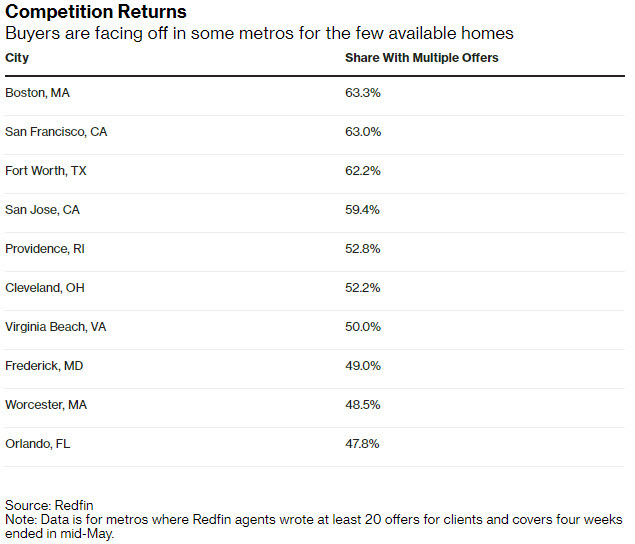
Bidding Wars Are Back in Housing Market Stung by Pandemic

While sales are way down, the lack of inventory has propped up prices and led to bidding wars, even as economic fallout from the pandemic mounts and real estate agents adjust to new public health guidelines that have made it more difficult to market homes. (…)

The supply-demand imbalance meant that roughly 40% of homebuyers that Redfin agents worked with recently faced competition when they tried to purchase a home. The rate was even higher in cities like San Francisco, Boston and even Fort Worth, Texas, where more than 60% of properties the company’s clients bid on received multiple offers.

PANDEMONIUM
Trump Points Finger at China’s Xi, Escalating Fight Over Virus Trump suggested Xi is behind a “disinformation and propaganda attack on the United States and Europe.”
Destined for conflict? Xi Jinping, Donald Trump and the Thucydides trap Tense relations with the US and the question of whether armed confrontation can be avoided will loom large when China’s political elites meet

(…) While observers generally agree that an all-out war between the nuclear-armed nations is improbable, there are potential risks for a limited military conflict. (…)

Speaking at the World Economic Forum in Davos in January 2017, Xi said the Thucydides trap “can be avoided … as long as we maintain communication and treat each other with sincerity”.

But since then, the devastating Covid-19 pandemic has driven the deeply fraught US-China relations to the brink of an all-out confrontation as a result of strategic distrust and misperception, said Wang Jisi, president of Peking University’s Institute of International and Strategic Studies.

“China and the US are shifting from an all-around competition to a full-scale confrontation, with little room for compromise and manoeuvring,” Wang said in a speech in late March. “We cannot rule out the possibility that the two powers may fall into the Thucydides trap.”

That seems to sum up the tone of recent communications from the US side. Trump has vowed to “take whatever actions that are necessary” to seek reparations and hold China accountable for the Covid-19 disease that was first identified in the city of Wuhan at the end of last year. His top aides, especially Secretary of State Mike Pompeo and Defence Secretary Mark Esper, have been particularly blunt.

During the Munich Security Conference in February , Esper described China as a rising threat to the world order and urged countries to side with the US in preparing for “high intensity conflict against China”. (…)

The deterioration of US-China ties has clearly alarmed Xi and his top aides. On April 8, the Chinese leader issued an unusually stark warning that “we must get ready for the worst-case scenarios” in light of unprecedented external adversity and challenges, according to Xinhua. (…)

The China Institutes of Contemporary International Relations (CICIR), affiliated with the Ministry of State Security, said Beijing may need to prepare for armed confrontation with Washington amid the worst anti-China backlash since the Tiananmen crackdown in 1989, according to Reuters, which cited an internal report.

The report warned that China’s overseas investments, especially the ambitious Belt and Road Initiative, could fall victim to rising anti-Chinese sentiments, while the US may accelerate efforts to counter Beijing’s expanding clout by increasing financial and military support for regional allies. (…)

Seth Jaffe, assistant professor of political science and international affairs at John Cabot University in Rome and an expert on Greek history, said the Chinese think tank report was “profoundly concerning”.

“The acrimonious narratives surrounding Covid-19 are currently reshaping the attitudes of leaders and populations alike, which is leading to harder-line strategic postures, as evidenced by the hawkish CICIR report,” he said. “In this way, the virus blame game is stirring up nationalistic pride and grievance, narrowing the space for political leaders to manoeuvre, and creating zero-sum dynamics that invite future conflict – a vicious cycle.” (…)

He said an international incident would put Trump and Xi on a reputational collision course, with each leader facing pressure to stand up to the other and not back down, given the mistrust and heated rhetoric.

“The danger, then, is an unforeseen spark, which could set off a frightening movement up the escalation ladder,” he added. (…)

Anybody having read about events prior to WWI knows what this last sentence means.

Pompeo slams ‘brutal’ Beijing over pandemic, 5G and Taiwan

America’s top diplomat launched a verbal salvo against China on Wednesday that was anything but diplomatic, attacking Beijing for its policies on health, defence, Taiwan and 5G and its “brutal” regime as he expressed US concern over certifying Hong Kong’s autonomy. (…)

Under the Hong Kong Human Rights and Democracy Act of 2019, the US has until the end of this month to assess whether Hong Kong remains suitably autonomous from China, a prerequisite for extending the city’s preferential US trading and investment privileges. (…)

Earlier on Wednesday, Trump lashed out on Twitter at “some wacko in China” for “blaming everybody other than China for the Virus which has now killed hundreds of thousands of people”, he wrote. “Please explain to this dope that it was the ‘incompetence of China’, and nothing else, that did this mass Worldwide killing!” (…)

China’s military seeks bigger budget amid growing threat of US conflict
Senate Bill Could Force Chinese Companies to Drop U.S. Listings Chinese companies could be forced to give up their listings on American stock exchanges under legislation approved unanimously by the Senate, aimed at addressing longstanding investor-protection concerns.

(…) At the heart of the dispute is China’s unwillingness to grant routine access to audit records sought by American regulators. Companies that sell shares publicly in the U.S. are legally required to be audited by firms that are inspected by the Public Company Accounting Oversight Board, an audit watchdog. (…)

Chinese companies have raised over $66 billion through U.S. initial public offerings since 1997, according to data from S&P Global Market Intelligence. There were 25 IPOs of Chinese companies in 2019, about 18% of all deals, according to data compiled by University of Florida professor Jay Ritter.

The legislation approved by the Senate would require the SEC to prohibit trading in any shares where the company’s auditor hasn’t faced a PCAOB inspection for three consecutive years. It also would require the companies to disclose whether they are owned or controlled by a governmental entity. (…)

TECHNICALS WATCH

13/34–Week EMA Trend Chart (CMG Wealth):

Announced Share Buybacks in the U.S.