The enemy of knowledge is not ignorance, it’s the illusion of knowledge (Stephen Hawking)

It ain’t what you don’t know that gets you into trouble. It’s what you know for sure that just ain’t so (Mark Twain)

Invest with smart knowledge and objective odds

THE DAILY EDGE: 20 MAY 2020

image

image
  • Axios says that 54% of all U.S. counties don’t have a testing site. Among counties with 50,000 or more people, 38% don’t have any testing sites. Among rural counties with fewer than 10,000 residents, 68% don’t have any.
China’s New Outbreak Shows Signs the Virus Could Be Changing

Chinese doctors are seeing the coronavirus manifest differently among patients in its new cluster of cases in the northeast region compared to the original outbreak in Wuhan, suggesting that the pathogen may be changing in unknown ways and complicating efforts to stamp it out.

Patients found in the northern provinces of Jilin and Heilongjiang appear to carry the virus for a longer period of time and take longer to test negative, Qiu Haibo, one of China’s top critical care doctors, told state television on Tuesday.

Patients in the northeast also appear to be taking longer than the one to two weeks observed in Wuhan to develop symptoms after infection, and this delayed onset is making it harder for authorities to catch cases before they spread, said Qiu, who is now in the northern region treating patients. (…)

Scientists still do not fully understand if the virus is changing in significant ways and the differences Chinese doctors are seeing could be due to the fact that they’re able to observe patients more thoroughly and from an earlier stage than in Wuhan. (…)

China has one of the most comprehensive virus detection and testing regimes globally and yet is still struggling to contain its new cluster. (…)

  • There are some 4.9 million confirmed infections world-wide, according to data compiled by Johns Hopkins University, and more than 323,000 deaths. In the U.S., nearly 1.53 million have been confirmed infected, and almost 92,000 have died.
  • The reopenings in the U.S. reflect similar moves in other parts of the world. But there is no clear indication that the pandemic is retreating world-wide. Brazil posted a record daily high of 1,179 fatalities on Tuesday—the world’s third-largest total of confirmed infections, with more than 271,000. Medical experts say the numbers there are not likely to peak until June.
  • China has reimposed lockdown conditions in the northeast of the country following a fresh outbreak and India also recorded a new daily high.
  • Germany’s new virus cases rose above 1,000 for the first time in 11 days, while the infection rate dropped further below the key threshold of 1.0. There were 1,227 new cases in the 24 hours through Wednesday morning, bringing the total to 177,778. That’s up from 182 on Tuesday but still well below the three-day average of about 2,700 a month ago.

Lockdown was much less severe than in other nations

Infographic: Russia Now Country With the Second-Most COVID-19 Cases | StatistaInfographic: Are U.S. States Flattening the Curve? | Statista

  • Brazil reports 17k+ cases in latest record jump. Brazil’s outbreak has been exacerbated by President Jair Bolsonaro’s insistence that the virus is just “a little flu”, and that the only sensible approach is to simply let the disease run its course, Bolsonaro has said.
  • the Guardian reported Wednesday that the number of confirmed coronavirus cases in Afghanistan had passed 8,000, as roughly 50% of tests done in a day come back positive for the 2nd straight day.
  • In Japan, infection levels have returned to their lows from late March
PANDENOMICS
U.S. Economy Likely to Shrink 5.6% This Year Amid Coronavirus, CBO Says

Gross domestic product will likely be 5.6% smaller in the fourth quarter of 2020 than a year earlier, the CBO said Tuesday, despite an expected pickup in economic activity in the coming months. Though the CBO raised its projection for GDP growth in the fourth quarter of 2021 to 4.2% from 2.8% in an April forecast, the outlook continued to depict a long road to recovery.

That owes to the suddenness and severity of the current downturn, as well as expectations that social-distancing measures will remain in place, to some degree, for at least another year. The CBO estimated GDP will shrink 11.2% in the current quarter from the January-to-March period, more than quadruple the next-biggest quarterly decline in records going back to 1947.

Business and residential investment will be the main drags on growth this year, the CBO said, falling 15.8% and 13.8%, respectively, in the fourth quarter from a year earlier. Consumer spending is seen declining 4.1%, while government purchases will likely slip 1%.

A key source of support for the economy will be the four economic-aid packages passed by Congress since March, the CBO said. It estimated the packages will increase the federal budget deficit by $2.2 trillion in the fiscal year ending Sept. 30 and by $600 billion in the following year.

The agency sees the number of U.S. jobs falling to 133 million in the second quarter from 158.6 million at the end of 2019—more than triple the number of job losses in the 2007-09 recession.

While jobs should start to gradually return in the third quarter of this year, the CBO expects household employment to remain below pre-pandemic levels at 148 million in the last three months of 2021.

The CBO cited three factors that are likely to tamp down on job growth as social-distancing measures ease and consumer spending rebounds in coming quarters.

First the federal Paycheck Protection Program of forgivable loans to small businesses “will wane in coming months, which may precipitate a new wave of layoffs and furloughs,” the agency said.

At the same time, health concerns could dampen laid-off workers’ incentives to search for new jobs. Finally, declining tax revenue in state and local governments will likely lead to more layoffs in those sectors, the CBO said.

Powell, Mnuchin Differ on Perils for Economy

The nation’s top two economic policy leaders offered contrasting visions about the economic outlook, with Treasury Secretary Steven Mnuchin favoring a wait-and-see approach to more federal aid and Federal Reserve Chairman Jerome Powell suggesting more would be needed. (…)

“There is the risk of permanent damage” to keeping commercial activity closed down too long, Mr. Mnuchin told the Senate Banking Committee.

Mr. Mnuchin echoed comments by President Trump and other administration officials who are predicting a V-shaped recovery—a sharp downturn followed by a strong bounceback. (…)

Mr. Powell, meanwhile, challenged the premise that there is a trade-off between economic growth and protecting the public’s health. Fear of coronavirus infection is the economy’s biggest hurdle, he said, and the recovery will be held back until Americans believe it’s safe to resume commercial activities involving person-to-person contact.

“The No. 1 thing, of course, is people believing that it’s safe to go back to work so they can go out,” said Mr. Powell. “That’s what it will take for people to regain confidence.” (…)

Mr. Powell and other senior central bank officials have indicated they don’t think a V-shaped recovery is likely. This has fueled their concern that the government’s initial relief measures may prove insufficient to nurse the economy through a shock with no modern parallel and with interest rates already near zero. (…)

“If consumers are afraid to eat out, shop or travel, a relaxation in laws requiring business closures may do little to bring back customers and thus jobs,” said Mr. Rosengren. “It is vital that the design and timing of reductions in business restrictions not result in worse outcomes and higher unemployment over a longer period of time.”

The nonpartisan Congressional Budget Office, which released its updated economic forecast Tuesday, said it anticipates a “gradual and incomplete pattern of recovery” over the next year and a half. CBO expects the economy will grow faster in 2021 than it projected last month, but will still be 1.6% smaller than it was at the end of 2019, while the jobless rate remains above 9% through the end of next year. (…)

“We are not going to spend our way out of this,” White House economic adviser Lawrence Kudlow said in an interview last week. Animating the administration’s approach is the expectation of a V-shaped recovery, he indicated. “We believe it’s the best bet,” Mr. Kudlow said.

Another White House economic adviser, Kevin Hassett, told reporters Monday a fourth round of economic stimulus might be unnecessary. “I think it’s possible that we’ll see a strong enough economy that we don’t need a Phase Four,” he said. (…)

Funny that it’s now the Fed saying the Administration is not doing enough…

  • President Trump didn’t press Senate Republicans Tuesday about specific ideas for the possible next round of coronavirus relief, instead focusing on the 2020 election and other concerns.
  • McConnell said congressional Republicans and Mnuchin, who negotiated previous rounds of stimulus with Democrats, are all in agreement that a pause is needed. With the Senate leaving later this week for a nearly two-week recess, he said discussions on next steps would happen in couple of weeks.
  • Behind Bond Market’s Stall, Investors See Hard Times Ahead Yields on U.S. government bonds have stalled near all-time lows, a sign that investors are anticipating a painful economic recovery and years of aggressive monetary stimulus.

  • As countries in Europe begin a gradual reboot of their economies, CEOs and Chairs of major industrial companies in Europe expect the global economy to recover slowly. A majority of respondents (53 percent) say it will take between one and two years for the global economy to recover from the COVID-19 crisis, and 45 percent expect it will take more than two years. However, 54 percent of CEOs said that if the COVID-19 pandemic were to end now, their revenue would return to early 2020 levels in less than one year, and 14 percent expected it to recover within three months.Economic recovery after COVID-19: Will large companies in Europe fare better than the global economy?
  • Some of the biggest U.S. retailers such as Amazon.com and Kroger are ending the extra pay they gave to front-line workers during the coronavirus crisis.
  • Landlords Fume as Starbucks, Other Chains Seek Extended Rent Cuts National restaurant chains and other stable businesses are asking for rent relief as the economic picture sours, setting the stage for court battles and protracted clashes between big tenants and property owners.
  • UK sells negative-yielding government bonds for first time ‘Symbolic hurdle’ coincides with debate into whether BoE should move to negative rates
  • Shutdowns Wreak Devastating Toll on Poorest Nations, World Bank Chief Says

(…) “The human toll in the developing world—in the poorest countries, in particular—from the shutdown is devastating,” World Bank President David Malpass said in an interview. “The question is: how long will it last? And for the developing world that depends heavily on the reopening of the advanced economies.”

The World Bank estimates that 60 million people world-wide are likely to fall into extreme poverty—subsisting on less than $1.90 a day—this year, while hundreds of millions more could lose their jobs. Such a backslide could have health implications beyond the coronavirus, such as stunting growth in children who can’t get enough nutrition, Mr. Malpass said. (…)

  • Chinese President Xi Jinping vowed to allocate $2 billion over two years to help countries fight and recover from the Covid-19 pandemic, particularly developing nations. In an address to an online session of the World Health Assembly Monday, Xi also pledged to make China’s coronavirus vaccine a global public good once one is available
Canada Warned About Coronavirus-Induced Mortgage Arrears The head of Canada’s state-owned mortgage insurer warns the income shock from the pandemic could leave a fifth of all the country’s mortgages in arrears.

Evan Siddall, chief executive of Canada Mortgage and Housing Corp., added the insurer now forecasts the average house price will fall 9% to 18% in the coming year, and won’t fully rebound until 2022.

“The resulting combination of higher mortgage debt, declining house prices and increased unemployment is cause for concern for Canada’s longer-term financial stability,” Mr. Siddall said, in testimony before a parliamentary committee on Tuesday. (…)

The country’s banks have allowed mortgage-payment delays of up to six months for roughly 740,000 households, representing about 15% of mortgages on banks’ balance sheets. After the deferral period ends, though, the debt payments will come due. The Bank of Canada said it expects a rise in the proportion of households whose debt-service payments exceed 40% of income—an indicator of household vulnerability.

Mr. Siddall said the mortgage deferrals are “adding to already historic levels of household indebtedness.” Data from the Bank for International Settlements indicates the total credit extended to Canadian households is just over 100% of gross domestic product, or nearly double the average for the Group of 20 industrial and developing nations. He said he expects a peak 130% later this year. (…)

He said CMHC, the country’s dominant mortgage insurer, has enough capital on hand to deal with an expected surge in insurance claims resulting from the pandemic—which the housing agency estimates will be up to 9 billion Canadian dollars (US$6.5 billion).

At the end of 2019, CMHC had total insurance in force of C$429 billion. The agency said the mortgage-arrears rate last year stood at 0.31%.

In our annual survey, we asked the CEOs of the Fortune 500 whether they agreed or disagreed with some of the predictions being floated these days about how things will permanently change. (Fortune)

  • “Business travel will become less frequent, replaced by video conferencing.” – 91% agreed.
  • “Nationalism will rise, and global supply chains will become less common.” – 82% agreed.
  • “Government surveillance techniques will become more common worldwide.” – 81% agreed.
  • “Trust in government will rise, as a result to their response to the crisis.” – 55% disagreed.
  • “China will be strengthened as a power in the world” – 42% agreed, 38% disagreed.
  • “Trust in capitalism will rise, as a result of the business response to the crisis.” – 28% agreed, 24% disagreed.
  • “Concern about the environment will fall, as a result of more immediate focus on economic problems.” – 42% agreed, 35% disagreed.
PANDEMONIUM
Trump says U.S. should consider ending trade deals under which it imports cattle

(…) “I read yesterday where we take some cattle in from other countries, we have trade deals. I think you should look at terminating those deals,” Mr. Trump said at a White House event on food aid. “We have a lot of cattle in this country.” Mexico exports more than one million cows across the border each year that become part of the U.S. beef supply. (…)

U.S. Birthrates Fall to Record Low American women had babies at record-low rates last year and pushed U.S. births down to their smallest total in 35 years.
Billionaire banker Jamie Dimon urges business and government to use the pandemic to create a fairer world

THE DAILY EDGE: 19 MAY 2020: Figure of 8

VIRUS UPDATE

image

Moderna’s Vaccine Hope

(…) Moderna’s mRNA vaccine gives cells a building manual to produce a particle that resembles the spike on the coronavirus. The goal is to induce an antibody response similar to the actual virus. Because the vaccine doesn’t utilize a pathogen particle, there are fewer safety risks. Production can also rapidly be scaled up using a standardized process. (…)

Moderna reported on Monday that all [see below] participants who had been evaluated after receiving two doses developed antibody levels at or above levels of those seen in patients who have recovered from the virus.

This suggests that the vaccine could be effective, and none of the participants experienced severe side effects. Separately, Moderna reported that its vaccine “provided full protection against viral replication in the lungs” in mice infected with the coronavirus. On May 7, the Food and Drug Administration cleared the company to begin phase two of its trial with 600 participants including individuals over age 55 to determine whether they also muster a robust immune response.

On May 12 the FDA granted Moderna fast-track designation, and the company plans to begin the third phase of its trial to assess the vaccine’s efficacy in thousands of people in July. A vaccine could be made available for high-priority groups such as health-care workers as early as the fall if results show promise. (…)

Relaxing lockdowns and social-distancing mandates will also be needed since masses of people will have to be exposed to the virus for manufacturers to figure out if vaccines work. Until a vaccine is widely available, large gatherings may not occur, international travel will be limited, and millions of people will feel anxious about returning to pre-virus habits. Which is why markets are cheering on Moderna, despite the uncertainties that remain, and Americans should be too.

Sarcastic smile The WSJ editorial team did not see fit to point out that “all” evaluated participants were a grand total of 8, a number that appeared within another WSJ piece:
Eight participants in the study who received the vaccine candidate developed antibodies at similar levels to recovered Covid-19 patients. Meanwhile, just one patient at the small-and-medium-dose levels experienced an adverse effect, though more patients had them at higher doses. A larger, late-stage study is slated to begin as soon as July with a goal of having a vaccine available for emergency use by the fall. (…) it is common for promising drug candidates to fizzle out in larger trials after promising early-stage results. More serious issues with safety or efficacy could emerge as the data set expands.

From FT Alphaville

(…) Moderna was valued at Monday’s close at just shy of $30bn. It still doesn’t have a product, or revenue, or anything much beyond some interim data from a first-stage clinical trial where blood assays from eight people showed antibodies that may or may not be capable of neutralising Covid-19.

Here’s a short and incomplete list of things we don’t know. We don’t know if antibodies provide Covid-19 immunity in humans. We don’t know anything about the eight people tested from the 45 person trial group, including why they were at the front of the queue. We don’t know if a trial of 18 to 55 year olds is representative for a virus that seems to disproportionately affect the over sixties. We don’t know anything whatsoever about efficacy because Phase 1 trials test safety, not efficacy. And we don’t know how Moderna might sell this vaccine, assuming it completes the very long road to regulatory approval, because the company has disclosed nothing useful from a financial perspective about its commercial relationships.

What we do know is that CEO Stephane Bancel was on Bloomberg moments after the release of the interim data to say the findings “couldn’t have been better”. We know also that Moderna chose a few hours later to launch a $1.3bn public equity offering priced at $76 a share, a 13 per cent premium to its price before the data release. We also know that Moderna’s the fifth most-shorted US biotech (with a short interest of 11.76 per cent, or $1.6bn approximately by value), which tends to amplify the price response to whatever news it releases.

All told, it might be worth going back to that 2017 story and reading again how Moderna, under the same management team, was considered within the industry to be triumph of hype and over delivery. Hope has replaced hype but the dynamics at work look much the same.

Coronavirus: warnings of second wave of infections as China fights ‘long-term war’

(…) “There have been new cases in Heilongjiang, Jilin and Wuhan, and there was another case going from asymptomatic to symptomatic infection in Shenzhen two weeks ago,” Hui said. “So it is important to watch out for a second wave on the mainland. The asymptomatic cases still carry high viral loads and are infectious.”

While strict lockdown measures in China’s outbreak epicentre Hubei province helped break the chain of local transmission, people in cities like Wuhan could be vulnerable to a second wave of infections because there is a low level of antibodies in the population. A study of 11,000 residents of Wuhan in April found that 5 to 6 per cent tested positive for coronavirus antibodies, Caixin reported last week.

“Lots of people in China have no background immunity and would be at risk if there is a second wave,” Hui said. (…)

“The majority of … Chinese at the moment are still susceptible to the Covid-19 infection, because [of] a lack of immunity,” Zhong said in the interview on Saturday. “It’s not better than the foreign countries I think at the moment.” (…)

South Korean Research Boosts Theory That Retesting Positive Isn’t Relapse Group who tested positive a second time hadn’t passed the coronavirus on to others

South Korean health officials found that a group of patients who tested positive a second time for the coronavirus hadn’t passed the disease on to others, lending credence to the possibility the suspected relapses were a testing fluke rather than the re-emergence of an active infection. (…) But the results were solid enough that starting Tuesday South Korea’s Centers for Disease Control and Prevention no longer requires quarantine for discharged patients and stopped using the term “relapse” in favor of “redetected” to describe such cases. (…)

“We’re putting more weight on the theory that dead virus fragments remain in a recovered patient’s body, since we haven’t seen evidence of infectivity,” said Ki Moran, a professor at the National Cancer Center who is advising the South Korean government on its Covid-19 response.

Health authorities said they are still gathering evidence to support this theory, as well as whether recovered patients develop immunity to the virus and how long any immunity may last. (…)

  • Brazil is now the world’s fastest-growing coronavirus hotspot, accounting for 13% of new cases globally in the past week, while cases in India rose at the fastest pace in Asia to top 100,000. Deaths linked to the virus in Britain exceeded 40,000, making it the first country in Europe to reach that threshold.
PANDENOMICS
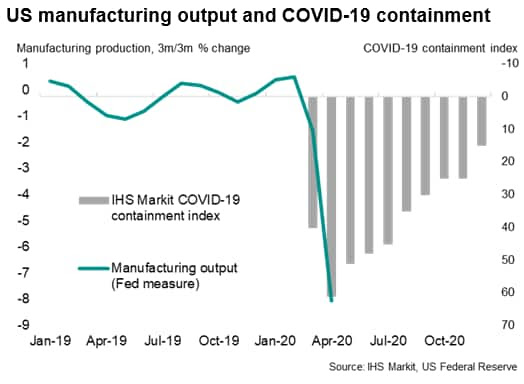
Record Drop in Industrial Production; Output at Level Last Seen in March 2010 Industrial production plummeted 11.2% in April led by a 13.7% fall in manufacturing output.

image

  • Will the production trend improve in May?

Given that measures taken to contain the coronavirus have started to be eased in some cases, it seems likely that the rate of decline of manufacturing output could likely moderate in May.

As well as producing the PMIs, IHS Markit compiles indices of COVID-19 containment measures, which allows us to see how aggressively measures taken to contain the virus have been applied in each country, and also how quickly they are being relaxed. These indices are based on information relating to issues such as closures of schools, non-essential shops and restaurants, as well as restrictions on public gatherings, internal mobility and external borders. We also forecast how these are expected to change in coming months, based primarily on government announcements.

Restrictions are already easing in the US in May and, barring a second wave of infections, look set to continue to be gradually relaxed further in coming months.

U.S. Retail and Food Service Sales Post Record Decline

image

Record Drop in Taxes Signal Deep Consumer Recession

In April, federal withheld income tax collections posted a record drop from year-ago levels. The scale of the decline indicates that the reported figures on job loss and unemployment are understating the collapse in labor markets. (…)

In April, the household employment survey showed that 22.4 million people lost their jobs, lifting the unemployment rate to 14.7%, up from 4.4% in March, an increase of 10.3 percentage points in one month. (…) One of the curious parts of the April employment report was the exodus of 6.4 million people from the workforce. If people did not exit the workforce in record numbers last month, the jobless rate would have topped 18%. Confusion over new federal legislation for unemployment compensation may have led people to misstate their labor force status last month. (…) As a result, the May jobless rate could spike 10 percentage points to 25% reflecting a surge in re-entrants and new job losers. (…)

Pointing up Harvard’s Reinhart and Rogoff Say This Time Really Is Different

(…) The recovery is unlikely to be V-shaped, and we’re unlikely to return to the pre-pandemic world. (…) I don’t know how we’re coming back to 2019 levels [in the economy] in any near term. The true fall in GDP, economic historians will debate for years. It’s probably much larger than the measured fall. It’s not just the people not working. What’s the efficiency of the people who are working? The monetary response has been done hand in hand with the Treasury. The market is banking on this V-shaped recovery. But a lot of the firms aren’t coming back. I think we’re going to see a lot of work for bankruptcy lawyers going across a lot of industries. (…)

Another reason I think the V-shape story is dubious is that we’re all living in economies that have a hugely important service component. How do we know which retailers are going to come back? Which restaurants are going to come back? Cinemas? (…)

And you want to talk about a negative productivity shock, too. The biggest positive productivity shock we’ve had over the last 40 years has been globalization together with technology. And I think if you take away the globalization, you probably take away some of the technology. So that affects not just trade, but movements and people. And then there are the socio-political ramifications. I liken the incident we’re in to The Wizard of Oz, where Dorothy got sucked up in the tornado with her house, and it’s spinning around, and you don’t know where it will come down. That’s where our social, political, economic system is at the moment. There’s a lot of uncertainty, and it’s probably not in the pro-growth direction. (…)

So there are going to be phenomenal frictions coming out of this wave of bankruptcies, defaults. It’s probably going to be, at best, a U-shaped recovery. And I don’t know how long it’s going to take us to get back to the 2019 per capita GDP. I would say, looking at it now, five years would seem like a good outcome out of this. (…)

Again, we’re going to see huge forces pulling apart the euro zone. (…)

China came into this with inflation running over 5% because of the huge spike in pork prices. So I think initially that the PBOC [People’s Bank of China] has been somewhat constrained initially in doing their usual big credit stimulus by uncertainty over their inflation. I think that’s changing because of the collapse in oil price. So I do think we are going to see more stimulus from China. (…)

I think if they [China] can average 1% growth the next two, three years, then that will look good. That’s not a bad prediction for China. And let’s remember, their population dynamic is completely changing. So 3% growth in that, with that Europeanizing of their population dynamics, would not be bad at all. But there’s a big-picture question about their huge centralization, which is clearly an advantage in dealing with the national crisis but maybe doesn’t provide the flexibility over the long term to get the dynamism that at least you’ve got in the U.S. economy.

(…) I think we’re not in a position to use deeply negative interest rates because the preparation hasn’t been done. And you have to deal with cash hoarding. That’s a shame because I think that would have been a valuable instrument, and would have been helpful for some municipals and corporates, and would have reduced the number of patients going into bankruptcy court. Monetary policy is essentially castrated by the zero bound. (…)

On the issue of negative interest rates, I do not share Ken’s views on that particular matter. When you have, as we do today, very fragmented markets, markets that became totally illiquid, I think the way I would deal with that would not be through making rates more negative, but by an approach closer to the one taken by the Fed, which is through a variety of facilities that provide directed credit. Sustained negative interest rates in Europe have led to a lot of bank disintermediation. And often bank disintermediation means that you end up with the less regulated, less desirable financial institutions. (…)

We don’t know where we will come out. So the probability is, for the foreseeable future, we’ll have deflation. But at the end of this, I think we’re going to have experienced an extremely negative productivity shock with deglobalization. In terms of growth and productivity, they will be lasting negative shocks, and demand may come back. And then you have the many forces that have led to very low inflation maybe going into reverse, either because of deglobalization or because workers will strengthen their rights. The market sees essentially zero chance of ever having inflation again. And I think that’s very wrong. (…)

We’re going to see a lot of risk aversion. We’ll be more inward-looking, self-sufficient in medical supplies, self-sufficient in food. If you look at some of the legacies of the big crises, those have all seen fixed investment ratchet down and often stay down.

  • European business leaders have an overwhelmingly pessimistic outlook for near-term prospects and expect a global economic recovery might take up to three years, according to a survey by the Conference Board, a U.S. business think tank. Business chiefs on both sides of the Atlantic rated their current confidence in the economy at a level of 34 on a scale of zero to 100, with expectations for the coming six months ranging between 48 and 50 for the economy overall and respondents’ own industries. U.S. and European executives gave grades of only three out of 100 when comparing current business conditions with six months ago, “an extraordinarily low measure,” the two business groups said in a report on the survey.
  • Italian and Greek government bond yields fell to their lowest in a month after France and Germany propose a recovery fund to support countries hard-hit by the coronavirus. Investors took the proposed €500 billion ($546 billion) fund as a sign that the European Union’s richest members would support nations with limited fiscal reserves, particularly the highly indebted Southern European countries.
  • Figures released Tuesday by the European Union’s statistics agency showed that across the eurozone as a whole, construction was down 14.1% on the previous month, and down 15.2% on March 2019. That was the largest drop in a single month since records began in 1995. But the national experiences were very different. In Germany and the Netherlands, construction rose on the month, by 1.8% and 1.5% respectively. In France and Italy, building work collapsed, by 40.2% and 36.2% respectively. Spain saw construction fall by just 2.5%. Surveys of construction companies in April indicate that activity declined even further as lockdowns tightened, with Germany seeing a fall in building work, although on a more modest scale than France and Italy.
  • The Office for National Statistics said the number of people claiming jobless benefits rose to 2.1 million in April from 1.2 million a month earlier, a 70% increase and the largest month-on-month change since records began in 1971. (…) The number of hours worked by employees in the first three months of the year fell on the quarter by the largest amount in a decade⁠—and that was before a nationwide lockdown took effect. Vacancies plummeted in the three months through April. The government is hoping that a taxpayer-backed program to pay the wages of furloughed workers, extended to the fall, will keep a lid on layoffs. Some 7.5 million workers are being paid at least 80% of their regular salary under the program even though they aren’t working.
  • J.C. Penney plans to permanently close more than 240 department stores, or nearly 30% of its locations, as the retailer tries to streamline its business under chapter 11 bankruptcy protection.
  • Reopenings Will Create Thousands of Jobs We’ve Never Seen Before Thermal scanners, cart wipers and contact screeners may put a small dent in unemployment.
  • Oil’s gains came as investors made wagers on brighter days ahead for the world economy and those bets are underpinned by an uptick in movement by consumers world-wide. Their optimism is also backed by a drop in key global stockpile hubs. Investors said rising prices might push producers to start boosting output, as they look ahead to next month’s scheduled meeting of the Organization of the Petroleum Exporting Countries and its allies.
  • China Ramping Up Purchases of U.S. Farm Goods China has significantly stepped up purchases of U.S. agriculture products in the past two months, according to U.S. officials, even as purchases in other sectors fall short of expectations under the first phase U.S.-China trade deal.
  • Russia Economy Contracted by a Quarter in April, Early Data Show
  • U.K. Bans Dividends at Firms Tapping State-Backed Loans
Pointing up Reopening China’s Economy: Tracking the Heartbeat of a Recovering Nation
PANDEMONIUM
  • Nasdaq Set to Tighten Listing Rules, Impacting Chinese IPOs
  • “It is clear the repeated missteps by you and your organization in responding to the pandemic have been extremely costly for the world,” Mr. Trump wrote. “The only way forward for the World Health Organization is if it can actually demonstrate independence from China.”
  • Australian exports of wine, seafood, oatmeal, fruit and dairy are in danger of being targeted by China if Beijing decides to escalate a row over Canberra’s calls for an investigation into the origin of Covid-19, according to people familiar with the matter.
  • US ‘surgical’ attack on Huawei will reshape tech supply chain Experts predict problems for Chinese group’s base station and HiSilicon businesses
EARNINGS WATCH

As of Friday evening, we had 454 reports in for a blended growth rate of -12.2% on revenues down -1.7%.

Corporate guidance has vaporized so analysts are going blind: Q2 revenues are seen down 12.4% (-9.0% ex-Energy) and earnings down -42.2% (-36.8%), followed by –24,2% (-20.0%) and –12.6% (-9.1%) in Q3 and Q4 respectively.

Trailing EPS are now $158.92 but full year profits are expected at $126.13, rising to $129.44 in May 2021 and $164.41, just above the 2019 number, for all of 2021. Goldman’s scenarios:

S&P 500 EPS Estimates for 2020 and 2021

At today’s 2950 on the S&P 500:

image

Using forward eps:

image
EBITDAC!

Bond investors balk at use of ‘ebitdac’ to skirt debt restrictions Investors warn companies not to make coronavirus-related adjustments to boost profits

Last Wednesday, the Financial Times highlighted a new metric used by some companies to gussy up their financial statements: Ebitdac, or “earnings before interest, taxes, depreciation, amortization and coronavirus.”  For instance, German equipment manufacturer Schenck Process LLC boosted its reported first quarter bottom line by €5.4 million ($5.9 million) to account for lost lockdown-related profits, a move which swung “adjusted Ebitdac” to a 20% year-over-year gain, instead of a 16% loss. (Almost Daily Grant’s)

  • Comparable-store sales, a key retail metric, increased 10% for U.S. Walmart stores in the period, compared with the 8.6% estimate compiled by Consensus Metrix. That’s the fastest pace of growth in almost two decades. Profit in the quarter also beat expectations.
  • On same-store-sale, ADG informs us that

In its form 10-Q filed on May 1, Restaurant Brands International, Inc. noted that, in light of the pandemic, “if a restaurant is closed for a significant portion of a month, the restaurant is excluded from the monthly comparable sales calculation.” In other words, the negative 10.3% same-store sales figure that RBI reported for the first quarter only counted stores that remained open during the lockdown.

BofA Poll Shows Investors Doubt This Stock Market Rally Can Last

In the May 7-14 poll, 68% of investors called the rebound in equities a bear-market rally, or a short-term and fast bounce in stocks before they fall to new lows. Only a quarter believe that equities have entered a new bull market. Just 10% of the surveyed fund managers expect the economic recovery to be V-shaped, or quick and sharp, in contrast with 75% who predict a U- or W-shaped rebound that will take longer. (…)

Exposure to equities in May rose 10 percentage points to a net 16% underweight after hitting the lowest level since 2009 last month, according to BofA. Fund managers are long U.S. equities and short euro-zone stocks, the poll shows. (…)

The responses shows hedge funds this month boosted their exposure to equities to a net 34% long position, bringing their allocation close to the levels seen before the February market collapse.

From Barron’s May 16:

Insider Transactions Ratio

  • In April, investors took a net $18 billion out of mutual funds and exchange-traded funds that invest across the U.S. stock market and channeled $16 billion into sector-focused funds, according to Morningstar U.S. fund data.
America’s Zombie Companies Are Multiplying and Fueling New Risks

(…) Yet as expectations of a V-shaped economic recovery vanish rapidly, more and more industry veterans are starting to express concern about these debt dynamics. Some warn that the Fed is putting credit markets on course for a future wave of defaults that makes the current stretch of corporate bankruptcies look timid by comparison. (…)

McIntyre said he’s buying select investment-grade corporate bonds in lieu of Treasuries “because the Fed has backstopped the market — if spreads widen, the Fed will step in.”

That’s just the sort of sentiment that can ultimately lead to the proliferation of zombies, economists say. (…)

But the question on the minds of investors and economists alike is: how long will the Fed be willing to support firms via its pledge to buy corporate debt if the recovery is slower to develop than expected? (…)

“We have entire industries that are going to be protracted long-term if not permanently disrupted because of this,” said Vicki Bryan, a veteran credit analyst who runs Bond Angle LLC. “The cruise industry is ripe for elimination of companies. It should logically renounce the weaker players but that’s not happening because we have dirt-cheap money that we’re willing to throw back into the market from the Fed.” (…)

“Taken together with margin contraction and leverage that was already near record highs, you may end up with a corporate sector that has less capacity to invest in growth,” said Noel Hebert, director of credit research at Bloomberg Intelligence. (…)

Some say as successful as the Fed has been boosting credit-market liquidity, the support is only temporary, and will result in a wave of distress when it steps back.

“There will be plenty” of debt defaults and bankruptcies when corporate borrowers start running out of cash in the months ahead, Howard Marks, co-chairman of Oaktree Capital Group, said in a Bloomberg TV interview. “There are large, highly levered companies and investment vehicles that the government and Fed rescue program is not likely to reach and take care of.”

Others see central-bank intervention keeping companies alive for much longer, crowding out investment and employment at healthy firms, similar to what occurred in Japan during the nation’s ‘lost decade’ of the 1990s, where the ‘zombie company’ term was first applied. (…)

Branson Sold $41 Million of Virgin Galactic Shares Last Week