Next Steps on Stimulus Package Divide Both Parties Senate GOP leaders are trying to rally support for a new, smaller aid bill, while some House Democrats want to vote this weekend on extending unemployment benefits
(…) Mr. McConnell told lawmakers on a call Tuesday he didn’t plan to hold a vote on the skinny bill next week to avoid any overlap with the GOP convention, which Republicans want to occupy center stage next week. (…) Voting on a new proposal would give the most vulnerable Senate Republicans up for re-election in November an action to highlight to voters, but it appears unlikely to break the gridlock that stymied recent negotiations among congressional Democrats and the White House. (…)
On Tuesday, a group of centrist Democrats were circulating a letter to Mrs. Pelosi and House Majority Leader Steny Hoyer (D., Md.) urging them to hold a vote Saturday on legislation to extend federal jobless benefits. The chamber is already scheduled to convene Saturday to vote on a bill that would prohibit operational changes to the Postal Service until well after the election and give $25 billion in additional funding to the agency.
A senior Democratic aide said there wasn’t currently a consensus among House Democrats around what kind of additional coronavirus aid should be voted on, and leaders hope to keep the focus Saturday on the Postal Service. (…)
If Congress and the White House can’t reach an agreement over a new stimulus package this summer, the negotiations could be combined with discussions over a spending bill that will be needed after the government’s funding runs out at the end of September.
And after many ordinary Americans’ funds will also have run out.

Fed advances policy review on ‘very elevated’ uncertainty Policymakers warn about impact of coronavirus outbreaks and waning fiscal stimulus
Fed Sees Need for Additional Support but Is Vague on Timing Federal Reserve officials said at their meeting last month they expected the economy would require greater support recovering from the coronavirus pandemic but were hazy about when they should deploy their tools
Minutes from the Fed’s July 28-29 meeting released Wednesday showed officials believed more government spending would be needed to prevent a longer or deeper downturn amid difficulties states have faced suppressing the virus.
A number of officials also believed more stimulus from the Fed could be required, the minutes said. With interest rates already cut to near zero, Fed officials could do this by providing more specifics about how long they will keep rates low—including by describing an inflation threshold and various labor market conditions that would warrant withdrawing any stimulus.
The minutes didn’t offer strong signals about the timing of such a move, saying only that a number of officials believe more explicit guidance would be “appropriate at some point.” (…)
Officials are preparing to wrap up a yearlong review by adopting an approach of making up for periods of low inflation by seeking subsequent periods of somewhat higher inflation. The practical effect is it will be a long time before they raise interest rates. (…)
The minutes indicated many officials don’t currently see a need for a new tool by which the central bank would cap yields on short- and medium-term Treasury securities by committing to buy whatever amounts are needed to do so. (…)
U.S. SALES MANAGERS REPORT A FURTHER DECLINE IN PROFITS, SALES AND JOBS IN AUGUST
Panelists responses to the question of sales performance were not positive in August, although the Index moved a full 5 points towards the 50 “no change” level. The Sales index is now way above the all-time low level seen in May of 34.3, recording an index level of 48.8 in August, no longer very far from the 50 level. But it should be remembered that this positive looking improvement (a fall in the rate of decline) relates to sales activity relative to that of the previous month. A bad month followed by a slightly less bad month will produce a positive looking result, but does not suggest an increase in sales levels, or economic activity in general.
The Staffing Index is of considerable significance this month, as (unlike the Sales Growth Index) it compares staffing levels in August this year with levels seen last year. The Staffing Index remains deep in negative territory, with few respondents appearing to have need of more people, and most making do with fewer employees than a year ago.
In general, panelists report an economy slowly re-opening and ready to produce, but still waiting for the consumer demand that makes up a sizeable proportion of overall economic activity in the United States.
UNITED STATES: STAFFING LEVELS INDEX

Cass Transportation Index Report July 2020
The Cass Freight Index showed that sequential volume improvement continued in June but still remains well below year-ago levels and also below where we were in the first quarter of the year. According to carriers on second quarter earnings calls, July was better than expected in the trucking market, both from a rate and demand standpoint. Rail traffic has also continued to march higher off the bottom at a faster pace than the Cass Freight Index (rail is only a small part of this index). Everything in the freight world, although mostly still below year-ago volume levels, seems at least to be moving in the same direction – up.
Cass Freight Index – shipments are sharply below previous years


Note that this doesn’t include a likely much higher number of small businesses that are
permanently closing but not formally going bankrupt. Sometimes creditors are willing to
write off losses when the legal recovery process would cost even more. But those closures
still represent jobs lost and dreams crushed. (Mauldin)
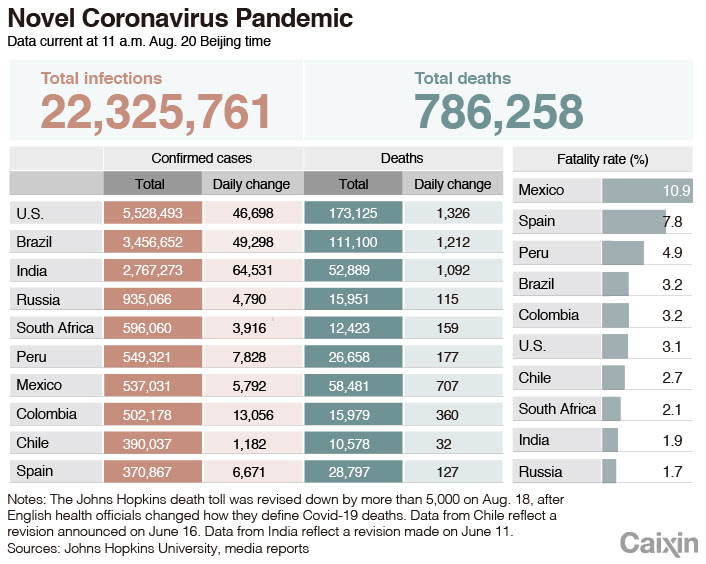
- The U.S. recorded 44,000 new COVID-19 cases Wednesday, up from the prior day’s 35,000, but the seven-day average of new cases remains below recent totals.
- Germany recorded more than 1,000 new coronavirus cases for a third straight day, with the number of infections near Tuesday’s four-month high. Cases increased by 1,586 in the 24 hours through Thursday morning, compared with a gain of 1,420 a day earlier and 1,693 on Tuesday, according to data from Johns Hopkins University.
- In France, new infections totaled 3,776 over the past 24 hours, the government’s health office reported Wednesday, the largest daily jump since May 6. Deaths increased by 17 to 30,468.

- Just one in seven parents said their children would be returning to school full time this fall, but four in five parents said they would have no in-person help educating and caring for them. (Morning Consult)

(NBF)
China and U.S. to Double Number of Weekly Flights
China and the United States agreed to double the number of scheduled passenger flights operated by each other’s airlines to eight a week in a move to ease a standoff between the world’s two largest economies on travel restrictions amid the pandemic.
The U.S. will allow four Chinese airlines flying to American cities to operate a combined eight weekly round trips, up from the current four, the Transportation Department said Tuesday. China’s civil aviation regulator issued a similar ruling concerning U.S. carriers.
The accord brings the number of scheduled flights between the two countries to 16 a week. Before the pandemic, Chinese and U.S. airlines operated about 300 weekly round-trip scheduled passenger flights between the two countries.
Trudeau Outlines ‘Expansionist Strategy’ With Freeland On Board
(…) The moves suggest Trudeau isn’t in any rush to reverse the kind of spending that has already driven the nation’s budget gap to 16% of economic output this year — the highest deficit since World War II. While the pandemic has been devastating, it also offers up an “unprecedented” opportunity for a long term recovery plan and to fill “gaps” in public health and social safety nets exposed by the pandemic, Trudeau told reporters.
“This is our moment to change the future for the better,” the prime minister said. “We can’t afford to miss it because this window of opportunity won’t be open for long.”
In Freeland, Trudeau has found an ally on aggressive fiscal policy, but someone with enough political clout in cabinet to maintain discipline on how the money is spent. (…)
Freeland on Tuesday endorsed the idea of an ambitious government plan. “This is a once in a lifetime challenge for our whole country and our commitment as a government is to do whatever it takes to support Canadians as we get through that challenge,” she said at the same press conference. The government wants “to turn this tremendous challenge into a fabulous opportunity for our country.”
Canada is poised to see budget deficits well in excess of C$100 billion for at least one more year. Economists see Canada’s budget gap at about that level in 2021 without new measures. The deficit for the current year is projected at C$343 billion — more than six times the previous all-time record. (…)
Trudeau said he will deliver a so-called Throne Speech in on Sept. 23 to outline the parameters of his new agenda, which is expected to include measures to bolster the country’s social safety net, such as revamping unemployment insurance, and more money for green infrastructure.
Without a majority of seats in parliament, he will need the support of at least one of the three opposition parties to press ahead, with the most likely partner being the left-of-center New Democratic Party.
Inflation in Canada Unexpectedly Falls Back to Near Zero
The consumer price index increased only 0.1% from the same month a year earlier, Statistics Canada reported Wednesday from Ottawa. That’s a reversal from last month when inflation turned positive on higher gas, food and shelter prices. On a monthly basis, prices were flat, and seasonally adjusted actually fell 0.1%.
Core inflation readings — seen as a better measure of underlying price pressure — ticked down to 1.63%, from 1.7% a month earlier. (…)
EQUITIES
The most benchmarked index in the world finally set a new high, ending the shortest bear market in history. It did so with only a single sector following it to a new high, and with odd readings and divergences. Relatively few tech stocks are above their medium-term averages, and even fewer industries, sectors, and countries are in solid uptrends. When the S&P reaches its first new high in months with only 1 or 2 sectors following suit, its future returns were mediocre with only one exception (1995). (…) It’s also odd to see a new high in an index like the S&P 500 with so few of its industries in solid uptrends. Only 57% of industries have a rising 200-day moving average. Even worse, only 55% of sectors have a rising average, and a pathetic 23% of countries do. There have only been three times in 30 years when the S&P hit a high and no more than 60% of industries, sectors, and countries were in solid uptrends. (SentimenTrader)
Yesterday, Lowry’s Research saw weak Breadth and Demand with total NY Volume again well below its 30-DMA, “suggesting a lack of conviction by bulls and bears, alike. Meanwhile, the Percent of NYSE Stocks Above 10-DMA fell to 41.76% as the short-term condition continues to weaken.”
SPY VS SPY EQUAL-WT
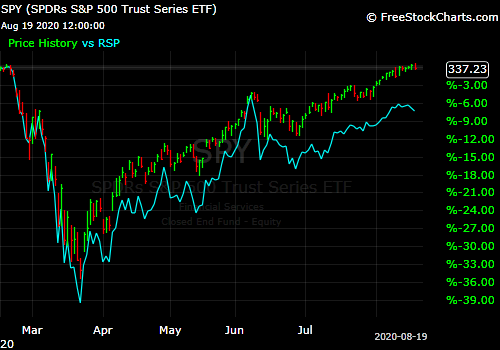
NDX VS NDX EQUAL-WT

US share buybacks almost cut in half by pandemic Provisional figures put the quarterly total at $89.7 billion, down 46% year-on-year, on pace for the lowest quarterly total since Q1 2012.
So, who’s doing the buying now?
-
Does Robinhood’s Design Make Trading Too Easy? The Silicon Valley company has turned the complex process of trading stocks into a simple, free swipe across a screen. But some researchers say the app’s simplicity nudges inexperienced investors to take bigger risks.
Well, at some point, many will discover the swipe does not really come free…
Barstool’s Portnoy Rattles Investors Saying He’s Sick
(…) Portnoy said he hasn’t left his bed in 40 hours. “Do I have Covid? Maybe,” he said in the video, which was posted to social media. “I’m just going to get better, so I can come back and do what I do, which is to entertain you.” (…)
Portnoy posted the video to explain to his followers why he didn’t post his live streamed day trading this morning. During quarantine, millions of Americans stuck at home with little to do have turned to investing and trading for the first time, including Portnoy, whose live stream show reaches millions of his followers. He tweeted last week about his interest in crypto. (…)
PANDEMONIUM
Trump calls for boycott of Goodyear tires after company bans political attire in the workplace
U.S. President Donald Trump on Wednesday called for a boycott of Ohio-based Goodyear Tire & Rubber Co. in response to a company policy that has deemed political attire, including that of the Trump campaign, unacceptable for the workplace.
“Don’t buy GOODYEAR TIRES – They announced a BAN ON MAGA HATS,” the Republican President tweeted, referring to his slogan, “Make America great again,” that often features on baseball caps worn by his supporters.
White House Press Secretary Kayleigh McEnany said Mr. Trump was concerned that the company allowed attire supporting the Black Lives Matter movement and other issues related to equality, but not the Blue Lives Matter group backing police officers, or MAGA. (…)
Goodyear said, it asks employees to avoid “workplace expressions in support of political campaigning for any candidate or political party as well as similar forms of advocacy that fall outside the scope of racial justice and equality issues.” (…)
FYI, Goodyear had about 15% of the U.S. tire market in 2019, in third place after Japan’s Bridgstone (27%), France’s Michelin (27%) and ahead of Germany’s Continental (13%) according to Statista. “MAGA!”
White House press secretary leaves open door to Trump rejecting results of election
“The only way we can lose, in my opinion,” he [Trump] said, intently, “ … is if cheating goes on.” (…)
In focusing so insistently on allegations of fraud, he has convinced many of his supporters that it occurs at significant scale and poses a persistent threat to our electoral system. According to his press secretary, Kayleigh McEnany, Trump himself actually believes his dishonest claims.
“The president said this week the only way we lose this election is if the election is rigged,” a reporter asked McEnany at a briefing Wednesday. “It begs the question: Does the president believe there’s any circumstance under which he can lose the election fairly?”
“The president believes he’s done a great job for the American people, and he believes that will show in November,” McEnany responded. “He believes that voter fraud is real, in line with what we see all across the country, particularly with mail-in ballots which are prone to fraud.”
“Is the president saying if he doesn’t win this election, that he will not accept the results unless he wins?” another reporter asked later.
“The president has always said he’ll see what happens and make a determination in the aftermath. It’s the same thing he said last November,” McEnany said, presumably referring to his assertions about November 2016. (…)
Trump Says QAnon Followers Are People Who ‘Love Our Country’ When asked, the president did not question the truth behind the claims of the QAnon conspiracy movement. Instead, he offered his help.
President Trump on Wednesday offered encouragement to proponents of QAnon, a viral conspiracy theory that has gained a widespread following among people who believe the president is secretly battling a criminal band of sex traffickers, and suggested that its proponents were patriots upset with unrest in Democratic cities.
“I’ve heard these are people that love our country,” Mr. Trump said during a White House news conference ostensibly about the coronavirus. “So I don’t know really anything about it other than they do supposedly like me.” (…)
The FBI intelligence bulletin from the bureau’s Phoenix field office, dated May 30, 2019, describes “conspiracy theory-driven domestic extremists,” as a growing threat, and notes that it is the first such report to do so. It lists a number of arrests, including some that haven’t been publicized, related to violent incidents motivated by fringe beliefs.
The document specifically mentions QAnon, a shadowy network that believes in a deep state conspiracy against President Trump, and Pizzagate, the theory that a pedophile ring including Clinton associates was being run out of the basement of a Washington, D.C., pizza restaurant (which didn’t actually have a basement).
“The FBI assesses these conspiracy theories very likely will emerge, spread, and evolve in the modern information marketplace, occasionally driving both groups and individual extremists to carry out criminal or violent acts,” the document states. It also goes on to say the FBI believes conspiracy theory-driven extremists are likely to increase during the 2020 presidential election cycle.
Alexei Navalny in a coma after suspected poisoning Russian dissident’s spokeswoman says the toxin was put in his tea on a flight to Moscow.


 Eventually, investors might need to factor this in: estimated S&P 500 Earnings Impact Based on Biden’s Proposals.


