Rebound in U.S. Retail Sales Slowed in July Amid Virus’s Surge
The value of retail purchases increased 1.2% from the prior month after an upwardly revised 8.4% gain in June, according to Commerce Department data released Friday. The median estimate in a Bloomberg survey of economists called for a 2.1% increase in July.
Even so, it was the third straight gain and the total value of retail sales is now above pre-pandemic levels, with July purchases also up 2.7% from a year earlier. That indicates one major part of the economy has returned to near its previous trend, though the mix of spending now is more concentrated in categories like online sales and groceries, while restaurants and apparel stores remain well below typical levels.
The monthly slowdown, compared with June, reflected declines in sales of motor vehicles and building materials, along with weaker gains at restaurants and clothing stores.

From the WSJ:
(…) Meanwhile, fresher data suggest growth in retail spending may have softened this month. (…)
Only 36% of consumers tracked by GlobalData spent more or the same amount on retail purchases during the first week of August as they did the same week a year ago. That is down from 57% who did so during the last week of June.
Foot traffic to retail stores declined six weeks ago, coinciding with the receipt of the last batch of stimulus checks, a separate part of the pandemic relief unrelated to the added unemployment benefits, according to Aneta Markowska, the chief financial economist at Jefferies Group LLC, which parses data from location-tracking company SafeGraph Inc. Since then, foot traffic has remained fairly steady, despite the end of the additional unemployment benefits.
Weekly Unemployment Claims Drop Below One Million for First Time Since March Number of people collecting unemployment benefits through regular state programs also fell at the beginning of August
New applications for unemployment benefits dropped to a seasonally adjusted 963,000 in the week ended Aug. 8, the Labor Department said Thursday, marking the second weekly reduction in filings. The number of people collecting unemployment benefits through regular state programs, which cover the majority of workers, also decreased to about 15.5 million at the beginning of August.
But both figures remain well above even the worst figures before the pandemic struck, with the number of people receiving benefits more than double the 6.6 million reached in 2009. (…)
Some workers who don’t qualify for benefits under regular state programs—such as the self-employed, gig workers and parents who can’t find child care—can collect benefits under a federal stimulus bill passed in March. About 10.7 million individuals were collecting benefits through this program at the end of July, a decline from the previous week’s 13 million.
Without the $600 weekly boost, payments dropped to the level set by states, which averaged about $330 a week for the 12 months through June, according to the Labor Department. (…)
A Cornell University survey that showed about 31% of workers who were placed back on payrolls after an initial layoff were laid off a second time. (…)
Bespoke charts the trends. Keep in mind that initial claims are a flow, continuous claims a stock. The flow feeds the stock.
Not only is the headline number of claims improving but so are claims for Pandemic Unemployment Assistance (PUA). Initial claims by this measure fell from 0.66 million to 0.49 million this week. These are some of the lowest readings since the program began in mid-April. That brings the total between NSA claims and PUA claims to 1.32 million. While lagged an additional week, continuing claims for the week ending July 24 (26.6 million) were the lowest since April 24th, and for PUA claims in particular, it was the lowest reading since the end of May.

The U.S. still has over 25 million jobless claimers, down only 5 million (17%) from the 30 million average since mid-May, and 15% of the total labor force at the end of February.
The WSJ Justin Lahart adds
Figures from scheduling-software company Homebase, for example, show that the number of hourly employees working at restaurants, retailers and other small businesses has been flat since early July. That is notable because the Homebase figures have been one of the better predictors of what the Labor Department’s monthly job figures will show since the pandemic struck. Data from Kronos, a workforce management software company, shows growth in work shifts following a similar path to the Homebase figures.
This looks like a swoosh:
China’s Recovery Loses Some Momentum as Retail Sales Disappoint Again Factories continued to lead the recovery, but retail sales remained in negative territory, defying expectations for a second straight month of a return to pre-coronavirus levels.
China’s factories continued to lead the recovery last month, though the 4.8% expansion in industrial production from a year earlier, matching June’s increase, undershot economists’ expected 5.0% increase, according to data released Friday by the National Bureau of Statistics.
For July, retail sales fell 1.1% from a year earlier, a narrower decline than June’s 1.8% year-over-year drop but missing economists’ projection for retail sales to finally match last year’s levels. With July’s disappointment, retail sales have recorded negative growth every month this year.
Taken together, Friday’s data release suggested to some economists that China’s rebound may have already seen its best days after the second quarter’s better-than-expected 3.2% expansion in gross domestic product. (…)
The higher jobless rate, coupled with stagnating income for many Chinese citizens, threatens to exert more pressure on the consumer sector, whose recovery has lagged behind that of other economic drivers this year.
Even so, there were some bright spots. China’s fixed-asset investment dropped 1.6% in the January-July period compared with the year-ago period, narrower than the 3.1% decline in the first half of the year and a touch better than economists’ estimates.
Investment in the property sector, which has rebounded quickly amid credit easing, accelerated its year-over-year growth rate to 3.4% in the first seven months of 2020, while home sales for the first time this year moved into positive territory by growing 0.4% in the January-July period from a year earlier. (…)
Reuters adds that “the decline in retail sales was broad based with garments, cosmetics, home appliances and furniture all worsening from June. A key exception was auto sales, which surged 12.3%, turning around from a 8.2% fall in June.”
ZeroHedge has the charts:

Meanwhile:
- As cases creep higher across Western and central Europe, France has placed Paris and the Bouches-du-Rhône department around Marseille on “virus red alert,” issuing a decree that allows local officials to impose new social distancing restrictions if need be. The move follows a rapid rise in the number of those testing positive for the virus in recent days. On Thursday, 2,669 people tested positive across France, the 4th time in a week that the number exceeded 2,000.
- New Zealand PM Jacinda Ardern announced plans on Friday to extend a new lockdown on Auckland by 12 days as more cases are discovered in the city.
- Germany reported 1,422 new cases in the 24 hours ending Friday morning, up from 1,319 the previous day and bringing its total to 222,281, according to JHU data. Meanwhile, Germany’s infection rate – represented algebraically as “R” – has remained below the key level of 1, above which denotes expansion.
- Brazil reported 60,091 new cases on Thursday evening, the biggest daily increase since July 29, according to the Health Ministry. That pushed Brazil’s total north of 3.2 million.

The key in this next log chart is the slope of each curves:

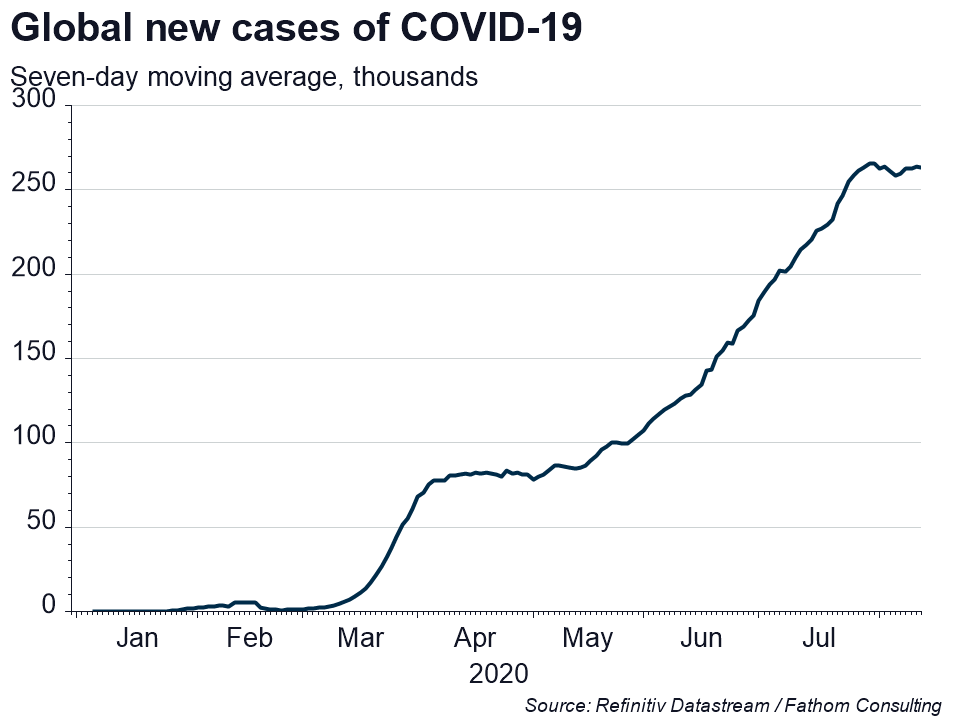
Yet, “new cases of COVID-19 have plateaued, globally. Newly identified coronavirus infections look to have plateaued at around 270,000 a day. The majority of new cases in recent weeks have occurred in the US, Brazil and India. The first two of these countries have already suffered substantial outbreaks.”
While COVID-19 is having a different impact on each state, the US economy as a whole remains at risk
(…) According to the WHO, a government should resist the urge to reopen if COVID-19 positivity rates (the share of COVID-19 tests that come back positive) exceed 5% over a 14-day period. While positivity rates in each US state are subject to sample bias related to the state’s testing policies, the data are still a useful benchmark. By juxtaposing these rates against each state’s economic output (we use 4Q19 Gross State Product), a clearer picture of how much of the US economy is exposed to the virus and potential lockdowns emerges.
Only 14 states in the US currently meet the WHO’s 5% criterion. The remaining 36 states (75% of US GDP) are grappling with positivity rates above 5%, and 13 of those (29% of US GDP) are registering positivity rates of 10% or higher—twice the WHO’s cutoff. While these numbers appear to have been improving in recent weeks, policymakers and business leaders should monitor them closely as they work to balance the public health risks with the risk to the US economy.

Over the past several days, the share of doctor visits for COVID-like illness symptoms compiled by Carnegie Mellon University’s COVIDcast has increased in most states compared to two weeks ago. In July, the decline in symptom prevalence that this series captured led the decline in new cases by about two weeks in some states. (GS) Chart below is from NBF.

FYI: The long-term impact of Covid-19 on children.
EQUITY MARKETS
Goldman Sees Room for S&P to Surpass 3,600
(…) “There is still room for market pricing of U.S. growth views to move higher, particularly given improving prospects for an early vaccine,” the note said. “While a back-up in real yields would be a potential drag on equity returns, as long as it is driven by an upgrade to the market’s cyclical views, the improved cyclical outlook would dominate the effect of rising real yields and drive equities higher.” (…)
Market strategists including Yardeni Research’s Ed Yardeni and Fundstrat Global Research’s Tom Lee have recently boosted their year-end estimates for the benchmark.
Here’s Yardeni’s reasoning: Another Roaring Twenties May Be Ahead
(…) World War I was followed by the Spanish Flu pandemic of 1918, which infected an estimated 500 million people and killed as many as 50 million. Given that the world population was 1.8 billion back then, that implied a 28% infection rate and nearly a 3% death rate. Both stats are currently significantly lower for the COVID-19 pandemic. Today, the global population is 7.5 billion. There have been 20 million cases and 735,000 deaths worldwide as of yesterday.
The good news is that the bad news during the previous precedent was followed by the Roaring Twenties. So far, the 2020s has started with the pandemic, but there are plenty of years left for the prosperous 1920s to become a precedent for the current decade. If so, the driver of the coming boom will be technology-enhanced productivity, as it was during the 1920s. (…)
Today’s doomsters could be confounded by biotechnological innovations that deliver not only a vaccine for COVID-19 but for all coronaviruses. Scientists are investigating a dizzying array of approaches to fight COVID-19. Hopefully, beyond finding a cure or a vaccine, one of beneficial outcomes of all this research will be that scientists learn many more ways to combat illnesses in general and viruses in particular. Typically, it takes roughly a decade for a new vaccine to go through the various stages of development and testing. However, the urgency of the pandemic has mobilized global medical resources as rarely seen in human history. Billions of dollars, provided by both the public and the private sectors, are funding the global campaign to develop tests, vaccines, and cures for the virus. (…)
Now consider the follow stats on technology capital spending in the US: High-tech spending on IT equipment, software, and R&D rose to a record $1.32 trillion (saar) during Q2-2020 (Fig. 1). It jumped to a record 50.1% of total capital spending in nominal GDP during the quarter (Fig. 2). Equipment and software accounted for 31.1%, while R&D accounted for 19.1% of capital spending in nominal GDP (Fig. 3).
The 1920s ended with a stock market meltup followed by a meltdown. The 2020s may already be seeing a meltup, begun on March 23. We live in interesting, though not unprecedented, times. The Roaring 1920s could be a precedent for the Roaring 2020s. As Mark Twain observed: “History doesn’t repeat itself, but it often rhymes.”
What Yardeni omits to mention is that equity valuations in 1920 was the lowest ever with the CAPE P/E at 4.8, roaring to 31.5 at the 1929 peak. It is now 30.0. Narratives are fun, numbers are boring.

-
REASONS (NOT) TO BE CHEERFUL Certainty, Absurdity, and Fallacious Narratives (GMO’s James Montier)
Never before have I seen a market so highly valued in the face of overwhelming uncertainty. Yet today the U.S. stock market stands at nosebleed-inducing levels of multiple, whilst the fundamentals seem more uncertain than ever before. It appears as though the U.S. stock market has drunk from Dr. Pangloss’ Kool-Aid – where everything is for the best in the best of all possible worlds. It is as if Mr. Market is taking a tail risk (albeit a good one) and pricing it with certainty. (…)
Instead, as best I can tell, the driving narrative behind a V-shaped recovery in the stock market seems to be centered on “The Fed” or, even more vaguely, “liquidity creation.” It is tricky to argue for any direct linkage from the Fed’s balance sheet expansion programs to equities. The vast majority of QE programs have really been about maturity transformation (swapping long debt for very short-term debt). Nor can one claim a good link between QEs to yields to equities. In fact, during each of the three previous waves of QE, bond yields actually rose. In addition, yields around the world are low but you don’t see other equity markets sporting extreme valuations. So, I think that Fed-based explanations are at best ex post justifications for the performance of the stock market; at worst they are part of a dangerously incorrect narrative driving sentiment (and prices higher).
The U.S. stock market looks increasingly like the hapless Wiley E. Coyote, running off the edge of a cliff in pursuit of the pesky Roadrunner but not yet realizing the ground beneath his feet had run out some time ago.
Investing is always about making decisions under a cloud of uncertainty. It is how one deals with the uncertainty that distinguishes the long-term value-based investor from the rest. Rather than acting as if the uncertainty doesn’t exist (the current fad), the value investor embraces it and demands a margin of safety to reflect the unknown. There is no margin of safety in the pricing of U.S. stocks today. Voltaire observed, “Doubt is not a pleasant condition, but certainty is absurd.” The U.S. stock market appears to be absurd. (…)


 China’s health authorities Thursday reported eight new locally transmitted cases, all in the northwestern region of Xinjiang. Authorities in the southern city of Shenzhen said they detected the coronavirus on packages of chicken imported from Brazil, while the eastern city of Wuhu found the virus on packages of shrimp imported from Ecuador. Imported food has been a recent source of alarm in China, leading to partial bans on imports from some countries.


 The U.S. Energy Department

