The enemy of knowledge is not ignorance, it’s the illusion of knowledge (Stephen Hawking)

It ain’t what you don’t know that gets you into trouble. It’s what you know for sure that just ain’t so (Mark Twain)

Invest with smart knowledge and objective odds

THE DAILY EDGE: 12 AUGUST 2020

Sixty-two percent of U.S. adults are “very” concerned about the coronavirus outbreak, the highest amount since late April.
Funding for $300-a-Week Unemployment Benefits Could Run Out in Six Weeks An extra $300 a week in federal unemployment benefits is likely to take a couple of weeks to reach workers and funding could be exhausted a month and a half later, a senior Labor Department official said.

(…) The Labor Department official said the $300 supplemental unemployment payments would give about 50% of workers at least the same amount of money through benefits that they earned while working. Raising the total to $400 with additional state funds would bring that total to about two-thirds of workers. (…)

So far, no state has said they plan to pay the extra $100, which the senior Labor Department official attributed to states’ need for additional information on Mr. Trump’s memo. (…)

MarketWatch:

(…) But there are several catches to the order that could leave behind some 6 million Americans who were previously eligible for the extra $600 a week benefit under the $2 trillion CARES Act stimulus package, said Eliza Forsythe, a labor economist and assistant professor at the University of Illinois at Urbana-Champaign. (…)

Unlike traditional salaried workers, self-employed and gig workers often have volatile incomes that are not automatically reported to state workforce agencies. Many of these workers are more likely to receive their state’s minimum unemployment benefit, which is below $100 for the majority of states, according to the Department of Labor.

Forsythe said this could apply to approximately 5 million workers.

Her calculations reveal that nearly 1 million unemployed workers are currently receiving below $100 a week from their respective states and hence would also be ineligible for the extra $300.

Fed to Lower Rates for Cities, States Seeking Short-Term Loans Interest-rate spread on tax-exempt notes will be reduced by 0.5 percentage point

(…) Both the municipal program and a separate Fed program to jump start corporate debt issuance have seen very little takeup. But critics have said the lack of demand for municipal debt is a problem because local governments are already responding to the downturn with layoffs and cutbacks in services that could be avoided if borrowing from the Fed’s program were cheaper. (…)

“Getting liquidity is helpful, but it doesn’t solve their bigger problem, which is they have a fiscal hole,” Dallas Fed President Robert Kaplan said in an interview last month.

“They need grants, and if they don’t get some fiscal relief, they’re going to need to cut back at a time when they’re at the forefront of trying to get schools reopened and…spend more on a whole range of services in their states and in their communities to help fight the virus.”

JULY NFIB SURVEY:

Half of the ten components of the Optimism Index fell, led by a 14 percentage point drop in the share of firms expecting the economy to improve to 25%. Expectations for real sales over the next six months decreased to 5% from 13%. And, only a net 11% of firms felt it was a good time to expand their business down from 13%.image

image

image

image

image

MOVING?

There are many ideas about how the pandemic will affect us over the long term. One of the most common theories is that large cities will be among the biggest losers. Looking beyond any increased health risk related to COVID-19, it seems reasonable to expect many will enjoy more flexible working patterns than before, including the option for increased working from home. That may be enough to persuade some city dwellers to move further afield, knowing that longer commutes may not be a daily requirement. There are signs of that from US rental prices. Data from Zumper show that nine out of ten of the most expensive US cities to rent a one-bedroom apartment have experienced declines in rental prices. However, it is still too early to tell whether this reflects cyclical or structural factors. Moreover, to the extent that any declines are permanent, large cities may actually increase their appeal once more, particularly for the young. (Fathom Consulting)

July Consumer Prices Rise Amid Increased Demand for Range of Goods, Services The consumer-price index climbed a seasonally adjusted 0.6% in July, the Labor Department said Wednesday.

The index also rose 0.6% in June, which was seen as a potential turning point for consumer prices, following declines in March, April and May amid the pandemic’s initial economic fallout. Compared with a year earlier, the gauge increased 1%, after June’s 0.6% rise.

Excluding the often-volatile categories of food and energy, so-called core prices rose 0.6%, compared with a 0.2% increase in June, posting its largest month-to-month increase since January 1991.

On an annual basis, core inflation measured 1.6%, a four-month high, following 1.2% in June.

This big jump in the YoY core CPI has a meaningful impact on the Rule of 20 P/E which is now 24.8, its highest level since June 2002.

image
Eurozone industrial production recovers, but it’s far from completing the V The mechanical recovery from lockdown remains underway and has not yet lost speed. This is encouraging, but at -11.6% below February levels, it is still unclear how large the lasting damage will be

Industrial production grew by 9.1% in June, confirming that the recovery from lockdown continues to quickly add to production. The recovery can be considered mechanical as mandatory shutdowns and voluntary closures or limited production to curb the virus have been gradually lifted, causing production to automatically increase. The 9.1% increase follows a 12.3% increase in May, meaning that the pace of recovery has fallen only slightly in the second month of reopening. The improvements were widespread across production categories with non-durable consumer goods production even accelerating in June. (…)

Whether the V will be completed in the summer months remains the question. We expect that it will fall short due to a lack of demand in the aftermath of the crisis, supply chain disruptions and even a possible flareup of the trade war. We now have to ask at what point will the mechanical recovery level off, giving a better idea of the lasting damage of the coronavirus crisis.

Even though it is unlikely that the V will be completed soon, recent survey data has been encouraging. Manufacturing businesses indicate that output has continued to recover in July and that new orders have also been returning quickly. Some pent-up demand will likely continue to cause industrial production to trend higher in the coming months, but due to all the downside risks to the manufacturing outlook, concerns about a sustained quick recovery of production remain justified.

China’s Xi Speeds Up Inward Economic Shift With the world in recession and U.S.-China tensions deepening, President Xi Jinping is laying out a major initiative to accelerate China’s shift toward more reliance on its domestic economy.

The new policy is gaining urgency as Chinese companies, including Huawei Technologies Co. and Bytedance Ltd., face increasing resistance in foreign markets, Chinese officials say.

In a series of speeches to senior government officials since May, Mr. Xi has trotted out the new strategy, translated as “domestic circulation,” prioritizing domestic consumption, markets and companies as China’s main growth drivers. Investments and technologies from overseas, though still desirable, would play more of a supporting role. (…)

The goal is to make China far less dependent on foreign firms, technology and markets (…)

A March survey by UBS Group of Japanese, Korean and Taiwanese companies that produce in China and sell to the rest of the world found that 85% had already relocated or intended to shift some capacity out of China. (…)

According to a new survey by the U.S.-China Business Council, 83% of more than 100 member companies in manufacturing, services, energy and agricultural sectors count China as either the top or among the top five priorities for their global strategies. (…)

“Xi has made it imperative to make the state sector bigger, stronger and better,” says a Chinese official involved in policy making. “That will never change.” (…)

Tesla to Enact 5-for-1 Stock Split Tesla will enact a 5-for-1 stock split after a share-price surge over recent months vaulted the electric-vehicle maker to the status of most-valuable car company as CEO Elon Musk navigated the pandemic.

THE DAILY EDGE: 11 AUGUST 2020

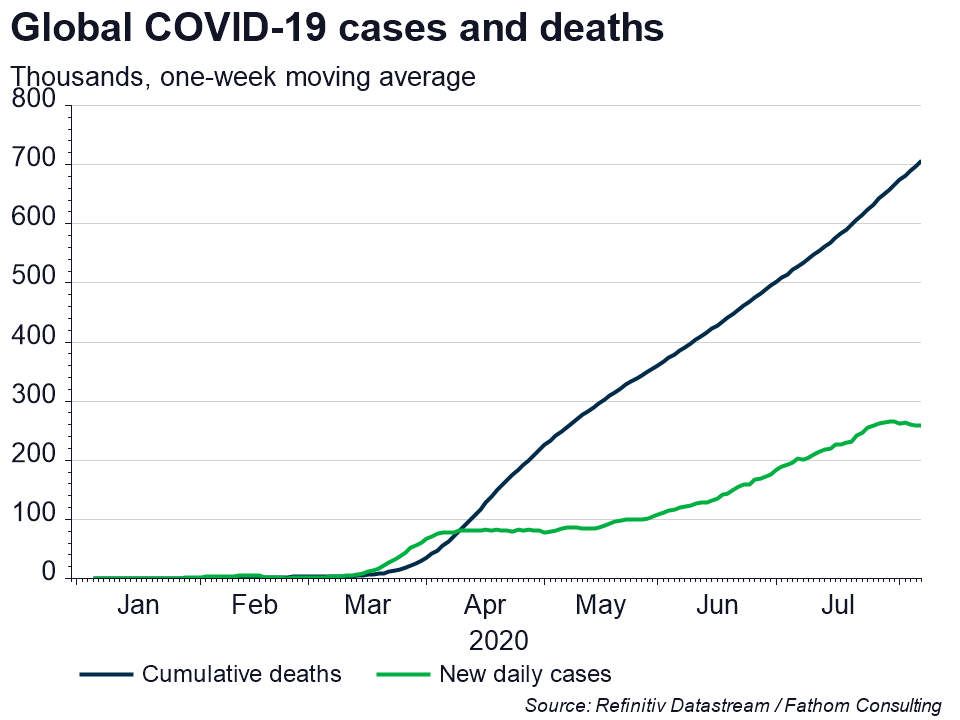
The U.S. reported fewer than 50,000 new coronavirus cases for the second day in a row, even as the number of cases world-wide surpassed 20 million.

0_All Key Metrics (20)

3R_Reg PosperMill (1)

2R_Reg Tests & % Pos (1)

image

  • Australia’s Victoria state reported 331 new cases and 19 deaths, the majority in nursing homes, which have borne the brunt of a second wave of infections in the state. Victoria’s premier appeared before a state government inquiry into the outbreak on Tuesday. State and federal leaders have indicated that border closures between states may remain in place until Christmas or beyond as they try to avoid fresh outbreaks of the scale seen in Victoria. New South Wales, home to Sydney, recorded 22 new cases, its highest daily figure since April.
  • Japan’s capital on Tuesday reported 188 new cases, the second day in a row Tokyo’s daily total has fallen below 200. Nationwide, 852 cases were reported, the lowest tally in two weeks.
  • From GS:
  • A review of 201 transmission events finds that clusters predominantly occurred indoors, including in restaurants, bars, senior housing, food plants, religious venues, offices, and dormitories. A detailed analysis from Japan estimates that the infection odds are nearly 19 times greater indoors compared to outdoors. We have also found a strong positive correlation between virus spread and summer restaurant activity across US states and in the Sun Belt, where hot weather drives customers inside.

    Relatedly, 238 scientists have emphasized the potential for the virus to spread in tiny droplets called aerosols that can accumulate in poorly ventilated areas. Airborne transmission is increasingly seen as an important source of transmission, in addition to larger droplets generated by coughing, sneezing, and talking. In contrast, a recent comment in the Lancet argued that the chance of transmission through surfaces is very small.

    We have also found that attendance of crowded public places sharply and significantly increases infections.

    image

Consumers’ Comfort Level With Most Leisure Activities Stagnates After Dropping in Late June

unnamed (41)

Putin Says Russia Has Registered World’s First Covid-19 Vaccine

(…) The vaccine, which is being developed by Moscow’s Gamaleya Institute and the Russian Direct Investment Fund, began Phase 3 trials last week. Medics could begin receiving the vaccine by the end of the month, Deputy Prime Minister Tatyana Golikova said at the meeting. (…)

PANDENOMICS
U.S. JOLTS: Job Market Continues to Improve in June

The Bureau of Labor Statistics reported that the total job openings rate rose to 4.1% during June, the highest level since February and up from April’s low of 3.7%. The openings rate is calculated as job openings as a percent of total employment plus jobs that have not yet been filled.(…)

As of the last business day of June, the job openings level rose a still depressed 5.889 million, down 18.0% y/y. The job openings level in the construction sector fell by one-quarter y/y and in manufacturing by nearly one-third y/y. It fell by 10.8% y/y in leisure & hospitality and by 21.6% y/y in the professional & business service sector. In government, the number of job openings declined 6.5% y/y. (…)

Beware the headline here. These days, “improvement” is all relative:

fredgraph - 2020-08-11T071156.361

The Conference Board Employment Trends Index™ (ETI) Increased in July

(…) This stark deceleration represents a preview of what’s to come: Over the next several months, job growth will significantly put on the brakes, likely causing the national unemployment rate to remain in double-digit territory. Less generous government stimulus will dampen consumer spending. In addition, more waves of downsizing and bankruptcies will spur widespread layoffs—and thus further constrain the expansion of the US workforce. (…)

image
Death spiral for consumers As Congress deadlocks over pandemic relief and President Trump issues executive orders of dubious potency, many Americans are suffering from a quintuple whammy: unemployment, overdue rent, mounting bills, food insecurity and health fears.

Joblessness remains “alarmingly high,” as one NYT article describes it.

Food pantries are overwhelmed. (Feeding America, which runs 200 food banks, says average demand is up nearly 60% and one in six Americans could face hunger as a result of the pandemic.)

A massive wave of homelessness is starting to swell. (“Eviction cairns” are cropping up in New Orleans, where piles of people’s belongings are being thrown out on the street.)

People are even surrendering pets because they can’t afford to take care of them. (…)

Employers Cast Wary Eye on Trump Payroll-Tax Deferral Employers considering President Trump’s plan to allow deferred payment of payroll taxes face a series of costs, uncertainties and headaches.

(…) Employers’ biggest worry: If they stop withholding taxes without any guarantee that Congress will actually forgive any deferred payments, they could find themselves on the hook. That is a particular risk in cases where employees change jobs and employers can’t withhold more taxes from later paychecks to catch up on missed payments. (…)

Lawmakers have criticized the payroll-tax cut for several reasons. They argue that it doesn’t provide much of a hiring incentive, gives too much money to people who already have jobs as opposed to the unemployed and could destabilize Social Security funding. (…)

“It’s just so risky on so many levels,” she said.

  • State agencies charged with paying unemployment benefits to jobless residents have their backs against the wall as they rush to parse President Trump’s executive actions on coronavirus aid, Axios’ Courtenay Brown writes. States are being asked to pitch in $100 per unemployed resident, but it’s a heavy lift for cash-strapped states that are still unclear about the details and may not opt-in at all. Plus, any changes to decades-old state unemployment systems would take weeks to implement. “If we have to make any changes to our computer system put in in 2000 … it’s going to keep people from getting those funds,” said Kentucky Gov. Andy Beshear.
  • President, Democrats Open to Restarting Stimulus Talks The White House and Democratic negotiators urged each other to resume discussions over a broad relief package after the president issued executive actions on jobless aid and other measures over the weekend.
Trump’s Executive Order on Evictions Likely Won’t Prevent Any Evictions The president’s order doesn’t actually require any concrete action to prevent a coronavirus housing crisis.

(…) Saturday’s executive order doesn’t renew the federal moratorium on evictions that expired in July. In fact, it doesn’t authorize any new action on evictions or foreclosures at all. Rather it instructs the leaders of several agencies, namely the U.S. Department of Housing and Urban Development, to look again at existing funds or options for protecting renters, without promising any specific relief. (…) Diane Yentel, the president of the National Low Income Housing Coalition, described Trump’s new executive order as an “empty shell of a promise” in an email. (…)

Trump Says He’s ‘Seriously’ Considering Capital Gains Tax Cut

President Donald Trump said he’s “very seriously” considering a capital gains tax cut, a move he decided against last September after saying it wouldn’t do enough to help the middle class.

“We’re looking at also considering a capital gains tax cut, which would create a lot more jobs,” Trump said Monday at a White House news conference.

The president can’t unilaterally cut the 20% long-term capital gains rate without Congress, but some advisers tell him he could issue an executive order that would slash tax bills for investors when they sell assets. The move, known as indexing capital gains to inflation, adjusts the original purchase price of an asset when it is sold so no tax is paid on appreciation tied to inflation.

Revamping capital gains taxes through a rule or executive order likely would face legal challenges, a concern that reportedly prompted former President George H.W. Bush’s administration to drop a similar plan. (…)

The White House seems to be in “whatever-it-takes” mode. Hence:

A survey released today by the NYC Hospitality Alliance details the latest data on the state of New York City’s devastated hospitality industry.

The survey of nearly 500 owners and operators of restaurants, bars and nightlife establishments across the city found that a growing number of businesses could not pay rent in July. 83 percent of businesses could not pay full rent in July and 37 percent of businesses reported paying no rent at all.

Adding to the challenges that restaurants, bars and nightlife venues face are inflexible landlords, some of whom have their own set of difficulties. 71 percent of landlords would not waive portions of rent due to COVID-19, 61 percent would not defer rent payments and 90 percent of landlords would not formally renegotiate leases.

UK sheds nearly 750,000 jobs during coronavirus crisis Number claiming out-of-work benefits rises to 2.7m in July, more than double the pre-pandemic level

(…) Total pay, including bonuses, was 1.2 per cent lower in the three months to June than a year earlier, while the total weekly hours worked in the UK fell by a record amount, to almost a fifth below pre-lockdown levels. (…)

China’s Strong July Auto Sales Fuel Hopes for Growth Chinese consumers flocked back to auto dealerships in July, boosting car makers’ hopes of returning to growth in the second half of the year and signaling a broader rebound in the world’s second-largest economy.

Retail passenger-car sales increased 7.7% in July from a year earlier, to 1.6 million units, the China Passenger Car Association said Tuesday, marking the strongest month of sales growth by percentage in more than two years. (…) The Chinese auto market now looks to be picking up, thanks to a combination of government incentives and bargain prices from dealerships eager to move vehicles off the lot. (…)

In July, the growth in wholesale sales continued to outstrip that of retail sales, rising 16.4% from a year earlier, according to the China Association of Automobile Manufacturers. The government-backed body warned Tuesday of excessive inventory levels as dealers restock with vehicles for which there is so far insufficient demand. (…) Second-half sales are now on track to increase roughly 4% from a year earlier, resulting in a full-year sales decline of roughly 10% for 2020. (…)

S&P 500 Announced and Completed Buybacks

Robinhood Blows Past Rivals in Record Retail Trading Year

The company, which runs a no-fee trading app in the U.S. that’s drawing millions of new users as well as a few critics, said that daily average revenue trades — known as DARTs — were 4.31 million in June. That’s about four times the number of fee-generating trades at E*Trade Financial Corp. for the same period, and higher than all of its publicly traded rivals. Robinhood is among brokers that still use the DART term even though they don’t charge fees. (…)

“It’s surprising that this organization’s only seven years old and has surpassed Ameritrade, which was founded in the mid ‘70s,” Larry Tabb, Bloomberg Intelligence’s head of Market Structure Research, said in an interview. “It’s really difficult to analyze information on a mobile screen.” (…)

FYI, Robinhood is mostly used by millennials to trade stocks and cryptocurrency and more than half of Robinhood customers are opening their first brokerage account, and the median customer age is 31 years old, according to the company. (CNBC)

FYI, Nielsen Media Research has defined millennials as adults between the ages of 22 and 38 years old in 2019.