SWOOSH
The Aggregate Weekly Payrolls Index is (employment x hours x hourly wages). It correlates very closely with consumer spending. Morphing from a V to a swoosh, down 7.1% from February’s level and -3.1% YoY in July. Let’s hope the swoosh keeps up. We are still down 13 million jobs from February’s peak.

Covid-19 Pandemic Triggers Wave of Long-Term Unemployment An increasing number of workers were unemployed for more than three months in July, a signal that the coronavirus pandemic is likely to have a lasting economic impact on many people.
The number who were unemployed between 15 and 26 weeks rose by a seasonally adjusted 4.6 million to 6.5 million people last month, according to the Labor Department. The July reading is the highest on record for the category in data going back to 1948, and it is nearly double the prior peak, set in 2009 at the end of the last recession.
It is an ominous signal that even as overall hiring improves, millions of workers are facing the prospect of being out of a job for a long time. (…)
- Government jobs, mainly in public schools, rose by a seasonally adjusted 300,000 in July. That’s welcome relief for a sector that typically stabilizes the economy in downturns, but which has been hard hit by the pandemic. However, it may be a mirage. On an unadjusted basis public-school jobs continued to decline in July, but the decrease was smaller than seasonal factors expected—because so many jobs have already been cut. Bottom line: If large school districts holding class online this fall don’t rehire staff, job losses will resume in the public sector soon. —Eric Morath (WSJ)
- Friday also saw this press release:
Job cuts announced by U.S.-based employers jumped in July to 262,649, the third-largest monthly total ever behind April’s 671,129 and May’s 397,016, according to a monthly report released Thursday by global outplacement and business and executive coaching firm Challenger, Gray & Christmas, Inc.
July’s total is 54% higher than the 170,219 job cuts announced in June, and 576% higher than the July 2019 total of 38,845. Prior to the COVID-19 pandemic, the highest monthly total of job cuts was 186,350 in February 2009. (…)
The reason cited for 77,092 of the announced cuts is market conditions. COVID-19 caused 63,517 cuts in July, followed by 60,831 job cuts due to demand downturn, and 17,069 cuts due to voluntary severance/buyouts. COVID-19 is the reason for 1,074,904 cuts so far this year.
“The lapse in extended unemployment benefits for millions of Americans will significantly impact the economy, as we see more employers announce they are cutting jobs permanently,” said Andrew Challenger, Senior Vice President of Challenger, Gray & Christmas, Inc. (…)
Hiring announcements almost equaled the number of jobs cut in July, as companies
announced 246,507 hiring plans. Warehousing led with 100,340 hires, as more and more Americans shop online. Government plans to add 22,024 jobs, and the Services sector is
looking to add 33,485 jobs. So far this year, 1,582,622 hiring plans have been announced.“The long-lasting ramifications of COVID-19 on certain industries are readily apparent. It is
clear that many job losses are now permanent, and it will be challenging for many workers to
find new jobs and feel safe taking jobs that are public-facing,” said Challenger.
Canadian economy adds 419,000 jobs in July; more than half of pandemic losses now recouped
The results were more subdued than June’s gain of 952,900, but were accompanied by a sharp reduction in the unemployment rate, to 10.9 per cent from 12.3 per cent, Statistics Canada reported Friday.
The labour market has now recovered about 55 per cent of the three million jobs lost between February and April, when COVID-19 forced lockdowns that shuttered non-essential businesses. (…)
To date, the U.S. has recouped about 42 per cent of its pandemic job losses and has struggled with a recent surge of COVID-19 cases and persistently high numbers of people filing unemployment claims. (…)
In the coming weeks, the Canada Emergency Response Benefit – which pays $2,000 every four weeks to workers affected by the pandemic – will be phased out. Some workers will be moved over to employment insurance; the federal government intends to relax the qualification criteria in order to include more people. (…)
Trump’s Executive Orders He escapes Pelosi’s political trap but uses Obama’s ‘pen’ and ‘phone’ method.
The good news is that President Trump on Saturday escaped the trillion-dollar terms of surrender demanded by House Speaker Nancy Pelosi. The bad news is that he followed the Barack Obama method with executive orders, one of which stretches the law in a way that a future progressive President will surely cite as a precedent. (…)
The President’s deferral of payroll taxes for Americans earning less than $104,000 a year through Dec. 31 poses no legal issues. Congress has already deferred the employer portion, and under the law Mr. Trump can defer the 6.2% employee share.
The rub is that cancelling the tax requires an act of Congress, so the deferred tax will have to be repaid. This makes the tax cut a limited economic stimulus because employers and employees aren’t likely to change their behavior if they know the tax must be repaid in 2021. At most it means more money in workers’ pockets for four months. But Mr. Trump said he’ll offer legislation to cancel the repayment if he wins re-election, which now becomes part of the campaign debate. Will Mr. Biden promise to raise this tax on middle-class workers next year? (…)
The executive orders extending relief on rental and homeowner evictions and interest on student loans are modest and also within the law. The eviction order is essentially a command for agencies to “consider” what can be done. The loan-relief order is within Congress’s grant of authority. It is only for three additional months through the end of the year for debt held by the Department of Education.
Mr. Trump’s worst order would redeploy up to $44 billion from the Federal Emergency Management Agency’s (FEMA) Disaster Relief Fund to finance extra jobless benefits by $300 a week (plus $100 a week if states choose to match it with previous relief money).
Covid-19 is a national emergency, and unemployment is the result of the virus and government shutdowns. But Congress passed jobless aid as part of the Cares Act that was separate from the Disaster Relief Fund. Mr. Trump is commandeering the power of the purse that the Constitution reserves for Congress.
Yes, Mr. Obama did it first. He paid health insurers cost-sharing subsidies under ObamaCare without an appropriation from Congress. More famously, as part of his “pen” and “phone” strategy, he used executive diktats to provide work permits for millions of undocumented aliens. Democrats and the media cheered these abuses, and Mrs. Pelosi’s charge now that Mr. Trump’s orders are “absurdly unconstitutional” is partisan hypocrisy.
Mr. Trump’s FEMA order may survive because no states are commandeered nor individuals harmed, and it lasts only through Dec. 6 or until the money runs out. The House would have standing to sue, but Mrs. Pelosi might not like the political look of suing to deny Americans extended jobless benefits.
These columns opposed Mr. Obama’s orders, and one constitutional abuse doesn’t justify another. Mr. Trump’s FEMA order is a bad legal precedent that a President Kamala Harris could cite if a GOP Congress blocked her agenda on, say, climate change.
All of this shows how our polarized politics is stressing the constitutional system. Democrats and the press blame Mr. Trump, but they are as culpable for enabling Mr. Obama’s executive end-runs around Congress. Congress and the President should work it out the constitutional way, but if they can’t, the voters will have to settle the debate.
In reality, this is getting out of control.
- Mohamed A. El Erian: Trump’s Executive Actions Are Just a Band-Aid
(…) while the measures could provide some quick relief for the most vulnerable segments of the population, they are unlikely to provide a foundation for longer-lasting economic improvements even if they survive legal challenges. This is particularly the case if the third issue, the deadlocked congressional negotiations, isn’t resolved by a quick compromise.
It is unclear how Trump’s executive actions will influence agreement on a new relief bill. With Trump and Republicans amplifying their narrative of the “do-nothing Democrats,” Democratic leaders may feel more inclined to compromise. On the other hand, with the economic impact of the executive actions likely to be limited and thus disappointing to many, the Democrats may just be tempted to run out the clock more in the hope of further amplifying their narrative of the administration’s failed crisis management.
Regardless of opinion on these issues, the U.S. risks inadvertently reinforcing a regrettable narrative both inside and outside the country: that dysfunctional politics continue to hamper the world’s superpower’s response to both health and economic emergencies. This would further undermine America’s role at the center of the international system and erode confidence about a coordinated global effort to achieve a sustainable recovery for public health and economic well-being.
-
Trump’s tax trap for Biden (Axios)
President Trump is trying to lure Joe Biden into a Walter Mondale trap — attempting to force the Democratic nominee to embrace middle-class tax increases as part of his election strategy, Axios’ Hans Nichols writes.
- Why it matters: With his Saturday evening executive action to unilaterally rewrite the tax code, Trump again is demonstrating the lengths to which he’ll go to change the conversation — and try to make the election a choice between him and Biden, and not a referendum on him.
In Biden’s response, he didn’t take the bait. Instead, he used the White House effort to suspend payroll taxes as a way to double down on his appeal to seniors and cast himself as the defender of Social Security.
- Look for Trump to try and force Biden to take a more explicit position on the payroll tax suspension for those making less than $100,000.
One-Third of American Renters Expected to Miss Their August Payment
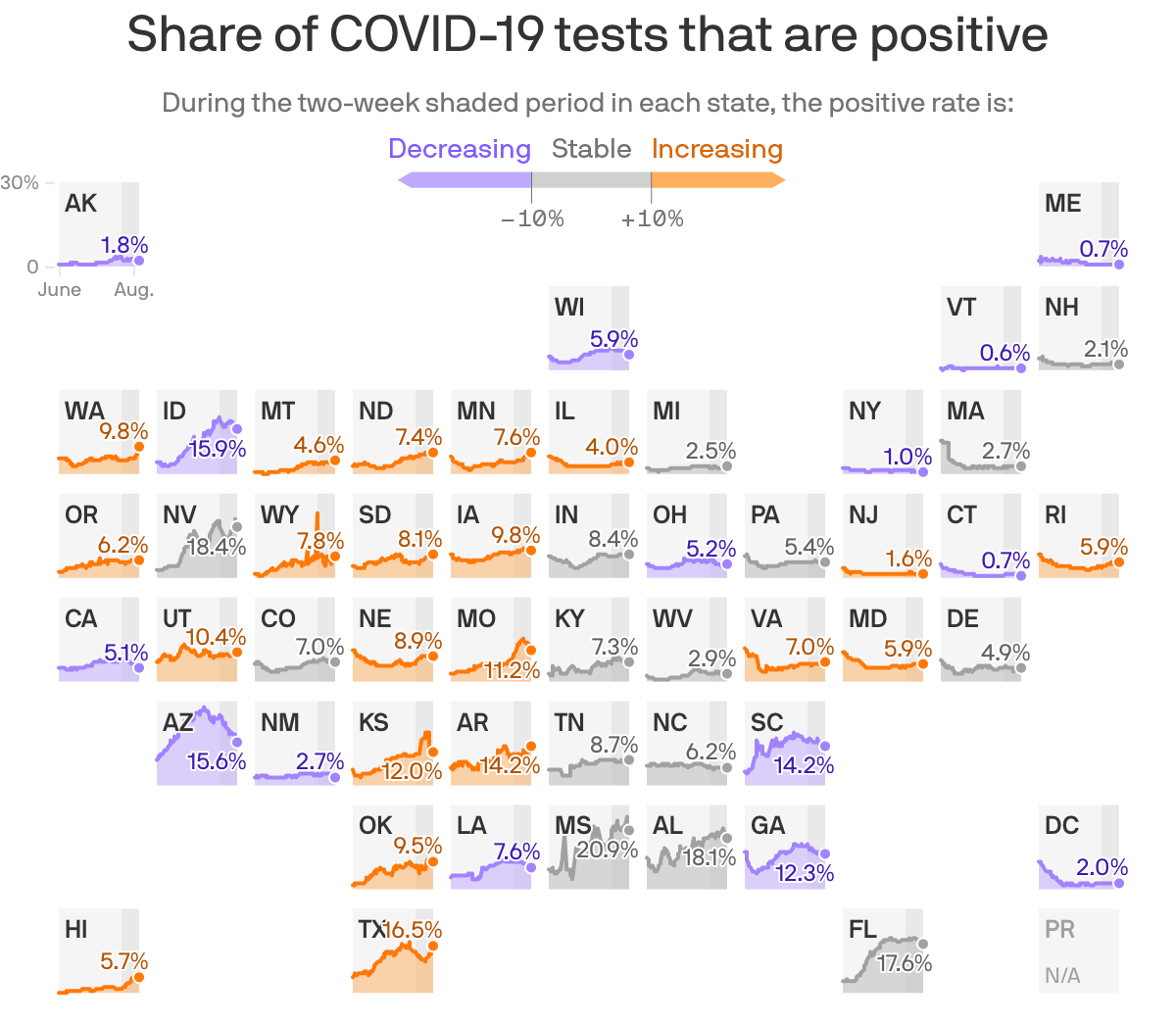
New Coronavirus Infections in Some Parts of the U.S. Trend Down The U.S. reported its lowest number of new coronavirus cases in nearly a week, as new infections in some parts of the country trended down.
Fewer than 47,000 new cases were reported in the U.S., while the total number of confirmed cases exceeded five million, according to data compiled by Johns Hopkins University. The nation’s death toll neared 163,000.
Thirteen states—Arkansas, Hawaii, Idaho, Illinois, Indiana, Kansas, Minnesota, New Hampshire, New York, North Dakota, South Dakota, Vermont and Virginia—have seen their seven-day average of new confirmed cases jump higher than the two-week average as of Aug. 8, according to a Wall Street Journal analysis of Johns Hopkins data. That held true for 44 states a month earlier, reflecting a decline in reported cases in many parts of the country. (…)
Still, the drop in confirmed cases could be tied partly to a drop in testing. In 29 states and the nation’s capital, the seven-day average number of tests per 1,000 people was down Sunday compared with a week earlier, according to Johns Hopkins data. Demand for testing has outstripped supply, even though testing and contact tracing are considered essential by health experts to curb the spread of the virus.
Deaths related to Covid-19, the disease caused by the new coronavirus, are still trending up in 19 states, including California, Georgia, Illinois and North Carolina, according to the Journal analysis of Johns Hopkins data. U.S. deaths appear to be holding steady, with the seven-day daily death tally average at 1,038, compared with a two-week average of 1,089, the analysis shows. (…)

Widespread Infection Among U.S. Children, Report Finds
As schools face the daunting challenge of reopening while the coronavirus continues to spread, at least 97,000 children around the United States tested positive in the last two weeks of July, according to a new report from the American Academy of Pediatrics and the Children’s Hospital Association. It says that at least 338,000 children had tested positive through July 30, meaning more than a quarter tested positive in just those two weeks. (…)
States in the South and West accounted for more than seven out of 10 infections in the new report, which relied on data from 49 states along with Washington, D.C., Puerto Rico and Guam. The count could be higher because the report did not include complete data from Texas and parts of New York State outside of New York City. (…)
The report noted that children rarely get severely sick from Covid-19. But another report, from the Centers for Disease Control and Prevention, highlighted how the threat from a new Covid-19-related condition, called Multisystem Inflammatory Syndrome in Children, or MIS-C, has disproportionately affected people of color.
The C.D.C. said that from early March through late July, it received reports of 570 young people — ranging from infants to age 20 — whose symptoms met the definition of MIS-C. Most of those patients were previously healthy, the report said.
About 40 percent were Hispanic or Latino, 33 percent were Black and 13 percent were white, the report said. Ten died and nearly two-thirds were admitted to intensive care units, it said. Symptoms include a fever, rash, pinkeye, stomach distress, confusion, bluish lips, muscle weakness, racing heart rate and cardiac shock. (…)
Case per 100k people from the Wa. Po.:

Australia records highest daily death toll, as New Zealand marks 100 days without community transmission
Two countries heralded as role models early in the pandemic marked vastly different milestones over the weekend. While New Zealand announced its 100th day without community transmission, Australia mourned a record daily death toll, after weeks of rising case numbers there.
In the Australian state of Victoria on Monday, [where it’s winter] authorities confirmed more than 300 new infections and 19 deaths over the last 24 hours. But despite the record number of fatalities, there were some hopes Monday that the peak of the outbreak might be over. The number of new daily cases in Victoria has been falling significantly since the middle of last week. The impact of a strict lockdown imposed on the state’s capital, Melbourne, more than a week ago is expected to show first results in the coming days, too. (…)
JPMorgan’s Jamie Dimon put it this way, “The range of outcomes for the economy in the second half is incredibly wide. Nobody knows what comes next.”
Big Landlord in Talks to Put Amazon Warehouses in Malls Simon Property Group has been in talks with Amazon to convert some Sears and J.C. Penney stores into Amazon fulfillment centers.
EARNINGS WATCH
From Refinitiv/IBES:
Through Aug. 7, 441 companies in the S&P 500 Index have reported earnings for Q2 2020. Of these companies, 82.3% reported earnings above analyst expectations and 15.4% reported earnings below analyst expectations. In a typical quarter (since 1994), 65% of companies beat estimates and 21% miss estimates. Over the past four quarters, 71% of companies beat the estimates and 22% missed estimates.
In aggregate, companies are reporting earnings that are 22.5% above estimates, which compares to a long-term (since 1994) average surprise factor of 3.3% and the average surprise factor over the prior four quarters of 4.3%.
Of these companies, 63.4% reported revenue above analyst expectations and 36.6% reported revenue below analyst expectations. In a typical quarter (since 2002), 60% of companies beat estimates and 40% miss estimates. Over the past four quarters, 59% of companies beat the estimates and 41% missed estimates.
In aggregate, companies are reporting revenue that are 1.0% above estimates, which compares to a long-term (since 2002) average surprise factor of 1.5% and the average surprise factor over the prior four quarters of 0.7%.
The estimated earnings growth rate for the S&P 500 for 20Q2 is -31.7%. If the energy sector is excluded, the growth rate improves to -25.2%. The estimated revenue growth rate for the S&P 500 for 20Q2 is -10.5%. If the energy sector is excluded, the growth rate improves to -6%.
The estimated earnings growth rate for the S&P 500 for 20Q3 is -22.5%. If the energy sector is excluded, the growth rate improves to -19.1%.
Trailing EPS are now $144.32. Full year 2020e: $124.79. 2021e: $163.31
TECHNICALS WATCH
Lowry’s Research continues to see strong breadth “across all markets and segments” even though only 60% of S&P 500 stocks are trading above their 200dma. Lowry’s also notes that strong demand remains missing since the June 8 highs. So far, softer demand volume has been more than offset by low supply volume. This is also what Ned Davis Research observes.
Part of the problem is that it takes a lot of guts and staying power to go short when there is a Robinhood momentum chasing crowd that can quickly drive your shorts into monetary black holes.
Picture yourself smartly going short on KODK after the stock quintupled from $2.25ish to $10ish on July 28. The next morning, at 10:00am, the stock trades in the $20s, hits $60 during the next hour, and closes at $33. The next morning’s opening is at $43! Most of the KODK buy volume during that week ended in accounts of people who really had no real knowledge of what they were buying other than something with covid-19 vaccine somehow tagged on it by a careless government.

More than 120,000 Robinhood users bought KODK between $9.92 and $40.78. As of Friday, almost 94k still held the stock at $14.88.
And this morning, another cold shower:
-
Agency Puts Planned $765 Million Loan to Kodak on Ice Amid Probes A federal agency has put a planned $765 million loan to Eastman Kodak on hold after the deal came under congressional and regulatory scrutiny.
KODK is $8.60 bid at 8:50am today..
We know this will not end well. We just don’t know when.
BTW, Robinhood Friday announced it will no longer give access to its data showing how many customers hold a certain stock…
We keep making history this cycle. We are about to do it again on the growth/value performance chart, unless…


At the February high, the NDX was 18% above its 200-day moving average. It is now 23%.

The 5-year chart:
SentimenTrader has its own “Medium-Term Risk Levels” indicator which aggregates readings from several ST measures:

- Berkshire Hathaway dumped almost $13 billion in stocks last quarter as Warren Buffett bailed on U.S. airlines and some financials. The conglomerate spent a record $5.1 billion on buybacks to tap a bigger discount to the S&P 500. It may have repurchased another $2.4 billion in July, Edward Jones analyst Jim Shanahan said. Berkshire’s cash pile grew to a record $146.6 billion.

PANDEMONIUM
Canada Ramps Up Retaliation Against U.S. Over Aluminum Tariff Canada plans to slap its own tariffs on a range of U.S. products that contain aluminum in retaliation to President Trump’s latest move to aggravate one of the world’s largest trading relationships.
(…) The administration justified the tariffs using a national security provision and argued that a depressed U.S. aluminum industry threatens U.S. national security. (…)
“We will not escalate, but we will not back down,” Ms. Freeland told reporters in a teleconference. Products targeted contain aluminum, and include items such as bars of the metal and consumer goods like washers, refrigerators and golf clubs. The goods targeted are meant to minimize damage to the Canadian economy, “and to have the strongest possible impact in the U.S.,” Ms. Freeland said. “We hope when Americans look at this list, they will understand why this dispute is a bad idea.” (…) “Any American who buys a can of beer or soda, or a bike, will suffer,” she said. (…)
Over the past year, total U.S. imports of Canadian aluminum have been little changed at about $200 million a month. But there has been a significant shift in the types of aluminum coming into the U.S. Imports of unalloyed aluminum have climbed rapidly, while alloyed aluminum has dropped. In justifying the tariffs, the U.S. pointed to the surge in unalloyed aluminum.
The Aluminum Association, which represents most of the U.S. aluminum industry, says the data has been cherry picked to make the case for a surge. “All in all, it’s the same volume of product that’s crossing [the border],” said Jean Simard, president of the Aluminum Association of Canada. “It’s just the balance of types [of aluminum] is inverted for the time being.” (…)




 Same postal service!