Nonfarm payroll employment rises by 1.8 million in July; unemployment rate falls to 10.2%
(…) Total nonfarm payroll employment rose by 1.8 million in July, less than the increases of 4.8 million in June and 2.7 million in May. In July, nonfarm employment was lower than its February level by 12.9
million, or 8.4 percent. (…)
Will the Covid-19 Pandemic Lead to Job Reallocation and Persistent Unemployment?
(…) One important consideration as we assess the persistent impacts of Covid-19 is that the pandemic has also been a reallocation shock: Because the pandemic has had disproportionate effects on different industries, it may lead to a reshuffling of workers across those industries.1 Because inter-industry reallocation is more difficult and time-consuming than within-industry reallocation (due, e.g., to necessary retraining and relocation), the reallocation induced by the pandemic may lead to a higher level of unemployment for a more extended period. (…)
The results show that by increasing the rate of worker reallocation, the Covid-induced dispersion may have a significant detrimental impact on unemployment in the short and medium term. The effects increase up to a horizon of two years after the initial shock and fade out after about three years. The analysis suggests that at the peak, the reallocation caused by the Covid-19 crisis may contribute about 2 percentage points to the unemployment rate, with the estimates ranging from 0.85 to 4 percentage points. (…)
Jobless recovery so far
Virus numbers and associated containment measures will clearly be the most important determinants of economic recovery paths in coming months, but the job market will also be important to watch, especially as job retention programmes come to an end in some countries. A jobless recovery would likely be tepid at best, and ultimately short-lived after the initial rebound from lockdowns and temporary non-essential business closures.
So far, the global PMI has seen new order inflows rise in July for the first time since January, helping reduce the rate of job cutting to the weakest since February. However, the rate of order book growth lagged that of output, indicating that at least some of the upturn in output was fuelled by firms processing orders placed in prior months (often prior to the pandemic) rather than reflecting new demand. Backlogs of works consequently continued to fall, albeit at a reduced rate.
Jobs were therefore subsequently cut again, dropping globally for a sixth successive month, as firms continued to scale back operating capacity despite the small rise in new orders in July. Worryingly, the rate of job cutting remained higher than at any time seen over the past 11 years prior to the pandemic.
Note that new orders for goods and services fell in the US, albeit only modestly, contrasting with increasing growth in Europe and China, the latter seeing the largest gain in new orders for almost ten years. (Markit)


More Than Half of Canada’s Workers Fear Returning to the Office
COVID-19’s long-term impact on the workforce: more flexible hours and remote work

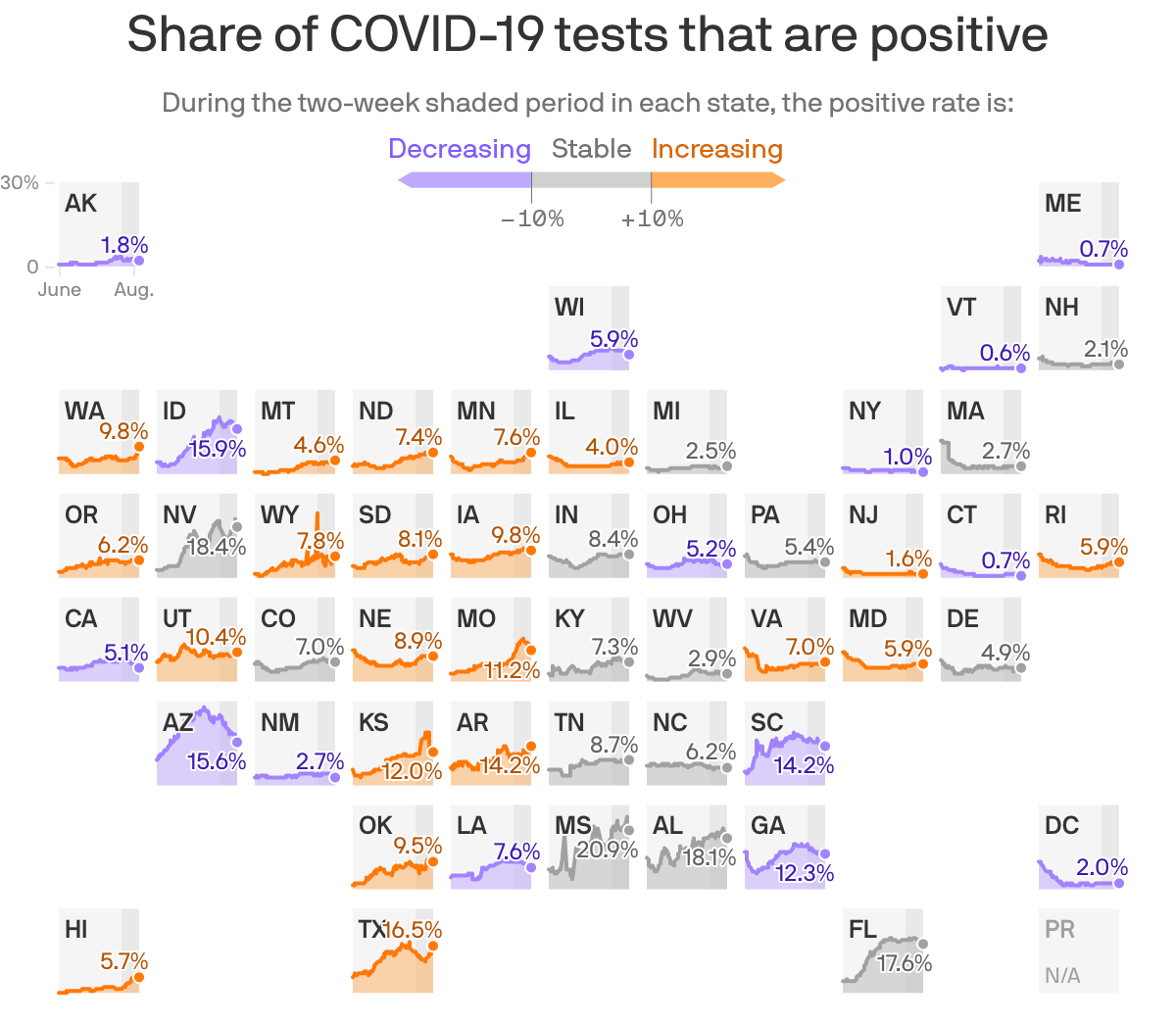
Coronavirus alarm bell in Midwest (Axios). A high positive rate means that a higher share of those getting tested are sick. That could be because there are more sick people, or because a state isn’t doing enough testing.
One in Three Americans Would Not Get COVID-19 Vaccine
(…) But many Americans appear reluctant to be vaccinated, even if a vaccine were FDA-approved and available to them at no cost. Asked if they would get such a COVID-19 vaccine, 65% say they would, but 35% would not.
The results are based on July 20-Aug. 2 polling in Gallup’s COVID-19 tracking survey, conducted with members of Gallup’s probability-based panel. (…)
Eighty-one percent of Democrats are willing to be vaccinated today if a free and FDA-approved vaccine were available. That compares with 59% of independents and just under half of Republicans, 47%. (…)
Such resistance is not unprecedented. When Gallup in 1954 asked U.S. adults who had heard or read about the then-new polio vaccine, “Would you like to take this new polio vaccine (to keep people from getting polio) yourself?” just 60% said they would, while 31% said they would not. So far, willingness to adopt a new vaccine looks similar today.
Support for Leaders’ Handling of the Outbreak is Falling Across the Board

EARNINGS WATCH
We now have 484 reports in (84%), an 82% beat rate and a +22.5% surprise factor.
Q2 earnings are now seen down 31.9% (-25.4% ex-Energy). Q3: -22.4% (-19.0%). Q4: -13.0% (-10.5%).
Trailing EPS are now $144.27. Full year 2020: $124.79e. 2021: $163.31.
NO IRRATIONAL EXUBERANCE OUTSIDE OF TECH AND THE FAANGS
Outside of technology and the FAANGs, US equity markets are pricing in a stalling of the economic recovery. The ratio of cyclical to defensive sectors has been trending sideways since the early June peak, as has the ratio of small-cap vs large-cap equities (top-left chart). This price action is consistent with high-frequency indicators such as Google mobility data, which stalled in June and July as the pace of re-opening slows in the US. Thus, US equities do not seem too optimistic on the recovery, and the sideways move in the cyclical-defensive ratio reflects the mixed economic data we are seeing at present. (…)


Fitch Revises United States’ Outlook to Negative; Affirms at ‘AAA’ The U.S. sovereign rating is supported by structural strengths that include the size of the economy, high per capita income and a dynamic business environment. However, the Outlook has been revised to Negative to reflect the ongoing deterioration in the U.S. public finances and the absence of a credible fiscal consolidation plan.
Coronavirus Upending U.S. States’ 2021 Budgets State governments have seen a steep drop in state tax revenues since the onset of the pandemic, and with the new fiscal year now in effect for 46 states, most, if not all, budgets will be revised over the next several months, representing an unprecedented lack of clarity facing state fiscal managers.
(…) “As a result, many states will need to take additional steps to achieve budgetary balance, which may include non-recurring actions and even deficit borrowing, which historically has rarely been used by states.” (…)
What has worked in states’ favor as a whole is that they took advantage of the long expansion after the Great Recession to build their fiscal resilience, bring structural balance to operations, add to reserves and reduce budgetary liabilities. Because of these actions, they are relatively well-positioned to address the current downturn. Additional federal aid could mitigate deep spending cuts or sharp revenue increases that could have material economic implications and prolong the recovery. That said, a pivotal factor over the next several months will be how long the fallout of the pandemic lasts with coronavirus outbreaks surging across much of the country.
Adequacy of Enormous 2Q US Bank Reserve Builds Uncertain Most of the largest U.S. banks reported substantial provisions to their respective allowance for credit losses in the second quarter of 2020 (2Q20) on news of the growing negative impact of the coronavirus-induced economic downturn on credit.
(…) Overall provision levels remain well below their 1Q10 peak of the last financial downturn. The comparison is somewhat challenging, however, given the different accounting standards in place in 2010 and now with Current Expected Credit Loss (CECL) standard.
Stimulus and forbearance programs are also aiding credit performance, particularly in consumer credit. This could change however as forbearance programs come to an end or are reduced. In commercial portfolios, nonperforming loans continued to march upward in 2Q20 as the economic impact of the pandemic has broadened to touch nearly every sector. While credit losses have been manageable thus far, in some sectors banks are taking credit losses due to collateral shortfalls on top of expected deterioration in cash flows. (…)
The Fed rate cut also significantly weighed on 2Q20 bank margins on a sequential basis. For the largest U.S. banks, net interest margin (NIMs) declined 28bps quarter-over-quarter at the median.
“Bank NIMs could show some resiliency in the coming quarters as banks will likely be able to more easily institute floors into loan pricing and as promotional deposits raised in the latter part of 2019 continue to roll off. We have already seen deposit pricing adjust significantly over the last two quarters,” added Rumohr. (…)
Donald Trump to order government to buy medicines from US companies President’s action aimed at reducing reliance on foreign supply chains for essential drugs
(…) “Over the course of the next four years, we will bring our pharmaceutical and medical supply chains home and we will end reliance on China and other foreign nations,” Mr Trump said. (…) The White House said Mr Trump would also direct the Food and Drug Administration, the main US drug regulator, to prioritise domestic manufacturers when vetting essential drugs and critical ingredients.
Trump to Reimpose Aluminum Tariffs on Canada Just a little over a month after implementing the new U.S.-Mexico-Canada Agreement designed to lower trade barriers across North America, the Trump administration has decided to reimpose tariffs on Canadian aluminum.
Second Canadian Sent to China’s Death Row in as Many Days China has imposed the death penalty on a second Canadian citizen for drug-related offenses in as many days, amid a deepening diplomatic row centered on Canada’s arrest of a well-connected Chinese tech executive.
China Becomes a Refuge for U.S. Companies After Overcoming Covid-19 Despite rising political tensions, American brands have suffered little commercial fallout among Chinese consumers, enabling them to capitalize on the economic rebound in China.
Kicking Out Chinese Stocks and WeChat Is Another Nail in the Coffin of U.S.-China Links The Trump administration’s latest moves against China could have profound impacts. But the winners and losers might not be who they seem.
(…) There is still significant uncertainty about the outcome. Delisting would be the penalty for missing a 2022 deadline to comply with U.S. audit requirements. Noncompliance is a longstanding source of tension between the U.S. and China: Of the 283 U.S.-listed companies whose auditors’ compliance can’t be verified, according to the Public Company Accounting Oversight Board, 251 are based in Hong Kong or China. The issue has gained new significance as ties have deteriorated.
It’s unclear that Chinese companies can comply: Under Chinese law, they require permission from securities regulators. Major U.S.-listed Chinese companies have already been moving to get their shares traded elsewhere as well, and this threat is likely to accelerate the process, even before any laws are enacted.
The two executive orders—one banning U.S. companies from transacting with ByteDance, and the other restricting transactions with Tencent, which operates social-media platform WeChat —also entail significant uncertainty: They say the types of transaction affected will be delineated in 45 days when the orders take effect.
Tencent’s WeChat is a dominant payments provider and the most important texting app in China, meaning restrictions might have major secondary effects on overall Chinese spending in the U.S., or on U.S. goods vendors in China.
The impact on China of delisting would be arguably smaller, but still significant.
Most of the equity that foreign investors own in Chinese companies is listed outside China. In total, foreigners owned 2.102 trillion yuan ($300 billion) of mainland-listed A-shares at the end of 2019, according to the country’s central bank. Though up considerably since such shares were added to major global indexes, that’s less than 4% of the market capitalization of the Shenzhen and Shanghai stock exchanges—and far below the value of the American depositary receipts of the 249 U.S.-listed Chinese companies, which a Jefferies research note last month put at more $1.5 trillion. (…)
Most of all, delisting ADRs would be a victory for Hong Kong, post-National Security Law. (…) American investors can own Hong Kong-listed stocks, so delisting from the U.S. wouldn’t likely require their removal from portfolios. (…)
Fortunes Won and Lost Trading in Kodak Stock: Inside a Wild Week The company’s sudden rise and plummet offer a warning for investors who ignore fundamentals and focus on a potential coronavirus connection.
(…) Alex Olsen, an airline industry worker, was watching the news when President Trump said his administration was lending Kodak $765 million to support the launch of Kodak Pharmaceuticals. The way the 44-year-old Florida resident saw it, this was the perfect time to buy Kodak.
“This is why you invest,” Mr. Olsen said. “I have the option of helping a company save us and make some equity.”
The next morning, when Mr. Olsen got in, the stock was skyrocketing again. He bought some shares at $17, more at $24 and a third group at $52.50. For the day, he bought 2,710 shares at an average of $35 a share.
Mr. Olsen was in for about $95,000. And he wasn’t alone.
More than 100,000 users of the popular trading app Robinhood jumped in that day, helping to push Kodak’s stock price higher, according to the data-mining website Robintrack. (…)
As the week wore on, the stock took a precipitous drop as the details of the preliminary agreement were shared.
Some investors said it was Wednesday evening when they first realized that the agreement between the government and Kodak was far from a done deal. The loan had to be secured by Kodak’s assets and included performance contracts. Moreover, the agreement was still going through due diligence. (…)
By Friday afternoon, Mr. Olsen decided he wanted nothing to do with Kodak.
He felt duped and angry after finding out the deal was far from certain. Mr. Olsen had only started trading this year, using a TD Ameritrade brokerage account. He was down almost $30,000 when he sold out.
“I guess what I learned is trading is just gambling,” Mr. Olsen said. “That’s a fact.” (…)
 Same postal service!
