Powell Says Fed Will Maintain Ultralow Interest Rates Federal Reserve Chairman Jerome Powell reaffirmed his intention of keeping easy-money policies in place until the labor market improves much further, but provided no sign the central bank will seek to stem a recent rise in Treasury yields.
(…) Fed officials “don’t appear particularly concerned about the current level of yields, which in both real and nominal terms is significantly higher than it was two weeks ago.”
The yield on the 10-year Treasury note rose above 1.55% after Mr. Powell’s interview—its highest level since before the pandemic—up from 1.46% earlier Thursday and 0.92% at the beginning of the year. (…)
Asked Thursday about the climb in long-term rates, Mr. Powell said it “was something that was notable and caught my attention.” But he signaled no imminent policy response from the central bank.
“I would be concerned by disorderly conditions in markets or a persistent tightening in financial conditions that threatens the achievement of our goals,” Mr. Powell said Thursday. He added that the Fed is looking at “a broad range of financial conditions,” rather than a single measure.
“If conditions do change materially, the [Fed’s rate-setting] committee is prepared to use the tools that it has to foster achievement of its goals,” Mr. Powell said. (…)

(…) Even before the recent climb in rates, surging U.S. home prices had begun to outweigh the savings afforded by historically low borrowing rates. The typical monthly mortgage payment in the fourth quarter rose to $1,040 from $1,020 a year earlier even as mortgage rates declined, according to the National Association of Realtors.
Rising rates can also put the brakes on refinancings, which accounted for about 60% of mortgage originations in 2020, according to the Mortgage Bankers Association.
With a 30-year rate of 2.75%, about 18 million U.S. homeowners could reduce their monthly payments through a refinance, according to mortgage-data firm Black Knight Inc. When the rate rises to 3.25%, the pool of eligible homeowners shrinks to about 11 million. (…)
John Authers: Powell Needs a Stock Selloff to Act on Bond Yields
(…) Thursday’s biggest development, arguably, was a surprising strengthening of the dollar. The popular DXY index, which compares the greenback to a group of the largest developed market currencies, is now above its 100-day moving average for the first time in 10 months, suggesting that the trend is turning. Meanwhile, the bond market is applying more upward pressure. Generally, as the chart shows, rate differentials tend to lead currencies, with a lag, and the spread of U.S. over German 10-year bond yields has risen sharply. If the dollar continues to rise, a widespread market assumption will have been thwarted. And the stronger currency will itself act as a counterweight against the inflation predicted for the U.S.:
(…) All the move away from value driven by last year’s pandemic has now been reversed. The market is clearly repositioning for companies that will prosper in a reflationary environment, and leaving those that prospered under pandemic conditions:
(…) Remarkably, bank stocks have now outperformed tech stocks since last year’s low (…).
If rising yields spark a significant equity selloff, as happened at the end of 2018, it’s fair to expect that the Fed will respond with extra support for the bond market. But not before that.
(…) the implied rental yield paid by property has moved in line with yields on long U.S. and Chinese bonds. An increase in bond yields that in turn causes a drop of 10% in the level of global house prices isn’t hard to imagine. That would be a wealth effect of almost $30 trillion, or about a third of global GDP, and a sledgehammer to the world economy.
(…) such a decline would inflict one last deflationary downdraft. That by extension means not betting all out on inflation just yet. He suggests the crucial stress point would come when 30-year yields reach 3.75%:
where is the pain point? Our answer is that if inflation fears lifted the average US and China 30-year bond yield to 3.75 percent (from 3 percent now), it would constitute the change in trend that would unleash a massive countervailing deflationary impulse from falling house prices. (…)


- Mohamed A. El Erian: Powell Can Roil Markets Now With Just a Word Remarks by the Fed chair starkly illustrate the central bank’s dilemma.
(…) This is a clear example of what I have detailed in earlier columns as an increasingly tight corner policywise for central banks that confronts them with an ever more uncomfortable lose-lose situation. This is likely to continue as the U.S. economic recovery quickens, the bond market looks to price in the prospects of both higher real growth and inflation, and the Fed finds itself torn: Should it allow genuine fixed-income repricing that risks destabilizing risk assets that have been driven excessively by actual and anticipated liquidity injections, or should it intervene further in markets and risk additional distortions and damage both to efficient market functioning and its own policy credibility?
The answer to this policy dilemma is to accelerate structural reforms and fiscal measures aimed at enhancing high, durable, inclusive and sustainable growth that would help validate existing elevated prices for many risk assets. Pending this, the Fed would be well advised to the extent possible to follow Burr’s advice to Hamilton [“Talk less, smile more”]. Any other action risks volatility that involves unsettling pockets of illiquidity in the most liquid markets of all.
 Bloomberg’s Joe Weisenthal smartly comes to Powell’s defense:
(…) What’s key though is that in the current economic environment, market volatility isn’t perceived to be an economic threat the way it was over the last decade. We’re probably on the verge of another $1.9 trillion dollars in stimulus soon and there’s a tidal wave of reopening spending set to wash over the economy. With this kind of economic tailwind, what does it really matter if ARKK is down for the year and the S&P is flat and the 10-year yield is at 1.50%? It’s not that big of a deal in this context.
The Fed could probably push back on some of the market action if it really wanted to, maybe by talking more about how it’s concerned by the rate rise or some nod to more bond purchases at the long end. But again, since the market volatility is no real threat to the economic fundamentals yet it simply does not need to.
Things could change of course. The economic fundamentals could sputter (no stimulus? unexpected pandemic setback?) or the market selloff could get much more serious. But at the moment, it looks we’re getting the stock market that people always say they want: One where the Fed doesn’t have to worry about every tick down so much, because robust economic fundamentals have severed (or at least diminished) the link between volatility and poor growth. Enjoy it folks!
Jobless Claims Hold Nearly Steady Initial claims rose slightly to 745,000 last week but have eased since the start of the year
The Labor Department said jobless claims, a proxy for layoffs, rose slightly to 745,000 for the week ended Feb. 27, from a revised 736,000 the prior week. The four week moving-average, which smooths out week-to-week volatility in claims numbers, was just under 800,000, its lowest level since early December. (…)
The total number of continuing claims—which offers a good approximation of the number of workers collecting benefits—was about 4.3 million in regular state programs for the week ending Feb. 20, down slightly from the prior week. The number of continuing claims for pandemic unemployment assistance—which provides benefits to gig workers, the self-employed and others not typically eligible for unemployment aid—fell to 7.3 million for the week ending Feb. 13 from 7.5 million the week prior. (…)
The total number of all state, federal and PUA and PEUC continuing claims was 18.0 million in the February 13 week, down by 1.02 million from the February 6 week.

The aggregation from Bespoke:

(Bespoke)
Chip Shortage Strains Heavy-Duty Truck Makers Surging orders for big rigs have the backlog at factories growing while key components are in short supply
North American production of Class 8 trucks, the biggest freight-carrying vehicles on highways, “has basically been flat since September in a market where more trucks are needed quickly,” said Don Ake, vice president of commercial vehicles at transportation research firm FTR.
He said the backlog of orders at truck manufacturers has grown from 89,300 last June, after truckers had pulled back capacity plans in the wake of coronavirus lockdowns, to 205,000 in January, the most recent month for which those figures were available. Fleet operators ordered 44,000 heavy-duty trucks last month, more than triple the number they ordered in February 2020, according to preliminary data from FTR. (…)
“We’ve been able, thus far, to work our way through the issues without interrupting production,” he said. “The situation is fluid, and we’re continuing to do everything we can to minimize the impact on customers.” (…)
CONSUMER WATCH
More adults in Britain now commuting than working from home
Vaccinated Americans’ Spending On Air Travel Soars
(…) spending on airfare surged for traditionalists as compared to other generations – this can be seen in the chart below which shows the indexed level of average spending by cohort to June 2020; traditionalists – i.e., vaccinated Americans’ – spending is now 4X the level in June.
As an aside, BofA did not see the same spending surge for lodging which may suggest that traditionalists are traveling to see family rather than take vacations. (…)


 (
(Also worth watching:


U.S. National Debt Is Likely to Nearly Double to 202% of GDP by 2051, CBO Projects Agency raises long-term economic growth forecast from 1.6% to 1.8% as it now expects smaller impact from pandemic
(…) The federal debt is projected to be 102% of the gross domestic product in 2021. It has exceeded that level only twice before in U.S. history, in 1945 and 1946, following a surge in federal spending as a result of World War II.
The forecasts don’t take into account the $1.9 trillion in federal spending proposed by President Biden and backed by Democrats, who narrowly control the House and Senate. (…)
Budget deficits will widen to 13.3% of GDP in 2051, from 5.7% in 2031, driven largely by increasing costs of servicing the debt, the CBO said. Net spending on interest will triple relative to GDP in the two decades leading up to 2051, and spending on programs such as Social Security and Medicare will also rise. (…)
The projections offered Thursday are an extension of forecasts CBO released last month for the next decade, which showed federal debt is expected to rise to a record 107% of economic output by 2031, from 100% of GDP in the last fiscal year ended Sept. 30. (…)
Net interest costs as a share of GDP will average 1.6% over the next decade, the CBO said, well below the 50-year average. But then they are projected to rise over the following two decades, reaching 8.6% by 2051. (…)
The CBO projected that yields on 10-year Treasurys will average 1.6% from 2021 to 2025 and 3% from 2026 to 2031, before rising steadily to 4.9% by 2051.
China Sets 2021 GDP Growth Target at Over 6% The goal is comfortably lower than most economists’ consensus expectations for the world’s second-largest economy to grow by 8% or more this year.
(…) Mr. Li said in the annual report on Friday that the government would seek to cut the fiscal-deficit target to 3.2% of China’s projected GDP this year, compared with a target of more than 3.6% in 2020.
Beijing also plans to reduce the amount of debt that local governments are permitted to raise, allowing localities to issue 3.65 trillion yuan, the equivalent of $580 billion, in local government special-purpose bonds in 2021, from the 3.75 trillion yuan earmarked last year. The bond proceeds primarily fund infrastructure projects.
Mr. Li said China aims to keep consumer price inflation at around 3% in 2021, compared with last year’s 3.5% target and its actual increase of 2.5%.
The government also said it plans to create 11 million new jobs this year, up from the 2020 target of 9 million. It also aimed to cap the urban surveyed jobless rate at 5.5% in 2021, compared with a ceiling of 6% in 2020.
Beijing said the defense budget would increase by 6.8% in 2021, compared with a 6.6% increase last year. (…)
In their five-year plan, Chinese leaders broke with convention in not giving an average numerical growth target, saying only that they would plan to keep the economy running “within a reasonable range.” In the 2016-20 plan, the target was “more than 6.5%.” (…)
In lieu of a five-year GDP target, Beijing’s leaders said that they would aim to cap the surveyed urban unemployment rate at 5.5%, with labor productivity growth outpacing overall GDP growth. It also planned to increase the country’s urbanization rate to 65%, from 60.6% in 2019.
Reflecting Beijing’s emphasis on encouraging consumer spending—given concerns that rising geopolitical tensions could hurt export demand—officials said they want Chinese residents’ disposable income to keep pace with the country’s overall economic growth over the five years.
And underscoring the increasing importance China’s leaders ascribe to science and technology, total research and development expenditures will grow by more than 7% annually for the five years, they said.
China’s leaders also talked up the importance of supply chains and cutting-edge technologies, including pushing forward in artificial intelligence, semiconductors, blockchain and next-generation 6G wireless networks.
The plan also pledged to keep the proportion of manufacturing “basically stable” during the 2021-25 period. (…)
Facing social and fiscal pressures stemming from a rapidly aging population, the government also plans to raise the statutory retirement age in “a phased manner,” reviving a long-mooted but unpopular proposal.
The proposal was mentioned in the five-year plan, without detail. Men currently can retire at 60, and female factory workers as early as 50. Female public-sector and white-collar workers can retire at 55. (…)
China’s 2021 fiscal budget projected growth in annual revenue and expenditures of 8.1% and 1.8%, respectively.
China’s Pursuit of Natural Gas Jolts Markets and Drains Neighbors Beijing’s quest to run the world’s second-largest economy on cleaner energy is reshaping global trade in the fossil fuel.
(…) A sudden confluence of global supply outages and an unusually cold winter tripled LNG prices in mid-January to a record $32.50 a million British thermal units from early December—and brought into focus China’s increasingly outsize role.
Underpinned by its economic boom and rising presence in LNG spot markets, Beijing’s efforts to shift from coal to gas as a fuel over the longer term has drawn ever-larger LNG imports in recent years, tightening supplies available to gas-dependent neighbors Japan and South Korea. The three economies account for 60% of the world’s LNG consumption. (…)
In December, China imported 7.6 million metric tons, the most ever. Utilities in Japan reported severe shortages of natural gas and averted blackouts by turning back to coal, oil and other older means of power generation. LNG consumption rose last year by some 11%, far outpacing the 1% rise globally, data from consulting firm Wood Mackenzie shows. Imports meet about 45% of China’s demand, which has been rising since President Xi Jinping set around 2015 decadeslong plans to pipe natural gas into millions of Chinese homes and factories. Beijing views natural gas as a steppingstone—a cleaner fossil fuel—in its campaign for carbon neutrality by 2060.
Provincial authorities, including in southern Guangdong, began requiring more manufacturers to burn gas instead of coal last year, official reports say. And Beijing loosened rules in the past two years to allow more companies to import LNG, turning provincial gas distributors into more active bidders in spot markets once reserved for a handful of state-controlled giants. (…)
“We are doing everything possible to increase supply of the resource,” the National Development and Reform Commission said at the time. “We are making every effort to increase the purchase of spot LNG.”
In Japan, power plants in the heavily populated Kansai region were running at 99% of generation capacity; more than the usual 60% for LNG-fueled plants. Japan depends on natural gas for about a third of its electricity. (…)
China’s gas demand is set to keep rising, underpinning the potential for supply shocks to turn prices volatile in coming years.
“Even before winter, there were a lot of policies to hasten infrastructure investment” in China’s LNG storage and connectivity, said Woodmac analyst Miaoru Huang. “But I think after this price spike, there will be renewed incentive to advance the build.”
OPEC, Allies Keep a Lid on Oil Output Saudi Arabia and Russia have careened between optimism and dire warnings amid pandemic’s ebb and flow
(…) In an illustration of the fast-changing assessment within the group, Riyadh and Moscow had earlier Thursday debated a separate scenario bringing back one million barrels of oil a day, according to officials familiar with the discussions. Saudi Arabia would have contributed half of that fresh production, while OPEC-plus countries would pump the remainder under the proposal. In the end, though, Prince Abdulaziz convinced his counterparts to mostly hold pat, in part by granting Moscow a small exemption from the curbs, delegates said. (…)
Christyan Malek, head of oil-and-gas research at JP Morgan Chase & Co., said the Saudi decision indicates Riyadh’s confidence that U.S. shale companies for now can’t take advantage of the price rally, especially after being hit by a winter storm that knocked out some 2.5 million barrels a day of production in Texas and one million barrels a day in other oil-rich states. Mr. Malek said OPEC-plus restraint is bringing “prices to a point where the Saudis are back in control.” (…)
TIMBER WATCH
- NDX’s head and shoulder, 100dma pierced, the 200dma is 9% below:


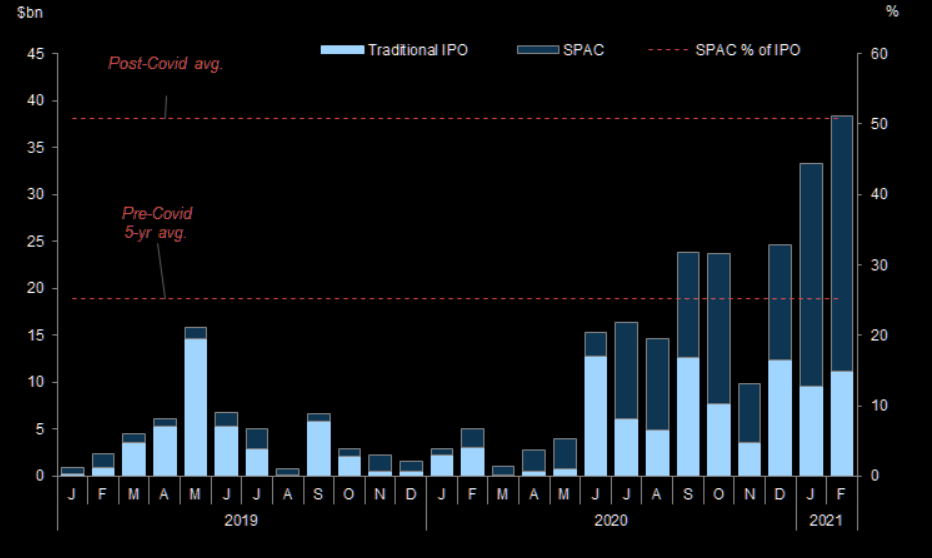
- The IPOX SPAC Index, which tracks the performance of a broad group, has fallen toward a bear market, down about 20% from its peak. Even the hot trend—in which famous executives, celebrities and athletes have rushed to raise money for yet-to-be identified future investments—isn’t immune to the souring sentiment on growth stocks. That, and maybe five new SPACs per day was just too many… (Bloomberg)

- SPAC offerings have constituted over 50% of total IPO volumes in the post-COVID era
- Portnoy-Backed ETF Sees Third-Highest Volume Ever in a Debut A new exchange-traded fund seeking to ride the companies most loved by investors online has found plenty of its own positive sentiment in its first day of trading.
About $438 million worth of shares in the VanEck Vectors Social Sentiment ETF (ticker BUZZ) changed hands on Thursday, making it the third best ETF debut on record, according to data compiled by Bloomberg. (…)
The fund, which has been promoted by Barstool Sports Inc. founder Dave Portnoy, follows an index that uses AI to scan online sources like blogs and social media to identify the 75 most favorably mentioned equities.
Because of its criteria for inclusion, the hottest names among the day-trading crowd like GameStop Corp. and AMC Entertainment Holdings Inc. don’t actually make it into the gauge. Its top holdings currently are Ford Motor Co., Twitter Inc. and DraftKings Inc. (…)
The fund opened at $24.40, closed yesterday at $23.52 (-3.6%).

Will be interesting to watch how artificial intelligence deals with this mob’s intelligence.
Speaking of cowboys:
 Marlboro Maker Asks FDA to Convince Americans Nicotine Isn’t That Bad


 The Beige Book’s assessment is pretty beige compared with Markit’s PMIs on both activity and costs pressures.


 Morgan Stanley Warns Tesla Is Losing Market Share To Ford Mustang Mach-E