U.S. Flash PMI: Private sector output growth hampered by severe supply chain hold-ups and capacity shortages
Private sector firms in the U.S. signalled a solid expansion in output during September, albeit at the slowest pace for a year and one that was much softer than that seen at the start of the summer. The overall upturn was weighed on by the weakest increase in service sector business activity in the current 14-month sequence of growth.
Adjusted for seasonal factors, the IHS Markit Flash U.S. Composite PMI Output Index posted 54.5 in September, down from 55.4 in August and much lower than May’s record high. The rate of output growth was the softest since September 2020, amid a notable slowdown in the pace of expansion in service sector activity compared to earlier in the year.
At the same time, new order growth eased to the slowest since August 2020. Although demand conditions at manufacturing firms remained very strong by historical standards, the upturn in service sector new business slowed to a 14-month low as COVID-19 concerns persisted. While new export orders increased at a faster pace, the improvement was confined to manufacturing. Service providers registered a solid decline in exports as ongoing virus restrictions continued to impede activity.
Challenges finding suitable candidates and difficulties retaining employees were reflected in firms reporting only a fractional rise in employment for a second month. Backlogs of work rose strongly due to the resulting pressure on operating capacity. The rise in outstanding business was the second-fastest in over 12 years of data collection, with a record increase seen in manufacturing.
On the price front, input costs rose at a sharper pace during September. The rate of cost inflation was the quickest for four months, and the second-highest on record, as supply chain disruptions and material shortages pushed prices and transportation costs up. Meanwhile, output charges continued to increase markedly, continuing to rise at a pace far outstripping anything seen in the survey’s history prior to May, as firms sought to pass on higher costs to clients where possible.
Optimism at private sector firms was robust in September. Business confidence was often linked to hopes of improved client demand and the removal of supply chain blockages.
The seasonally adjusted IHS Markit Flash U.S. Services PMI™ Business Activity Index registered 54.4 in September, down from 55.1 in August, to signal a solid but slower rise in business activity across the service sector. The upturn in output was the softest in the current 14-month sequence of expansion and slowed once again from May’s recent high.
Contributing to the softer increase in activity was a slower rise in new business. Though solid, the rate of growth slowed for the fourth month running amid less robust demand conditions and ongoing COVID-19 worries. Total sales were also hampered by a quicker decline in new export orders, and one that was the fastest since December 2020.
Employment levels were broadly unchanged during September, bringing an end to a 14-month sequence of job creation. Capacity pressures led to a solid rise in outstanding business. Although quicker than the series trend pace, the rate of accumulation was the least marked for four months.
Cost pressures remained historically elevated, as greater supplier prices and increased wage bills following incentives to entice workers pushed costs up. Firms sought to pass on higher prices to their clients through a marked rise in output charges.
Meanwhile, the degree of optimism reached a three-month high amid hopes of stronger client demand and an end to the pandemic.
The health of the manufacturing sector improved substantially in September, as highlighted by the IHS Markit Flash U.S. Manufacturing Purchasing Managers’ Index™ (PMI™) posting 60.5 at the end of the third quarter, down slightly from 61.1 in August. Although the pace of improvement in operating conditions was the slowest for five months, it was marked overall.
Supporting the overall upturn was a robust increase in new business. New orders were reportedly driven by strong demand conditions. At the same time, new export orders rose solidly and at the fastest pace for four months.
That said, supply constraints and material shortages dampened output in September. Although strong, the rate of expansion in production was the slowest for 11 months. Lead times lengthened substantially as trucking issues and capacity shortages led to one of the greatest deteriorations in vendor performance on record.
Manufacturers expanded their workforce numbers at a steeper rate in September. Despite many firms noting challenges finding suitable candidates and retaining current employees, many were able to hire additional workers, often offering greater wages to entice staff.
Goods producers registered another significant rise in input costs, albeit slightly slower than August’s recent high. Soaring material prices led to one of the fastest increases on record. As a result, the rate of selling price inflation accelerated to the sharpest since data collection began in May 2007 as firms passed higher costs on to their clients.
Hopes of greater availability of materials and staff over the coming months, alongside stronger demand conditions, reportedly supported optimism at manufacturers. The degree of confidence slipped to a four-month low, however.

- U.S. and European Economies Slowed by Delta Variant, Supply Chain Bottlenecks Manufacturing and services businesses in both the U.S. and Eurozone reported slower growth in activity this month, more so in Europe.
This is really a Delta (services) and supply-chain slowdown, not a dangerous demand weakness:
- U.S. manufacturers are seeing a “robust increase in new business” driven by “strong demand conditions” and “solid new export orders”.
- Service providers continued to see a “solid” rise in new domestic business.
- In the Eurozone, “inflows of new orders rose at the slowest pace since April” but that was “after exceptionally strong gains seen in prior months.”
The key remains the American consumer. August retail sales were good with control sales up 2.6% after -2.0% and +1.6% in the previous two months. Last 3 months: +9.1% annualized.
Per Chase’s spending tracker, September sales look solid through Sept. 18.

Chase’s control sales tracker is flat at a high level so far in September:

Only Travel and Entertainment spending has materially weakened:

That said, Markit’s flash PMI survey suggests weak employment growth in September and broad inflation pressures…
Perhaps offsetting:
(…) despite all of this economic damage and ongoing scarring, today’s flow of funds data from the Federal Reserve shows that household wealth has surged $26tn since the end of 2019 and is in fact up $32.2tn since the low point in 1Q 2020.
Non-financial assets – primarily real estate, but it also includes things such as cars, jewellery and equipment – now totals $46.2tn versus $40tn at the end of 2019. Meanwhile financial assets total $113.1tn, up from $93.4tn in 2019 – an astonishing 21% increase in 18 months.
The largest categories here are pension entitlements ($31tn), corporate equities ($30.5tn), small business equity ($13.7tn), mutual funds ($12.3tn) and time and savings deposits ($10.6tn).
Household Liabilities are “just” $17.7tn and are primarily mortgage and consumer loans, which leaves household net worth at $141.7tn. This is equivalent to 624% of US GDP and 786% of annual disposable income. As the chart below shows, the household balance sheet, in aggregate, has never been in as strong a position.
Household balance sheets have never been stronger
Change in US household wealth versus 4Q 2019 (USD tn)
It is undoubtedly the fact that the majority of the increases in wealth will have been experienced by higher income and already wealthy households since they will have been heavily invested in the “winning” asset classes. The biggest contribution to the financial wealth gains came from corporate equities and mutual funds due primarily to risk appetite rebounding and equity markets surging higher on unprecedented Federal Reserve and government stimulus. The same reasons led to strong performances for pension and life insurance funds. Conversely, the value of debt security holdings has actually fallen.
Lower income households will also have benefited to some extent with government stimulus checks of $1200, $600 and $1400 combined with uprated and extended unemployment benefits contributed to huge increases in household incomes over the past 14 months. This can be seen in the chart below with the orange bars representing the income boost from the checks and the grey bars representing the expanded unemployment benefits.
An NBER paper calculated that 69% of unemployment benefit recipients actually earned more money being unemployed than when they were working. The median recipient received 134% of their previous after-tax compensation. Encouragingly we are now seeing positive income growth from higher wages and salaries and this will hopefully mean that incomes can keep rising even as benefits are scaled back.
Change in annualised US household incomes versus February 2020
With employment growth looking resilient and higher income growth becoming increasingly evident the outlook for consumer spending remains positive. Today’s evidence of further massive accumulation of wealth only adds to the potential spending ammunition of the household sector. In an environment where supply constraints persist this adds another reason to argue that the demand growth in the economy is likely to outpace the supply side capacity. Another argument for inflation staying higher for longer and why the Fed will taper QE this year and start to raise interest rates from next year.


The Chicago Fed National Activity Index (CFNAI) fell to 0.29 in August after rising to 0.75 in July (revised up from 0.53), according to the Federal Reserve Bank of Chicago, suggesting a slower but still above-average growth.
The index’s three-month moving average (CFNAI-MA3), which smooths out the m/m volatility in the index, increased to 0.43 in August, a three-month high, from 0.36 in July. During the last 10 years, there has been 98% correlation between the level of the Chicago Fed Index and quarterly growth in real GDP.
The Production & Income index declined to 0.11 in August after rising to 0.40 in July. The Employment, Unemployment & Hours component decreased to 0.12, the lowest level since April, from 0.38. The Sales, Orders & Inventories reading slipped to 0.03, a three-month low, from 0.07. In contrast, the Personal Consumption & Housing index rebounded to 0.03, the highest level since March, from -0.09.
The CFNAI diffusion index, which measures the breadth of movement in the component series, eased to 0.30 in August from 0.34 in July. Forty-nine of the 85 component series contributed positively and 36 made negative contributions to the index overall.

The Conference Board’s Composite Index of Leading Economic Indicators increased 0.9% m/m (10.0% y/y) in August following a slightly downwardly revised 0.8% m/m gain in July (initially 0.9%) and an upwardly revised 0.6% m/m rise in June (previously 0.5%). A 0.7% rise in August had been expected in the Action Economics Forecast Survey.
Nine of the 10 components contributed to the August increase with fewer unemployment claims, an increase in the ISM orders diffusion index and a rise in building permits making the three largest contributions. The drop in consumer expectations was the only component to subtract from the overall gain in August.
The Index of Coincident Economic Indicators increased 0.2% m/m (4.0% y/y) in August versus an unrevised 0.6% m/m gain in July and an upwardly revised 0.5% m/m increase in June (previously 0.4%). Each of the index’s four components contributed to the August, led by gains in nonagricultural employment and industrial production.
The Index of Lagging Indicators edged up 0.1% m/m (-1.1% y/y) in August following a downwardly revised 0.5% m/m gain in July (previously 0.6%). Three of the index’s seven components made positive contributions to the August gain, while three subtracted and one was neutral.

Initial claims for unemployment insurance were 351,000 (-59.2% y/y) for the week ended September 18, up 16,000 from the prior week’s 335,000; that was revised from the 332,000 reported initially. The Action Economics Forecast Survey expected 320,000 initial filings in the latest week.
Initial claims for the federal Pandemic Unemployment Assistance (PUA) program in the week ended September 18 were 15,162, down from 23,037 the week before. The latest number was the lowest in the program’s history, which started April 4, 2020, at the beginning of the pandemic; for comparison, the three months through August averaged 101,555. The PUA program provided benefits to individuals who are not eligible for regular state unemployment insurance benefits, such as the self-employed. This program expired on September 6, likely explaining the very small number of new claims in the latest couple of weeks. Given the brief history of this program, these and other COVID-related series are not seasonally adjusted.
Continued weekly claims for regular state unemployment insurance rose in the September 11 week to 2.845 million (-77.6% y/y) from 2.714 million in the prior week, which was revised from 2.665 million. The associated rate of insured unemployment rose to 2.1% from 2.0%, which was revised from 1.9%.
Continued weekly claims in the PUA program fell to 4.896 million in the September 4 week (-59.0% y/y) from 5.487 million the week before. Continued weekly claims for Pandemic Emergency Unemployment Compensation (PEUC) were 3.645 million in the September 4 week, down from 3.806 million. This program covers people who have exhausted their state unemployment insurance benefits.
In the week ended September 4, the total number of all state, federal, PUA and PEUC continued claims was 11.250 million, down 856,440 from the prior week. These total claims averaged 11.868 million over the four weeks ended September 4. These figures are not seasonally adjusted. (…)
Bespoke’s claims chart remains the best:
 (Bespoke)
- Retail Sales in Canada Rebound After Stalling in Early Summer The value of receipts rose 2.1% in August, according to preliminary results provided by Statistics Canada on Thursday in Ottawa. That more than offset a 0.6% decline in July. Retail sales are still below the record monthly total reached in March, but are well ahead of pre-pandemic levels.
- Have Consumers’ Long-Run Inflation Expectations Become Un-Anchored?
(…) Roughly speaking, inflation expectations are considered un-anchored when long-run inflation expectations change significantly in response to developments in inflation or other economic variables, and begin to move away from levels consistent with the central bank’s (implicit or explicit) inflation objective. In that case, actual inflation can become unmoored and risks drifting persistently away from the central bank’s objective. Well-anchored long-run inflation expectations therefore represent an important measure of the success of monetary policy. (…)
Taken together, these survey findings provide evidence that even though the current surge in inflation has affected short- and, to a lesser extent, medium-term inflation expectations, it did not significantly affect the anchoring of long-run inflation expectations.
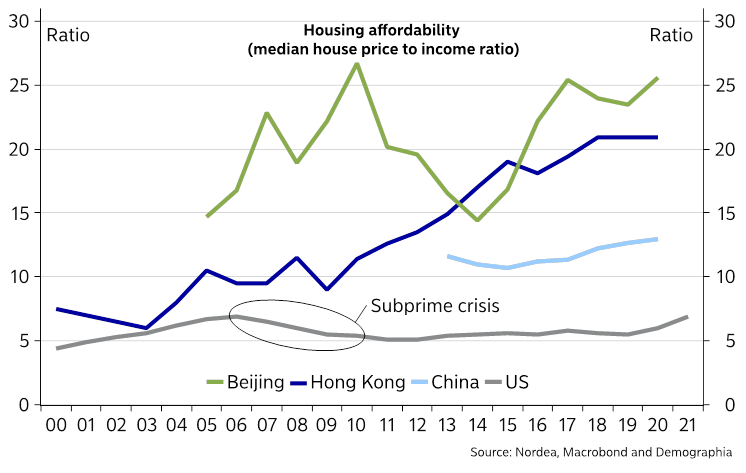
Evergrande bondholders left in the dark as crucial deadline passes Indebted Chinese property developer faces imminent default on $84m offshore coupon payment
It’s still not clear if Evergrande will make the $83.5 million interest payment due yesterday. Three bondholders say so far they’ve received zilch.
(…) Bank of China (601988.SS), the country’s fourth largest lender by assets, is monitoring closely all its developer clients, to prevent contagion risks, said a person with knowledge of the matter.
“The expectation is that not only Evergrande, but also some of the top leveraged developers are on edge of liquidity crash even insolvency,” said a person at the Bank of Shanghai Co Ltd (601229.SS).
To calm the market and in an unusual move, Chinese lenders including China Minsheng Bank (600016.SS), China Zheshang Bank (2016.HK) and China Everbright Bank (601818.SS) have been publicly reassuring and voluntarily disclosing their exposure to Evergrande and the property sector.
But internally, financiers are scrambling to reduce their exposure to “non-quality property assets”, bracing for a sharp deterioration in the financial health of some developers. (…)
Chinese banks, insurers and bond funds have provided large scale funding to the property sector in recent years, and their exposure is among the more significant risks facing the financial system, Scope research said on Thursday.
Property loans accounted for nearly 30% of total outstanding loans of Chinese financial institutions at the end of September 2020, as per data from the People’s Bank of China.
Fitch Ratings said in a report on Friday that many of the smaller mid-tier Chinese banks are expected to face “greater asset-quality headwinds” as the property sector suffers an increase in the credit stresses that were highlighted by Evergrande.
- Evergrande deadline sends chills through $400bn Asian debt market
- China Declares Crypto Transactions Illegal, Sending Bitcoin Lower China’s central bank said all cryptocurrency-related transactions are illegal, reinforcing the country’s tough stance against digital rivals to government issued money.
China’s central bank said all cryptocurrency-related transactions are illegal, reinforcing the country’s tough stance against digital rivals to government issued money.
In a statement posted on its website on Friday afternoon, the People’s Bank of China said the latest notice was to further prevent the risks surrounding crypto trading and to maintain national security and social stability. (…)
It also said it is illegal for overseas exchanges to provide services for residents in China through the internet.
China banned cryptocurrency exchanges from operating within its borders several years ago, but individuals in the country have continued to find ways to trade bitcoin and other digital currencies via over-the-counter or peer-to-peer transactions.
In May this year, a powerful Chinese superregulator pledged to crack down on bitcoin trading and energy-intensive mining, helping to send the price of bitcoin tumbling. Financial regulators in the country have also gotten tougher on banks and payment companies and in June ordered them to take a more active role in weeding out crypto-related transactions.
The statement was dated Sept. 15 but it was only posted onto the central bank’s website at 5 p.m. local time on Friday.
- Alibaba, Under Beijing Pressure, Moves to Sell Stake in State-Owned Broadcaster Alibaba plans to dispose of its minority ownership in a state-owned broadcaster, the first concrete step the Chinese internet giant is taking to dismantle its sprawling media empire following pressure from Beijing.
- Chinese booze baron jailed for life in latest warning to tycoons The maker of Mao’s beloved ‘baijiu’ became enmeshed with Xi Jinping’s anti-graft crusade



 (
(