The enemy of knowledge is not ignorance, it’s the illusion of knowledge (Stephen Hawking)

It ain’t what you don’t know that gets you into trouble. It’s what you know for sure that just ain’t so (Mark Twain)

Invest with smart knowledge and objective odds

THE DAILY EDGE: 25 JUNE 2021

Personal Income and Outlays, May 2021

Just out this a.m.:

Expenditures for March and April were revised up. No meaningful slowdown in May, Americans are still spending merrily. The savings rate was 12.4% in May, down from 14.5% in April. Core PCE inflation is 3.4% but last 3 months annualized: +6.6%. Last 2 months: +7.4% a.r.. No base effect there.

More analysis on Monday.image

U.S. Initial Unemployment Insurance Claims Edged Down

Initial claims for unemployment insurance fell 7,000 in the week ended June 19 to 411,000 from an upwardly revised 418.000 in the previous week (initially (412,000). The Action Economics Forecast Survey panel expected new claims to decline to 380,000. The 4-week moving average edged up to 397,750 last week from 396,250 the previous week, a pandemic low.

Initial claims for the federal Pandemic Unemployment Assistance (PUA) program rose for the second consecutive week, increasing to 104,682 in the week ended June 19 from a downwardly revised 97,762 in the previous week (initially 118,025). The PUA program provides benefits to individuals who are not eligible for regular state unemployment insurance benefits, such as the self-employed. Given the brief history of this program, these and other COVID-related series are not seasonally adjusted.

Continuing claims for regular state unemployment insurance fell 144,000 to a new pandemic low of 3.390 million in the week ended June 12. The insured rate of unemployment slipped 0.1%-point to 2.4%, also a new pandemic low. This rate reached a high of 15.9% in the week of May 9, 2020.

Continuing claims for PUA fell to 5.950 million in the week ended June 5, the lowest since the week ended April 25, 2020, from 6.126 in the previous week. By contrast, continuing PEUC claims rose to 5.273 million in the week ended June 5 from 5.165 million in the previous week. The Pandemic Emergency Unemployment Compensation (PEUC) program covers people who have exhausted their state unemployment insurance benefits.

The total number of all state, federal, and PUA and PEUC continuing claims was 14.845 million in the week ended June 5, an increase in 3,756 from the previous week. The level of total continuing claims in the week ended May 29 was the lowest since early April 2020. These figures are not seasonally adjusted.

(Bespoke)

U.S. inflation likely to remain elevated for up to four years – BofA

BofA expects U.S. inflation to remain elevated for two to four years, against a rising perception of it being transitory, and said that only a financial market crash would prevent central banks from tightening policy in the next six months.

It was “fascinating so many deem inflation as transitory when stimulus, economic growth, asset/commodity/housing inflations (are) deemed permanent”, the investment bank’s top strategist Michael Hartnett said in a note on Friday. (…)

Good read: The Ghost of Arthur Burns along with my own THE INFLATION DEBATE: JFK, LBJ, JOE AND JAY

Related, from Grant’s Interest Rate Observer:

(…) The inflation horse was out of the barn, Martin admitted to his fellow FOMC committeemen in December 1967, and, to complicate matters, to quote Martin’s paraphrased words in the FOMC minutes, “many observers apparently had become convinced that the Committee would not move toward restraint under almost any conditions. The existence of that attitude, particularly abroad, was unfortunate.”

History is only a sometime friend to the forward-looking investor. Its study reveals the constancy of human behavior but also the variety of human experience. The Great Inflation that Martin unwittingly cultivated, and which he failed to prune, was one thing. Today’s pop-up inflation, which Powell is inclined to discount, is something else. Financial circumstances are different. Demographic, geopolitical and policy settings are especially different.

As inflation is unpredictable, we make no attempt to predict it, only to observe that the stars are aligning in a potentially inflationary pattern. From supply chains to globalization, from monetary policy to fiscal policy, from wage rates to the political zeitgeist, the forces of entitlement and demand might be gaining ground on the forces of production and supply.

Assume that what’s supposed to be transitory instead proves persistent. And assume that a stagflationary economy hands the Powell Fed the unwelcome choice of combating joblessness or attacking inflation. What would the FOMC elect to do? The new operating format isn’t much help:

The Committee’s employment and inflation objectives are generally complementary. However, under circumstances in which the Committee judges that the objectives are not complementary, it takes into account the employment shortfalls and inflation deviations and the potentially different time horizons over which employment and inflation are projected to return to levels judged consistent with its mandate.

Which, translated into English, with a little editorial license, means: “Because we control events, we won’t have to make that choice. But if we did, we would favor employment over price stability because, after all, we want to promote a higher rate of inflation to compensate for the embarrassing post-2008 decade in which the core PCE never got to 2%. Besides, we have the tools to reverse any unwanted deviation from 2%.” (…)

Drought indicators in Western U.S. flash warnings of the “big one.” Summer in the U.S. begins with widespread drought already at historic levels across 11 states. Experts warn of worsening conditions once wildfires start.

(…) Swain terms this process the aridification of the West—a complete shift in the region’s climate. “It is hard to call it drought anymore because it is a permanent state of being,” he says. “Things are moving in one direction rather than going back and forth.” (…)

The pressure is mounting on agriculture, which consumes 80% of California’s water. California’s Central Valley alone accounts for 17% of all irrigated land in the U.S. But the problem reaches far beyond the Golden State. (…)

FedEx shares fall as labor woes weigh on 2022 outlook

Shares in U.S. delivery firm FedEx Corp (FDX.N) shed more than 4% on Thursday after hiring difficulties tempered its 2022 earnings forecast that missed Wall Street expectations.

FedEx founder and CEO Fred Smith told analysts that operations at the Memphis-based company are being crimped by an inability to find enough workers.

Widespread labor shortages are hitting FedEx in the form of “higher wage rates and lower productivity, particularly in the (current fiscal) first quarter, and this is reflected in our overall outlook for the year,” Chief Financial Officer Mike Lenz said.

FedEx expects 2022 earnings, excluding some items, of $18.90 to $19.90 per share – less than analysts’ average estimate of $20.37, according to Refinitiv data. That sent its shares down $13.31 to $290.38 in extended trading. (…)

The pandemic created so much demand for package delivery and freight services that FedEx and rival United Parcel Service Inc (UPS.N) are turning away some business.

That means customers are less likely to push back when the carriers raise fees and add surcharges, said Edward Jones analyst Matt Arnold.

Still, Arnold said labor could continue to be an issue going into the holidays. (…)

Biden, Senators Agree to $1 Trillion Infrastructure Plan President Biden and a group of senators agreed to a roughly $1 trillion infrastructure plan, securing a long-sought bipartisan deal that lawmakers and the White House will now attempt to shepherd through a closely divided Congress.

While the latest deal falls far short of what the White House and progressives want to see in a broader economic agenda, most of the remaining priorities — including spending related to the environment, child care and elder care — may move through Congress in the legislative vehicle of budget reconciliation. That will let Democrats bypass Republican support, assuming the party remains unified in its thin majorities. (…)

Thursday’s agreement lists a hodgepodge of sources for funding the infrastructure spending while steering clear of raising taxes — something Republicans made clear was a red line. They range from repurposing other pandemic relief funds to investing in tougher Internal Revenue Service tax collection and selling oil from the Strategic Petroleum Reserve.

The plan avoids an increase in the 18.4-cents-per-gallon federal gas tax that infrastructure supporters have sought to provide a dedicated funding source for long-range construction projects.

Biden’s proposals to raise taxes on corporations and high-earning Americans remain firmly on the table, however. The administration is likely counting on most of its suite of tax proposals ending up in the reconciliation legislation, providing financing for the trillions in social spending that the bill is expected to include.

Companies drop plans to sublease space as more workers want to return to the office

TMX Group, Intelex Technologies Inc. and other companies trying to get rid of their downtown Toronto office space are reversing course, anticipating more of their employees will return to the workplace after more than a year at home. (…)

Downtown Toronto’s office vacancy rate was nearly 10 per cent at the end of March, the highest level since the global financial crisis, due to many companies trying to sublease some of their space.

Now some are rethinking those plans and taking space off the market as employees report they want to return to the office, at least for a few days a week.

“A lot of them have decided that they need an office presence and that is what is driving some of the decisions,” said Juana Ross, Toronto market research director for Cushman & Wakefield, a commercial real estate company. (…)

Space available to sublet, which is included in calculating the office vacancy rate, is declining, according to commercial real estate company Avison Young. (…)

Banks Pass the Fed’s Stress Tests. It’s Buyback Time.

unnamed - 2021-06-25T075157.669

Spac boom is creating ‘castles in the sky’, Jim Chanos warns Veteran short seller is betting against some Spac companies as market draws scrutiny from regulators
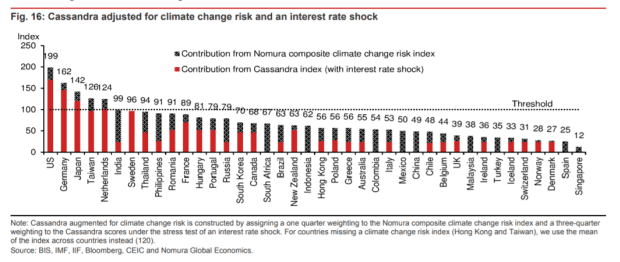
The U.S. is the country most vulnerable to a new financial crisis, Nomura warns

(…) The Singapore-based economics research team at Nomura built a model around five different early warning signs: the ratio of private credit to GDP, the debt service ratio, real equity prices, real property prices and the real effective exchange rate. Nomura says Cassandra correctly signalled two-thirds of the past 53 crises in 40 countries since the early 1990s, and it is currently warning that six economies – the U.S., Japan, Germany, Taiwan, Sweden and Netherlands – appear vulnerable to financial crises over the next 12 quarters.

Nomura also tested for interest-rate and climate change risk — and adding those to the model, the overall scores rose but the number of countries at the threshold to crisis vulnerability actually fell, as Sweden would drop out.
“I’m totally screwed.” WD My Book Live users wake up to find their data deleted Storage-device maker advises customers to unplug My Book Lives from the Internet ASAP.

Western Digital, maker of the popular My Disk external hard drives, is recommending customers unplug My Book Live storage devices from the Internet until further notice while company engineers investigate unexplained compromises that have completely wiped data from devices around the world.

The mass incidents of disk wiping came to light in this thread on Western Digital’s support forum. So far, there are no reports of deleted data later being restored. (…)

The My Book is a popular storage device for consumers and businesses. It plugs into computers, typically through USB. The affected model here, known as My Book Live, uses an ethernet cable to connect to a local network. From there, users can remotely access their files and make configuration changes through Western Digital cloud infrastructure. Western Digital stopped supporting the My Book Live in 2015. The support forum thread was first reported by Bleeping Computer.

On its website, Western Digital advised customers to disconnect their My Book Live devices to prevent further attacks while the company investigates the mass wiping. (…)

Scary stuff, particularly for the Internet Of Things industry.

THE DAILY EDGE: 24 JUNE 2021: Flash PMIs

U.S. New Home Sales Decline Unexpectedly in May

Sales of new single-family homes declined 5.9% (+9.2% y/y) during May to 769,000 units (SAAR) from 817,000 during April, revised from 863,000. It was the lowest level of sales in twelve months. March sales were revised to 886,000 from 917,000. The Action Economics Forecast Survey expected 870,000 sales in May.

Sales in the South fell 14.5% (+3.1% y/y) to 432,000 units after weakening 10.1% to 505,000 in April, revised from 545,000. It also was the lowest level of sales in twelve months. Rising by one-third (57.6% y/y) to 52,000 were sales in the Northeast. April sales were revised to 39,000 from 44,000. Sales in the West rose 6.7% both m/m and y/y to 190,000 from 178,000 in April, revised from 164,000. Sales in the Midwest held at 95,000 (28.4% y/y) but April sales were revised from 110,000.

The median price of a new home rose 2.5% (18.1% y/y) to $374,400, following a 4.9% April gain to $365,300, revised from $372,400. Working 2.3% higher (16.8% y/y) to $430,600 was the average sales price. April’s average price was revised to $420,900 from $435,400. These prices are not seasonally adjusted.

The supply of new homes for sale rose to 5.1 months in May, the most in 12 months. The median number of months a new home stayed on the market was 3.5, following 4.5 months in April and 5.0 months in March.

 image image

Sales are back on trend but could undershoot from here as the craze has seemingly ended. It will be interesting to watch prices now. We saw yesterday that prices of existing homes has kept rising while sales eased back on trend :

image

This CalculatedRisk chart shows that New Home Inventory is back to normal at around 300k units but needs to await completion of units permitted but not yet finished.

FLASH PMIs

U.S. private sector businesses registered a further marked expansion in activity during June, as further easings of COVID-19 restrictions boosted new orders. The rate of expansion softened slightly from the high seen in May, but remained substantial overall.

Adjusted for seasonal factors, the IHS Markit Flash U.S. Composite PMI Output Index posted 63.9 in June, down from 68.7 in May, but nonetheless signalling a historically elevated rate of expansion in output across the private sector. Moderations in activity growth were seen in both the manufacturing and service sectors, with goods producers hampered in particular by significant supplier delays and both sectors reporting difficulties finding staff.

image

New business growth remained marked during June, despite easing to a three-month low. The rise in new orders was substantial among manufacturers and service providers alike, as COVID-19 restrictions were relaxed further and client demand remained buoyant. At the same time, firms reported another strong monthly upturn in new export orders amid looser containment measures in key export markets.

Price pressures also remained elevated in June. The rate of input price inflation softened slightly but was the second-fastest on record. Manufacturers continued to note rapid increases in raw material and fuel costs, whilst service providers highlighted higher wage bills to attract workers plus greater transportation fees and fuel costs.

Higher costs were commonly passed on to clients through a steep rise in output charges during June. The increase in selling prices was the second-sharpest since data collection began in October 2009.

Employment issues remained prevalent during June, as numerous panellists mentioned difficulties finding suitably trained candidates for current vacancies. Although the rate of job creation remained strong overall, growth in backlogs of work was also among the highest seen over the past decade.

Business confidence ticked higher in June, as firms remained broadly upbeat regarding the outlook for output over the coming 12 months. Optimism was widely linked to strong client demand and the further reopening of the economy following mass vaccination.

The seasonally adjusted IHS Markit Flash U.S. Services PMI™ Business Activity Index registered 64.8 in June, down from May’s series record of 70.4. The marked expansion was the second-sharpest since data collection began in October 2009, and reportedly due to further upturns in customer demand as pandemic conditions eased further during the month.

Service sector activity was supported by a further significant rise in new business. Although slower than that seen in May, the rate of growth was among the quickest in the series history and was linked to robust demand conditions. New export order growth likewise remained strong, with some firms attributing this to looser travel restrictions.

Meanwhile, struggles among companies to find suitable workers hampered employment growth in June. Although strong, the rate of job creation was the slowest for three months. Pressure on capacity was reflected in a solid rise in backlogs of work.

At the same time, inflationary pressures remained elevated in June. Service providers stated that wage costs and additional transportation fees pushed up cost burdens, which rose at the second-fastest pace on record. Similarly, output prices increase markedly as firms sought to pass on greater input costs to clients.

Service sector businesses registered a slight moderation in the degree of optimism in June, with some concerned about the impact of rising inflation over the coming months.

June data signalled the greatest improvement in operating conditions among goods producers on record, as highlighted by the IHS Markit Flash U.S. Manufacturing PMI posting 62.6, up from 62.1 in May.

Rates of output and new order growth remained well above their respective series averages. However, there were reports that the softer rise in production among manufacturers was linked in part to supplier delays and difficulties finding suitable workers. Average supplier delivery times lengthened to the greatest extent on record by some margin.

Despite a substantial rise in backlogs of work, employment growth slowed in June as firms struggled to find staff or entice workers back to employment.

Amid worsening vendor performance, input prices soared once again at the end of the second quarter. The rate of input cost inflation accelerated to a fresh series record amid broad-based raw material price hikes. Firms raised their selling prices at a quicker rate in an effort to pass on these higher costs, with charge inflation also surpassing all previous records.

Unlike their service sector counterparts, goods producers expressed a greater degree of confidence in future output during June. Firms reportedly hope that an end to restrictions and further increases in customer demand will boost output over the next year.

The headline IHS Markit Eurozone Composite PMI® increased from 57.1 in May to 59.2 in June, its highest since June 2006, according to the preliminary ‘flash’ reading*. The latest reading indicated a third successive month of accelerating output growth as the economy continued to open up from COVID-19 related restrictions.

image

A further improvement in demand was also recorded, as new order growth likewise accelerated to the fastest since June 2006.

image

Business confidence in the outlook meanwhile rose to the highest since future sentiment data were first available in 2012, buoyed by the recent surge in demand and prospects of the economy opening up further in coming months.

Manufacturing continued to lead the upturn, reporting a twelfth successive month of output growth with the rate of expansion picking up again, albeit remaining slightly below March’s record high. Production growth was again sharpest in Germany, with France lagging the rest of the region amid a slower rate of new order growth.

Although manufacturing reported the stronger pace of growth, it was the service sector that again reported the biggest improvement in performance, with business activity growth accelerating to a pace not exceeded since July 2007.

The steepening pace of service sector growth seen over the past three months contrasts markedly with the seven months of successive declines seen prior to April, and principally reflects the easing of virus-fighting measures in many eurozone member states, notably in hospitality. Service sector growth accelerated across the region, albeit with an especially marked improvement in performance evident in Germany.

Underscoring the economic boost from the removal of some pandemic-related travel restrictions was the largest rise in services exports since at least September 2014 (when data were first collected).

The renewed surge in demand and brightening outlook prompted firms to take on additional staff for a fifth straight month, boosting employment numbers to the greatest extent since August 2018.

Despite the rise in employment during the month, with job gains in both manufacturing and services hitting the highest since 2018, firms reported the largest accumulation of backlogs of work since data were first available in 2002. While manufacturers reported an especially marked rise in uncompleted orders, backlogs also rose at the fastest rate for over two decades in the service sector.

Rising backlogs of work were accompanied by widespread supply shortages for many inputs. Manufacturers reported a lengthening of supply chains that was only slightly less marked than the 24-year survey record seen in May. Producers’ inventories of finished goods stock meanwhile fell at the sharpest rate since 2009 as high sales depleted warehouses.

Amid these signs of demand continuing to run ahead of supply for many goods and services, inflationary pressures increased again in June.

Average input prices rose at a rate exceeded only once (in September 2000) over the 23-year survey history. A record increase in manufacturers’ material prices was accompanied by the steepest increase in service sector costs since July 2008, the latter reflecting widespread reports of higher supplier prices, increased fuel and transport costs plus rising wage pressures.

Average prices charged for goods and services meanwhile rose at by far the fastest pace since comparable data for both sectors were first available in 2002, with prices rising in each sector at rates not exceeded for approximately two decades.

image

Note the first mentions of wage pressures in both the U.S.the Eurozone.

More from Markit:

Supply shortages continued to put pricing power in the hands of the seller, causing industrial prices to rise at survey record rates in the US, Eurozone and UK.

With service sector costs also being pushed higher by a combination of higher supplier prices, rising fuel costs and wage pressures, average input costs across the G4 economies rose in June at the fastest rate since comparable data were first available in 2009.

Selling price inflation also hit a new all-time survey high across the G4 as firms increasingly passed these higher costs on to customers. Selling price inflation was led by the US, despite the pace moderating slightly, though the UK and Eurozone saw fresh record rates of inflation.

Prices in Japan meanwhile again rose only modestly by comparison in June as sellers continued to offer discounts to stimulate sluggish sales.

unnamed (53)

Many of the price pressures reflect pandemic-related disruptions, many of which should prove temporary. Employment across the G4, for example, is running behind output growth as firms struggle to find sufficient numbers of staff to meet the sudden rise in demand that has accompanied the opening up of economies, most notably in the US. This has pushed up pay growth in many cases.

Many material price rises have meanwhile reflected temporary supply chain disruptions emanating from the pandemic, including a lack of transport or container availability and port congestion due to COVID-19 restrictions. These have been exacerbated by record safety stock building in recent months, the impact of which should soon wane.

However, it remains uncertain how long these disruptions will persist for, especially if further virus waves threaten to disrupt supply chains in Asia, in particular. It also remains unclear how far labour participation rates have fallen, and for how long they might remain lower than before the pandemic, which could affect longer term pay trends.

unnamed (55)

Fed’s Bostic Says Bond Buying Drawdown Near, Sees Rate Rise in Late 2022 Federal Reserve Bank of Atlanta President Raphael Bostic said Wednesday he has moved forward his expectations for a central bank rate rise to next year and that the time is coming soon for the Fed to pare its bond buying stimulus efforts.

TRANSITORY WATCH

(…) The most-active lumber futures contract on the Chicago Mercantile Exchange is almost 50% below last month’s record high of $1,733.50 per 1,000 board feet. Spurred sharply higher by strong home building and renovation demand, prices are still well above historical levels, at around $900, more than double the cost just a year ago, when the rally began.

Capital Economics forecasts that lumber prices will drop to $600 per 1,000 board feet by the end of 2021. (…)

Winter storms in the first quarter of this year reduced supplies of resin, which is used to make oriented strand board, or OSB, a lower-costing stand-in for plywood that is widely used to make walls and floors in U.S. houses. That has led to a supply shortage and price rally in OSB.

“It’s even more difficult to get OSB at the moment than it is lumber,” Flitman said.

The bellwether of the industry — the wholesale market where dealers buy and sell in bulk — has already topped out and prices of individual second hand cars should follow in a matter of weeks, said Zo Rahim, industry analyst at Cox Automotive. Cox owns Manheim, the biggest U.S. auction house selling millions of vehicles every year. (…)

The cost of used cars and trucks climbed 10% in April, and another 7.3% in May when they were responsible for one-third of the overall rise in consumer prices. (…)

Manheim’s wholesale index of used-vehicle value was 36% higher than a year earlier as of mid-June –- down from an annual rate above 50% in April. One effect of higher prices has been to push the average age of vehicles on U.S. roads up to a record 12.1 years in January. (…)

China’s Debt Reckoning Hammers ‘Too Big to Fail’ Borrowers

(…) Beijing is taking advantage of a strengthening economy and stable financial markets to toughen up its corporate sector. The result is a repricing of risk that should discourage the kind of reckless debt-fueled expansion that inflated some companies to a dangerous size. The spawning of such bloated empires created a threat to the financial system as well as a challenge to President Xi Jinping’s grip on power.

The danger for Xi is that smashing investor faith in government guarantees triggers precisely the kind of crisis he’s trying to avoid. It’s a dilemma that has frustrated Chinese leaders for decades: Ending moral hazard for indebted giants like China Huarong Asset Management Co. and China Evergrande Group would make the financial system more resilient over the long run, but a major default would cause significant short-term pain. (…)

The shift was visible in May’s credit data, which showed net corporate bond issuance contracting by the most in four years. (…)

Companies are under more scrutiny than ever as Xi enters a crucial period in his rule. China’s leader has in the past year doubled down on perceived threats to the Communist Party ahead of a 2022 leadership shuffle that could see him hold on to the presidency for a third term. (…)

State-owned enterprises aren’t immune. SOEs and other non-private corporates accounted for 54% of the value of onshore defaults in the first four months of the year, according to JPMorgan Chase & Co. (…)

Vaccination time-line

Californias drought is so bad that almond farmers are ripping out trees, dairy farmers are sending cows to slaughter, and fields are sitting bare because it’s too costly to irrigate them. Meanwhile, farmhands are working in life-threatening conditions as the brutal temperatures increase the risk of heat stroke and dehydration. Of course, this isn’t just a California problem. The state’s dramatic situation is a stark reminder that climate change is here and it’s wreaking havoc on food production across the world. (Bloomberg)