A Memorial Day treat that you should really spend an hour of your time listening to (less with faster speeds).
Stan Druckenmiller’s talk to the USC Student Investment Fund Annual Meeting two weeks ago.
A Memorial Day treat that you should really spend an hour of your time listening to (less with faster speeds).
Stan Druckenmiller’s talk to the USC Student Investment Fund Annual Meeting two weeks ago.
Initial claims for unemployment insurance fell 38,000 in the week ended May 22 to 406,000 from an unrevised 444,000 in the previous week. The Action Economics Forecast Survey panel expected 436,000 new claims. The latest week’s figure represents still another new low since the start of the pandemic in March 2020. While the most recent reading for claims remains well above levels reached immediately before the pandemic, the level of claims is approaching the 300,000-400,000 range in which claims have fluctuated during previous economic expansions. The 4-week moving average was 458,750 in the week ended May 22, down from 504,750 in the previous and also a pandemic low.
Initial claims for the federal Pandemic Unemployment Assistance (PUA) program fell to 93,546 in the week ended May 22 from 95,142 the previous week. The most recent figure is the lowest since just after the program began in April 2020. The PUA program provides benefits to individuals, such as the self-employed, who are not eligible for regular state unemployment insurance benefits. Given the brief history of this program, these and other COVID-related series are not seasonally adjusted.
Continuing claims for regular state unemployment insurance edged down to 3.642 million in the week ended May 15 from 3.738 in the previous week. The state insured rate of unemployment ticked down 0.1%-point to 2.6%. It reached 15.9% in May 2020, while the average rate in 2018 and 2019 was 1.2%.
Continuing PUA claims were 6.516 million in the week ended May 8, down from 6.606 million in the previous week. By contrast, in the May 8 week, the number receiving Pandemic Emergency Unemployment Compensation (PEUC) edged up 49,000 to 5.192 million. This program covers people who have exhausted their state benefits.
The total number of all state, federal, and PUA and PEUC continuing claims was 15.802 million in the May 8 week, a 175,255 decline from the previous week. This was the lowest reading since just after the pandemic-related programs began in early April 2020. This grand total is not seasonally adjusted.

 (Bespoke)
(…) The factors crimping labour market supply “may not be particularly susceptible to monetary policy,” he and several of his economists wrote in a blog on the Dallas Fed’s website.
Though those factors may fade as the year progresses, labour supply may ultimately increase less than expected. “It is our view that this possibility should be kept in mind as policy-makers assess the appropriate stance of monetary policy,” they wrote. (…)
The blog noted “resilient” wage growth and “relatively abundant” jobs, indicating the labour market has less slack than suggested by the fact that the U.S. economy now employs 8.5 million fewer people than before the pandemic.
It’s unclear how many sidelined workers will return. Many have retired. Others are caring for family members, or are worried about their health, the authors said. The extra $300 weekly in unemployment benefits, part of the federal government’s pandemic aid package, may also be playing a role. (…)U.S. Pending Home Sales in April Reverse March Gain
Pending home sales fell 4.4% (+51.7% y/y) during April following a 1.7% March rise, revised from 1.9%. Sales volume fell to the lowest level since May of last year. Weakness continues to reflect a record low number of homes on the market.
Sales in the Northeast declined 12.9% (+96.5% y/y) in April following a 6.1% gain. Sales in the South fell 6.1% (+45.3% y/y) after a 3.0% March rise. In the West, sales also were off 2.6% (+57.3% y/y) and reversed their increase in March. Moving 3.5% higher (39.4% y/y) were sales in the Midwest following five straight months of decline.

Manufacturers’ orders for durable goods declined 1.3% in April (+60.1% y/y) after rising 1.3% during March, revised from the previously reported 0.8% on May 4. This was the first monthly decline since April of 2020. A 0.8% rise had been expected in the Action Economics Forecast Survey.
Last month’s decline was driven by a 6.7% (+335.2% y/y) fall in transportation equipment orders, notably a decline of 6.2% in vehicle and parts orders. Excluding transportation, orders were up 1.0% (+29.9% y/y), following a 3.2% (+17.2% y/y) rise in March.
Orders for nondefense capital goods orders excluding aircraft, “core capital goods” orders, rose a strong 2.3% (+27.1% y/y) in April, following a 1.6% (+14.8% y/y) rise in March.
In the major categories of the report, orders for primary metals rose 3.0% (+46.6% y/y), orders for fabricated metal products rose 0.9% (+46.9% y/y), orders for machinery rose 1.4% (+29.3% y/y), and for computers 0.4% (+9.5% y/y). Orders for electric equipment and appliances declined 0.9% over the month (+25.2% y/y).
Shipments of durable goods rose 0.6% in April (+37.4% y/y) following a 2.7% (+12.3% y/y) rise in March. Shipments of core capital goods rose 0.9% (+23.5% y/y). Shipments of transportation products dropped 0.4% over the month (+90% y/y), while shipments excluding transportation products rose 1.0% (+23.7% y/y).
Unfilled orders for durable goods rose 0.2% in April (-2.5% y/y), following a 0.5% rise in March (-4.4% y/y). Unfilled orders excluding transportation rose 1.6% (+10.1% y/y).
Inventories of durable goods rose 0.5% (+2.3% y/y) in April, following a 1.0% (+2.1% y/y) rise in March. Excluding transportation, inventories rose 0.4% (+1.1% y/y) and 0.8% (+0.8% y/y) in March.
Core cap-goods orders are 15% above their pre-pandemic level and 9% above their previous peak. Their unfilled orders are 6.6% above their Feb. 2020 level and rising.

The Biden administration’s first budget, for the fiscal year beginning Oct. 1, would put the nation on a path to spend $8.2 trillion annually by the end of 2031, the people said. Under the plan, debt would exceed the record level seen at the end of World War II within a few years and reach 117% of economic output by the end of 2031, up from about 100% this year.
The government was on track to spend $5.7 trillion in fiscal year 2021, according to Congressional Budget Office projections released in February, before Congress enacted Mr. Biden’s $1.9 trillion Covid-19 relief package. The Biden budget plan would boost federal spending by $300 billion, or 5%, above the 2021 projected level. (…)
Officials have said those plans, which envision sharply higher taxes on corporations and the wealthy, will generate enough revenue to offset higher spending within 15 years, but will add to deficits in the meantime. (…)
For the White House, the budget proposal reflects a broader shift in economic thinking that focuses on keeping interest payments on government debt in check rather than eliminating deficits. (…)
Officials now believe they can borrow more over the next few years to pay for spending programs—such as investments in roads, bridges and broadband—that they say will raise the productive capacity of the economy, allowing faster growth without triggering unwelcome increases in inflation or interest rates.
The crux of their argument: Higher deficits in the short term would help foster stronger growth and lower debt over the long term.
While overall debt would rise to the highest level ever, the administration expects net interest costs to hover around 2% of GDP for the next decade, which it sees as a prudent threshold. (…)
“It is very dangerous to base your economic plan on the hope that interest rates will stay low forever,” said Brian Riedl, a senior fellow at the Manhattan Institute and a former Senate Republican budget aide. (…)
President Biden’s expected $6 trillion budget assumes that his proposed capital-gains tax rate increase took effect in late April, meaning that it would already be too late for high-income investors to realize gains at the lower tax rates if Congress agrees, according to two people familiar with the proposal.
Mr. Biden’s plan would raise the top tax rate on capital gains to 43.4% from 23.8% for households with income over $1 million. He would also change the tax rules for unrealized capital gains held until death. (…)
Currently, people who die with unrealized gains don’t pay any income taxes. Their heirs pay only when they sell assets and only on any gains since the prior owner’s death. That gives people an incentive to hold on to appreciated assets and, without the proposed change to the tax rules at death, the higher tax rate would prompt more people to hold assets until death.
The Biden proposal would apply income taxes to those unrealized gains at death. It would have a $1 million per-person exemption, plus existing exclusions for gains on principal residences. Family-owned farms and businesses would get special rules that would defer their taxes as long as they own and operate the businesses.
Taxing capital gains at death is different from the estate tax, which is based on net worth and currently has an exemption of $11.7 million per person. The administration hasn’t proposed any changes to that tax.
On Thursday, the European plane maker said it has asked suppliers of parts for its powerhouse Airbus A320 narrow-body jet family to prepare for a firm monthly production rate of 64 by the second quarter of 2023, which is close to the 67 figure it was targeting before the pandemic. The company also wants to be ready to ramp up to 70 by the first quarter of 2024, and is even considering a rate of 75 by 2025.
Likewise, a recent report by Reuters suggested that, in the U.S., Boeing is aiming to lift output of its 737 MAX to 42 jets a month in the fall of 2022.
Investors shouldn’t let their enthusiasm run wild. While consumers are hungry for chip-filled cars and electronics, airlines probably don’t want many planes in the near term, beyond opportunistic purchases at discounted prices. Indeed, 2021 output targets for the A320, which is the most popular aircraft family in the world, haven’t changed and remain set at 45 a month by the final quarter. This is lower than Airbus expected only seven months ago. (…)
Still, the new schedule implies a marked improvement relative to the production rates priced in by brokers. More important, it gives Airbus’s suppliers a clear signal that future sales will be higher, now that vaccination rates imply an end date for the Covid-19 crisis. This is essential for them to be able to increase capacity without gambling on their survival, and offers a lesson on the role that managing demand can play in easing bottlenecks. (…)
Even if demand for jets ultimately falls short of Airbus’s plans, the company’s priority in announcing them is to avoid the supply constraints that were prevalent in aviation before Covid-19. Walking back on Thursday’s commitments would be a last resort, given how hard it is to manage and resize production at each link in the long chain of smaller suppliers.
The large and complex aviation ecosystem needs greater visibility almost as much as it needs higher sales. Finally, it is getting some.
About 20 million vaccines were distributed on Thursday alone and over the past week, vaccinations have proceeded at a pace faster than the U.S., European Union or U.K. have registered at any point during their rollout.
UBS economists note that it’s worth watching for any pinch in supply of Chinese vaccines to countries currently deploying them: notably Chile, Indonesia, Turkey, Mexico and Brazil. (…)
After a year of stockpiling record amounts of capital to protect against a wave of loan defaults, Royal Bank of Canada and Toronto-Dominion Bank — the country’s two largest banks — reversed course last quarter. Toronto-Dominion on Thursday reported a surprise C$377 million ($312 million) release of provisions for credit losses for its fiscal second quarter, while Royal Bank released C$96 million. Analysts had projected both lenders would continue setting aside capital to absorb potentially soured loans.
With vaccination campaigns putting economic reopenings in reach in Canada and the U.S., strong housing markets fueling mortgage lending, and surging equity markets supporting capital-markets and wealth-management businesses, Toronto-Dominion and Royal Bank are asserting they have more than enough capital to handle any bumps along the road to recovery. (…)
Those rising measures may put pressure on Canada’s bank regulator, the Office of the Superintendent of Financial Institutions, to allow the country’s banks to resume share buybacks and dividend increases. The U.S. Federal Reserve allowed American banks to resume buybacks last year. (…)
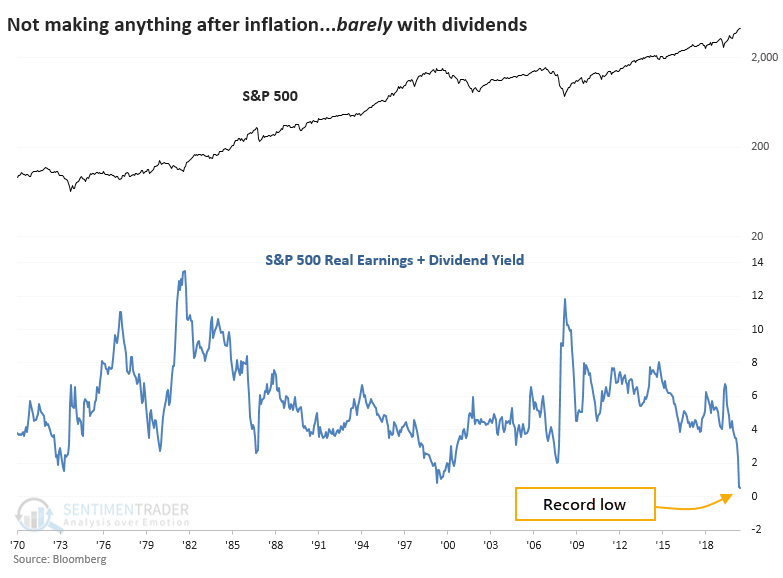
(…) Until recently, one of the main arguments for stocks was that even though they weren’t yielding much, at least they were earning more than Treasuries, even after accounting for inflation.
Now that there has been a spike in inflation gauges, the earnings yield on the S&P 500 has turned negative. This is not a condition that investors have had to tackle much over the past 70 years.
When an investor in the S&P adds up her dividend check and share of earnings, then subtracts the loss of purchasing power from inflation, she’s barely coming out even. This is a record low, dating back to 1970, just eclipsing the prior low from March 2000.
Like all valuation measures/tools, this offers little help in timing. But it warns that if and when the time comes, there is little “value/income backstop”. WE sure need rising inflation to be transitory.
The Dow Jones Industrial Average reached its 125th anniversary Wednesday after displaying more independence than usual from the S&P 500 Index. The correlation between the U.S. stock benchmarks over 60 trading days, or about three months, shows as much. Typically the indexes move in lockstep, as the average correlation has been 0.96 since 2000, according to data compiled by Bloomberg. Yet this month’s readings have been as low as 0.81, the lowest since November 2000.
The rise and fall of Ark Investment Management’s flagship exchange-traded fund echoes the dot-com stock crash of the early 2000s, according to Michael Hartnett, Bank of America Corp.’s chief global investment strategist. Hartnett raised the issue in a May 7 report that highlighted a ratio between the ARK Innovation ETF and Warren Buffett’s Berkshire Hathaway Inc. — the “new economy” versus the “old economy,” as he put it. For historical perspective, he tracked the ratio between Invesco Ltd. and Berkshire in the late 1990s and beyond. Invesco was then one of the largest U.S. stock-fund managers.

History rhymes…

 Delivery Apps Have Never Been Hotter. They’re Still Not Making Money. The pandemic sent business through the roof for DoorDash and Uber Eats, but they’re still trying to cook up secret sauce for profitability. Grubhub calls restaurant delivery a ‘crummy business’