The enemy of knowledge is not ignorance, it’s the illusion of knowledge (Stephen Hawking)

It ain’t what you don’t know that gets you into trouble. It’s what you know for sure that just ain’t so (Mark Twain)

Invest with smart knowledge and objective odds

THE DAILY EDGE: 2 JUNE 2021

U.S. Manufacturing PMI: Production growth accelerates amid stronger client demand,but supply chain disruption remains marked

May PMITM data from IHS Markit indicated a substantial improvement in the health of the U.S. manufacturing sector, with the rate of overall growth accelerating to a fresh record high. The upturn was supported by stronger expansions in output and new orders, with the pace of the latter reaching the fastest on record. Nonetheless, constraints on production capacity were exacerbated further during the month, as severe supply-chain disruptions led to a marked accumulation of backlogs of work and one of the fastest rises in input prices since data collection began in May 2007.

Although firms were able to partially pass on higher cost burdens, supply shortages and the potential for future strain on capacity pushed output expectations down to their lowest for seven months.

The seasonally adjusted IHS Markit U.S. Manufacturing Purchasing Managers’ Index™ (PMI™) posted 62.1 in May, up from 60.5 in April and from the earlier release ‘flash’ estimate of 61.5. The increase in business activity signalled among U.S. manufacturers was among the strongest in the 14-year series history.

image

Contributing to the uptick in the headline figure was a significant expansion of production during May. The increase in output was widely attributed to stronger client demand and a further marked rise in new order inflows. The accelerated pace of growth in production was the second-strongest since late-2014. That said, component shortages and supplier delays reportedly continued to limit operating capacity, and stymied the upturn. Although the extent to which lead times for inputs lengthened softened slightly, it was among the most marked on record.

New orders increased at the fastest pace on record in May, as both domestic and foreign client demand ticked higher. The upturn was often linked to the loosening of COVID-19 restrictions and successful vaccine rollouts, which led to stronger demand conditions. Similarly, new export order growth quickened, and was the sharpest since the first month of data collection in May 2007.

As a result of the combination of strong demand and supply constraints, supplier prices were hiked once again, leading to the sharpest rise in cost burdens since July 2008. Greater demand for inputs across the sector, in addition with higher logistics fees, were commonly cited as factors driving the rise in input prices.

Firms sought to pass on higher cost burdens to their clients amid favourable demand conditions, with the rate of charge inflation quickening to a fresh series high.

Meanwhile, backlogs of work rose at an unprecedented pace. Despite a further expansion in employment, firms noted that efforts to process work-in-hand were stymied by input shortages. As such, the rate of job creation slowed to the softest since December 2020. Others also stated that the slower rise in employment was linked to difficulties finding suitable candidates and struggles to fill available vacancies, exacerbating capacity constraints.

In an effort to protect against future supply shortages, firms increased their input buying activity markedly. Pre-production inventories were built at the fastest rate on record, but stocks of finished goods fell further as holdings were used to supplement production.

Finally, supply issues weighed on business confidence in May. The degree of optimism remained upbeat on average, but dipped to a seven-month low amid concerns regarding future supply flows.

Chris Williamson, Chief Business Economist at IHS Markit:

These backlogs of orders should support further production growth in the next few months, adding to signs of impressive economic expansion over the summer. But manufacturers’ expectations further ahead have moderated, hinting that the growth rate is peaking, linked to worries about capacity limits being reached, rising prices hitting demand and a peaking of stimulus measures.

China Factories Delay New Orders as Costs Rise, Risking Supply Shortages Buffeted by rising costs, some Chinese manufacturers are refusing to accept new orders or are considering shutting down operations temporarily—moves that could put more strain on global supply chains and cause more inflation.

(…) Surging raw-material prices and a shortage of workers have pinched smaller Chinese manufacturers, including many that sell their products to the U.S. and other Western markets. While many have passed their higher costs on to overseas buyers, the pain is so severe at some manufacturers that they are finding it hard to raise prices enough to make up the difference. Others don’t want to risk losing business to competitors. Many are now looking for other solutions to avoid losing money. (…)

But the strategy could fail if prices of raw materials continue to climb, or if Western demand doesn’t cool. In that scenario, factories that curb production would just be creating more goods shortages that in turn could lead to more cost pressures. (…)

The latest gauge of China’s factory activity showed signs of a slowdown. The official manufacturing purchasing managers index edged down slightly to 51.0 in May from 51.1 in April, led by a cool-off in new orders, though the index remains above the 50 mark that separates activity expansion from contraction. A subindex tracking small enterprises fell into contraction in May after two months of expansion. (…)

In a recent survey conducted by the Shanghai branch of the People’s Bank of China, about 47% of manufacturers said they plan to adjust prices in the near term. And 37% said they will be cautious about accepting new orders, wrote Lü Jinzhong, head of research with the PBOC’s Shanghai branch in an official publication in May. More than 38% of those surveyed expect prices for raw materials to continue climbing for another quarter on average, the article said. (…)

Foshan Modern Copper & Aluminum Extrusion Co., an aluminum processing firm with around 700 factory workers in Guangdong province, said the factory is still short 70 workers even after it raised salaries by 10% this year, compared with the usual 3% annual increase before the pandemic.

“Obviously that’s still not attractive enough for many young people,” said Huang Ruifeng, a representative at the company. “Covid likely prompted more workers to stay in their hometowns instead of looking for jobs.” (…)

Yesterday we saw apparent, though mild, contradictions between China’s official Manufacturing PMI and Markit’s, the former being down a little from 51.1 to 51.0 and the latter being up a little from 51.9 to 52.0. Markit’s survey is broader and includes more mid and small size firms while the official PMI is more weighted towards larger companies. China’s increased emphasis on pollution control may be responsible for slowing production at larger, state-controlled, firms.

According to Markit,

The ASEAN manufacturing sector as a whole saw sustained growth in May. Central to the latest upturn were further expansions of both output and new orders. For the latter, the rate of increase slowed only slightly from April’s eight-year high and remained strong overall. As a result, factory production rose for the third straight month. The rate of output growth slowed on the month, but was nonetheless the second-strongest since May 2018.

The global manufacturing sector expanded at a robust pace in May. Production rose at one of the fastest rates in a decade, as new order growth accelerated to an 11-year high. The outlook remained positive, with manufacturers forecasting further increases in output over the next 12 months.

The J.P.Morgan Global Manufacturing PMI™ – a composite index produced by J.P.Morgan and IHS Markit in association with ISM and IFPSM – posted 56.0 in May, up from 55.9 in April, to register its highest level in over 11 years (April 2010). Solid improvements in business conditions were seen across the consumer, intermediate and investment goods sectors. (…)

Subdued growth was registered in Japan, China, Russia and India. The Philippines, Turkey, Thailand, Mexico, Colombia and Myanmar all saw contractions. (…)

Pressure on capacity continued to build during May. Average vendor lead times lengthened to the greatest extent in the survey history, while backlogs of work at manufacturers rose at a near survey-record pace. This fed through to increased inflation, as highlighted by the steepest rise in input costs for over a decade and record inflation of selling prices.

image

John Authers today: China’s Inflation Could Be the World’s Problem

(…) A fascinating piece by Gavekal’s Louis Gave attempts to derive the likely psychology of the current leaders from their upbringing. They spent their youth under Mao Zedong, and had their fill of Marxist orthodoxy. Counterintuitively, this might make them very anxious to avert rising inflation:

“all Chinese leaders were raised in the Marxist church. And the first tenet of this faith is that historical events are shaped by economic forces (rather than individuals or ideas), with inflation being among the most powerful. For Karl Marx, Louis XVI would have kept his head and his throne, had it not been for rapid food price inflation in the years before France’s revolution in 1789. And for a Chinese technocrat, the Tiananmen uprising of 1989 only happened because, at the time, inflation was running above 20%.”

As this chart from Gave shows, the Tiananmen massacre of 1989 followed a period of extreme inflation, while China’s devaluation a few years later, as Deng Xiaoping opted for a policy of aggressive growth, brought another awful price spike in its wake. The degree to which it has kept headline inflation under control since then, against the background of historically impressive growth, is remarkable. It suggests that China’s leaders really, really want to avoid higher inflation:

relates to China's Inflation Could Be the World's Problem

On this basis, the People’s Bank of China is the latter-day Bundesbank, dedicated to eradicating inflation when all others are more relaxed about it.

(…) if China is a less enthusiastic buyer of stuff, it could mean slower global growth. And second, if it exports inflation as it once exported deflation, it creates a very distinct extra problem for the rest of the world.

  • Historically, the U.S. dollar tends to fall when U.S. CPI is higher than rest of DM (BCA Research)

image

While still on inflation, Markit’s data is troubling:

Eurozone manufacturing continued to grow at a rate unprecedented in almost 24 years of survey history in May, but also indicated record capacity constraints. While several indicators suggest output growth will remain very strong in coming months as firms reduce backlogs of work, these indicators also highlight growing price pressures, which are currently at a record high.

The IHS Markit headline PMI broke new records for a third month in a row during May to rise to a new high of 63.1. The surging manufacturing sector adds to signs that the eurozone economy is rebounding strongly in the second quarter, especially as the upturn in May was accompanied by signs from the flash PMI of the service sector also showing renewed signs of life.

However, production growth would have been even stronger in May had it not been for record supply delays. Supply difficulties and widespread shortages of inputs are constraining output and leaving firms unable to meet demand to a degree not previously witnessed by the survey.

With new orders growing faster than output, the production shortfall relative to demand signalled in May was the largest for 12 years.

unnamed (40)

Backlogs of uncompleted work (orders received by manufacturers but not yet started or completed) have consequently accumulated at a record pace.

unnamed (41)

High sales volumes are consequently depleting warehouse stocks, resulting in a new order to inventory ratio far in excess of anything previously recorded by the survey.

unnamed (42)

While these forward-looking indicators bode well for production and employment gains to persist into coming months as firms seek to catch up with demand, the flip-side is higher prices. The combination of strong demand and deteriorating supply is pushing up prices to a degree unparalleled over the past 24 years.

unnamed (43)

The survey data therefore indicate that the economy looks set for strong growth over the summer, but will likely also see a sharp rise in inflation.

We expect price pressures to moderate as the disruptive effects of the pandemic ease further in coming months and global supply chains improve. We should also see demand shift from goods to services as economies continue to reopen, taking some pressure off prices but helping to sustain a solid pace of economic recovery. However, this assumes the impact of the pandemic continues to wane in the coming months, and further waves of COVID-19 infections would inevitably darken this improving picture. With signs already appearing of Asia-Pacific economies being hit by a renewed surge in cases, a smooth path to the restoration of global supply chains is by no means assured.

ING adds:

Across eurozone industry, multiple sectors are now reporting significant shortages in equipment. The European Commission’s Economic Sentiment Indicator provides quarterly information on which factors are limiting production and ‘equipment’ has spiked as a factor in 2Q 2021. In fact, for total eurozone industry, it is now at its highest level since the start of the indicator in 1985, with 22.8% of businesses reporting equipment shortages as a key factor limiting production.

Shortages are rising across sectors, but the sectors affected most by this are logical given the pressing problems in computer chips, plastics and lumber. Rubber and plastics producers top the list, with electrical equipment producers a close second. Automotive, wood and computer and electronics producers round out the top five, showing a clear link to the problems in finding chips, plastics and lumber at the moment.

The impact on production has varied for now, with the main problems accumulating in the auto sector so far due to semiconductor shortages. This has brought production down -14.3% from its November peak. Other sectors are seeing less impact in terms of outright production declines. Furniture production is also down 6% from its recent peak, while smaller declines are reported among computer and electronics producers.

Shortages have become a key issue in several industrial sectors

unnamed - 2021-06-02T081604.555

Source: Eurostat, ING Research

The impact on producer prices has started to show. In April, producer prices increased by 7.6% year-on-year, the strongest increase since 2008, much of which is because of energy price base effects. For some of the sectors most affected by shortages, the lack of availability of inputs has not yet translated into excessive increases in producer prices up till now. This could be because the data lags a bit; producer prices for May have not yet been reported. It could also be because the shortages represent a small amount of total inputs in the production process, think of computer chips in car production. In wood production, we’re starting to see elevated producer prices at 6.3% YoY in April, but the spike in lumber prices continued in May so this is not yet the peak.

The sectors for which we have seen large increases in producer prices have been base metals and the manufacture of coke and refined petroleum products, at 18.3 and 53.1% YoY. So for many of the sectors experiencing shortages, margins have not yet come under huge pressure, which has limited the pressure to raise prices so far.

Even though producer prices have had differing responses to shortages, businesses do seem ready to start increasing prices. Selling price expectations among businesses have shot up dramatically in recent months, which has been led by sectors depending on lumber as its main input, but also the oil and chemicals sector, rubber and plastics and basic metals sector have seen a rapid rise in expected selling prices.

While other sectors have seen a more muted response, almost all goods-producing sectors currently face a much higher percentage of businesses expecting to increase prices than was the case on average in the 2016-2019 period. This shows that businesses do intend to increase prices on the back of the disruptions facing the supply chain.

Selling price expectations are the highest for industries experiencing shortages

unnamed - 2021-06-02T081812.881

Source: European Commission, ING Research calculations

The question is how this is going to influence consumer price inflation and importantly, whether the impact is temporary or more long-lasting. When looking at past behaviour of businesses experiencing equipment shortages, we find that the impact on selling price expectations is usually coincident with the shortage. This means that once shortages fade, selling price expectations normalise again.

What firms are currently facing is not a normal event though as chart 3 shows. We’re currently at the highest level of reported shortages limiting production since the start of the time series. When we look at the impact for another period with significant shortages like 2011 when supply chains were significantly disrupted by an earthquake and tsunami in Japan, and flooding in Thailand, we find a slightly longer-lasting effect of higher expected selling prices into the next quarter. Given the extent of the current issue, that could be expected in this period as well.

Now ultimately, we see that this relation between shortages and selling price expectations does translate into consumer prices, but the effect is more watered down and uncertain. Chart 4 shows that the relationship between the two is stronger with a lag of two quarters, which would result in an acceleration of non-energy industrial goods prices for the consumer over the summer.

Shortages are at historic highs, expect goods inflation to trend higher over the summer months

unnamed - 2021-06-02T082517.737

Source: European Commission, Eurostat, ING Research

Goods prices have only risen cautiously so far, but this is just the start. With supply chain issues, shortages of inputs and strong demand, they are going to increase from here and add to inflation that is already above the European Central Bank’s target. This means that when energy base effects start to fade, the ECB will not be out of the woods and we expect inflation to remain above 2% for a large part of 2021.

Still, we do expect most disruptions, and the shortages, to ease over the course of this year and early next, with semiconductors being the major exception, as tight markets are likely to remain. This means that we expect goods inflation to rise over the coming months, but the effect of shortages should fade over the course of 2022 because we find that the impact of shortages on inflation is usually only temporary.

For the ECB this means that, bar any second round effects, the spell of above-target inflation is likely to end sometime early next year. Still, with a strong economic rebound and above-target inflation, a discussion around tapering will be unavoidable in the coming months.

I bet the same is happening in the U.S.. Businesses are now padding orders and hoarding materials, amplifying the problems and inflation expectations.

Oil Price Hits Two-Year High as OPEC Sees More Demand Producers led by Saudi Arabia and Russia plan to pump more as global rebound boosts commodity appetite.

(…) Members of the Organization of the Petroleum Exporting Countries and their allies, a group known as OPEC+, agreed Tuesday to a previously planned output increase of about 450,000 barrels a day, starting next month. Saudi Arabia, meanwhile, agreed to continue easing separate, unilateral cuts of one million barrels a day that it put in place earlier this year.

In April, the group agreed to increase output by more than two million barrels a day by the end of July, bringing cumulative additions over the past year to some four million barrels a day. That is a big chunk of the 9.7 million barrels a day the group agreed to cut early in 2020 when the coronavirus first started shutting down economies, sapping global crude demand and sinking prices. (…)

A technical committee of the OPEC+ group forecast on Monday that oil demand would jump by six million barrels a day in the second half, according to OPEC delegates. As a result, global oil stocks will fall below their five-year average for the 2015-2019 period by the end of July, signaling an end to the pandemic glut, they predicted. (…)

The Organization for Economic Cooperation and Development said Monday it expects global output to increase by 5.8%, which would be the strongest expansion since 1973. (…)

(…) Corporate trips remain 70% or more below pre-pandemic levels, according to airlines, which rely heavily on business travel for a huge share of their revenue. (…) In a survey by the U.S. Census Bureau conducted in May, 35% of small-business owners said they expect to have travel expenses in the next six months, up from 31.5% in April and 26.5% in mid-February. (…)

Before the pandemic, business travel accounted for roughly 30% of trips, but high-paying corporate customers typically account for as much as half of airline revenues, according to trade group Airlines for America. Domestic and international business travelers in the U.S. directly spent more than $330 billion in 2019, according to the U.S. Travel Association. (…)

Airlines have said they are expecting more business travel to resume this fall, once offices and schools reopen, but a full rebound could be years away. (…)

Bloomberg:

More signs of bullishness in the oil market: Gasoline demand reached the highest since the start of the pandemic last week, reaffirming bets that Americans will be out traveling in force this summer. The cautious optimism is now “fully optimistic,” RBC said. Morgan Stanley boosted its long-term oil price forecasts. U.S. inventories of oil and clean fuels are all seen dropping last week, a survey showed.

AMC Soars as Company Sells $230 Million in Stock to Hedge Fund Mudrick Capital quickly unloads at a profit 8.5 million shares it purchased in deal with movie-theater chain

AMC Entertainment Holdings Inc. took advantage of a skyrocketing stock price last week to sell shares to a hedge fund for $230.5 million, it disclosed Tuesday, news that drove its stock higher still.

The hedge fund that bought the shares, New York-based Mudrick Capital Management LP, was a winner too. It had paid a premium to Friday’s closing price but promptly turned around and sold for a profit, according to a person familiar with the matter, unloading all 8.5 million shares it received in the deal.

AMC’s share price soared as high as $33.53 before ending the session at $32.04, a 23% jump. The movie-theater chain’s stock price is up more than 1,400% for the year, including a furious 116% climb last week. (…)

Mudrick Capital sold the shares it bought—its entire equity position in AMC—on the belief that the stock is overvalued, the person familiar said. (…)

The hedge fund bought the shares at about $27.12 apiece, AMC said in a news release, a 3.8% premium to Friday’s close of $26.12. The price at which the fund sold wasn’t immediately clear. (…)

Individual investors continued to bid up the shares Tuesday. “DIAMOND HANDS BABY, NOTHING CAN LET ME SELL,” one user posted on Reddit. (…)

Mudrick saved AMC from bankruptcy last December injecting $100M in debt financing. Last Friday, it bought $230.5M in equity and promptly resold the 8.5M shares on Tuesday for a profit of around $33M while boosting the value of its debt holding. Good luck baby!

Bloomberg adds:

Chief Executive Officer Adam Aron also addressed the deal in a series of tweets on Tuesday.

“Some of you have asked questions about AMC raising $230.5 million from the sale of 8.5 million shares. Like you, I am an AMC shareholder, and my team and I have the best interests of AMC shareholders very much top of mind.”

Curious as I can be, I fetched INK’s latest insider trading activity report on AMC. Mr. Aron’s teammates seem to have something different at the top of their mind.

image

image

No Grave Dancing for Sam Zell Now. He’s Paying Up for Hot Properties. Storied real-estate investor is focusing on more mainstream deals, a strategy reflecting the dearth of distressed properties

Sam Zell, who made a fortune buying distressed commercial properties, isn’t finding many bargains these days.

Instead, the storied real-estate investor is doing something he usually avoids: following the pack and spending big on something safer. (…)

But the 79 year-old’s more conventional investment strategy is the latest sign that the pandemic hasn’t produced the distressed opportunities many investors expected.

Hotels, malls and other properties have suffered enormous declines in revenue. But few owners have been forced to sell at steep discounts thanks to government stimulus programs and the Federal Reserve’s easy money policy which kept a lid on foreclosure. (…)

Yet on a recent conference call, Mr. Zell described retail real estate as a “falling knife”—investors who think they are getting a bargain might end up getting bloody themselves. Prices haven’t fallen enough in the sectors that are getting beaten up, he said.

“There obviously is going to be an opportunity in retail. I just don’t think it’s here yet,” he said. He added that hotels also look expensive: “I can’t relate…pricing to the way I see opportunity.” (…)

Huawei Targets Google’s Android Dominance with Harmony OS The Chinese tech giant plans to launch its new operating system, known as Harmony OS, across many of its smartphones, as well as unveil smart devices that will also run the company’s latest homemade software.

(…) While Huawei’s own smartphone sales are in free fall after briefly topping the world a year ago, the company is targeting other handset vendors that they hope will adopt Harmony OS, posing a direct challenge to Google Android’s dominance of the market.

Samsung Electronics Co., Xiaomi Corp.  and the rest of the world’s top-selling phone makers besides Apple Inc. all use Google’s Android. Chinese sellers make up 57% of the global handset market, according to market-research firm Canalys and could be potential takers if Huawei’s Harmony OS develops into a worthy match. (…) More than eight out of 10 smartphones sold run Android. (…)

THE DAILY EDGE: 1 JUNE 2021

U.S. Spending Boost Is Adding Fuel to Economic Growth Consumer spending rose 0.5% in April as Americans extended a spending binge and continued to catch up on activities they held off on during the pandemic, propelling a broad economic recovery.

(…) After months of buying goods from the safety of their homes, Americans are increasingly comfortable enough to go out in public and buy things in person, a shift that economists say is crucial to getting the economy running at full speed again. Spending on services, which account for the bulk of all consumer purchases, rose 1.1% last month; spending on goods fell 0.6%.

(…) household income was 11% higher than in February 2020, the month before the pandemic hit the U.S. Households have saved about $2 trillion more than they would have absent the pandemic and federal relief efforts in response to it, according to Morgan Stanley. (…)

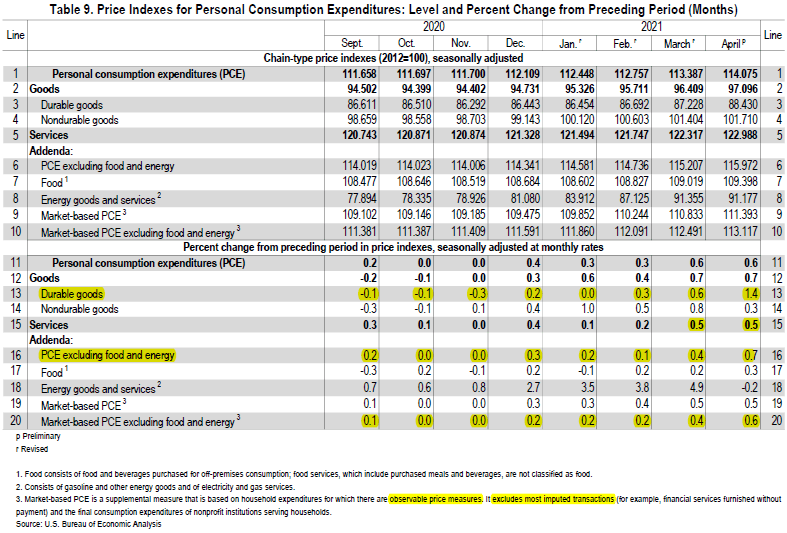
The Commerce Department’s inflation measure showed consumer prices rose 0.6% in April from a month earlier and 3.6% from a year earlier. Core prices, which exclude energy and food, rose 0.7% over the month and 3.1% over the year. (…)

It is not easy to effectively and objectively analyse consumer data given the pandemic rescue payments, base effects and uneven re-openings. To me, the most important stats from Friday’s income and expenditures data are the following ones:

  • Wages and Salaries rose 1.0% MoM, after +1.0% in March, +0.1% in February and +0.8% in January. That is a +9.0% annualized rate in the first 4 months of 2021. W&S are now 4.3% above their February 2020 level while some 8 million more workers remain on the sidelines.
  • Total personal expenditures diverged from aggregate payrolls (employment x hours x wages) for the second consecutive month and are up 4.6% from their February 2020 level, against +1.8% for labor income. Americans are beginning to dissave as confidence returns and the economy reopens.

fredgraph - 2021-05-29T073259.749

  • Importantly, March expenditures were revised up, from +4.2% MoM to +4.7%. Not insignificant although not mentioned by the media/pundits.
  • Spending on durable goods remains very strong even as spending on Services is gradually recovering. Pent-up is still winning over spent-up.

fredgraph - 2021-05-29T073351.122

  • Core PCE inflation, normally more subdued than core CPI inflation, has been rising at the same pace since January and is now even at +3.0% on a YoY basis. In the last 2 months, core PCE inflation is +6.7% annualized. Even if transitory, that ought to be a surprise to the Fed.

fredgraph - 2021-05-29T074649.727

  • Sequentially, trends in core inflation rates are worrisome:

fredgraph - 2021-05-30T075616.237

  • Inflation on durable goods has sharply accelerated on strong demand and constrained supply but inflation on services is also quite strong at +6.0% annualized in March-April. Spending on services is not back to its pre-pandemic level yet. Note the strength in “ Market-based core PCE”, also at +6.0% annualized. This measure is totally objective as it excludes most imputed prices.

image

  • Goldman Sachs seeks to reassure us that “transitory” is the right qualifier: “We forecast core PCE inflation of 2.50% at end-2021 (up from 2.3% previously), 2.10% at end-2022, 2.15% at end-2023, and 2.20% at end-2024 based on our bottom-up inflation model.”
  • But its own key inflation drivers are all pointing upwards:
    • Its composition-Adjusted wage tracker (light blue) is holding steady at 3.0% but pre-pandemic trends were all clearly upwards and its actual wage tracker (blue), at 4.0%, is back on trend. Worker shortages amid booming demand and rising minimum wages could surprise.

image

    • “Recent dollar weakness points to further moderate upward pressure on import prices.” If the recent dollar weakness continues, upward presures could become less “moderate”.
    • Commodity prices, including energy and ag, may not have peaked just yet as supply issues could well endure after years of under-investment.

From a WaPo biz piece last Saturday:

(…) No one in Wildwood seemed to have enough help. Businesses were getting desperate and creative. Raising wages. Dangling bonuses. Busing in workers from neighboring counties. Sharing workers with competitors. Cutting back hours. Turning to family and friends.

“Help Wanted” signs were everywhere. The main highway into town was dotted with billboards from Morey’s offering $15 an hour — well above the state’s $11.10 seasonal worker minimum wage. A sign outside the Douglass Candies store on the boardwalk advertised $13 an hour, plus a $150 signing bonus and $50 for getting vaccinated.

“I think it’s going to be a banner year. I just need to find more workers,” said Jason Dugan, co-owner of the popular candy store. (…)

Baralos said he had already raised prices — 50 cents here, $1 there. He’d ordered new laminated menus. The kids breakfast — two eggs, pancakes or French toast with meat — was now $7.99, a dollar more than last summer. (…)

How transitory will these new laminated menus be?

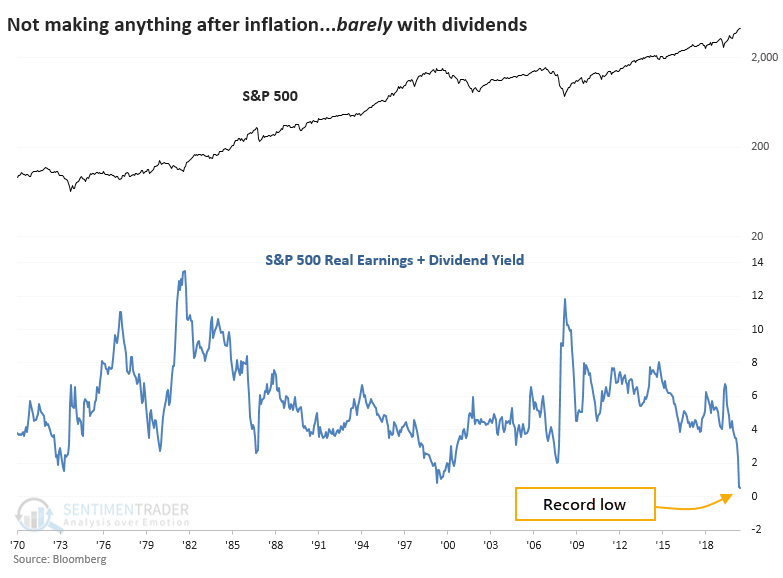
Last week I offered this chart and comment from SentimenTrader showing that there is little, if any, value/income backstop in this market.

When an investor in the S&P adds up her dividend check and share of earnings, then subtracts the loss of purchasing power from inflation, she’s barely coming out even. This is a record low, dating back to 1970, just eclipsing the prior low from March 2000.

S&P 500 real earnings dividend yield inflation

Steve Blumenthal posted this chart from Lohman Econometrics which excludes dividend yields but adds visuals to the valuation risk. The recent sharp drop commes exclusively from the spike in inflation, underscoring the importance of the word “transitory”.

unnamed - 2021-05-30T081017.679

The YoY change in core CPI jumped from 1.3% in February to 3.0% in March. This added 1.6 points to the Rule of 20 P/E to 24.8 using the current 2021 estimated EPS of $189.61. We will get the May CPI data on June 10. An unchanged core would leave the YoY growth at 3.1%.

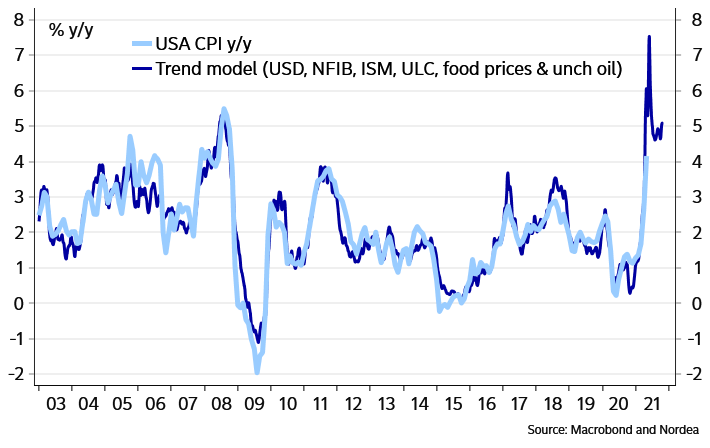
Nordea’s model on total CPI is scary:

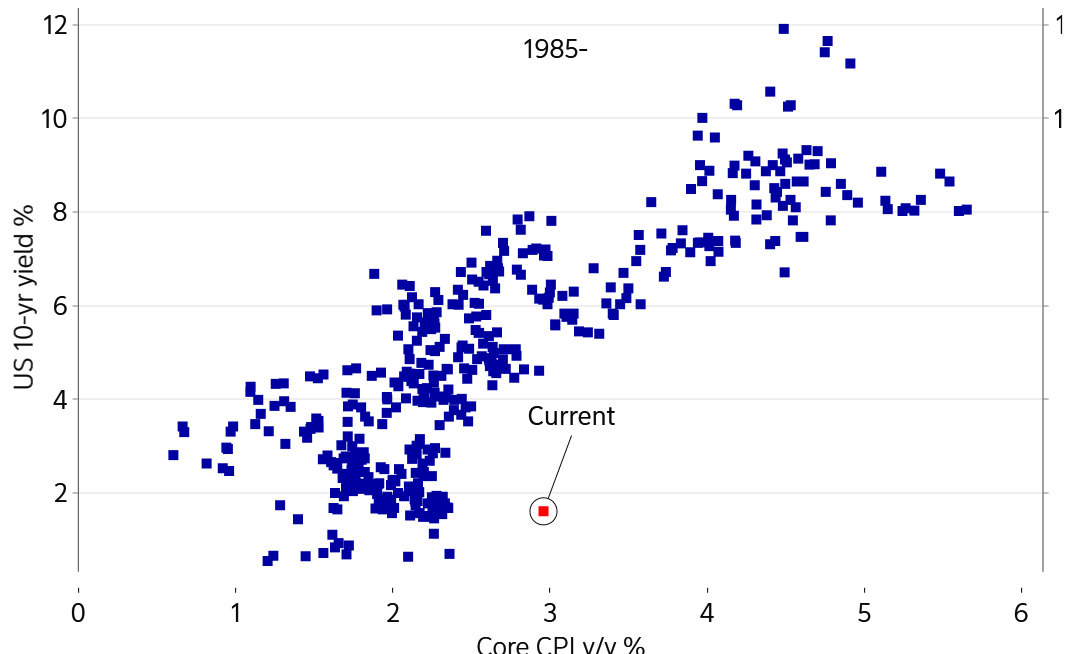
But isn’t the inflation story already market consensus? Well, even though there is a lot of talk of inflation and the FinTwit crowd has started to call sticky inflation a consensus view, a scatter plot of core inflation and the US 10-year yield says that the bond market rather has fully bought into the transitory peak inflation story.

The bond market believes that inflation is transitory

Meanwhile, the demand side of the equation keeps getting help:

Biden Is the $6 Trillion Man A blowout for the ages on everything but defense and security.

From the WSJ Editorial Board:

(…) If Mr. Biden gets his way, spending in fiscal 2022 will still be $6 trillion, which is some $2 trillion more than before the pandemic in 2019. Then spending will keep rising and remain a little under 25% of GDP for the rest of the decade. That level has never been reached in a single year since World War II, and the postwar pre-Covid average was 19.4%.

Even this level of spending is surely understated since much of it will finance Mr. Biden’s new cradle-to-grave federal entitlements for child care, paid family leave, community college and more. These are mandatory programs that don’t require an annual Congressional appropriation. (…)

The President’s discretionary priorities also deserve a word. Most executive agencies would get huge budget increases, including Health and Human Services (23.1%), Commerce (27.7%), and the Environmental Protection Agency (21.3%). Apparently, the administrative state will need more money for the vast regulatory buildup the President has ordered.

On the other hand, Defense (1.6%) and Homeland Security (0.2%) budgets would decline after inflation. China is a generational challenge. Iran is arming its proxies across the Middle East. Migrants are flooding the Southern border. Yet Mr. Biden believes the military and border security need to go on a diet.

Mr. Biden proposes to finance all this with some $3 trillion in tax increases, the largest tax hike as a share of the economy since 1968, according to Strategas Research Partners. (…)

Even Mr. Biden’s budget assumes that interest payments on the debt will more then double to 11.2% of spending by the end of the decade. But that assumes the Federal Reserve won’t raise interest rates all that much, and that America’s creditors won’t demand a higher premium to guard against inflation and financial risk. Mr. Biden is counting on the Fed to monetize all of this debt, but no one knows how long this modern monetary theory can last. (…)

(…) “Where we choose to invest speaks to what we value as a nation,” Biden said in a statement released by the Office of Management and Budget. “It is a budget that reflects the fact that trickle-down economics has never worked.”

The idea is that boosting the middle class and the poorest Americans will provide more stable, long-term growth. (…)

Equity is mentioned almost 40 times in the budget document, double the references to growth. (…)

This chart is from Stan Druckenmiller. (If you missed my Memorial Day post, you probably missed his recent presentation, a must). Good demand cannot remain 15% above trends without goods inflation.

unnamed - 2021-05-31T074342.967

The Chase spending tracker is as of May 24. There is no let down, even on nondiscretionary spending:

image

Fed’s Bullard: US jobs market is tighter than it looks Comments could accelerate central bank’s timeframe for removing some monetary stimulus from the economy

In an interview with the Financial Times, James Bullard, president of the St Louis Fed argued that anecdotal evidence suggests that conventional measures of employment may not fully reflect the reality and that “labor markets should be interpreted as fairly tight”.

So much for a data and evidence dependent Fed…

unnamed - 2021-06-01T070024.285

Graphic: U.S. Chamber of Commerce (via Axios)

Euro-Area Inflation Rate Hits 2% for First Time Since 2018

(…) Core inflation, a less volatile measure that excludes volatile items such as food or fuels, was just 0.9% in May. (…)

Inflation accelerated 2% in May, but core reading remained subdued

Nordea:

The flash inflation data provides only a very limited amount of detailed information on each country’s price developments but it points to a direction that the core inflation seems to be sluggish in most Euro-area countries and energy was driving the increases in headline inflation in all countries. Out of the big economies, the HICP core inflation slowed down to 0.1% in Italy and in France, available information both on services and manufactured products showed very modest inflation in monthly terms and core inflation very likely kept hovering at around 1%.

The only signs of higher core inflation came from Germany where service price inflation (based on the national data) accelerated from 1.6% to 2.2%. Based on the regional data, it seems that the rise was mainly due to higher inflation in transport and package holidays which both are typically volatile and especially the transport prices were probably at least partly driven by the higher fuel prices. Otherwise, the regional data showed very gradual price developments among services in Germany.

ING:

Goods inflation is set to rise as well – which has hardly happened so far – as supply chain problems, shortages and high capacity utilisation are resulting in price pressures. In May, it increased from 0.4% to 0.7%, which is likely to be the start of a longer rally, as supply side issues are set to last for at least a few more months, and demand for goods continues to come in very strong.

For services, a lot of prices are still imputed as restrictions remain in place in a lot of countries, which makes real price developments harder to read. Reopenings have occurred over the course of May though, but the full inflation impact is probably going to show up in June. German data did reveal yesterday that prices for package holidays increased more significantly in May. We expect more reopening jumps to play into the services inflation data over the months ahead. (…)

With goods and services inflation set to increase more, elevated eurozone inflation is the best bet for the coming months. The discussion about whether this is indeed temporary or structural will be a very prominent debate for the months to come. We expect the recovery to moderate after a few strong months initially and see most goods inflation disruptions fading towards the start of 2022. That means we still expect inflation to come down to about 1.5% in 2022.

MANUFACTURING PMIs

The eurozone manufacturing economy experienced a new record improvement in operating conditions during May. The headline PMI® recorded 63.1, compared to 62.9 in April and its highest reading in the survey history (data for the eurozone have been available since June 1997). The headline index has now recorded readings above the 50.0 no-change mark that separates growth from contraction for 11 months in succession.

image

All three market groups once again recorded strong improvements in operating conditions during May. Investment goods producers were again the best-performing, registering rapid gains in both output and new orders. The intermediate goods and consumer goods categories both saw stronger growth, with respective PMI readings for May close to survey record highs.

imageAt the country level the Netherlands registered the highest PMI, followed by Austria. In each case, latest readings were respective survey records.

Of the remaining six countries covered by the survey, Ireland and Italy also recorded their highest ever PMI numbers, whilst Greece, France and Spain all registered multi-year peaks. Germany was the only nation to record slower growth, though still managed to register a rate of expansion close to March’s survey record.

Growth of manufacturing output was the slowest recorded by the survey for three months, though it nonetheless remained close to March’s survey record with production again underpinned by rapid gains in new orders. May’s survey indicated that sales rose at the third-strongest rate in the survey history (surpassed only by increases seen in the preceding two months). New order books were swollen by increased demand from across domestic and international markets: new export business rose again at a historically sharp pace.

Placing constraints on production activities were ongoing difficulties in sourcing inputs from vendors. Deliveries from suppliers deteriorated at a severe and unprecedented rate during the month, as demand for inputs again exceeded the supply capabilities of vendors.

Indeed, purchasing activity amongst eurozone manufacturing firms rose at a fresh survey record rate but, faced with delays in delivery, firms again utilised their existing stocks wherever possible. The result was a twenty-eighth successive monthly fall in input inventories. In a bid to meet strong demand, manufacturers reduced their stocks of finished goods to the sharpest degree recorded by the survey since November 2009.

On the price front, average input costs again rose substantially, with the rate of inflation hitting an unprecedented level in line with widespread product shortages. Boosted by strong market demand, manufacturers took advantage of improved pricing power by raising their own charges at the fastest rate in more than 18 years of data availability.

With new orders rising at a faster rate than output, levels of work outstanding continued to increase in May. Moreover, the rate of growth hit a fresh survey record for the third month running. This encouraged firms to add to their workforce numbers, leading to a net rise in manufacturing employment for the fourth successive survey period. Growth also accelerated, reaching its highest since January 2018. All nations once again registered a rise in staffing levels, with Austria, Ireland and the Netherlands enjoying the sharpest gains.

Finally, confidence about the future remained highly positive in May despite easing to its lowest in the past four months. Manufacturers remained buoyed by the potential opportunities over the coming year from the hoped-for further reopening of economies and easing of restrictions related to dealing with the COVID-19 pandemic.

Chris Williamson, Chief Business Economist at IHS Markit:

(…) High sales volumes are consequently depleting warehouse stocks and backlogs of uncompleted work have soared at a record pace. While these forward-looking indicators bode well for production and employment gains to persist into coming months as firms seek to catch up with demand, the flip-side is higher prices. The combination of strong demand and deteriorating supply is pushing up prices to a degree unparalleled over the past 24 years.

The survey data therefore indicate that the economy looks set for strong growth over the summer but will likely also see a sharp rise in inflation. However, we expect price pressures to moderate as the disruptive effects of the pandemic ease further in coming months and global supply chains improve. We should also see demand shift from goods to services as economies continue to reopen, taking some pressure off prices but helping to sustain a solid pace of economic recovery.

(Goldman Sachs vis The Market Ear)

China’s manufacturing sector continued to expand in May, with firms reporting the strongest increase in new work for five months. As a result, production expanded further, though the rate of growth softened since April amid reports of material shortages and higher purchasing costs. Suppliers’ delivery times lengthened solidly, which in turn drove a rapid increase in input prices. As part of efforts to contain costs, employment was broadly stable in May. At the same time, firms raised their factory gate prices at the quickest rate for over a decade.

The headline seasonally adjusted Purchasing Managers’ Index ™ (PMI ™ ) climbed from 51.9 in April to 52.0 in May, to signal a further improvement in operating conditions. Though mild, the upturn was the strongest recorded in the year to date.

image

Latest data signalled a further increase in demand for Chinese manufactured goods, with total sales rising at the fastest rate for five months. The expansion was supported by greater demand both at home and overseas. Notably, new export order growth improved to a six-month high in May.

image

Greater amounts of new work led to a further increase in Chinese manufacturing output during May. The rate of expansion softened since April and was moderate. Anecdotal evidence indicated that material shortages and higher purchasing costs had dampened the latest upturn in output.

The subindex of total new orders hit its highest point in 2021 and the gauge for new export orders was at its highest since November. Supply was relatively weak as raw material shortages and high prices hindered expansion.

The sustained improvement in customer demand led firms to raise their buying activity at a solid rate. However, average vendor performance deteriorated again in May, and at a faster pace than in April. According to panel members, greater demand for inputs and low stock levels at suppliers drove the latest deterioration in lead times.

Inventories data meanwhile pointed to a slight drop in stocks of both pre-and post-production items. The falls were often linked to the greater usage of current inventories for production and fulfilment of orders.

After rising slightly in April, employment was broadly unchanged in May. While some firms added to their payrolls in order to expand capacity, other companies expressed a more cautious approach to hiring due to rising input costs. Consequently, backlogs of work rose for the third month in a row.

Average cost burdens rose rapidly in the latest survey period, with the rate of inflation the quickest since December 2016. Panel members frequently mentioned that higher raw material costs pushed up expenses. Firms generally passed on greater input costs to clients by raising their output prices which increased at the fastest rate since February 2011.

Manufacturing firms remained confident that output would increase over the year ahead amid forecasts of rising customer demand and new product releases. That said, the level positive sentiment dipped to a four-month low, largely due to concerns over rising costs and pandemic-related uncertainty.

The headline au Jibun Bank Japan Manufacturing Purchasing Managers’ Index™ (PMI) edged down from 53.6 in April to 53.0 in May, signalling a softer but still moderate improvement in the health of the manufacturing sector. The latest increase extended the current sequence of expansion to four months and highlighted a sustained turnaround for the Japanese manufacturing throughout 2021 following COVID-19 related disruption last year.

image

Latest data pointed to manufacturing output increasing for a fourth consecutive month. The pace of growth softened from the previous survey period, but was still solid overall amid reports of improved demand conditions as firms adjusted to operating under COVID-19 restrictions.

New orders among Japanese manufacturers also rose further. The overall pace of expansion dipped in comparison to April, and was only modest overall. Respondents linked higher sales to greater client confidence for tools and machinery. Moreover, foreign demand for Japanese manufactured goods remained in expansion territory in May, with firms citing stronger demand in key markets, notably in China.

The Japanese manufacturing sector was boosted by a second successive rise in employment levels in May, with firms taking on additional personnel in response to greater output requirements. Indications of greater pressure on capacity rose, as backlogs of work increased for the third time in as many months, though the pace of growth eased from April.

At the same time, Japanese goods producers indicated a quicker expansion in purchasing activity in May, with the respective seasonally adjusted Index reading at the highest level since February 2014. Firms linked additional input buying to growing output requirements and new orders. That said, average vendor performance deteriorated further in May, as manufacturers indicated that raw material shortages meant lead times extended further. As a result, holdings of pre­production goods were raised for the first time since March 2019 to guard against delivery delays, while panellists noted that existing orders were completed using stocks of finished goods where possible.

May data signalled further rises in average cost burdens among Japanese manufacturers. The pace of input cost inflation remained rapid overall, and reached the fastest pace since October 2018. Respondents commonly attributed higher input costs to widespread rises in raw material prices. These were partially passed on to clients through higher factory gate charges, which rose only modestly in comparison.

Looking ahead, business optimism rose at Japanese goods producers, as firms continued to forecast a rise in output in the coming year. Manufacturers predicted that a wider economic recovery from the pandemic would boost demand.

China’s official manufacturing purchasing managers index slipped slightly to 51.0 in May from the previous month’s 51.1 reading, according to data released Monday by the National Bureau of Statistics. (…)

A recent surge in prices for raw materials such as iron ore, crude oil and coal sent the subindex for input prices to 72.8 in May, the highest level since November 2010, while output prices notched up a record-high reading of 60.6, according to Monday’s PMI data. (…)

Total new orders retreated to the lowest level in a year as fewer bookings from overseas markets pushed new export orders into contraction territory, the statistics bureau said.

“The soaring prices will soon dent demand and squeeze profit margins for manufacturers by adding production costs,” said Xing Zhaopeng, an economist at ANZ. (…)

Monday’s data showed larger manufacturers performing better while a subindex tracking small enterprises fell into contraction, below the 50 mark. (…)

Separately on Monday, China reported that its nonmanufacturing PMI, which includes services and construction activity, rose to 55.2 in May from 54.9 in the previous month.

The subindex measuring construction activity climbed to 60.1 in May from April’s 57.4, the statistics bureau said, while those for transportation and accommodations marked a second month above 65—indicating a sustained rebound in travel. The retail, catering, cultural, sports and entertainment sectors also remained well in expansion territory in May, reflecting what the statistics bureau described as an accelerating consumer recovery. (…)

However, expansion for the service industry as a whole narrowed slightly to 54.3 in March, compared with 54.4 in April, held back in part because of production-linked services, according to the statistics bureau. (…)

Does China’s Baby Bust Mean a Global Inflation Boom? The effects of China’s demographic crisis will percolate to nearly every corner of the global economy.

China will allow couples to have three children and will invest more in education and child care, after decades of restricting most families to one or two children. The change is welcome, but the limited success of many other countries trying to boost births with financial incentives—and the lackluster response to a similar policy change in 2015—mean it is probably too late to head off the worst of China’s demographic crisis. The effects of the great Chinese baby bust will percolate to nearly every corner of the global economy.

(…) all things being equal, it does seem likely that costs for labor-intensive manufacturing in aggregate could be set to rise significantly over the next decade or so, particularly if India continues to struggle with poor infrastructure and protectionism. Places like Vietnam will help, but the scale is several degrees of magnitude away. China’s Guangdong province alone is home to around 30% more people. (…)

About half of migrant workers in China are older than 40, according to Commerzbank, compared with around 30% in 2008. Many of them will find themselves responsible for supporting two elderly parents back home.

The growth rate of both the migrant and overall urban labor force has slowed sharply since 2017, right around the time the 15- to 64-year-old population began to fall in earnest. That is a more worrisome trend than lower population growth itself. It implies that one main source of Chinese productivity growth—moving workers from low-value-added agriculture or local services into high-value-added manufacturing—may be starting to bump up against some natural limits. (…)

Many investors seem to view copper as a sure thing given the tailwinds behind investment in clean energy and vehicles. But as of 2018, construction was still the biggest source of copper demand in China, according to mining giant BHP, accounting for 26% of total demand and edging out the power sector and consumer durables at 22% and 23%, respectively. If future Chinese households stop seeing real estate as their best financial bet, the hit to demand for nearly every major industrial commodity would be substantial. (…)unnamed - 2021-06-01T071343.957

TECHNICALS WATCH

Fresh new highs on several broad indices are encouraging but tech and smaller caps remain problematic.

S&P 500                                           Canada

 spy tsx

Russell 2000                                  NYFANG

 iwm nyfang

Fingers crossed Amgen Wins Approval for Pathbreaking Lung Cancer Drug A potential blockbuster, the drug is the first to treat a common cancer mutation called KRAS that researchers struggled for years to target.