U.S. Industrial Production Firms During September
Industrial production increased 0.4% (5.3% y/y) during September after easing 0.1% in August, revised from -0.2%. Production rose 0.7% in July, revised from 0.5%. The level of industrial output during September was a record, and it has risen by roughly one-quarter since the 2020 low. A 0.1% improvement had been expected in the Action Economics Forecast Survey.
By industry group, manufacturing production increased 0.4% in September (4.7% y/y), the same as in August, revised from 0.1%. Durable goods rose 0.5% (6.0% y/y) after edging 0.1% higher in August. Computer & electronic products production gained 1.1% (1.9% y/y) for the second straight month. Motor vehicle & parts production rose 1.0% (19.4% y/y) after falling 1.5% in August. (…)
Utilities output eased 0.3% (+0.5% y/y) in September after dropping 3.3% in August. Mining activity rose 0.6% (+11.1% y/y) in September after holding steady in August.
The capex-sensitive business equipment category increased 0.5% after +0.8% and +1.6% in July and August respectively.
Actually, manufacturing production has significantly trailed orders, presumably because of shortages and delays.

Th U.S. Manufacturing PMI has declined but remains above contraction levels:

But the ISM New Orders index is now contracting. In September, only 5 of the 18 manufacturing industries tracked reported growth in new orders.
New Orders
U.S. Home Builder Index in Marked Downtrend
The Composite Housing Market Index from the National Association of Home Builders-Wells Fargo fell 8 points or 17.4% m/m in the October survey (-52.5% y/y) to 38, yet again the lowest level since May 2020. The index is down 57.8% from its November 2020 high of 90. A reading of 44 had been expected in the Informa Global Markets survey.
All three HMI components declined again this month. The index of present sales conditions fell five points or 16.7% (-47.7% y/y) to 45, the ninth decline in ten months. The October level was 53.1% below the record-high of 96 in November 2020. The index of expected sales over the next six months dropped 23.9% in October to 35 (-58.3% y/y), down for a sixth consecutive month. The October value is the lowest level since June 2012.
The index measuring traffic of prospective buyers fell 19.4% (-61.5% y/y) to 25, the seventh consecutive monthly decline.
Among the regions of the country, the Housing Market Index actually rose in Northeast to 48 this month from 47 in September, a 2.1% increase (-34.2% y/y). The other regions all declined, with the largest reduction in the West, -26.5% in the month from 34 to 25 (-70.6% y/y). The index in the South was 41, down 21.2% in the month and 51.2% from a year ago. In the Midwest, the index was 38 in October, down 9.5% in the month and 47.2% in the year.

Biden to Sell More Oil From Strategic Reserve President will also consider more reserve sales this winter

NY Fed’s Service Business Leaders Survey
Activity declined in the region’s service sector, according to firms responding to the Federal Reserve Bank of New York’s October 2022 Business Leaders Survey. The survey’s headline business activity index dropped twenty-one points to -15.5, its lowest level in nearly two years. The business climate index fell thirteen points to -41.6, also a multiyear low.
The employment index rose five points to 13.2, pointing to a pickup in employment growth despite the decline in overall activity. At 57.4, the wages index was little changed, indicating another month of strong wage growth. The prices paid index held steady at 79.5, pointing to ongoing significant input price increases, and the prices received index moved down three points to 39.2.
Conditions are expected to worsen over the next six months. The index for future business activity fell twenty-four points to -7.9, and the index for the future business climate dropped twenty-seven points to -30.2; this marks the first time in nearly two years that both indexes were negative. Employment is expected to grow in the months ahead, and wage and price increases are expected to remain widespread.


Sounds like stagflation in services…supposed to offset lower goods demand.
Last Friday’s update to the Atlanta Fed’s wage tracker (a 3-m m.a.) suggests wage growth might have peaked. Job stayers’ at 5.3% is down from its June 6.1% growth rate and back to April’s. The large gap to job switchers is not preventing the slowdown.

Goldman Sachs’ wage survey leading indicator also points to slower wage growth:

Goldman Sachs analysed the housing rental market to conclude
Asking rents on new leases have decelerated sharply. (…) The best measures slowed to an annualized growth rate of 3% in 2022Q3 (…).
But continuing lease rent growth is likely to run hotter as these units catch up to market rates. We estimate that this catch-up effect boosted annualized continuing lease rent growth to over 8%, driving the strength in CPI shelter inflation, but that these units are still priced 3% below the new lease market rate, on average. Our estimate of the speed of catch-up suggests that continuing lease rents will rise 6% in 2023. Because rent growth is likely to be faster on continuing leases than on new leases, it should be faster in the CPI than in alternative measures.
Based on this analysis and some idiosyncrasies of the CPI measure, we forecast that year-on-year CPI rent and owners’ equivalent rent inflation will rise from 6.8% currently to peak at 7½% next spring before gradually decelerating to just under 6% at end-2023. If new lease rents are instead flat next year, we would instead expect 5% CPI shelter inflation at end-2023. But if the BLS new rent index instead fully catches up to the alternative data, which would also imply a wider gap between new and continuing lease rents, we would expect 7% CPI shelter inflation at end-2023. In both our baseline and upside scenarios, some additional catch-up would spill over to 2024.
Shelter inflation has an outsized impact on every measure of the underlying inflation trend that Fed officials watch. This is likely to keep these measures—core, trimmed mean, median, and sticky price—far above target next year, even if new lease rent growth falls to zero. While the FOMC has signaled an intention to hold the funds rate steady once it reaches a sufficiently restrictive level of 4.5-4.75%, we see some risk that ongoing firmness in these inflation measures could make hiking further the path of least resistance.
Morning Consult’s measures of real monthly spending and purchasing power both declined in September, suggesting that more consumers are backing away from and/or trading down on purchases as elevated core inflation continues to strain household budgets. These findings coincided with a decline in real retail sales in September and, based on recent precedent, indicate that official statistics for personal consumption expenditures could also show that growth in real outlays was weaker in September.
Real Consumer Spending Growth
(…) In a reversal from earlier this year, when consumers were most inclined to curb discretionary goods purchases, services categories registered the highest index scores for Price Sensitivity and Substitutability in September. This latest development suggests that recent increases in inflation may be slowing the ongoing reallocation of goods spending to services despite consumers’ best attempts to resume pre-pandemic purchasing patterns.

- Nearly 25% of those surveyed by Morning Consult in September said they’re buying fewer items at the grocery store in order to save money, up from 15% in October 2021.
BTW, last week’s Amazon.com 48-hour “Prime Early Access Sale” replay was rather quiet, generating some $8 billion in gross merchandise sales per Bank of America, some 25% below July’s original. The average ticket size was apparently 22% lower than in July.
- Amazon workers reject union bid in upstate New York. The 406 to 206 vote against unionizing deals a major blow to the Amazon Labor Union. It would’ve been the second Amazon site in the U.S. to unionize. (Axios)
- Freight Operators’ Peak Shipping Season Is Crumbling With retailers overstocked and shipping demand receding, clouds are gathering over U.S. supply chains just as demand should be growing
(…) Trucking bellwether J.B. Hunt Transport Services Inc. on Tuesday evening reported that revenue remained flat in the third quarter compared with the prior quarter at $3.84 billion and that the company anticipates a weakened peak season. Warehousing giant Prologis Inc. is expected to report earnings on Wednesday.
“The growth in U.S. import volume has run out of steam, especially for cargo from Asia,” said Ben Hackett, founder of Hackett Associates and the author of the Global Port Tracker report issued by the National Retail Federation. “Recent cuts in carrier shipping capacity reflect falling demand for merchandise from well-stocked retailers, even as consumers continue to spend.”
The NRF report is one of several measures showing shipping volumes slowing sharply from August to September, signaling waning demand rippling through supply chains even as retailers are lining up goods for the traditional sales season.
The Global Port Tracker report projects that imports into major U.S. seaports will be down 4% in the second half of the year after expanding 5.5% year-over-over in the first six months of 2022.
[Descartes Datamyne]’s report earlier this month said September container imports, measured in 20-foot-equivalent units, were down 11% year-over-year and were off 12.4% from August, an unusually sharp falloff in the months considered the height of the peak shipping season. Container imports from China, where manufacturers of goods including furniture, toys and electronics stuff boxes bound for U.S. retailers, tumbled 18.3% from August to September. (…)
The slowdown in imports is already hitting rail volumes. Average weekly loads carried in intermodal operations, a combined truck-rail service favored by retailers, fell 4.8% year-over-year in September, according to the Association of American Railroads. The volume was also 5.4% below August levels.
Trucking business, too, shows signs of moderating.
FTR Transportation Intelligence said in a report Monday issued through Truckstop.com, a load board matching truckers and available loads, that spot-market business on the West Coast recently fell to its lowest level since May 2020 and that demand in the Southeast “fell sharply after recent strength.” (…)
A wave of crises may be about to break
Global economic and financial risks have intensified over recent weeks and months. A wave of sovereign, currency and banking crises are now in prospect, as Fathom has been warning for some time. In this note, we discuss how these risks developed. (…)
In a sense, the current slowdown in growth is just a ripple from the storm that was the pandemic: a natural consequence of that colossal shock. All major recessions tend to see a rapid recovery, and then a pause — the timing of which tends to be a couple of years after the trough of the recession. The timing of that pause is important: it is a good predictor of financial crisis.
The intuition here is as follows. In the teeth of a major recession, policymakers are highly focused on restoring growth and preventing further damage. They will use whatever tools they have at their disposal and will have an easy time persuading others that that is what is needed. Moreover, international institutions like the IMF will be on their guard to prevent the recession from escalating in emerging economies, ready to turn on the taps of lending or other kinds of support where necessary. Financial crises are rare during recessions, for those reasons. Scroll forward a couple of years, though, through the most rapid part of the recovery and into the pause, and the frequency of financial crises peaks. It’s not the recession: it’s after the recession. The risk of financial crisis is related to the magnitude of the recession, but it peaks a couple of years later. It peaks, in other words, now.
Fathom’s global Financial Vulnerability Indicator (FVI) has been ringing alarm bells ever since the COVID recession about the coming risk of financial crisis. It suggests that the risk of a banking crisis is higher now than it has been at any time since the Great Financial Crisis of 2008/09. Moreover, the proportion of countries in each region at an increasing risk of a banking crisis has also surged, with almost 30 per cent of countries in South Asia and 20 per cent of countries in Sub-Saharan Africa having a greater than one in twenty-five chance of a crisis.


Chip Maker TSMC Weighs Expansion in Japan to Reduce Geopolitical Risk Japan has signaled that it would like TSMC to expand in the country beyond a factory already under construction, but no decision has been made and TSMC is studying the feasibility, people familiar with the matter said.
EARNINGS WATCH
We now have 45 reports in, a 69% beat rate and a +4.9% surprise factor. These 45 companies have reported actual earnings down 5.6% on a 7.9% revenue gain.
By comparison, after 48 reports in Q2, the beat rate was 79%, the surprise factor +4.1% and those 48 companies reported actual earnings down 10.5%.
Q3 earnings are now expected up 2.8% (+4.1% on October 7). Ex-Energy: -3.9% (-2.6%).
Q4 earnings are now expected up 5.0% (+5.2% on October 7). Ex-Energy: +0.8% (+1.3%).
(…) sentiment ahead of earnings season is miserable, and indeed as negative as it’s ever been (including during the Global Financial Crisis). Past experience suggests that earnings per share estimates should already be diving, so there’s a big disjunction between money managers on the buy side and brokers on the sell side preparing the estimates:
In such conditions, a positive surprise can have quite a galvanizing effect on a share price. But as it stands, the good news, which helped stocks to another good day on Tuesday, is that almost all hope has been lost.

Stocks Volatility Prompts JPMorgan, Morgan Stanley to Shift Tone
Morgan Stanley’s Mike Wilson says US stocks are ripe for a short-term rally given the absence of an earnings capitulation. It’s an unusual positive call from a long-time bear who correctly foresaw this year’s slump.
In contrast, JPMorgan Chase & Co.’s Marko Kolanovic, among Wall Street’s most vocal bulls, has exhibited more caution for the coming months, citing increasing risks from central bank policies and geopolitics. Kolanovic, in effect, cut the size of his equity overweight and bond underweight allocations. (…)
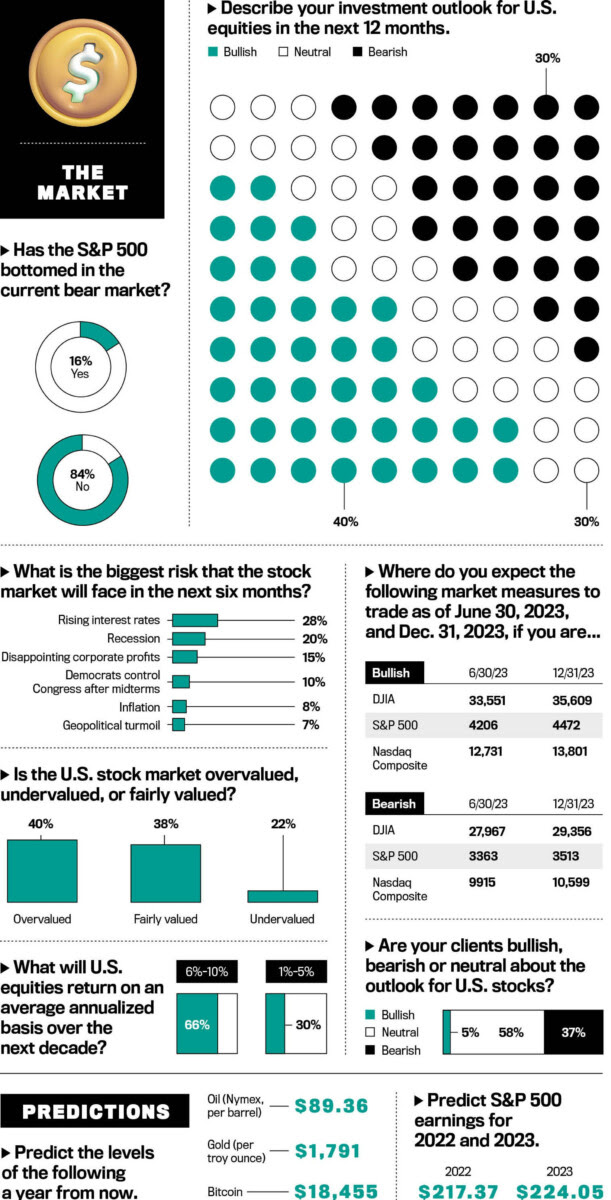
Morgan Stanley’s Wilson wrote in a note on Monday that he “would not rule out” the S&P 500 rising to about 4,150 points — a nearly 13% upside from yesterday’s close — adding that this would be “in line with bear market rallies this year and prior ones.” Still, the chief equity strategist said he sees the bear market eventually bottoming at around 3,000 to 3,200 points. (…)

Day Traders Go Back to Their Day Jobs As the stock market swoons, individual investors are placing fewer trades at Schwab, Morgan Stanley and Robinhood.
 Scientists May Have Just Cracked the Code on Fast Electric Car Charging
(…) A typical EV takes around 30 minutes or more to charge with a high-powered DC fast charger. But today researchers at Penn State University published a study in Nature revealing they have developed an EV battery that, crucially, can charge up to about 70% capacity in roughly 10 minutes. The technology can work for any size of battery, but perhaps the biggest benefit is that it will enable automakers to sell EVs with smaller batteries without triggering consumers’ range anxiety. The faster a battery can charge, the less need there is for big battery packs with long range, since stopping to charge will be no less an inconvenience than going to a gas station. And smaller battery packs also mean cheaper EVs. (…)
The company [EC Power] is building a factory in Pennsylvania to start mass producing the batteries—they say the technology will be commercially available in about two years. (…)
Their approach involved burying thin sheets of nickel foil inside a battery, which could heat the internal components to just the right temperature during charging, helping them to absorb electricity more efficiently—without, of course, overheating the battery and creating a fire risk. “Battery technology has been lagging behind, and its fast charging problem has been a longstanding challenge,” Wang says. “Only now, we’re beginning to crack the code.”
 Americans who are working from home have reclaimed 60 million hours they used to spend commuting to an office each day—and they’ve been using the time to get more sleep, according to the NY Fed.
COVID-19 State of Affairs: Oct 18 (Katelyn Jetelina)
(…) It’s incredibly difficult to predict what will happen in the U.S. given that we have such a different immune landscape than other countries. We only have 14.8 million Americans boosted with the fall vaccine—far below what’s needed to divert 100,000 deaths this winter. According to recent models, we are still on track for a fall/winter wave. (…)
(Source: JPWeiland)
From last Friday’s new data update, Northeast has the highest proportion of BQ.1.1, which jumped from less than 1% to 11% of cases. (…)
New York, specifically, has the highest proportion of BQ.1.1—an estimated 25% of cases—in the country. Perhaps more concerning is that it is causing an uptick in hospitalizations. (Keep in mind that reported cases remain flat; these no longer accurately reflect transmission due to at home antigen testing.)
There is very preliminary data (n=1) showing BQ.1.1’s cellular mechanisms are getting close to Delta in regards to disease severity. We need more data, but not a great thing to see.
Bottom line
Cross-country comparisons are less straightforward than ever. However, subvariants are growing, and metrics around the globe are starting to reflect it. COVID-19 transmission is rising in the Northeast United States, which means it’s time to start riding the wave.


 Use of credit cards (blue) tends to increase when real income growth (black) weakens. The fact that revolving credit rises faster than actual spending (red) is not a sign of a healthy consumer.