Did you miss yesterday’s EQUITY MARKETS: SEEKING FAIR VALUE
Fed Official: ‘We Have a Lot More Work to Do’ to Bring Inflation Down Governor Michelle Bowman said the labor market will likely need to soften this year to better control inflation.
Interesting chat between Nick Timiraos and San Fran Fed President Mary Daly. Some extracts with my emphasis:
(…) But I will say, right at the top of our time together, that the Fed is very data dependent. We’re completely data dependent. (…)
It is the core services inflation, excluding housing services, shelter services, that just has shown no sense that it’s coming down. And that is particularly, historically, been persistent and very highly related to the progression of the labor market and wage growth. So that’s why my own forecast for inflation rose in the December SEP; it’s because we see more persistence in some of the aspects of inflation that are just harder to bring down quickly. And I think what you’re seeing is an agreement across FOMC [Federal Open Market Committee] participants that the inflation data have just come in more persistent than we had expected, and we have to build that in.
D.O. here: the data says that CPI-services ex-shelter only rose in 2 of the last 5 months and none of the last two. Last 5 months a.r.: +3.6%, last 3 months a.r.: +3.2%. The sequence of 3-m % changes since June: +3.1%, +2.1%, +1.9%, +1.7%, +1.4%, +0.8%.
Ultimately, policy makers are risk managers. We have to have a modal outlook, the most expected outlook, but then we also have to manage the risks, and right now the biggest risk out there that would be very hard to entangle is that inflation expectations, which have held steady—so far—would start to drift in response to more persistent inflation. And so we’re determined, dedicated, united, resolute—you can use any of the words you’ve probably heard one of us say—to just remind people that we are committed to bringing inflation down to our price stability target of 2%. But it isn’t going to happen quickly and it won’t be complete, in all likelihood, in the coming year. (…
MR. TIMIRAOS: Now, money markets have reacted strongly to these revisions to average hourly earnings, and also on Friday there was a sizable drop in a widely watched survey of business purchasing managers for the service sector, especially in the leading new orders component. The market has an assessment right now that you’ve basically done your job and that you don’t need to tighten as much as you projected just a few weeks ago. Now, when you and I did this conversation a year ago, you told me that those interest rate projections, the dots, are only good on the day that they’re submitted. So why shouldn’t the wage data and some of these other reports we’ve seen lead now to a downward revision in your rate forecast, closer to where the market is?
MS. DALY: Well, there’s really two, maybe three reasons. Let me start with one and see how many numbers I get to.
So the first one—and you’re absolutely right; the dots are only as good as the day that we print them. So the question is, to what extent do the—do my dots, as we call them, do my projections change as the incoming information came in? And so for me what I see is it’s one month of data. You said that right out of the gate. It’s one month of data. I don’t want us—I don’t think we should declare victory on inflation, on the labor market, on any of the things that we’re seeing based on one month of data.
D.O. again: the data says that, since May 2021, the sequence of 5-month annualized growth rates in hourly earnings was +5.7%, +5.2%, +5.1%, +4.1%. Last 3 and 2 months: +4.0% a.r..
Second is if I asked us all to do this thought experiment, so I’m going to ask us all to do it. Imagine you don’t know anything about where we’ve come from. You just know—you look at the data we have today and you see unemployment’s historically low, jobs are being created a—we’re adding about a hundred thousand more jobs per month than we actually can sustain with new entrants and re-entrants to the labor force, and we have inflation at high rates and, you know, painfully injuring millions of Americans—low, moderate, middle-class Americans—who really are strapped to find ways to substitute across to continue to live their lives and, you know, increase their well-being, you would—most people—would say: Wow, the Fed’s really got to do something. The economy’s out of balance and we need to fix that.
And so I think that, importantly, we need to separate the fact that, yes, we do have good news [data] coming in. Yes, we are seeing monetary policy transmission working. But it’s really too soon to declare victory on this. And if you declare victory early and stop, you can find yourself with a much worse situation down the road. And that’s what happened in the 1970s and we found ourselves with the need to do the [Paul] Volcker disinflation, which was necessary, of course, but painful. And I don’t want to put the economy in that situation again.
And I would return us all to the level of the economy is still out of balance. Demand for labor still outstrips supply by quite a lot. Demand for goods and services is still outstripping supply. So we still need to bring those two things back in balance so that we can have 2% inflation. And ultimately—this is really how I think about it—we want to return the economy to a place where Americans—businesses, consumers, you know, communities—they don’t have to think about inflation every day. When I’m out there in the community, that’s the No. 1 topic on people’s mind: inflation. It beats out recession by quite a lot.
MR. TIMIRAOS: What does being mindful of the lags mean for you in concrete terms? Does it mean, for example, that the Fed can slow down or stop raising interest rates absent clear signs of economic weakness in the data? I mean, people ask me all the time: If you wait to see signs that the economy is rolling over, doesn’t that mean you’ll have gone too far, that you’ll have overshot?
MS. DALY: So that’s a terrific question. So I look at this many, many ways, try to get empirical information about lags but also just you have to use the data that are incoming.
So let’s start with there are lags in monetary policy. We don’t actually know how long they are. What we do know is that the speed of transmission from when we talk about our policy to where markets price in the policy rates has sped up tremendously. It’s almost immediate. We say something, markets put it in. (…) So that piece of the transmission mechanism is very fast.
But there’s still this piece between when rates go up and when it starts to impact the real economy, and we’ve seen it evolve but it comes with lag. So we raised the interest rate starting March of ’21 and we saw the housing sector respond almost immediately. It’s interest-sensitive. Other interest-sensitive sectors respond. But only now are we seeing that trickle through to a slower growth in the economy that would mean slower employment growth and slower wage growth and, you know, slower demand growth more generally. So that’s what the lags are. You could hear just by my description of them we don’t know a precise number of quarters, so it requires intense study on a regular basis. I would say that’s basically the definition of data dependence.
But the other thing that I use—and I found this very helpful—is San Francisco Fed researcher Andrew Foerster, along with some other colleagues of his, have done something they call the proxy funds rate. And it just recognizes that not only is our funds rate that adjusts that’s important for policy, it’s also our forward guidance and our balance-sheet policy. And his own estimates would put the proxy rate well above the funds rate we have in place right now. And so I’m mindful that right now the funds rate is actually higher, and it’s why we’re seeing the economy slow, in my judgment.
So what I’m looking at is we don’t need to see inflation get to 2%. We don’t need to see inflation even get necessarily down to something within a stone’s throw of 2% before we would stop raising and simply hold. (…)
The December CPI is out tomorrow.
Federal Reserve officials are making a full-court-press effort to convince investors they won’t be slashing their benchmark interest rate before year’s end.
It’s not working.
Money markets are pricing a rate peak around 4.9%, followed by nearly half a percentage point of rate cuts by the end of 2023. That’s despite multiple officials in recent days delivering a sharply contrasting message: Rates are heading above 5% and will stay there all year. (…)
“The market thinks the Fed is playing without a playbook, since their forecasts have been wrong before and they’ve downplayed them in the past,”’ said Marc Chandler, chief market strategist at Bannockburn Global, who’s been working in financial markets since 1986. Investors judge that the US is “headed for a recession, and that the Fed doesn’t quite yet get it.” (…)
“Fed officials have turned more hawkish because investors aren’t listening to their warnings,” Ed Yardeni, the veteran watcher of the bond market who heads his namesake research firm, wrote in a note to clients. “Perhaps, Fed officials should listen to the bond market.”
One problem is that Powell and his predecessors have each downplayed the relevance of the so-called dot plot of policymakers’ forecasts for the benchmark rate. Another issue is that the Fed’s 2021 forecasts proved woefully wrong in failing to anticipate the rate hikes of 2022. [Actually, the median dot plot for the end of 2022 a year ago was 0.9%…](…)
Swaps traders see the Fed boosting its policy rate — now in a 4.25% to 4.5% target range — to just under 5% by June and then cutting it to around 4.5% by the end of December. While traders’ pricing of the terminal funds rate, as it’s known, has ebbed and flowed through recent months, cuts have consistently been priced in for before the end of 2023. (…)
Minutes of the Fed’s Dec. 13-14 meeting showed participants worried about any “misperception” about monetary policymaking fueling optimism in financial markets that would then “complicate the committee’s effort to restore price stability.” (…)
Economic data such as Friday’s surprise contraction in the Institute for Supply Management’s services gauge back the view that a recession in the offing and inflation has peaked, she says. “The Fed’s ultimately going to have to catch up.”

“My 40 plus years of experience in finance strongly recommends that investors should look at what the market says over what the Fed says,” the DoubleLine Capital LP Chief Investment Officer told listeners on a webcast Tuesday. (…)
Treasury yields have tumbled in the wake of recent data showing a moderation in US wage gains and a contraction in the services sector. Far from pricing in a benchmark above 5%, Treasury yields across the curve are trading below the Fed’s current range, with even the two-year note ending just shy of 4.25% on Tuesday. (…)
Bonds are more attractive than equities, according to Gundlach. That is reflected in his view that investors right now should favor a portfolio that is 60% bonds and 40% equities, rather than the opposite, more traditional 60/40 mix that allocates the bigger share to stocks.
Gundlach’s comments on the Fed echo remarks he made late last week on Twitter in which he said “There is no way the Fed is going to 5%. The Fed is not in control. The Bond Market is in control.” (…)
He also drew attention to the inversion of the Treasury yield curve, which have successfully predicted economic slumps in the past. Inverted yield curves have always led to recession in relatively short order, he said, adding that “there is tremendous upside in many bond strategies.”
BTW, Minneapolis Fed President Neel Kashkari told the New York Times in an interview published this week that the central bank will be proved right. “I’ve spent enough time around Wall Street to know that they are culturally, institutionally, optimistic,” Kashkari said. “They are going to lose the game of chicken, I can tell you that,” he said. (…)
Party to the current game of chicken:
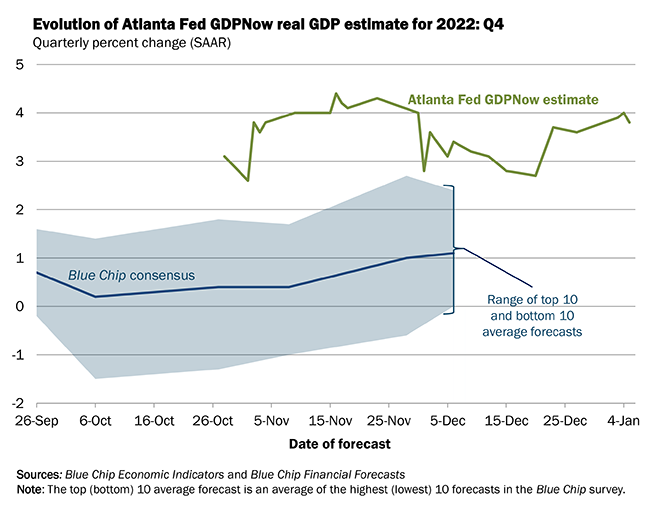
The GDPNow model estimate for real GDP growth (seasonally adjusted annual rate) in the fourth quarter of 2022 is 4.1 percent on January 10, up from 3.8 percent on January 5. After recent releases from the Institute for Supply Management, the US Bureau of Labor Statistics, and the US Census Bureau, the nowcasts of fourth-quarter real personal consumption expenditures growth and fourth-quarter real gross private domestic investment growth increased from 3.2 percent and 5.8 percent, respectively, to 3.5 percent and 6.8 percent, respectively.

Economist Says His Indicator That Predicted Eight US Recessions Is Wrong This Year
Economist Campbell Harvey has had a winning track record since he showed in his dissertation at the University of Chicago decades ago that the shape of the bond yield curve was linked to the path of US economic activity.
US recessions have been preceded by an inverted yield curve — when short-term rates exceed those of longer tenors — since the late 1960s. Fast forward to 2023, that’s exactly what’s been happening with the Treasury yield curve in the past month and half. Yet, Harvey is saying this time the US economy will manage to avoid a real slump even though it will keep slowing down for a bit longer.
“My yield-curve indicator has gone code red, and it’s 8 for 8 in forecasting recessions since 1968 — with no false alarms,” Harvey, now a professor at Duke University’s Fuqua School of Business, said in a interview Tuesday. “I have reasons to believe, however, that it is flashing a false signal.” (…)
Despite the curve being inverted for the ninth time since 1968, Harvey said it’s probably not a harbinger for a recession.
One of the reasons is the fact the yield curve-growth relation has become so well known and widely covered in popular media that now it impacts behavior, he said. The awareness induces companies and consumers to take risk-mitigating actions, such as increasing savings and avoiding major investment projects — which bode well for the economy.
Another boost to the economy is coming from the job markets, where the current excess demand for labor means laid-off workers will likely find new positions more quickly than usual. In addition, he said, given the largest job cuts so far have been in the tech sector, those highly skilled recently fired workers are also not apt to be unemployed for very long.
Harvey’s model was linked to inflation-adjusted yields and he said the fact inflation expectations are inverted — meaning traders see price pressures easing through time — also eases odds for a recession ahead.
“When you put all this together it suggests we could dodge the bullet,” Harvey said. “Avoiding the hard-landing — recession — and realizing slow growth or minor negative growth. If a recession arrives, it will be mild.” (…)
Harvey’s view is not the consensus. Many Wall Street firms are calling for a recession some time this year or early 2024 in the aftermath of the Federal Reserve’s most aggressive hiking campaign in decades to rein on inflation.
Former Fed Chair Alan Greenspan said Tuesday a US recession is the “most likely outcome,” a view also shared by former New York Fed President William Dudley.
If the US economy manages to avoid recession, for Harvey, that won’t mean mean his model is now debunked.
Higher Rates Wards Off Small Business Expansion
The National Federation of Small Businesses (NFIB) released its Small Business Optimism Index for December early this morning. The report showed optimism has begun to fade after a modest rebound in the past few months. The index fell back below 90.0 to the lowest level since the June of 89.5. (…)
(Bespoke)


@C_Barraud
- Hmmm…

@AndreasSteno


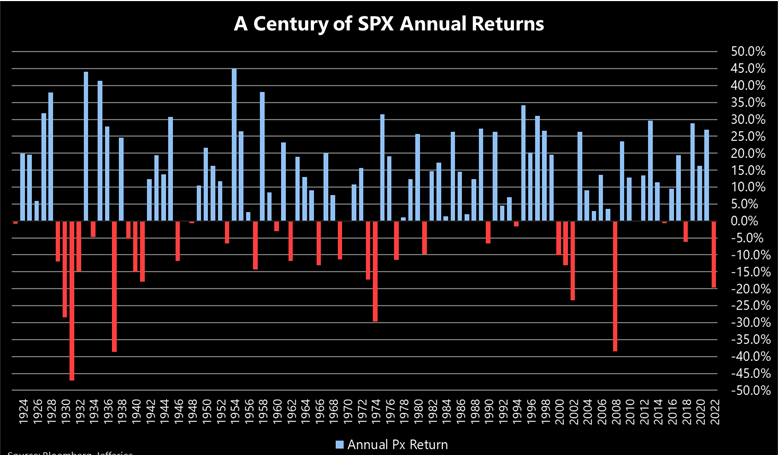


 But here’s an even better indicator: over the past 100 years, no bear market associated with a recession has bottomed before the recession has even begun.