The enemy of knowledge is not ignorance, it’s the illusion of knowledge (Stephen Hawking)

It ain’t what you don’t know that gets you into trouble. It’s what you know for sure that just ain’t so (Mark Twain)

Invest with smart knowledge and objective odds

THE DAILY EDGE: 13 NOVEMBER 2023

LABOR MARKET WATCH

Some subtle shifts in the U.S. labor market:

  • Since August, 43% of Americans who entered the labor force had not found a job by mid-October.

image

  • Since August, the number of unemployeds rose 11.4% and is now 12.1% above its pre-pandemic level. Meanwhile, continuing unemployment claims turned up in September, back to their April level, meaning that it now takes longer to find jobs after losing one.

image

  • The next BLS measure of private job openings (for October in early December) is likely to show a meaningful drop judging by trends in Indeed Job Postings:

image

Consumer credit is already deteriorating amid a solid Q3 economy. The combo of high financing costs and rising unemployment could really accelerate the trend.

 Image Image

A few more stats:

  • Fitch Ratings reports that 6.1% of subprime auto loans were 60 days+ overdue in September, highest since 1994. Yes, 1994, not 2008 or 2009 as we would suspect. They peaked at 5.0% in January 2009. Student loan payments resumed in October.
  • Moody’s says that delinquency rates on newly opened credit card accounts are back to their 2008 levels.
  • Several companies, from staples producers (e.g. General Mills) to luxury goods merchants (e.g. Harley Davidson, Malibu Boats) recently warned of changing consumer behavior impacting their Q4 revenues.
  • A recent survey of auto dealers revealed that financing availability for new car buyers is tougher to get across 62% of auto dealers.
  • In October, more than 90% of Affirm’s interest-bearing volume was offered with annual percentage rates up to 36%. And it has managed to keep its credit performance steady. Its 30-plus-day delinquency rate, excluding for its pay-in-four installments, was 2.4% in the quarter, down from 2.7% a year prior. Hmmm…
US Consumer Long-Term Inflation Expectations Reach 12-Year High Inflation views over 5-10 years rose to 3.2% in November

Consumers expect prices will climb at an annual rate of 3.2% over the next five to 10 years, up from 3% a month earlier, according to the preliminary November reading from the University of Michigan. They see costs rising 4.4% over the next year, compared to last month’s 4.2%, according to data released Friday. (…)

Nearly one in five consumers surveyed said that unemployment will cause more hardship than inflation over the coming year. The government’s latest jobs report showed hiring was concentrated in only a few sectors, while the unemployment rate climbed to the highest level since the start of 2022. (…)

An index of buying conditions for durable goods slumped from a month earlier by the most since November of last year. A record 36% of consumers spontaneously blamed high borrowing costs or tight credit conditions for poor motor-vehicle purchase conditions. The share of consumers blaming similar factors for poor home and durable goods buying conditions was the highest since 1982. (…)

China’s Consumption Recovery Is Losing Momentum, Data Show Alternative indicators show weakening consumer demand

An indicator of Chinese consumer demand for recreation and transport published by Paris-based QuantCube Technology, along with an independent survey of consumer sentiment by US company Morning Consult, both fell in October from the previous month. A poll of private business sentiment from the Cheung Kong Graduate School of Business also declined in the month. (…)

The QuantCube indicators are based on alternative data sources, such as web search queries, transportation figures reflecting people’s movements, and consumer reviews. (…)

Retail sales growth generated by China’s biggest online shopping festival, which runs from October through November, was slower than in previous years. The value of sales rose 2.1% from last year, significantly lower than the 14% increase recorded in 2022, and apparently the lowest in many years, Nomura Holdings Inc. economists led by Lu Ting said in a note citing third party data.

China’s property sector also shows signs of worsening this month, Nomura said, with sales in 21 major cities falling 44% from 2019 levels in the early weeks of November. That’s similar to the pace of contraction in July, before Beijing started a new round of property easing measures, the bank said. (…)

Data provider Syntun, meanwhile, estimated cumulative gross merchandising volume (GMV) sales across major e-commerce platforms rose 2.08% to 1.14 trillion yuan ($156.40 billion) compared with growth of 2.9% last year. (…)

The GMV figures take into account the value of all orders placed, and do not capture the amount that will be returned later.

Analysts and industry executives expect return rates to be high this year as consumers buy more in order to obtain larger discounts on checkout, only to return the items they do not need.

A Bain and Company report released last week found that 77% of the 3,000 consumers it surveyed had planned to spend less or the same amount on Singles Day compared with last year. (…)

(…) The lobby association expects nominal sales growth of 1.5% for November and December — a drop of 5.5% after taking the annual increase in consumer prices into account.

For the full year, including the food sector, it confirmed its prediction for sales to increase by some 3% to about €650 billion ($695 billion) — a decline of 4% after factoring in inflation. (…)

US Credit-Rating Outlook Changed to Negative by Moody’s Assessor cites risks from deficits, political polarization

The US was threatened with the loss of its last top credit rating on Friday, as Moody’s Investors Service signaled it was inclined to downgrade the nation because of wider budget deficits and political polarization.

The rating assessor lowered the outlook to negative from stable while affirming the nation’s rating at Aaa, the highest investment-grade notch. Amid higher interest rates, without measures to reduce spending or boost revenue, fiscal deficits will likely “remain very large, significantly weakening debt affordability,” Moody’s said.

“Interest rates have shifted materially and structurally higher,” William Foster, a senior credit officer at Moody’s, said in an interview. “This is the new environment for rates. Our expectation is that these higher rates and deficits around 6% of GDP for the next several years, and possibly higher, means that debt affordability will continue to pressure the US.” (…)

Moody’s sees federal interest payments relative to revenue and gross domestic product rising to around 26% and 4.5% by 2033, respectively, from 9.7% and 1.9% in 2022, according to Friday’s report. Those projections reflect the likelihood of higher-for-longer interest rates, the company said, with the average annual 10-year Treasury yield peaking at around 4.5% in 2024. (…)

Nordea:

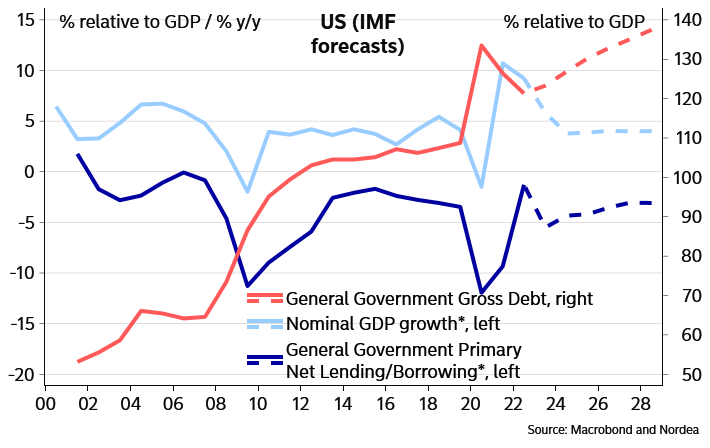
A US debt crisis is seldom seen as an imminent threat, and we do not expect such a crisis to surface any time soon either. (…) But the outlook is more worrying due to the massive primary deficits the US is running. One does not need to do any stress testing on the IMF baseline forecasts to find a rising debt-to-GDP ratio.

US public debt on a worrying path

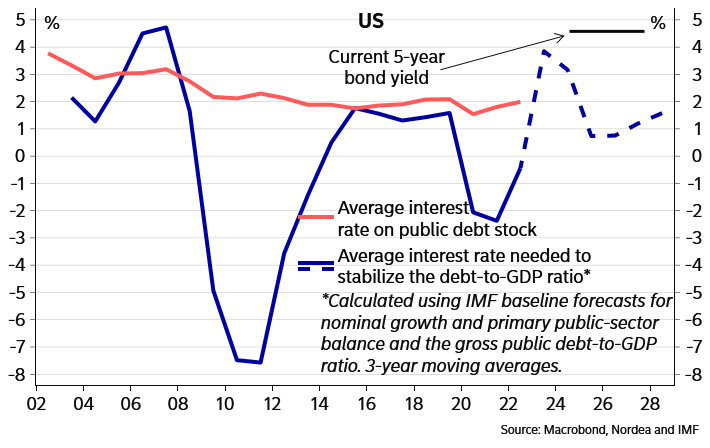
On a path set by the IMF forecasts for the following five years, the average interest rate that would stabilise the debt-to-GDP ratio is in the order of 1-2%. This is not far from the average interest rate on the debt stock of around 2% last year, but at current yield levels the average interest rises rapidly (around a third of US public debt matures over the next 12 months), putting the US debt on an unsustainable trajectory.

US debt metrics not compatible with the current level of interest rates

This is not to say that we expect to see a US debt crisis in the near future. Far from it. The global role of the dollar and the Treasury market allow the US to run irresponsible fiscal policies for longer than other countries, and we are unlikely to be close to the breaking point. And buying by the Fed also serves as a backstop, if needed. As we have argued before, cyclical considerations and new signals from central banks are a more likely driver of long bond yields than rising debt worries.

However, this does not mean that the US fiscal outlook would not pose considerable risks. Market focus could easily stay on the debt outlook and the huge amount of bonds that private investors have to buy at a time when the central bank is reducing its holdings, which could yet propel yields higher.

Government debt burdens can quickly become unsustainable if the willingness to finance new borrowing vanishes. The higher the debt burden, the higher the risk of this happening. As stated above, we do not think we are near such a point, but such risks certainly cannot be disregarded.
EARNINGS WATCH

Pre-announcements look ok only when compared with Q3’23 at the same time but last week was quite poor: of last week’s 18 pre-announcements, 16 were negative. Are we going to see the inverse of the Q2 trend which started poorly (3.0 N/P on July 28 with 112 pre-announcements but gradually improved in subsequent weeks? Remember GDP jumped 4.9% in Q3 with strong consumer spending.

image

Analysts keep revising upward however:

image

image

Yet, estimates for Q4 EPS are +5.8%, down from +11.0% on Oct. 1 and down from +7.0% last week. Go figure!

Note also that FactSet numbers are weaker:

  • For the third quarter, the S&P 500 is reporting (year-over-year) earnings growth of 4.1%. [LSEG is at +6.3%]
  • For the fourth quarter, analysts are now projecting (year-over-year) earnings growth of only 3.2%. [LSEG is at +5.8%]

Trailing EPS are now $218.73. Full year 2023: $220.62e. Forward EPS: $236.29e. Full year 2024: $245.31e. All per LSEG/IBES which most pros use.

Rosenberg Research:

While headline S&P 500 earnings per share (EPS) growth is running at +2.5% in Q3, that glow is being masked by just 7 stocks. Like the price action throughout much of 2023, the “Magnificent 7” (Tesla, Nvidia, Meta, Amazon, Alphabet, Microsoft and Apple) is doing all the heavy lifting — earnings are growing at a whopping +59% YoY pace.

The remaining companies are seeing a profit decline of -13%. This trend is expected to continue into the next quarter as well, with the Magnificent 7 projected to see a +45% net income surge with the rest at -2%.

(…) if we update our guidance tracker, which looks at available Bloomberg data and compares S&P 500 company projections to analyst expectations, we note that nearly 80% of revenue guidance for the coming Q4 reporting season have missed estimates; for EPS that number is at 60%.

Looking at full year guidance, 60% of revenue guidance has missed while 40% of EPS have done so as well. The fact that companies look to be facing pressure on the sales front is rather concerning for two reasons: i) it makes any growth in EPS of lower quality (managing costs rather than a demand pick-up) and ii) the close ties with nominal GDP growth.

This chart is from Goldman Sachs:

I have shown before how rising interest expense is biting into corporate profits. This chart via Callum Thomas shows how cash rich companies are benefitting from Fed tightening. All of the “Magnificient Seven” contribute to the grey line:

Source:  Substack Notes Platform

Feeling contrarian?

Hezbollah Fires at Israeli Infantry Across Border

THE DAILY EDGE: 10 NOVEMBER 2023: Careful CBs

Even if Fed Stays on Hold, Jerome Powell Is Keeping His Options Open The Fed chair said it was premature for the central bank to declare a conclusive end to its historic interest-rate increases of the past two years even though he didn’t make an argument for further hikes right now.

Price and wage pressures have eased recently, leading more investors to think the Fed is done raising rates. Powell disappointed those investors in a speech Thursday by explaining why he thinks the Fed is more likely to tighten policy than ease it if any change is warranted.

While Powell didn’t build a case for lifting rates now, he pointed to earlier inflation “head fakes,” past episodes in which price pressures ebbed for a while before surprising Fed officials by picking up again. He said they would monitor economic conditions closely to avoid both the risk of having been “misled by a few good months of data,” as well as the risk of having raised rates too high, Powell said. (…)

In his prepared remarks for a conference at the International Monetary Fund, Powell said the central bank was “not confident” that it had raised rates high enough to lower inflation to its 2% goal in the next two or three years.

But during a question-and-answer session, Powell allowed that inflation-adjusted interest rates were high. “We’re in the place where we have restrictive policy, and probably significantly restrictive policy, and we’re watching the effect carefully on the economy,” he said. (…)

The Fed chair cautioned that continuing to bring down inflation could be harder if those supply-side tailwinds had run their course. “We know that ongoing progress toward our 2% goal is not assured,” he said.

Bank of Canada Governing Council deliberations

This is an account of the deliberations of the Bank of Canada’s Governing Council leading to the monetary policy decision on October 25, 2023.

Substitute Canada with USA and Governing Council with FOMC and you would probably get the verbatim of the last FOMC meeting. What about data dependency?

Canada’s economic growth had slowed over the past year, averaging about 1%. Members agreed signs were clearer that monetary policy was working to dampen spending. With demand slowing and supply catching up, the economy was approaching balance.

Consumer spending was weaker than expected. Members noted that household credit growth had declined substantially as households adjusted to higher borrowing costs. Responses to the Canadian Survey of Consumer Expectations for the third quarter pointed to more weakness in spending on housing and durable goods, and members noted that weaker spending had begun to spread to services.

Exports were expected to stall as foreign demand softened. And businesses responding to the Business Outlook Survey for the third quarter reported softer investment intentions due to elevated funding costs and weaker sales prospects.

Governing Council members discussed the aggregate spending plans of federal and provincial governments, which are projected to increase at an annual pace of roughly 2.5% in 2024. If all those plans are realized, this would contribute materially to growth over the next year. By adding to demand at a faster pace than the growth of supply, government spending could get in the way of returning inflation to target.

On the labour market, Governing Council agreed that a wide range of indicators pointed to continued easing. But overall, the labour market still looked to be on the tight side:

  • The pace of job creation had slowed to below that of labour force growth.
  • Businesses reported widespread easing in the intensity of labour shortages.
  • Job vacancies had declined gradually but were still above pre-pandemic levels.
  • The unemployment rate had risen slightly but was low by historical standards.
  • Wages continued to grow in a range of between 4% and 5%.

Members observed that the pace of recent wage growth partially reflected a catch-up in real wages. Some businesses reported plans to continue raising salaries to retain workers. Members discussed the likelihood that chronic labour shortages could persist in sectors such as health care and skilled trades, even as the overall tightness in the labour market continued to recede.

Governing Council reviewed recent data on inflation. While consumer price index inflation had declined from a peak of 8.1% since June 2022, recent inflation data had been volatile: 2.8% in June 2023, 4% in August and 3.8% in September. Nevertheless, members agreed that the effects of higher interest rates were increasingly reflected in the prices of many goods that people buy on credit, such as furniture and appliances.

Progress in reducing inflation is also evident in the prices of many semi-durable goods and services excluding shelter. Along with durable goods, these components grew at 2% or less in September. Inflation in services excluding shelter was below its historical contribution to inflation overall, but there had been some unusual volatility in certain services prices. Food price inflation eased as well but remained elevated at close to 6%. Members agreed that food price inflation should moderate further as lower input costs are passed along to final food prices.

Despite this progress, members revised up their near-term outlook for inflation. Members discussed several factors that had been standing in the way of the disinflationary process: 

  • Higher global oil prices had pushed up gasoline prices. This was the main factor behind the rebound in inflation since June.
  • Shelter price inflation was running around 6%. This was partly due to rising mortgage interest costs following increases in the policy interest rate. But high shelter price inflation was also evident in rent and other housing-related costs. Higher interest rates would normally exert downward pressure on house prices and other costs that are closely linked to house prices, such as maintenance, taxes and insurance. However, the ongoing structural shortage of housing supply in the economy was sustaining elevated house prices. And the rapid increase in Canada’s population had added to the existing imbalance between demand and supply for housing.
  • Near-term inflation expectations and wage growth remained elevated.
  • Corporate pricing behaviour was normalizing only gradually.

Together, these factors were contributing to persistence in inflation. Measured on a three-month annualized basis, core inflation had been stuck in a range of 3.5% to 4% for the past year, suggesting little downward momentum in underlying inflation.

As a result, Governing Council members revised up their forecast for inflation in the near term. But with a weaker growth outlook and more excess supply, they continued to expect inflation would return to the 2% target in 2025. (…)

At the October meetings, members agreed that the evidence demonstrated further progress toward rebalancing the economy. Monetary policy continued to gain traction—excess demand was being absorbed, and price pressures were easing for many goods and services.

However, members acknowledged that the translation of weaker demand into lower price growth had been slow. The lack of downward momentum in underlying inflation was a source of considerable concern. They reflected again on the two possible explanations for this persistence: that the transmission of monetary policy actions through to inflation required more time, or that monetary policy was not yet restrictive enough to relieve price pressures.

Members discussed whether the stickiness in core inflation measures reflected the fact that excess demand remained in the system or that inflation could be becoming entrenched.

While the output gap indicated the economy was entering a period of excess supply, considerable uncertainty surrounds this estimate. Latent excess demand could explain why:

  • the labour market remained on the tight side
  • businesses continued to raise prices more often than normal
  • near-term inflation expectations remained elevated

Wage growth, if sustained at the current pace of 4% to 5%, would be inconsistent with restoring price stability. Members agreed they would be watching closely to see if higher labour costs began to be reflected in renewed inflationary pressures.

On corporate pricing behaviour, despite some progress toward normalization, many businesses were still reporting that they would raise prices more frequently than normal. Members expressed concern that businesses would:

  • be slower to pass on price decreases as input costs decline
  • increase their prices more rapidly in response to future shocks

Finally, members noted that while near-term inflation expectations remained elevated, they had been easing. Long-term inflation expectations remained well anchored. Thus, current household spending and business decisions more likely reflected recent experiences with inflation rather than an acceptance that high inflation was here to stay.

As excess demand continues to be absorbed, persistence in core inflation, elevated inflation expectations and wage growth, and atypical corporate pricing behaviour could be indications of high inflation becoming entrenched. In such a scenario, members acknowledged that further monetary policy tightening would likely be required to restore price stability.

Members also discussed the implications of elevated shelter price inflation for monetary policy. Given that increasing the supply of housing enough to substantially narrow the shortfall will take time, shelter price inflation could continue to contribute more than normal to overall inflation for some time.

Finally, Governing Council also discussed the risk that the economy could slow more than expected. The outlook for GDP had been revised down from the July MPR, in part due to tighter financial conditions globally. If global financial conditions tighten further or past increases in the policy interest rate restrain demand more than expected, the economy could be weaker and inflation lower than projected.

Overall, Governing Council members agreed that monetary policy was working to lower demand and ease price pressures for many goods and services. They also agreed that as the economy moved into excess supply, past monetary policy tightening should continue to translate into lower inflation. However, with a higher near-term forecast for inflation and persistent core inflation, as well as the risk that rising global tensions could lead to higher oil prices or renewed supply chain disruptions, they agreed that overall inflationary risks had increased.

Governing Council discussed whether monetary policy was sufficiently restrictive to return inflation to target.

Some members felt that it was more likely than not that the policy rate would need to increase further to return inflation to target. Others viewed the most likely scenario as one where a 5% policy rate would be sufficient to get inflation back to the 2% target, provided it was maintained at that level for long enough.

However, there was a strong consensus that, with clearer evidence of higher interest rates moderating spending, slowing growth and relieving price pressures, Governing Council should be patient and hold the policy rate at 5%. They agreed to revisit the need for a higher policy rate at future decisions with the benefit of more information.

Given the slower-than-expected progress toward price stability and increased inflationary risks, members agreed to state clearly that they were prepared to raise the policy rate further if needed.

Members noted that they needed to see downward momentum in core inflation to be confident that monetary policy was sufficiently restrictive to restore price stability. They agreed to continue to assess the evolution of underlying inflationary pressures by focusing on the following indicators:

  • the balance between demand and supply in the economy
  • inflation expectations
  • wage growth
  • corporate pricing behaviour

Members also reviewed the Bank’s quantitative tightening program and agreed to continue the current policy of normalizing the balance sheet by allowing maturing bonds to roll off.

BTW:

  • ECB Vice President Luis de Guindos says any talk of lowering borrowing costs in the coming months is too early, citing continued upside risks to inflation (@economics)
  • RBA Warns Inflation More Persistent Than Expected The Reserve Bank of Australia sharply revised up its forecasts for core inflation in the near term and warned that inflation pressures are cooling at a slower pace than anticipated.

About wages:

The Atlanta Fed’s Wage Growth Tracker

The Atlanta Fed’s Wage Growth Tracker was 5.2 percent in October, the same as for September. For people who changed jobs, the Tracker in October was 5.6 percent, also the same as in September. For those not changing jobs, the Tracker was 4.8 percent, down from 5.0 percent in September.

image

More junk-rated companies downgraded than upgraded in October -JPM

October saw downgrades to 18 junk bond issuers’ ratings accounting for $22.2bn in debt, while just 16 issuers were given upgrades by ratings agencies, the JPMorgan report said.

This is the first time downgrades have surpassed upgrades on U.S. junk-rated borrowers in four months, it added. (…)

Ratings agency Moody’s Investors Service has forecast defaults among low-rated U.S. companies will peak at 5.6% in January 2024, before falling to 4.6% by August 2024.

October’s ratings actions reflect a broader trend as there have been 293 downgrades totaling $393 billion over the last 12 months, compared to 264 upgrades equaling $479 billion, the JPMorgan report said.

The largest number of junk issuer downgrades this year have been in the healthcare and financial sectors.

While high-grade companies’ credit ratings have proven resilient during the Federal Reserve’s interest-rate hikes, businesses with significant leverage and floating-rate debt have struggled to keep pace with rising debt-servicing costs.

image

China Is Making Too Much Stuff—and Other Countries Are Worried Factories lack customers and are pushing exports harder, raising trade tensions

Makers of electric vehicles, solar panels and other products are cutting prices and trying harder to muscle into overseas markets as they face weakened demand at home, upsetting competitors who see threats to their bottom lines.  

The tensions are most acute in Europe, where European Union regulators in September unveiled an antisubsidy probe, reflecting concern that China is flooding the region with low-cost electric vehicles. (…)

Prices of goods shipped from China have fallen around 20% this year, according to ABN AMRO. While some of that drop reflects easing supply-chain bottlenecks, it is also a sign that Chinese sellers are discounting to preserve or expand market share during a period of weaker global demand, according to economists.

Local governments in China have been subsidizing trips abroad for companies to sell more overseas, including chartering flights for them. They are urging banks to lend to companies that want to expand in countries participating in China’s Belt and Road program.

Beijing has also called on financial institutions to direct credit to the manufacturing sector.

Chinese manufacturers are reaping an extra advantage from a declining currency, with the Chinese yuan at its weakest level against the U.S. dollar in more than 15 years, making their goods less expensive overseas.

In an August report, Goldman Sachs singled out several products that are oversupplied in China, including batteries, excavators and some chemicals.
(…)

JPMorgan estimates that falling producer prices in China will lower global core goods inflation outside the country by 0.7 percentage point over the second half of 2023. (…)

With more than 100 car brands, many unprofitable, and slowing sales growth at home, China’s auto industry has a powerful incentive to look for more-lucrative markets overseas, according to a recent report by Rhodium Group, a research company.

China’s share of global EV exports grew from 4% in 2020 to 21% in 2022, it said. 

While many of those exports are foreign brands that produce in China, especially Tesla, Chinese brands, with their lower sticker prices, are becoming a bigger part of the picture. Their share of total EU EV sales grew from 0.5% in 2019 to over 8% so far in 2023, according to Schmidt Automotive Research.
(…)

China needs to find more markets for its conventional gasoline-powered autos, as domestic consumers shift toward EVs, said Andrew Batson, a China-focused analyst at Gavekal. China’s exports of gas cars have risen sixfold over the past three years, according to Batson. (…)

“Their incentive to keep that capacity active by pushing vehicles into export markets at low prices is only getting stronger,” he said. (…)

In Europe, solar module prices fell by 50% within four weeks starting late last year even though market fundamentals were largely unchanged during that period, said Gunter Erfurt, chief executive officer of Meyer Burger Technology, a Switzerland-based manufacturer of solar cells and modules.

To Erfurt, it was a sign China was discounting at what he called “unprecedented speed” to grab market share. (…)

European solar producers sent a letter to EU authorities in September urging them to buy up their inventories to avert a new wave of bankruptcies related to intensifying Chinese competition and slowing demand in Europe. (…)

China’s steel export prices have plunged about 60% from a year earlier, while its steel exports volume went up 53% in October compared with 2022, according to Frederic Neumann, chief Asia economist at HSBC. (…)

Some related charts from Ed Yardeni for your appreciation of that case:

image

image

image

image

image

image

image

More Executives Vanish in China, Casting Chill Over Business Climate An executive at a video-streaming platform and another at a pharmaceutical company joined the growing list of figures who have vanished or been detained this year.