“THE HARD PART IS OVER”
(…) in a new note out yesterday, Goldman’s economists lead by Jan Hatzius declared that “The Hard Part Is Over.” As the team sees it, there is more disinflation in store in 2024, the Fed is done hiking rates, and the odds of an imminent recession are only 15%.
In the note, the team lays out three reasons why “the last mile of disinflation” will not be particularly hard.
The first is that there’s more improvement in store simply core goods. If you measure supply chain stress by supplier delivery times, there’s been quite a bit of normalization that will show up in prices on a lag.
Secondly, there’s still a ways to go for rent growth to fall in their view. This is a widely held perspective, given the softness we’re seeing in private sector measures of rents across the country.
And then finally, the labor market is showing clear signs of softening, or coming into balance, based on a number of metrics, including the rate of job openings, and the deceleration of nominal wages.
What’s interesting to note here too is that while a lot of the focus is obviously on the Fed and the US, Goldman sees the same story playing out virtually everywhere right now, as normalization occurs across a range of measures in a range of countries. (…) (Bloomberg’s Joe Weisenthal)

ING:
(…) With business attitudes becoming more cautious on the economic outlook we are seeing a reduction in price intention surveys. The chart below shows the relationship between the National Federation of Independent Businesses’ (NFIB) survey on the proportion of members expecting to raise prices in coming months and the annual rate of core inflation. It suggests that conditions are normalising, with core inflation set to return to historical trends.
NFIB price intentions surveys suggest corporate pricing power is normalising
Source: Macrobond, ING
While concerns about the outlook for demand are a key factor limiting the desire for companies to raise prices further, a more benign cost backdrop has also helped the situation. The annual rate of producer price inflation has slowed from 11.7% to 2.2%, having dropped to just 0.3% year-on-year in June while import prices are falling outright in year-on-year terms.
There are also signs of labour market slack emerging, with unemployment starting to tick higher and average hourly earnings growth slowing to 4.1% from near 6% just 18 months ago.
Perhaps more importantly, non-farm productivity surged in the third quarter with unit labour costs falling at a 0.8% annualised rate. With cost pressures seemingly abating from all angles, this should argue for core services ex-housing, a component that the Fed has been keeping a careful eye on, to soften quite substantially over coming months.
Fed’s “supercore” inflation should slow more rapidly
Source: Macrobond, ING
Another area of recent encouragement is energy prices. The fear had been that the conflict in the Middle East would have consequences for energy markets but, so far, we have seen energy prices soften. Gasoline prices in the US have fallen 50 cents/gallon between mid-September and early November, leaving prices at the lowest level since early March. Gasoline has a 3.6% weighting in the CPI basket.
Our commodity strategists remain wary, warning of the risk that an escalation in the conflict could lead to oil and gas supply disruptions from some key producers in the region, most notably Iran. For now though, energy prices will depress inflation rates and could mean at least one or two month-on-month outright declines in headline prices with lower energy prices limiting any upside potential from airline fares (0.5% weight in the CPI basket).
On top of this, we expect to see new and used vehicle prices (combined 6.9% weighting in the CPI basket) being vulnerable to further price falls in an environment where car loan borrowing costs are soaring. New vehicle prices have risen more than 20% since 2020 amid supply problems and strong demand while used vehicle prices rose more than 50%, according to both the CPI measure and Manheim car auction prices. Prices for used cars have fallen this year but still stand 35% above those of 2020. Experian data suggests the average new car loan payment is now around $730 per month while for second-hand cars it is now $530 per month.
With car insurance costs having risen rapidly as well (up 18.9% YoY with a 2.7% weighting in the CPI basket), the cost of buying and owning a vehicle is increasingly prohibitive for many households and we suspect we will see incentives increasingly capping the upside for vehicle prices. It is also important to remember that the surge in insurance costs is a lagged response to the higher cost of vehicles – and therefore insured value – and that too should slow rapidly (but not fall) over coming months.
Gasoline prices and oil prices surprise to the downside
Source: Macrobond, ING
The big disinflationary influence should come from housing over the next couple of quarters. The chart below shows the relationship between Zillow rents and the CPI housing components. This is important because owners’ equivalent rent is the single biggest individual component of the basket of goods and services used to construct the CPI index, accounting for 25.6% of the headline index and 32.2% of the core index.
Meanwhile, primary rents account for 7.6% of the headline index and 9.6% of the core. If the relationship holds and the CPI housing components slow to 3% YoY inflation, the one-third weighting that housing has in the headline rate and 41.8% weighting in the core will subtract around 1.3 percentage points of headline inflation and 1.7ppt off core annual inflation rates.
Rents point to major housing cost disinflation
Source: Macrobond, ING
There are some components on which there is less certainty, such as medical care, but we are increasingly confident that inflationary pressures will continue to subside and this means that the Federal Reserve will not need to raise interest rates any further. Next week’s October CPI report may not show huge progress with headline CPI expected to be flat on the month and core prices rising 0.3% month-on-month, but we expect headline inflation to slow to 3.3% in the December report with the annual rate of core inflation coming down to 3.7%.
Sharper declines are likely in the first half of 2024. Chair Jerome Powell in a speech to the Economic Club of New York acknowledged that “given the fast pace of the tightening, there may still be meaningful tightening in the pipeline”. This will only intensify the disinflationary pressures that are building in an economy that is showing signs of cooling. We forecast headline inflation to be in a 2-2.5% range from April onwards with core CPI testing 2% in the second quarter.
With growth concerns likely to increase over the same period, this should give the Fed the flexibility to respond with interest rate cuts. We wouldn’t necessarily describe it as stimulus, but rather to move monetary policy to a more neutral footing, with the Fed funds rate expected to end 2024 at 4% versus the consensus forecast and market pricing of 4.5%.
ING CPI forecasts (YoY%)
Source: Macrobond, ING


That said, we believe it would be premature to claim that the economic storm has passed, because the battle against inflation has not yet been decisively won. The FOMC will want to be confident that inflation is returning to 2% on a sustained basis, so it likely will maintain a restrictive policy stance through the early months of 2024.
In our view, the FOMC probably is done hiking interest rates, but it likely will be some time before the Committee begins to ease policy. Therefore, the real fed funds rate will creep higher in the coming months as the FOMC maintains its target range for the federal funds rate at its current level of 5.25%-5.50%, while inflation continues to slowly fall toward 2%. This rise in the real fed funds rate will lead to a passive tightening of monetary policy that will exert increasing headwinds on the economy, thereby clouding the economic outlook.
There are already some cracks that are beginning to appear in the economy. The rise in mortgage rates has weighed on the housing market as the number of housing starts looks likely to be down roughly 10% in 2023 compared to last year. Household delinquencies on auto loans and credit cards are moving higher, and growth in business fixed investment spending has downshifted due to rising interest rates.
These strains likely will intensify in coming months as monetary restraint remains in place. Our base case is that real GDP will contract modestly starting in mid-2024. As economic resiliency gives way to weakness, we look for the FOMC to cut its target range for the federal funds rate by 225 bps by early 2025, which is more than both Fed policymakers and market participants currently project. (…)
In our view, the U.S. economic outlook over the next year or so is far from sunny. A full-blown economic storm may not develop, but storm clouds likely will dominate the horizon for the foreseeable future.
Yesterday:
Rent Growth Finally Reaccelerates After Nearly Two-Year Slowdown Annual rent growth ticked up in October for the first time since the pandemic peak in early 2022
The nearly two-year-long slowdown in rent growth may finally have come to an end in October. After slowing in every month since a record-high 16.1% in February 2022, the annual change in typical U.S. asking rent increased in October, according to the Zillow Observed Rent Index (ZORI). ZORI increased in October by 3.23% from a year ago, slightly faster than September’s 3.19% annual change, and now sits at $2,011.
It remains to be seen whether this is the beginning of a recovery in annual rent growth back toward longer-term averages, or more of a stabilization. Indeed, despite the uptick in annual appreciation, typical U.S. asking rent fell slightly in October from September, ticking down by less than one-tenth of a percent, in line with usual monthly changes in pre-pandemic Octobers. (…)
October’s uptick in annual rent growth may be an indication that the affordability benefits of renting – relative to buying – a home are stoking demand for rental housing. In much of the country, monthly rent payments are cheaper than the mortgage payment associated with the purchase of a home thanks, in large part, to the substantial increase in mortgage rates over the past year.
For several years prior to the pandemic, the opposite was true. The affordability benefits that renting now provides has made it an attractive – if not necessary – option for many households seeking their next home. With a return to pre-pandemic home purchase affordability remaining unlikely, this rental market advantage should persist in the months ahead, buoying demand for rentals as a result.
From the Oct. 23 Daily Edge:
The chart below plots the Zillow Rent Index with CPI-Rent, both indexed at Jan. 2017=100 (Zillow data starts in 2015).

The series diverge starting in 2021 when Zillow rent (“market rent” per Powell and Yardeni) takes off reflecting the pandemic effect on new leases, while the BLS more gradual method takes time to reflect how all leases, including renewals which typically account for 90%+ of all leases, adjust to the “market”.
True, Zillow data show that new leases have flatlined since spring …

…but
- they are still rising MoM and are up 2.2% annualized this year (this is the seasonally adjusted data) and
- importantly, Zillow’s “market rent” remains 9.2% above CPI-Rent, suggesting that the BLS data needs to rise further, for a while, before it truly reflects the “reality”.
Anecdotally on single family rentals:
- On their recent earnings call, both Invitation Homes and American Homes For Rent talked about the resiliency they are seeing on both the new and renewal sides of the business. AMH is still sending out renewal rent increases in the 6% range while occupancy is in the low 96s in October.

(CalculatedRisk)
-
This is from Tricon Residential which operates in the U.S. Sunbelt where supply is increasing fast (but so is demand):

CONSUMER WATCH
(…) This article presents findings from McKinsey’s ConsumerWise team and our latest Consumer Pulse Survey, which outline when consumers will shop for the holidays, how much they will spend, and what matters most to them during this time. (…)
The survey was in the field from October 17 to October 19, 2023, and collected responses from more than 1,000 consumers in the United States (sampled and weighted to match the general US population, ages 18 to 74). These insights build on the work we have undertaken since March 2020, when we began to regularly conduct consumer surveys and combine our research and analysis with third-party data on US spending to glean insights into how consumer sentiment has shifted since the beginning of the COVID-19 pandemic. (…)
While most consumers started their holiday shopping in October or earlier, 40 percent of consumers this year say they intend to start holiday shopping in November, compared with 35 percent in 2022. Additionally, of the consumers who started their holiday shopping in mid-October, only about a quarter of them completed more than half of their holiday shopping, leaving plenty of room for retailers to reach these shoppers through the end of the year. November and December, therefore, are still critical holiday shopping months.
Consumers say they are shopping earlier and that their holiday shopping will last longer this year, in both cases citing price as their primary motivation for doing so. Shoppers who started browsing for products earlier did so in anticipation of price increases; other shoppers, expecting sales to come closer to the holidays, may have delayed their purchases. In addition to concerns about availability and lead times, consumers say they want to make their purchases over a couple of months rather than all at once.
Seventy-nine percent of consumers say they are changing their shopping behaviors to trade down (swap their purchases for cheaper alternatives or forgo purchases altogether)—an increase of five percentage points compared with July 2022. This can be observed across generations and income levels, although younger shoppers are more likely to trade down (despite ranking better prices and promotions as slightly less important than other factors). In general, this means that value and promotions will be increasingly important to retailers.
(…) most consumers rank better prices and promotions as their top consideration for holiday shopping this year (66 percent), higher than how they ranked this consideration last year (59 percent), and significantly above their next highest considerations, which are product availability and convenience. (…)
(…) the percentage of consumers who intend to splurge on either themselves or others this holiday season declined four percentage points year over year, from 39 percent in 2022 to 35 percent in 2023.
This decline is mostly fueled by Gen Z belt-tightening: in this cohort, there was a 12-percentage-point decrease in consumers who intend to splurge—although they intend to splurge at a higher rate than other generations. Despite Gen Z’s practical approach to holiday shopping this year, they still indicate that they are more excited to shop this year compared with last year, and that they expect to spend more on gifts for others and themselves than they did last year. Meanwhile, Gen Xers and boomers actually express a greater intent to splurge. (…)
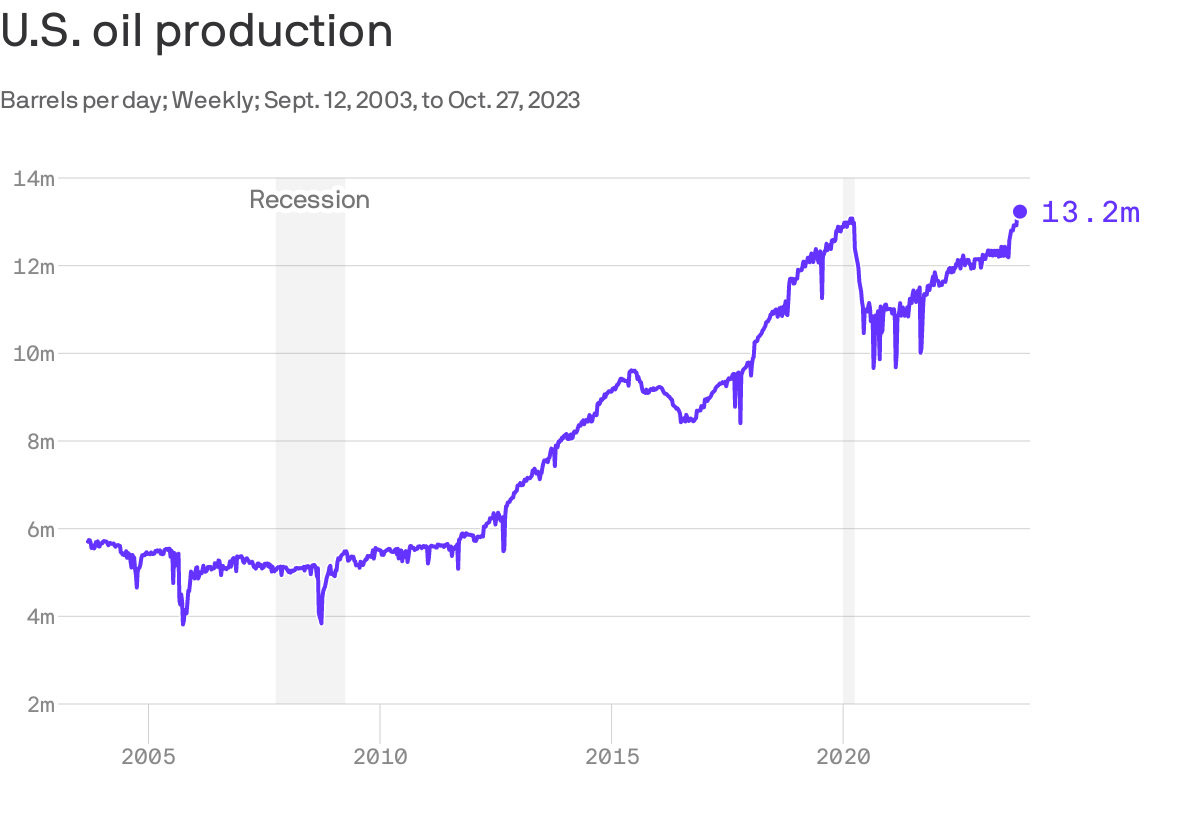
- Record U.S. oil production helps tame prices
In the first week of November, U.S. crude oil production hit 13.2 million barrels per day, a new record. U.S. production is a far bigger factor in global markets now, as is Chinese demand, and both are currently developing in a way that would favor lower prices. (Axios)
Data: FactSet, Energy Information Administration; Chart: Axios Visuals
China’s Consumer Deflation Returns as Recovery Remains Fragile Consumer prices fell 0.2% year-on-year in October, data shows
Consumer prices fell 0.2% last month after hovering near zero in the previous two months, according to data from the National Bureau of Statistics Thursday, lower than the median forecast in a Bloomberg survey of economists. Producer prices fell for a 13th straight month, dropping 2.6%. (…)
Recent consumer price declines have been driven by large drops in the price of pork, which is the country’s most-consumed meat and so has a heavy weighting in China’s consumer price index. Pork producers increased supply, betting on surging demand after the end of the country’s coronavirus restrictions at the end of last year. But the rebound fell short of expectations. (…)
Food prices fell 4% from a year ago. Core CPI — which strips out volatile food and energy costs — rose 0.6%, weaker than the 0.8% increase a month earlier. (…)

China’s headline and core inflation rates

Source: CEIC, ING
FYI:
- Hollywood actors and studios reached a tentative deal to end a 118-day strike. The contract—worth over $1 billion—includes unprecedented restrictions on the use of AI and the first-ever performance-based bonuses, the actors’ union said.
- AI Will Cut Cost of Animated Films by 90%, Jeff Katzenberg Says


 Thawing US-China ties following high-level meetings are sending “