More than half of 526 respondents [to Bloomberg’s latest Markets Live Pulse survey] said that personal consumption — the most important driver of economic growth — will shrink in early 2024, which would be the first quarterly decline since the onset of the pandemic. Another 21% said the reversal will happen even sooner, in the last quarter of this year, as high borrowing costs eat into household budgets while Covid-era savings run down. (…)
“The big question is: Is this strength in consumption sustainable?” says Anna Wong, Bloomberg Economics’ chief US economist, who expects a recession to start by year-end. “It is not sustainable, because it’s driven by these one-off factors” – notably a summer splurge on blockbuster movies and concert tours. (Read More: Barbenheimer, Swift, Beyonce = Mirage of US GDP Boom) (…)
 THE WEALTH DEFECT
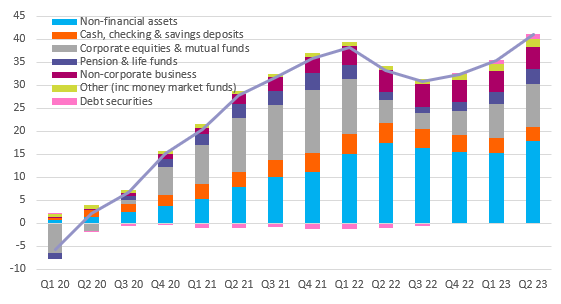
US household wealth leapt $5.5tn in the second quarter (ING)
The net wealth held by US households increased by $5.5tn in the second quarter, according to data released by the Federal Reserve. The total value of assets held by the household sector rose to $174.4tn while liabilities rose just $170bn to $20.1tn, leaving net household worth at $154.3tn.
Rising equity market prices were a key factor with corporate equity and mutual fund holdings rising $2.15tn in the quarter. Meanwhile a partial recovery in home prices, caused by a dearth of supply of homes for sale offsetting the drop in demand in response to surging mortgage rates, meant non-financial asset holdings increased $2.6tn. The value of debt securities, pension and life funds and non-corporate business all increased as well with holdings of cash, checking and time savings deposits the only component to post a decline – of $200bn.
This means that the value of financial assets held by the household sector, after initially being dragged down by a sharp drop in equities in the first quarter of 2020, stands $41.1tn above pre-pandemic levels while the amount of liabilities – primarily mortgages but with consumer credit accounting for more than a quarter – is up $3.5tn on fourth quarter 2019 levels.
Cumulative Increase in value of assets held by US households
since December 2019 ($tn)
Source: Macrobond, ING
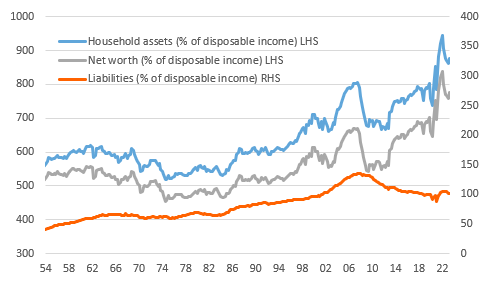
In aggregate household assets are now equivalent to 876% of annual disposable income while liabilities are ‘just’ 101% of disposable incomes. While this is down on the peak seen in the first quarter of 2022 and there are questions over wealth concentration, this is a much better position than any previous recessionary environment and means that the consumer sector, on the face of it, should be better able to withstand intensifying economic headwinds and support the narrative that the US economy will experience a soft landing without a painful recession. (…)
Household assets and liabilities as % of disposable income
Source: Macrobond, ING
Consumer loan delinquencies are already on the rise, particularly for credit card and vehicle loans, with household finances set to become more stressed with the restart of student loan repayments. As a result, we fear that after a strong leisure and tourism-led summer spending splurge, darker skies are likely to emerge as we head towards winter.
Personal consumption expenditures are naturally highly correlated with disposable income. Deviations occur when people elect to increase or decrease their savings, either through saving more or less and/or through borrowing more or less. The savings rate, essentially the difference between income and consumption, is a rather elusive measure that often confounds economists, causing wrong forecasts of consumer spending, 70% of the U.S. economy.
At their core, American consumers are rational animals. They enjoy consuming but, over time, they spend what they earn. When they did not, it was either because of difficulties/uncertainty (e.g. recessions) or because their rapidly rising net worth allowed for splurging thanks to realized capital gains or increased borrowings against rising asset values.
The chart below illustrate these trends. When inflation-adjusted household net worth rose rapidly above trend like in the late 1990s, the mid-2000s and recently, expenditures grew faster than income.

After the GFC, Ben Bernanke, concerned that a worried and financially bruised consumer would stall the economy, launched QE monetary policies designed to boost asset values (the “wealth effect”) through exceptionally low interest rates (“lower for longer”).
Once household net worth got back on trend after 2015, the savings rate remained well above its historical average as consumers feared a repeat of the two recent crisis (the “lost decade” and the “new normal”). So a cautious Fed elected to maintain its very loose monetary policy amid decent economic growth (+2.5%) and household net worth rising well above trend.
While inflation-adjusted stock prices climbed back above their 2000 peak in 2015, real house prices, down 35% between 2006 and 2012, needed another 5 years (and a pandemic) before getting back to their 2006 peak.
As we stand now, real disposable income is only 2.9% above its pre-pandemic level but real expenditures rose 9.2% thanks to a low 3.5% savings rate, down from 9% before Covid-19.
July real expenditures were up 3.0% YoY, the best growth rate since February 2022.
This in spite of very low, like 2008-09 lows, measures of consumer sentiment!
And interest rates up 525 bps in 17 months!
Another example that the conventional playbook is ineffective post this period of non-conventional monetary policy!
The Fed’s policies boosted household wealth 15.5% above their 2019 level and 35% above trend. Thanks to rising stock prices but, principally, to rising home values due to unusually low supply of existing homes due to Fed-supplied mortgage handcuffs.

Mortgage rates are up more than 4% over the past 2 years including +1% to 7.2% in the last 6 months. Yet home prices are up 5.3% this year, back to their mid-2022 peak.
Active listing per Realtor.com are down 50% from their pre-pandemic level, including an 8% YoY decline this summer. As much as it wants to reduce demand, the Fed is running against cratering supply by its own doing. Meanwhile, sales of new one-family houses jumped 27% in the past 12 months. Talk about mortgage rate sensitivity!
From a monetary policy perspective, the wealth effect is now a wealth defect: rising interest rates have little impact on a very wealthy, under leveraged, consumer looking to enjoy life AMAP (as much as possible) post pandemic.
The coming holiday season will be an interesting test. True, the less wealthy, and often more indebted, segment of the population is under some inflation duress but unemployment is still very low and lower wage earners are enjoying strong wage increases.

A big risk is energy inflation, down 11.1% YoY in Q2 (-12.3% in July). Oil prices dropped 32.2% YoY in Q2 but are up 30% from their July lows above their November 2022 level. Combined with a potentially colder winter than last year (pretty high odds in my view), discretionary income could be pressured particularly for lower income people.
Oddly enough, given interest rates relative impotence (sic), it may be that only rising oil/energy costs could dampen overall demand sufficiently for the Fed to achieve its targets.
Would it be enough? Great buy-side strategists such as KKR’s Henry McVey, Fiera Capital’s Jean-Guy Desjardins and RBA’s Richard Bernstein think that demand is too resilient and that the Fed will need to do more or that inflation will rest at a higher level than most investors expect.
Interestingly, Fiera recently changed its probability scenarios: “Deep Recession” declined from 50% to 30% and “Stagflation” rose from 35% to 55% with ‘Disinflation”, investors’ current favorite, steady at 15%.
- Fiera’s Stagflation narrative:
As policymakers are unable to simultaneously achieve their inflation and growth targets, they are forced to choose between the two and opt to prioritize the economy and live with above-target inflation. In our high probability “Stagflationary” scenario, well-anchored long-term inflation expectations and tentative signs of easing wage and price pressures allow the Federal Reserve to tolerate above-target inflation for longer, with the central bank abandoning its tightening campaign at levels that would avoid an outright contraction in growth.
Global growth slows to below-potential levels, but global inflation remains elevated and above-target. So long as the economy is operating below its potential, supply-demand imbalances would subsequently rebalance and allow inflation to subside, albeit over a longer period of time.
While less-dire than the hard landing recessionary scenario, the lingering risk of a self-fulfilling wage price spiral where wage and price setters increasingly orient themselves to higher inflation rates could potentially translate into even steeper rate hikes down the road and a prolonged period of economic stagnation.
- Fiera’s Deep Recession narrative:
In the hard landing recession scenario, stubbornly elevated inflation that proves increasingly entrenched triggers the continuation of aggressive monetary tightening that inevitably sparks a recession. The depth and magnitude of the recession ultimately hinges on how persistent inflation proves to be, and on how much pain policymakers are willing to inflict on the economy in order to bring inflation down to levels deemed acceptable.
While goods prices subside, underlying “core” inflation proves to be more sticky and entrenched, with continued resilience in the labor market and consumer spending slowing the descent of wage and services inflation.
Inflation expectations de-anchor and spiral higher in response, which forces central banks to prioritize tackling inflation in order to restore their inflation-control credibility, regardless of the economic fallout. As a result, central banks tighten monetary policy much more assertively and keep rates in restrictive terrain for longer.
Policymakers are unlikely to pause the rate hike cycle until they see more convincing evidence that inflation is subsiding meaningfully, which when combined with the delayed impact of cumulative monetary tightening to date ultimately means that central banks will be hiking interest rates well into economic weakness, making way for a “Deep Recession.”
Both scenarios rest on resilient consumer demand preventing 2% inflation compelling the FOMC to eventually chose between inflation or the economy.
What if oil prices rise to $100-120? That would probably reduce overall demand but it might increase inflation expectations, a no-no for the Fed…

BTW, if you don’t know Rich Bernstein, here’s a good podcast that explains his style and current strategies and why he is not outright bearish on equities:
An Important Shift in Fed Officials’ Rate Stance Is Under Way
For more than a year, Federal Reserve policy makers were unanimous that they would rather raise interest rates too much than too little—that is how serious they considered the threat of persistently high inflation.
That is changing.
Some officials still prefer to err on the side of raising rates too much, reasoning that they can cut them later. Now, though, other officials see risks as more balanced. They worry about raising rates and causing a downturn that turns out to be unnecessary or triggering a new bout of financial turmoil. (…)
For the past year, officials have placed the burden on evidence of a slowing economy to justify pausing rate increases. As inflation cools, the burden has shifted toward evidence of an accelerating economy to justify higher rates. (…)
Overtightening is a risk, but “we’ve been underestimating inflation,” Cleveland Fed President Loretta Mester said in an interview last month. “Allowing inflation to be up for longer does carry a cost for the economy.” (…)
Another camp is more supportive of pausing increases. They want to shift the focus from how much higher rates have to go to how long they can stay at current levels. While the economy grew a robust 2.1% annualized in the second quarter and might grow above 3% in this quarter, these officials are skeptical this will be sustained, particularly given slower growth in China and Europe and the lagged impact of past rate rises.
“The risk of inflation staying higher for longer must now be weighed against the risk that an overly restrictive stance of monetary policy will lead to a greater slowdown than is needed to restore price stability,” said Boston Fed President Susan Collins in a speech last week. “This phase of our policy cycle requires patience.” (…)
The WSJ’s Nick Timiraos infers that “the shift is under way” but the influential NY Fed’s John Williams last week kept the focus on wages and inflation:
We’ll have to keep watching the data carefully analyzing all of that and really asking ourselves the question: is this sufficiently restrictive. Do we need to maybe raise rates again to make sure that we’re keeping that steady progress in terms of shrinking imbalances in the labor market and bring inflation back down?
As a wrote on August 28 after Jackson Hole (Careful!?), some FOMC members worry that “past increases will continue to weaken the economy” (the “lags”), but Mr. Powell, was very focused on winning the inflation battle, and seemed more careful about inflation than about the economy, noting that
- The FOMC is “attentive to signs that the economy may not be cooling as expected.”
- “The housing sector is showing signs of picking back up.”
- “Evidence that the tightness in the labor market is no longer easing could also call for a monetary policy response.”
- “Additional evidence of persistently above-trend growth could put further progress on inflation at risk and could warrant further tightening of monetary policy.”
- “Although inflation has moved down from its peak—a welcome development—it remains too high,”
- “We are prepared to raise rates further if appropriate, and intend to hold policy at a restrictive level until we are confident that inflation is moving sustainably down toward our objective.”
- “Two percent is and will remain our inflation target.”
- “The message is the same: It is the Fed’s job to bring inflation down to our 2 percent goal, and we will do so.”
Meanwhile, Japan’s central banker has a very different problem:
BOJ Gov. Kazuo Ueda said he would consider ending negative rates if he was confident that wages and prices were rising in a sustainable way, according to an interview with Japanese daily Yomiuri published Saturday. He added there might be enough data by the end of this year to make such a decision. (…)
If corporate earnings remain solid and core inflation stays at around 3%, the BOJ may be able to determine with confidence by year-end that wages in annual spring negotiations in 2024 will also rise strongly, said BNP Paribas economist Ryutaro Kono.
Ueda and other policymakers have said the wage trend is the key to determining whether inflation will be sustainable.
EU downgrades growth forecast and raises inflation expectations Revised figures come as ECB prepares for pivotal decision on interest rates this week
The U.S. economy is chugging along while the rest of the world falls behind. Driving the division among the world’s most powerful economies: a slowdown in trade that is hurting some much more than others. (…)
At the losing end are “extroverted” economies that have traditionally recorded trade surpluses and are now seeing their growth lag behind those of the U.S. and India, for instance, vast markets that have historically relied more on domestic demand for growth relative to their peers. (…)
The trade slump reflects a slew of temporary factors including rising interest rates and living costs, and a snapback in business inventories as global goods shortages ease. But it also results from longer-term changes such as a slowdown in China’s growth rate, more protectionist industrial policies in the West, and the increasing recourse to economic measures, from technology embargoes to outbound investment screening, as tools of geopolitical competition.
“Global trade will be less global” in the future, with exchanges occurring more within regional blocs, said Holger Schmieding, chief economist at Berenberg Bank. It will also shift away from goods and toward services, he added, providing a boost to economies like the U.S. and India that specialize in IT and other services at the expense of manufacturing powerhouses like Germany and China. (…)
That is particularly painful for countries where industry forms an outsize part of the economy. Manufacturing accounts for nearly a third of economic output in China compared with 18% for Germany and 11% for the U.S., according to the World Bank. (…)
In a rapidly changing global economy, the flexible and more inwardly focused U.S. is an outlier. Despite signs that the labor market is cooling, consumer spending remains robust and manufacturing output appears to be holding up better than in other advanced economies. The U.S. is benefiting from a surge in factory investments as businesses increasingly locate production facilities close to customers and cheap energy sources. (…)
There are bright spots, however. Surging vehicle exports have contributed to stronger-than-expected growth in Japan and China in recent months. The sharp downturn in semiconductors—a key factor in weakness in Asian trade—may be bottoming out, economists say. (…)
The country added 40,000 jobs in August, while the unemployment rate held steady at 5.5% following three straight monthly increases, Statistics Canada reported Friday in Ottawa. The figures beat expectations for a gain of 20,000 positions and a jobless rate of 5.6%, according to the median estimate in a Bloomberg survey.
Rising employee pay reflects some remaining tightness in the labor market, with wage growth for permanent employees accelerating to 5.2%, beating expectations for a 4.7% rise. A month earlier, wages were up 5%. (…)
Still, the data suggest the jobs market is looser than it was last year. Population growth outpaced the increase in employment in August and the employment rate fell 0.1 percentage point to 61.9%. That’s the seventh straight month this year that population growth outpaced job gains.
Since January, employment has increased by 25,000 on average per month, while the population aged 15 and older grew by 81,000. Given this pace of population growth, monthly job gains of about 50,000 per month are required for the employment rate to stay constant. (…)
Last month, total hours worked rose 0.5% on a monthly basis, the fastest pace since February, and were up 2.6% compared to a year earlier. That points to relatively strong economic momentum in the middle of the third quarter, when economists surveyed by Bloomberg expect gross domestic product to expand 0.7%. Last week, preliminary data suggested gross domestic product was flat in July. (…)
The increase followed July’s drop of 0.3% — the first decline in more than two years. Core inflation, which strips out volatile food and energy costs, climbed 0.8%.
Producer prices fell 3%, easing from a decrease of 4.4% in July. Factory-gate deflation has persisted for almost a year.
CPI:
- +0.1% YoY after -0.3% in July
- +3.6% MoM annualized
Non-food:
- +0.5% YoY after +0.0% in July (fuel -4.5% after -13.2%)
- +5.0% MoM annualized
PPI:
- -3.0% YoY after -4.4% in July
- +7.6% MoM annualized after -2.0%
PPI Goods:
- -3.7% YoY after -5.5% in July
 Once upon a time, world economies were in sync!
EARNINGS WATCH
Changes this week:
- 6 additional companies pre-announced, 5 positive and 1 negative.
- Last 2 weeks: 18 new pre-announcements, 14 positive, 4 negative.
- So far, 150 pre-announcements, 40 more than at the same time during Q2 (that’s a lot!), and only 50.7% negative.

- Q3 estimates are +2.0% (+7.4% ex-Energy) vs +1.3% on July 1.
- Q4 estimates are +10.8% (+14.7%) vs +9.5% on July 1.
Trailing EPS are now $216.74. Full year 2023: $221.39e. Forward EPS: $233.38e. 2024e: $247.91.
Approaching 2024, the S&P 500 sells at 18.0x next year EPS…

…which is where the red line is.

Ed Yardeni reckons that IT adds 1.8 multiple point to the S&P 500 P/E; the dashed red line is where 16.2x stands.
This is on trailing EPS but it gives you an idea where we non-IT stocks might be if analysts are right.
The same exercise on the Rule of 20 (with core CPI at 4.7%) leaves the R20 P/E at 20.9, a touch above “fair value”.
August CPI is out this Wednesday. Wells Fargo sees core CPI at +4.3% bringing the R20 P/ to 20.5.
MARGINS WATCH
This will pique your interest:
Dom White, chief economist at Absolute Strategy Research in London wrote this thread:
I’ve seen this chart from @albertedwards99 pop up in my feed several times in the last few weeks. It’s pretty striking and would explain a lot about the US economy’s resilience to tighter monetary policy. Only problem – I think it’s wrong.
 This isn’t a criticism of Albert, btw. He’s just using the data as published in the NIPAs. And there’s some intuitive logic too: a lot of businesses locked in historically low borrowing costs back in 2020-21 so have been insulated from higher rates since then.
Plus, the corporate sector’s cash pile is now bigger than ever before, and that’s probably being compensated at 5%+.
Even so, the idea that nonfinancial corporate net interest payments have been declining doesn’t sit comfortably with me. It doesn’t tally up with other data.
For example, if you aggregate up the listed sector’s accounts, they show interest expenses rising relative to profits or sales.
 And if you look at the nonfinancial corporate sector’s balance sheet in the Fed’s Z.1, it shows the share of total debt likely to be linked to short-term rates has been rising. This is the flipside of the growth of leveraged loans, private credit etc.
 A proportion of these loans will be fixed rate, and some are subject to interest rate ceilings etc. But they also roll over more frequently than bonds AND the value of them is 35% larger than the stock of cash and cash-like assets held by businesses.
So what’s going on?
My feeling is that this is an artefact of how the NIPAs are constructed. Early vintages of the NIPAs (currently covering the period from 1Q22 to 2Q23) don’t measure corporate interest costs directly.
They instead get imputed as the residual after other sectors’ interest costs have been accounted for, since interest payments across the whole economy must sum to zero.
For the 2022 data, this will change once the Annual Comprehensive Revisions are published at the end of this month. Those will see corporate interest payments & receipts get measured directly. I wouldn’t be surprised if they showed a very different picture.
P.s. I should give credit to the amazing guys at @BEA_News who helped me understand this a lot better.
But Goldman Sachs, using Compustat data (aggregating public corporate data), shows that interest costs are not a problem for S&P 500 companies, yet at least (there were $50B of corporate bonds sold last week at an average rate of 5.7%):

That helps explain earnings beats, that and sharply lower oil prices in Q2 combined this resilient demand.
Analysts see S&P 500 margins on the rise starting in Q3 and accelerating sharply in 2024. 


(…) Corporate treasurers at larger companies have done a good job of pushing the maturities of their debt beyond next year. In 2025, however, much more debt will need to be renegotiated, creating what might be called a corporate version of a “fiscal cliff.” Meanwhile, the problems for smaller companies could soon become acute. If bond yields are still close to 5% by the end of next year, as begins to looks possible, monetary policy might finally bite in a big way.


