The enemy of knowledge is not ignorance, it’s the illusion of knowledge (Stephen Hawking)

It ain’t what you don’t know that gets you into trouble. It’s what you know for sure that just ain’t so (Mark Twain)

Invest with smart knowledge and objective odds

THE DAILY EDGE: 8 September 2023

Walmart Cuts Starting Pay for Some New Hires Under the new structure most new hires will make the lowest possible hourly wage for that store.

The country’s largest private employer changed its wage structure for hourly workers in mid-July, according to documents reviewed by The Wall Street Journal and Walmart employees.

Under the new structure, most new hires will earn the lowest possible hourly wage for that store. In the past, some new hires, such as those who collect items for online orders, would have made slightly more than other new staff members, such as cashiers. (…)

The recent flatlining in Indeed Job Postings (as of Sept. 1) suggests that BLS Job Openings could as well.

image

  • NY Fed’s John Williams yesterday confirmed the focus on wages:

“We’ll have to keep watching the data carefully analyzing all of that and really asking ourselves the question: is this sufficiently restrictive,” he said. “Do we need to maybe raise rates again to make sure that we’re keeping that steady progress in terms of shrinking imbalances in the labor market and bring inflation back down?”

(…) Some 43 million people, or around 17% of adults in the U.S., have federal student loan debt. The typical monthly student loan payment falls between $209 and $314, equating to a pay cut of around 4% to 5% of U.S. median household income before taxes, according to a Wells Fargo analysis, which used data collected in 2019. (…)

Via John Authers:

Credit card delinquency rates are far from their extremes before the Global Financial Crisis, but they’re clearly rising, particularly among the young. That’s shown in another Ned Davis Research chart:

It’s also concerning to see that use of “Buy Now Pay Later” — a classic sign that consumers are no longer flush with cash — is rising. This chart is from Torsten Slok, chief US economist of the Apollo Group:

(…) Finally, there is a worrying argument from the summer’s excitement over pop concerts, in particular the mega-tours by Beyoncé and Taylor Swift. Incredibly, it looks like they had a measurable impact on US consumption. Now that Swift has moved on to tour the rest of the world, while Beyoncé’s concerts are winding down, that’s reason to expect the consumer to be less active. Indeed, the end of the Beyoncé and Taylor Effect could on its own pull back consumption by 0.6 percentage points in the fourth quarter compared to the third. (…)

During the third quarter, Swift’s “Eras” tour had 15 concerts, with average stadium capacity of 54,000 people. The average spend per attendee was $1,500, (Repeat: Each person paid $1500 to go to a concert, my emphasis added) including tickets, hotels, flights, food and other items. Beyoncé’s “Renaissance” tour has 34 concerts scheduled this quarter in stadiums with an average capacity of 70,000. Each of those attendees is expected to pay a total of $1,800 for the experience. In total, that’s $5.4 billion in extra spending during the quarter. The Barbie and Oppenheimer movies also brought more people to cinemas.

According to Morgan Stanley, the two great female performers don’t seem to have displaced demand for other artists. The fan count at Live Nation concerts (which didn’t involve Swift or Beyoncé) rose 17% in the second quarter of this year compared to the second quarter of 2019. Demand for concert-going is rising.

(…) But these numbers are extraordinary, suggest unnatural consumer strength that must now be close to exhaustion, and imply that expenditures will reduce in the fourth quarter.

A bigger risk…

…considering how low inventories are (strategic reserves included (left) and excluded (right)):
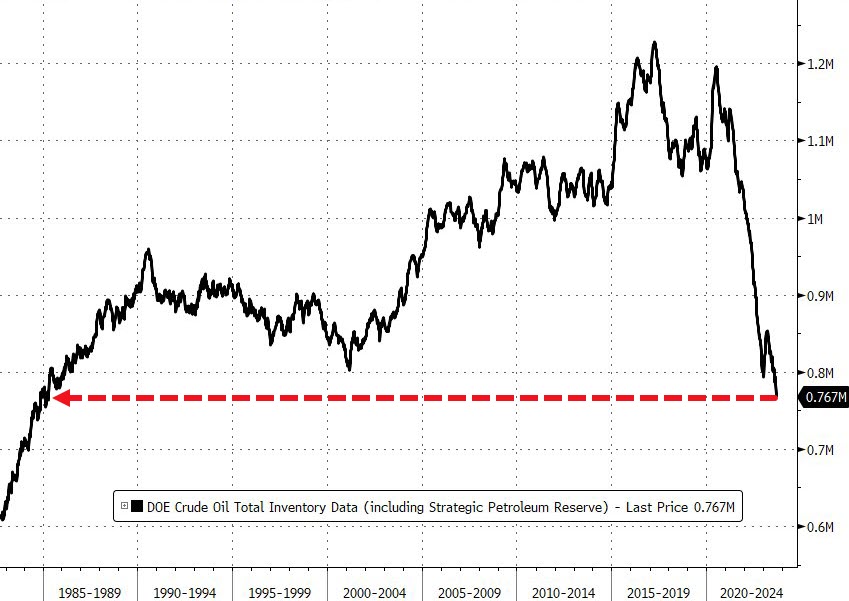
 Image Image

@zerohedge

(…) The crown prince has targeted a higher oil price to pay for its costly Vision 2030 reform project, which ranges from building the concept city Neom on the Red Sea to buying in superstar footballers such as Cristiano Ronaldo. “The reality is that the Saudi budget and MBS’s long term ambitions is going to require oil around $85 or higher,” said Alkadiri. “Projects like Neom don’t get built on $70-a-barrel oil.”

In case you missed yesterday’s Daily Edge:

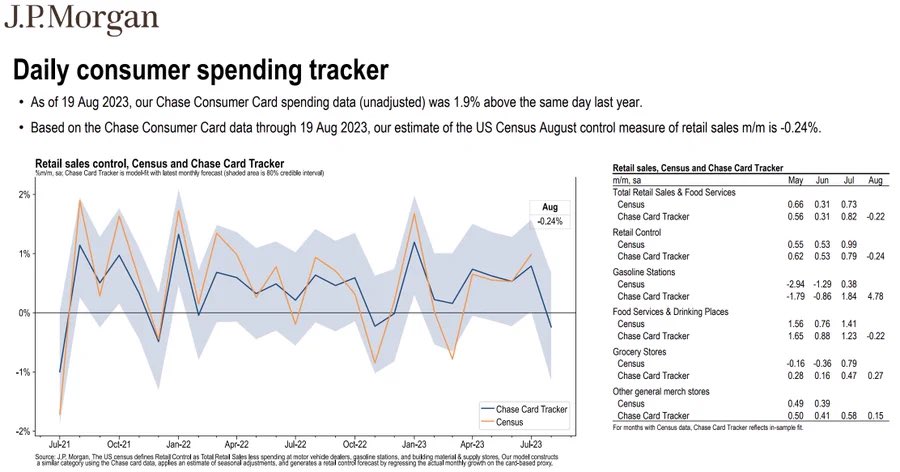
  • Based on Chase consumer card data through Aug 29, JPM’s estimate for Aug control group retail sales is a big step down to -0.49% from a boomy 0.99% in July (Census figure; JPM’s estimate for July is 0.79%). (@Econ_Parker)

Image

  • GM offers 10% wage hike in contract talks that UAW calls ‘insulting’

The largest U.S. automaker said it offered workers a 10 per cent wage hike and two additional 3 per cent annual lump sum payments over four years in its offer to the union ahead of the Sept. 14 contract expiration.

It is also offering a $6,000 one-time inflation-related payment and $5,000 in inflation-protection bonuses over the life of the agreement, along with a $5,500 ratification bonus.

GM said that under its offer, current temporary employees will receive a 20 per cent increase to $20 per hour wage and it would shorten the time it takes to get to the maximum wage rate for permanent employees – mirroring proposals from Ford.

Last week, Ford said it had offered a 9 per cent wage increase through 2027 and 6 per cent lump sump payments, much less than the 46 per cent wage hike being sought by the union. The UAW has said 97 per cent of members voted in favor of authorizing a strike if agreement is not reached.
(…)

The union’s demands include a 20 per cent immediate wage increase followed by four 5 per cent annual wage hikes, defined-benefit pensions for all workers, 32-hour work weeks and additional cost of living hikes. GM is proposing to give employees an additional paid holiday.

The UAW also wants all temporary workers at U.S. automakers to be made permanent, seeks enhanced profit sharing and the restoration of retiree health-care benefits and cost-of-living adjustments.

The UAW said Ford’s profit-sharing formula change would have cut payouts by 21 per cent over the last two years. (…)

Canada Rate Policy Might Be ‘Sufficiently Restrictive,’ Gov. Tiff Macklem Says Bank of Canada Gov. Tiff Macklem said higher interest rates are suppressing consumption and dampening price increases, and might be at “sufficiently restrictive” levels for the central bank to achieve its 2% inflation target.

(…) “Excess demand in the economy has diminished substantially,” due to higher interest rates, Macklem said. “With past interest rate increases still working their way through the economy, monetary policy may be sufficiently restrictive to restore price stability.” (…)

Macklem said softening consumer spending was most pronounced on furniture and other durables often bought on credit.

Together with a fifth-straight quarterly decline in housing investment, “this points to the moderating effect higher interest rates are having on household spending,” Macklem said in his speech. He said the central bank also sees signs of slowing in the labor market from “overheated” levels, noting employment gains have lagged behind population growth for five of the last six months and job vacancies are down by about a quarter from their peak last year.

The unemployment rate has climbed by a half-point, to 5.5%, in the past three months. Macklem said annual wage growth between 4% to 5% remained elevated, although he added he expects those pay increases to slow as well.

Macklem said “inflation is still too high, and the downward momentum [on prices] is slow. And we are concerned that there’s a certain stubbornness in the stickiness of inflation.” (…)

image

US bank profits, deposits broadly steady as spring turmoil abates – FDIC

Overall industry profits in the second quarter fell 11.3% year-on-year to $70.8 billion, driven by the acquisitions of Silicon Valley Bank and two other large lenders which failed from March to May after depositors yanked their cash. Stripping out those rescue deals, profits were up 5.7% from the prior year.

While deposits declined for the fifth quarter in a row, they were down just 0.5% compared with a record 2.5% decline in the first quarter. That was driven by a decline in uninsured deposits, while insured deposits actually rose again in the second quarter by 0.8%. (…)

Unrealized losses on securities increased 8.3% in the second quarter, rising to $558.4 billion, the FDIC said, although that increase comes after banks had reporting declining unrealized losses for two straight quarters.

“Despite the period of stress earlier this year, the banking industry continues to be resilient,” FDIC Chairman Martin Gruenberg said in a statement.

“However, the banking industry still faces significant challenges from the effects of inflation, rising market interest rates and geopolitical uncertainty.” (…)

The FDIC’s “problem bank” list was unchanged at 43 firms in the second quarter. (…)

U.S Treasuries yielded 3.8% at the end of June and 4.0% on July 31. Now: 4.25%.

KKR reckons that U.S. banks had nearly $700B of unrealized bond losses at July 31 and suggests that “these holders will likely sell quickly if prices do rally back”.

Apple Becomes the Biggest U.S.-China Pawn Yet Few companies are safe if the iPhone maker isn’t immune to China’s retaliation.

The Wall Street Journal reported on Wednesday that the Chinese government is banning the iPhone and other foreign-branded devices from use by workers at central government agencies. Bloomberg reported Thursday that such a ban might also be extended to state-owned enterprises and other government-backed entities. That could amount to a significant swath of people in a state-led economy with a population totaling more than 1.4 billion.

According to China’s National Bureau of Statistics, about 56.3 million urban workers were employed by “state-owned units” in 2021. Those jobs commanded an average wage about 8% above the national urban average—an attractive segment for a company specializing in premium devices. And because Apple now ships roughly 230 million iPhones globally every year, 56 million would be a notable chunk to take out of the pool of potential buyers—especially in a mature global smartphone market with low growth prospects. (…)

China has at least some interest in not overly harming a major local employer during a time of growing unemployment. One Chinese city alone reportedly has more than one million workers building Apple products or employed in related jobs. (…)

The recent developments are also just the latest challenge Apple has faced in the country that now serves as its third-largest geographical segment, accounting for 19% of the company’s total revenue in the 12-month period ending in June.

Apple’s sales in its Greater China segment also generated pretax operating margins that were 12 percentage points higher than the company’s total during its most recent fiscal year. (…)

But China is still the company’s largest manufacturing base by far. And the iPhone is still Apple’s largest business, accounting for 52% of revenue. That ironically makes Apple a relatively easy target in the economic war between the U.S. and China. (…)

China has also deployed other creative punishments for U.S. firms, such as withholding approval on major mergers and acquisitions, throwing a wrench into growth plans for major U.S. semiconductor companies such as Qualcomm, Intel and Applied Materials

Throwing a rock at Apple also creates major ripples across the tech pond. The company is one of the world’s largest buyers of chips for its devices. (…)

Stocks vs bonds

Image

@TaviCosta

  • Unit Labor Costs Revised Up (GS)

Nonfarm productivity was revised down by 0.2pp in Q2 to +3.5% (qoq ar) and the year-over-year rate was unrevised at +1.3%. Since 2019Q4, labor productivity has grown at an annualized rate of 1.4%, roughly in line with the pre-pandemic trend.

Unit labor costs—compensation divided by output—were revised up by 0.6pp in Q2 to +2.2% (qoq ar), and the year-over-year rate was revised up by 0.1pp to +2.5%.

Compensation per hour was revised up by 0.2pp to +5.7% in Q2 (qoq ar), and the year-on-year rate was revised up by 0.1pp to +3.8%. Our wage tracker now stands at +4.4% year-over-year in Q3 (vs. +4.8% in Q2).

Total business sales growth turned negative in March They were -3.1% YoY in June while ULC rose 2.5% in Q2 when pretax profits dropped 9.3%.

image

Here’s a close up view:

image

Andrew Ng: Opportunities in AI – 2023

Two of our sons are true geeks who try to keep me abreast of tech stuff. The link above will take you to a 36 minutes presentation that I found quite instructive.

BTW, if any of you have smart ideas in search of Ai brains to execute, Danny can help you (bld.ai)

THE DAILY EDGE: 7 September 2023

U.S. SERVICES PMIs

Thumbs up US Service Gauge Rises to Six-Month High, Topping All Forecasts ISM service-sector index rose to 54.5 in August, est. 52.5

The Institute for Supply Management’s services index increased almost 2 points to 54.5, data showed Wednesday. Readings above 50 indicate expansion, and the figure topped all estimates in a Bloomberg survey of economists. (…)

Thirteen services industries reported growth in August, led by real estate, rental and leasing as well as accommodation and food services.

The ISM’s employment index rose last month to its highest level since November 2021, re-enforcing the broad-based hiring seen in last week’s jobs report. Additional hiring also allowed firms to make progress on backlogged orders.

Meanwhile, costs for materials and wages continued to accelerate in August, with the group’s prices-paid index rising to a four-month high. A sustained pickup in costs for service providers would risk keeping inflation elevated for longer.

ISM’s gauge of new orders rose to a six-month high and a measure of business activity edged higher. Exports expanded at the fastest pace in nearly a year. (…)

High five Nobody mentions the other, much less buoyant, survey:

Thumbs down S&P Global: Service sector demand falters sparking weakest growth in activity for seven months

The seasonally adjusted final S&P Global US Services PMI Business Activity Index posted 50.5 in August, down sharply from 52.3 in July. The rate of output growth slowed for the third month running and was only marginal. Although some firms noted that activity growth was led by efforts to work through past orders, weak client demand and a return to contraction in new business weighed on the expansion.

 image

Although only fractional, the fall in new orders was the first in six months and signalled a marked turnaround from the sharp upturn seen in the second quarter of 2023. Muted demand conditions reportedly stemmed from the impact of higher interest rates and inflation on customer spending.

Foreign client demand remained more supportive, with new export orders continuing to rise in August thanks to new client acquisition and sustained interest from existing customers.

Service providers largely noted that greater wage bills drove input price inflation during August, alongside reports of upward energy and fuel price pressures as well as some firming of materials prices. The rate of increase picked up from that seen in July and was marked overall. Although slower than the 2023 average to date, the pace of inflation was historically marked.

Subdued demand conditions led firms to be more hesitant regarding increases in selling prices in August. Although still sharp overall by pre-pandemic historical standards, the rate of output charge inflation was the slowest since February.

Service sector firms meanwhile recorded only a fractional rise in employment midway through the third quarter. Lower new order inflows were widely cited as encouraging a drawback in hiring activity. The rate of job creation weakened for the third successive month to the slowest since October 2022.

The softer uptick in workforce numbers reflected emerging evidence of spare capacity across the service sector, amid the renewed drop in new business. Backlogs of work fell for a second month running, declining at the steepest rate since November 2022.

Firms remained upbeat in their assessment of the outlook for output over the coming year, despite the current muted demand. The degree of confidence improved from that seen in July, yet remained below the series average. Although companies were often buoyed by hopes that initiatives such as marketing campaigns would drive growth in new orders, client hesitancy amid interest rate hikes subdued expectations.

image

History has shown that it’s generally better to put one’s chips on S&P Global’s surveys. But the ISM gets most of the coverage…

Which one does the Fed watch? Not a moot point given services’ relative importance.

Fed Set to Double Its Economic Growth Forecast After Strong US Data

Following a string of stronger-than-expected reports on everything from consumer spending to residential investment, economists have been boosting their forecasts for gross domestic product. One widely-followed, unofficial estimate produced by the Atlanta Fed even has it expanding 5.6% on an annualized basis in the third quarter.

That marks a sharp turnaround from three months ago — the last time policymakers updated their own numbers — when the consensus view was that the economy would stall in the current quarter. And it may be enough to prompt Fed officials to scale back their estimates for interest-rate cuts in 2024.

“Consumer spending was robust in June and July, so the third quarter is virtually baked in the cake at this point,” said Stephen Stanley, the chief economist at Santander Capital Markets US who is projecting 3.7% growth in the July-to-September period. “5% seems too high, but not impossible.” (…)

When Fed officials last updated their own projections for the US in mid-June, they showed the median policymaker thought GDP would expand just 1% in 2023. At the time, that marked an upgrade over the previous projection round in March, which implied a recession this year.

That number will probably go up to 1.8% or 2% in the new projections set to be released at the conclusion of the central bank’s Sept. 19-20 policy meeting, and the outlook for the unemployment rate could be revised lower, according to Omair Sharif, president of Inflation Insights LLC.

The growth upgrade may also lead Fed officials to scale back the easing they had projected for next year to 75 basis points of rate cuts instead of 100, Sharif said. (…)

Better-than-expected numbers in a monthly Institute for Supply Management report on the US services sector published Wednesday bolstered the theme. (…)

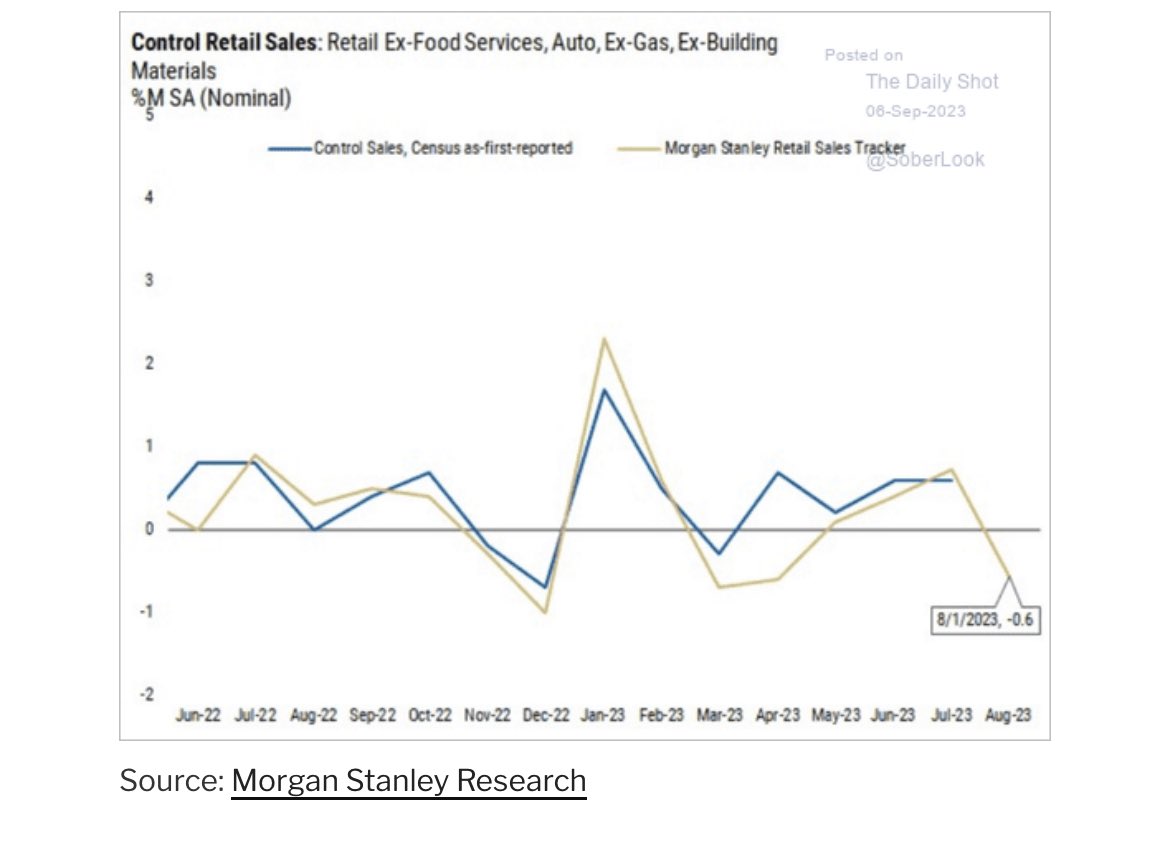
After the spectacular summer retail sales data, Morgan Stanley and J.P. Morgan warn of a very weak August (h/t @BobEUnlimited):

:

Image

Image

Recall that August autos sales of 15.0MM (saar) were down 4.5% from July and 3.8% from their Q2 average of 15.6MM even as incentives rose.

The Fed’s latest Beige Book suggests that growth in the US economy and jobs market slowed in July and August as “contacts from most districts indicated economic growth was modest. (…) Companies around the country are reporting increasing difficulty in passing higher costs along to customers.” Not a sign of strong demand.

Speaking of costs:

China’s Exports Fall for a Fourth Month as Once-Reliable Growth Engine Sputters A deep downturn in the property sector has also pushed imports to their 11th month of declines in the past year.

(…) China’s outbound shipments dropped 8.8% in August from a year earlier, contracting for a fourth consecutive month, China’s General Administration of Customs said Thursday. (…) They represented an improvement from the 14.5% year-over-year drop in exports in July, which marked the worst such result since February 2020.

Imports into China, including intermediate components, commodities and consumer products, fell 7.3% in August from a year earlier, a pace slower than July’s 12.4% drop as well as the 9.7% decline anticipated by economists. (…)

In the first half of the year, China accounted for 13.3% of U.S. goods imports, down from a high of 21.6% in 2017, which represented the lowest level since 2003.

Trade with the 10-nation Association of Southeast Asian Nations has grown over the past year to become China’s largest export market, ahead of the U.S. and European Union, according to a recent report by HSBC. (…)

Bloomberg views the same data more optimistically:

China’s trade slump eased in August, adding to early signals the worst may be over for some parts of the world’s second-largest economy as it tries to regain momentum.

Overseas shipments fell 8.8% in dollar terms from a year earlier while imports contracted 7.3%, both better than estimates and significantly less severe than July’s downturn. (…)

Other data has suggested global demand is beginning to pick up, providing some hope for China’s trade in the coming months. South Korea’s exports — a bellwether for world trade — also declined at a more moderate pace in August than the previous month.

Thursday’s data showed China’s shipments to Europe and Asean continuing to record double-digit declines, but there was a notable improvement in US trade: Exports dropped 9.5% in August, compared to a 23.1% slump in July. (…)

The milder decline in imports, meanwhile, provided a sign that the downturn in domestic demand may be bottoming out. (…)

But as we saw from yesterday’s PMIs, the Chinese economy continues to struggle.

The slowdown in business activity coincided with a weaker increase in overall new business. New orders increased modestly, and at a pace that was below the average seen for 2023 to date. Data suggested that this was partly due to weaker foreign demand for Chinese services.

New export business fell for the first time since December 2022, albeit marginally, amid reports of sluggish overseas market conditions.

Call me “Moving production to India, euh?”

(…) Figures released Thursday by Germany’s statistics agency showed industrial production fell by 0.8% in July from June, and was 4% down from February 2022, the month of Russia’s invasion.

The German economy should contract by 0.3% in the current quarter, and by 0.5% in 2023 as a whole, the Kiel Institute for the World Economy said Wednesday, cutting its previous estimate. (…)

According to the statistics agency, sales in stores and their online equivalents fell in July and were 4% lower in the first seven months of this year than in the same period of 2022. In particular, households have been cutting back on food consumption as prices soar, buying 5.3% less than in the first seven months of last year.

Hobbled by falling demand at home, German manufacturers are also under pressure in overseas markets. In July, the country’s businesses sold goods valued at 130.4 billion euros—equivalent to $139.86 billion, to the rest of the world, a decline from June and a 1% drop from a year earlier.

The surprising resilience of the U.S. economy despite rising interest rates has helped, with exports to the world’s largest economy rising by 5.2% from the previous month. Sales to Chinese buyers were up a more modest 1.2%. Exports to the U.K., which has stagnated since the start of the war, were down 3.5%. (…)

There are few signs of a rebound beyond this quarter. Wages began to rise faster than consumer prices during the second quarter, and that should restore some lost spending power to households. But the outlook for factories is gloomy.

According to the statistics agency, new factory orders were almost 12% lower in July than in June, reversing a recent pickup that had been partly driven by demand for military equipment. It was the largest fall in a single month since April 2020. (…)

The world’s 4th largest economy continued to sink at the end of the third quarter per S&P Global:

Manufacturers scaled back output for a fourth consecutive month in August. Furthermore, the rate of contraction accelerated once again to the fastest seen since the initial COVID shutdowns in spring 2020. Production was down across all main industrial groupings, reflecting a broad-based reduction in demand.

New orders continued to fall sharply, with the rate of decline quickening slightly since July to the fastest for more than three years (and far outstripping the reduction in output). New export orders were down markedly, amid reports of reduced sales to China and across Europe, although the rate of decline eased from the previous month and was noticeably slower than that of total new business.

Germany’s service sector slipped back into contraction in August after having grown throughout the first seven months of the year, the latest HCOB PMI® survey compiled by S&P Global showed. Businesses reported a sustained weakening of demand amid a backdrop of economic uncertainty and strong inflationary pressures.

The survey showed that activity had finally succumbed to a sustained decline in demand, with inflows of new business across the service sector falling for a second straight month in August. Furthermore, the rate of decline accelerated to the quickest since last November, amid reports of growing reluctance amongst clients and persistently high inflation. Weaker foreign demand was also a factor behind the sector’s downturn, although the third successive monthly fall in new export business was softer than that seen in July.

image

Gross domestic product rose only 0.1% in the three months through June, compared with a prior increase measured at 0.3% — an outcome that had surprised to the upside when first published in late July. (…)

The remainder of the year looks similarly bleak, with PMI data signaling private-sector activity in contraction and surveys pointing to further anemic expansion of just 0.1% in the current quarter. (…)

The data confirm how China-led weakness in global demand is hurting exporters badly enough to be weighing down the region as a whole.

Both Germany, the euro area’s biggest economy, and Italy — its third-largest — are suffering likely recessions in manufacturing at present. The latter country even experienced an overall GDP contraction during the second quarter.

Image

Bank of Canada Holds Rates Steady as Economy Shifts Into Weaker Period The Bank of Canada held its main interest rate steady at 5% after back-to-back rate rises in June and July, saying the economy has shifted into a weaker phase and labor-market pressures have eased.

Nevertheless, the central bank Wednesday said it remained concerned “about the persistence of underlying inflationary pressures,” and is prepared to raise rates again should conditions not improve. (…)

In a statement explaining its decision, the Bank of Canada said the Canadian economy “has entered a period of weaker growth, which is needed to relieve price pressures.” (…)

The Bank of Canada added that labor-market activity “has continued to ease gradually,” although noted that annual wage growth was elevated at between 4% and 5%. Canada’s unemployment rate rose by a half percentage point in the span of three months, and now sits at 5.5% as of July. Employment growth has slowed, and job vacancies have dropped about 25% from their peak last year and sit at their lowest level in more than two years. (…)

It said year-over-year and three-month measures of core inflation—which strips out volatile items like food and energy—were both running at 3.5%, “indicating there has been little recent downward momentum in underlying inflation. The longer high inflation persists, the greater the risk that elevated inflation becomes entrenched.” (…)

Of mounting concern for economists is Canada’s per capita gross domestic product, which has declined for four straight quarters—down 2% in the second quarter from a year ago. This reflects growth in Canada’s population fueled by an aggressive immigration plan.

Historical data indicates that the Bank of Canada was cutting rates in the four prior instances since 1980 when GDP per capita fell below the year-ago level, according to economists at National Bank Financial. This time, they add, the Bank of Canada has been raising rates to wrestle down inflation.

Real-Estate Doom Loop Threatens America’s Banks Regional banks loaded up on commercial real-estate loans and investments that are now a looming danger—and their exposure is more substantial than it appears.

(…) Banks roughly doubled their lending to landlords from 2015 to 2022, to $2.2 trillion. Small and medium-size banks originated many of those loans, and all that lending helped push up property prices. (…)

Over the past decade, banks also increased their exposure to commercial real estate in ways that aren’t usually counted in their tallies. They lent to financial companies that make loans to some of those same landlords, and they bought bonds backed by the same types of properties.

That indirect lending—along with foreclosed properties, trading portfolios and other assets linked to commercial properties—brings banks’ total exposure to commercial real estate to $3.6 trillion, according to a Wall Street Journal analysis. That’s equivalent to about 20% of their deposits.

The volume of commercial property sales in July was down 74% from a year earlier, and sales of downtown office buildings hit the lowest level in at least two decades, according to data provider MSCI Real Assets. When deals begin again, they will be at far lower prices, which will shock banks, said Michael Comparato, head of commercial real estate at Benefit Street Partners, a debt-focused asset manager. “It’s going to be really nasty,” he said. (…)

Depositors withdrew funds from many small and regional lenders earlier this year after the collapse of three midsize banks stoked fears of a systemwide crisis.

The doom-loop scenario is starting to play out in big cities where office vacancies have soared. Real-estate investors that are unable to refinance their debt, or can only do it at high rates, are defaulting. The lenders, no longer getting the debt payments, often have to write down the value of those mortgages. Sometimes the bank ends up owning the property.

“The plumbing is clogged right now,” said Scott Rechler, chief executive of real-estate investor RXR. “And that is going to create a backup that will eventually overflow on the commercial real-estate markets and on the banking system.” (…)

Besides banks, lenders such as private debt funds, mortgage REITs and bond investors can also provide funding—but many of them are financed by banks and can’t get loans. “We are seeing a serious credit crunch developing,” said Ran Eliasaf, managing partner of Northwind Group, a private real-estate lender. (…)

The first quarter of 2023 marked the first decline in banks’ commercial real-estate holdings since 2013, according to the Journal’s analysis. At that point, banks’ overall securities holdings had lost nearly $400 billion in value, largely due to higher interest rates. Banks don’t have to mark down the value of loans in most cases, so the real losses are likely greater.

Banks with less than $250 billion in assets held about three-quarters of all commercial real-estate loans as of the second quarter of 2023, the Journal’s analysis shows. They accounted for nearly $758 billion of commercial real-estate lending since 2015, or about 74% of the total increase during that period. (…)

Roughly $900 billion worth of real-estate loans and securities, most with rates far lower than today’s, need to be paid off or refinanced by the end of 2024. (…)

In early 2021, an affiliate of Brookfield Asset Management borrowed $465 million in CMBS and other debt against the Gas Company Tower, a 52-story office building in downtown Los Angeles.

At the time, appraisers valued the property at $632 million, according to Trepp, up from a valuation of $517 million when Brookfield bought the building in 2013. When the loans came due this February, the owner defaulted. An appraiser earlier this year cut the building’s estimated value to $270 million.

High five Data through August 23rd show that deposits have stabilized since SVB…

image

…while lending kept rising, particularly at smaller banks… Actually, CRE loans at smaller banks are up 1.3% from their pre-SVB level.

image

More Binance Executives Leave, Including Some Overseeing Russia Several Binance executives have left recently, including leaders overseeing its Russian business, extending a period of rapid senior turnover at the crypto giant.

Binance has faced intense regulatory scrutiny this year. The latest departures, including those of regional head Gleb Kostarev and Russia chief Vladimir Smerkis, follow exits by its general counsel, chief strategy officer and head of investigations in recent months. Binance has also laid off staff and curtailed benefits. (…)

Founded in 2017, Binance is by far the largest crypto exchange in the world. For years it operated without licenses and without an official home base, serving traders through its Binance.com platform. As regulators started cracking down on the industry, the company said it would change and become compliant, though it continued to take risks. (…)