Shoppers Boosted Retail Sales in April, Reversing Two Months of Declines Consumers spent more on autos, dining out and home projects last month after cutting spending earlier in the year
Retail sales—a measure of spending at stores, online and in restaurants—rose a seasonally adjusted 0.4% last month from the month before, after declining in February and March, the Commerce Department said Tuesday.
Consumers spent more on autos and dining out last month, while boosting online purchases. They cut spending on gasoline and on big-ticket purchases such as appliances and furniture. (…)
Retail sales rose 1.6% in April from a year earlier, below the 4.9% inflation rate for the same period. (…)
Home Depot said Tuesday it expects annual sales to decline for the first time in over a decade as households spend less on home improvement in favor of services. Chief Financial Officer Richard McPhail said customers are also balking at making big-ticket purchases that can be easily deferred. (…)
Auto purchases started to rebound in the first quarter as dealers built up inventories after supply-chain constraints faded, with many companies reporting higher sales. (…)
Retail sales (i.e. goods consumption) have flatlined in the past 12 months but remain 30.6% above their pre-pandemic level, substantially higher than total consumption expenditures (including services) at +22.4% and disposable income at +17.0%. The convergence will continue.

- US retail sales increased 0.5% over the last year, the lowest growth rate since May 2020 & well below the historical average of 4.8%. After adjusting for inflation, though, the story is far worse. Real retail sales fell 4.2% over the last year, the 6th consecutive YoY decline.

@charliebilello
Not so fast Charlie. If you want to adjust retail sales for inflation, you can’t use total CPI which is up 5.0% in April. You must use CPI-Goods, +2.0% in April. Real retail sales are thus down, but not quite as much as your measure suggests.
How Car Sales Could Keep the Economy Humming Retail spending is still growing and could soon get a boost for car sales
The Commerce Department on Tuesday reported that retail sales rose a seasonally adjusted 0.4% in April from a month earlier after slipping 0.7% in March. That was less than the 0.8% economists polled by The Wall Street Journal had expected. But sales excluding gasoline stations, car dealers, building-materials stores and food services—the so-called control group that economists use to track the underlying pace of consumer spending— rose 0.7%. That put control spending above its first-quarter average, setting the stage for another quarter of spending gains.
The report also showed how the contours of consumer spending continue to shift. Sales at furniture and home furnishing stores, department stores and electronics and appliance stores, all of which were pandemic beneficiaries, fell. Sales at food services and drinking places rose.
Sales at motor vehicle dealers also rose a bit, increasing by 0.1% from a month earlier. Gains there seem likely to continue, and strengthen, in the months ahead, providing support for spending and the economy. (…)
Last year, there were 13.75 million cars, pickup trucks and other light vehicles sold in the U.S., the fewest since 2011, when auto sales were still pulling out of the financial crisis. Lately, with supply chains steadier and vital semiconductor chips more widely available, sales have been making a comeback. Through the first four months of the year, Commerce Department figures show that 15.41 million light vehicles have been sold at a seasonally adjusted, annual rate. (…)
In 2019, 16.9 million light vehicles were sold. And considering how many people have been holding on to their cars longer than they usually would, sales could feasibly go higher than they were before the pandemic. (…)
Recent research from the Federal Reserve Bank of San Francisco suggests that the excess of savings households built up after the pandemic hit can continue to support spending through at least the fourth quarter of this year. (…)
And there is also the fact that cars are getting older:
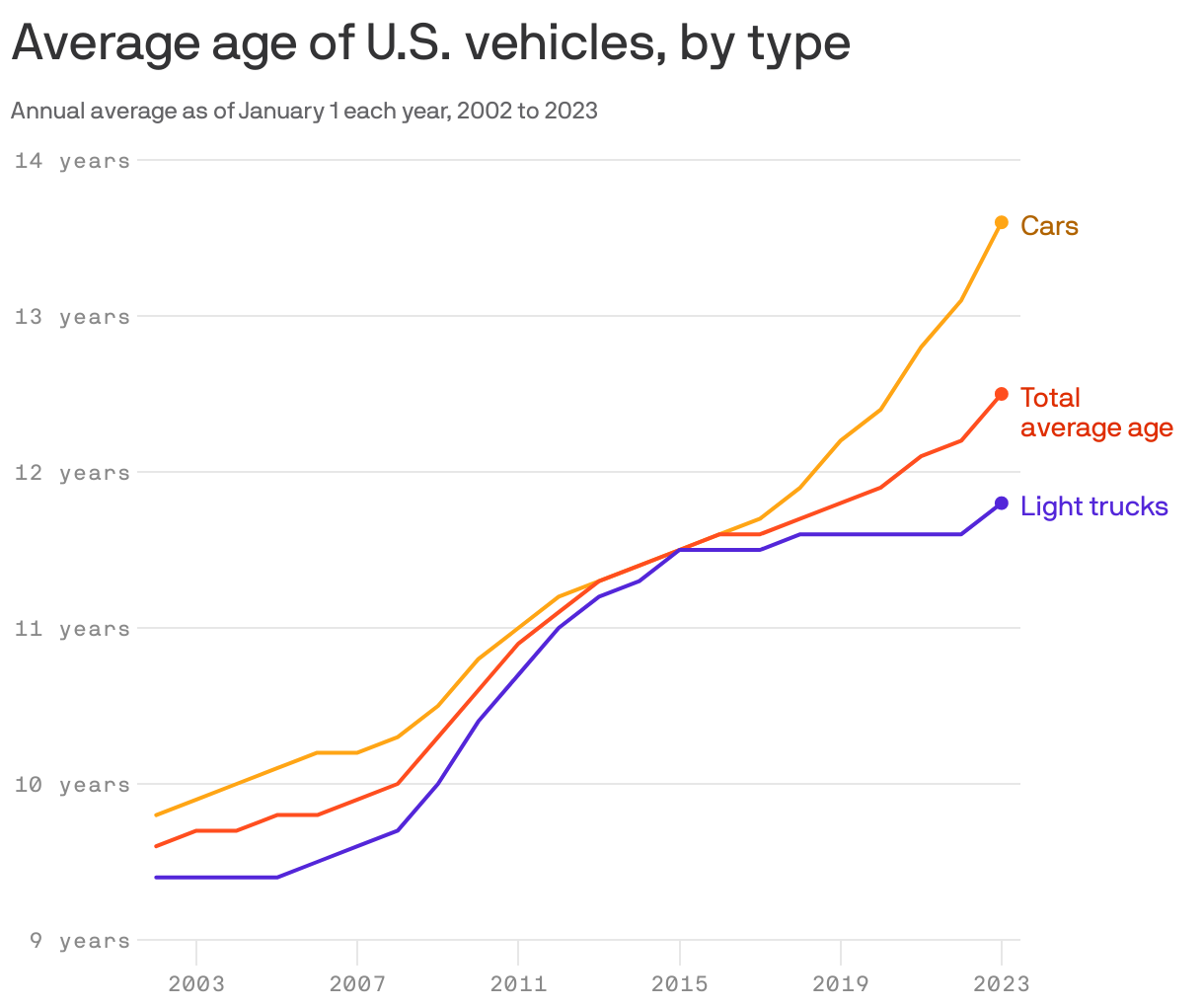 Reproduced from S&P Global Mobility. Chart: Axios Visuals
Fed Officials Debate Whether to Pause Rate Rises Some central bankers are more worried about banking-sector stresses, while others haven’t seen enough inflation progress
(…) The Fed should raise and then hold rates at a level where the next move is equally as likely to be an increase or a decrease, and the central bank isn’t there yet because inflation isn’t showing enough signs of improvement, Cleveland Fed President Loretta Mester said Tuesday.
“The question in my mind is have we gotten to that rate yet? At this point, given the data we’ve gotten so far, I would say no,” she said during a question-and-answer session after a speech in Dublin. (…)
Two other Fed officials suggested they were leaning toward holding interest rates steady at the central bank’s June 13-14 meeting to study the effects of past moves as well as the impact of three bank failures since mid-March, which could further tighten credit conditions.
“You don’t land the plane nose down,” said Chicago Fed President Austan Goolsbee at a conference in Amelia Island, Fla., on Tuesday evening. (…)
Speaking on the same panel, Atlanta Fed President Raphael Bostic said he expected it would take time for inflation to come down, in part because interest rates had only recently reached levels that would restrict economic activity.
Mr. Bostic said he was inclined to pause rate rises next month because of his concern that continuing to raise rates without allowing more time to assess their impact would lead the central bank to overshoot. The Fed could decide after that whether to raise rates again or hold them steady, he said.
A fourth official, New York Fed President John Williams, didn’t tip his hand, but indicated he was comfortable with current market expectations of no increase at the June meeting. Investors in interest-rate futures markets on Tuesday saw a 22% chance of an increase next month, according to CME Group. (…)
On a YoY basis, total CPI was up 5.0% in April but its major components were all above that: core CPI was +5.5%, “CPI-essentials” was +6.1% and core services was 6.8%.

The bar chart shows the same categories on a MoM basis with the dash line indicating where we need to be to reach a 2% annualized rate. A hard grind, to say the least. And we have been lucky on energy, thanks to a very mild winter.


The big worry is that stubbornly high inflation gets transmitted to higher wages. The Atlanta Fed Wage Growth Tracker is seen as the gold standard on wages since it is composition-adjusted. Wage gains peaked last August at 6.7% but they have remained above 6% since.

But this is a 3-month moving average. It so happens that the April number came in at -1.4% MoM bringing the non-smoothed April number to +5.1% YoY, down from +6.4% on average in the previous 3 months. The Daily Shot has the non-smoothed charts:


This gives more credibility to the non composition-adjusted BLS wage measures which were both below 5% in April.

The share of job seekers who relocated to take up a new position fell to 1.6%, the lowest level on record, in the first quarter of 2023, according to a quarterly survey that’s been carried out by executive coaching firm Challenger, Gray & Christmas, Inc. for decades.
Behind the shift in attitudes lies a post-pandemic surge in remote and hybrid positions, which has made it possible for more workers to stay where they’re living even as they change jobs. What’s more, higher interest rates have made buying a house somewhere else more expensive — especially when it also requires people to sell an existing home that’s financed with a mortgage locked in at low costs. (…)
About one-third of US companies say most of their workers are in the office, according to Challenger — up from just 13% last fall. Still, many workers are digging in their heels and refusing to come back.
Fewer than half of workers went to the office in 10 of the largest US business districts in the week ended May 10, according to data from Kastle Systems, a office key-fob firm.

Canadian Inflation slowing
- Headline CPI inflation edged up 0.1% to +4.4% yoy in April.
- Core CPI edged down to +4.4% YoY in April (vs. +4.5% in March), and the average of the BoC-preferred CPI-trim and CPI-median edged down to +4.20% YoY from a downwardly revised average of +4.45% in March.
- On a three-month average annualized basis, CPI-Trim increased to +3.7% (vs. +3.3% in March) and CPI-Median increased to +3.8% (vs. +3.6%).
- On a seasonally adjusted MoM basis, headline CPI increased +0.6% in April. March was revised to +0.3%, up from the +0.1% published originally.
 Core CPI was unchanged at +0.3% MoM.
Europe Car Sales Up in April as Output Gains on Better Supply
New-car registrations increased 16% to 964,932, the European Automobile Manufacturers’ Association said Wednesday. While the recovery continues, deliveries during the first four months of the year remain roughly a fifth below pre-pandemic levels. (…)
Fully electric vehicles saw a nearly 50% increase in registrations compared to April last year, while sales of gas-fueled cars rose by 15%. Orders for diesel-powered vehicles declined slightly.
China’s Home-Price Growth Slows as Housing Rebound Fizzles
New-home prices in 70 cities, excluding state-subsidized housing, rose 0.32% last month from March, when they grew 0.44%, National Bureau of Statistics figures showed Wednesday. Price gains slowed to just 0.01% in the secondary market, after climbing 0.26% a month earlier. (…)
High-frequency indicators in recent weeks show momentum in home purchases has fizzled, despite Beijing’s effort to prop up the market. (…)
New household mid and long-term loans, a proxy for mortgages, posted the first decline in a year in April, suggesting residents repaid more than they borrowed.


 (Bloomberg)
 (
(
 Consumers with student loan debt were able to save, on average, more than $15,000 since March 2020 — and that’s about to end
 Data: New York Fed (Credit-card balances delinquent by 90 days or more). Chart: Axios Visuals


