CONSUMER WATCH
More evidence that something happened since the end of September:
- Goldman Sachs:
We review the preliminary holiday spending indicators from Big Data and industry sources. Tracking holiday spending is confounded by the multitude of data points and press accounts available, and the official data from the Census Bureau will not be released until December 14 and January 17. At this point in the season, we place considerably more weight on hard measures that track actual spending, as opposed to consumer surveys, mall traffic, or website visits. One of the timeliest of these hard measures is Adobe Digital Insights, a panel of 4,500 retail websites that includes 80 of the top 100 retailers.
(…) we find that the Adobe panel is indeed predictive of the broader retail control category in November (correlation +0.69, see right panel). For November 2023, the Adobe data would imply roughly unchanged sales on a sequential basis for this subaggregate.
Indicators of brick and mortar spending trends argue for a potentially softer reading. As shown in Exhibit 2, the seasonally adjusted change in Fiserv credit card spending and the Redbook department store panel would be consistent with outright declines in the brick-and-mortar segment, which represents 70% of retail control. (…)
Taken together, we are assuming a 0.1% decline in Census retail control in both November and December (ex-auto, gas, building materials, mom sa). (…)
Adobe data show a sharp increase in online discounting in the month, with apparel prices falling 25% over the course of November on a not-seasonally-adjusted basis—a larger drop than the 15.5% comparable decline reported by Adobe a year ago.
- Credit card spending has collapsed (@GameofTrades)

More US holiday shoppers turn to ‘buy now, pay later’ loans
Our sense after surveying what limited data are available is that BNPL is not a major problem for consumer spending yet. But until there is a definitive measure for it, there is no way to know when this phantom debt could create substantial problems for the consumer and the broader economy. This report looks at the upsides and downsides of one of the fastest growing categories in consumer finance. (…)
While some individuals may be in over their heads, even by the most robust estimates, the total pile of BNPL loans is not large enough yet to be problematic enough to derail consumer spending on its own. The category is still small relative to more traditional forms of consumer financing. (…)
More worryingly, BNPL does this in de-facto stealth mode because it largely flies beneath the radar of both regulators and policymakers. (…)
Needless to say, the specific size of the BNPL market can be maddeningly difficult to quantify. Or, as researchers at the Philadelphia Fed put it “data on BNPL loans…are scarce. BNPL loans are not currently reported to any of the major credit reporting agencies, and the firms themselves are understandably reluctant to share proprietary data in a competitive environment.” (…)
If we look at publicly available data from Affirm, the market leader in the BNPL space, the gross merchandise value rose from $12B in 2021 to what WF equity analysts estimate to reach $23B this year. If Affirms’ share of the U.S. BNPL market simply held constant over the period, that would suggest a BNPL total of around $46 billion in loans originated in 2023.

Company reports and Wells Fargo Securities FRB New York and Wells Fargo Economics
Through Q3, credit card debt totaled roughly $1.079 trillion, which represents a $154 billion increase from what the total had been a year earlier. If BNPL transactions indeed accounted for $46 billion in transactions in the current year, then that implies that BNPL transactions are roughly equivalent to about a third of the annual increase in credit card debt.
The BNPL providers are quick to point out that they provide consumers with increased purchasing power and greater control in managing their personal finances. To a degree, they have a point. When credit card interest rates are north of 21%, it is just common sense for consumers to take reasonable measures to avoid such financing cost. But with no oversight of BNPL providers, it is not immediately clear that savings on financing cost are not offset by fees and penalties.
The watchdogs have their doubts. In a report to Congress in November, the CFPB made it clear that some of the consumers apt to engage in BNPL programs were households that were financially vulnerable. Specifically, the report stated “BNPL borrowers were, on average, much more likely to be highly indebted, revolve on their credit cards, have delinquencies in traditional credit products, and use high-interest financial services such as payday, pawn, and overdraft compared to non-BNPL borrowers.” Even if BNPL is a relatively small share of the consumer borrowing market today, increasing vulnerabilities in a small segment can still pose a risk. (…)

Vehicles Sales decrease to 15.32 million SAAR in November; Up 7% YoY
Labor-related plant shutdowns in the U.S. that covered the latter half of September and most of October negatively impacted deliveries in November. Combined sales of the vehicles impacted by shutdowns fell 15% year-over-year in November. If those vehicles had matched year-ago results, sales would have totaled a 15.9 million-unit SAAR.
The case for early rate cuts (Axios)
“The Fed is on a path to a March rate cut,” Tim Duy, chief U.S. economist at SGH Macro Advisors, writes in a new note. “All the pieces are there, the Fed just needs to put them together.”
- “I have high confidence the data will unfold in a way that allows for the Fed to cut by then,” he continues, arguing that the central bank may need to ease in January to avoid a recession.
- “I am beginning to suspect that January instead might be the drop-dead date for the soft-landing,” Duy writes. “The longer the Fed waits, the more likely that we start seeing soft employment numbers and rising unemployment. It will be harder to arrest any recessionary dynamics at that point.”
- He acknowledges this is a “a non-consensus call.” Many leading analysts don’t envision rate cuts until May or June.
With the underlying inflation trend now approaching the Fed’s 2% target (the three-month annualized rise in core PCE inflation is at 2.4%, for example), the central bank finds itself at a delicate juncture.
- With inflation falling, real interest rates — borrowing costs over and above inflation — are rising. The absence of rate cuts, against that backdrop, amounts mechanically to monetary tightening.
Duy has leaned hawkish for the last couple of years, which adds credibility to his dovish forecast. Back in 2021-22, he was among those shouting from the rooftops that inflation pressures were building and the Fed was behind the curve in raising rates.
- Rate cuts are accelerating, driven by EM central banks. (The Daily Shot)
 Source: Bank of America Institute
The Beat Goes On! U.S. oil production record (Axios)
American production is part of the reason that recent efforts by OPEC — and its strategic ally, Russia — haven’t been able to end the slide in global oil prices.
Economic weakness in China — the world’s largest oil importer — is dampening demand and also playing a role in the price drop.
U.S. benchmark oil prices are down nearly 20% in the fourth quarter, to below $75 a barrel.
The national average price for a gallon of regular gasoline is $3.24, according to AAA. That’s down 5% in the last month.

Eurozone Services PMI: Employment drops for first time in nearly three years as eurozone economic activity continues to shrink
The HCOB Eurozone Services PMI Business Activity Index remained below the 50.0 mark that separates growth from contraction in November, posting 48.7. This was up slightly from 47.8 in October, but nevertheless signalled a continuation of the service sector’s decline in activity that has been ongoing since August.
New business wins fell for a fifth month in succession midway through the fourth quarter. While the rate of decline was the slowest for three months, it was solid overall and outpaced that for activity.
The drag on activity from falling new business was once again partially alleviated by backlogs of work, which fell further during November. The rate of depletion was moderate and broadly in line with the trend since July.
Inflation remained persistent across the eurozone services economy in November, with rates of increase in both input costs and output prices edging higher on the month.
The seasonally adjusted HCOB Eurozone Composite PMI Output Index recorded a sub-50.0 reading for a sixth successive month in November, signalling another month-on-month reduction in private sector output levels across the eurozone. While the latest reading of 47.6 was up from October’s 35-month low of 46.5 and the highest since July, it was still indicative of a solid deterioration in economic conditions.

The euro area’s four largest economies all registered contractions in business activity during November. France remained the worst performer, with output declining at a rate that was only slightly softer than September’s near three-year record. Germany and Italy saw downturns ease from October, while activity across Spain’s private sector shrank for the first time since August. Ireland was the only monitored eurozone constituent to record an expansion in output.
Demand for eurozone goods and services remained a major drag on business activity during November. New business fell for the sixth month running, albeit at the softest rate since July. Manufacturing new orders continued to fall at a sharper rate than demand for services.
Demand from non-domestic clients once again faltered midway through the fourth quarter. New business received from external sources fell sharply and for a twenty-first month in succession. As was the case with total order volumes, export sales performances were considerably worse at manufacturers than service providers.
Falling receipts of new work led eurozone companies to make additional inroads into their backlogs during the latest survey period. As a result, November saw outstanding orders across the private sector fall strongly and for an eighth month running.
Weak demand conditions, coupled with falling levels of pending work, clearly weighed on businesses’ appetite for hiring as employment fell for the first time in nearly three years. The drop in workforce numbers exclusively reflected job losses at manufacturers, however, as services companies recorded a further, albeit slower, expansion in staffing capacity.
Meanwhile, November survey data indicated a slight intensification of price pressures across the euro area. Input prices rose sharply and at the joint-fastest pace since May (matching that seen in September). The service sector was once again the root of input cost inflation as manufacturers’ expenses continued to decrease.
Equally, softer factory charge discounting, in tandem with slightly more aggressive price setting by services firms, saw the overall rate of output charge inflation tick up in November.
Factoring in the latest PMI indicators, a fall in GDP is on the cards for the fourth quarter. If two consecutive quarters of negative growth define a recession, we find ourselves currently on the brink.

Moody’s Cuts China Credit Outlook to Negative on Rising Debt China stepped up usage of fiscal stimulus to aid growth
Moody’s lowered its outlook to negative from stable while retaining a long-term rating of A1 on the nation’s sovereign bonds, according to a statement. China’s usage of fiscal stimulus to support local governments and its spiraling property downturn is posing risks to the nation’s economy, the grader said. (…)
“Considering the policy challenge posed by local government debt, the central government is focused on preventing financial instability,” Moody’s said. “Still, maintaining financial market stability while avoiding moral hazard and containing fiscal costs of support is very challenging.” (…)
- China’s Colossal Hidden-Debt Problem Is Coming to a Head Cities and provinces across the country have accumulated a massive amount of hidden debt following years of unchecked borrowing and spending.
(…) The International Monetary Fund and Wall Street banks estimate that the total outstanding off-balance-sheet government debt is around $7 trillion to $11 trillion. That includes corporate bonds issued by thousands of so-called local-government financing vehicles, which borrowed money to build roads, bridges and other infrastructure, or to fund other expenditures.
No one knows what the actual total is, but it has become abundantly clear over the past year that local governments’ debt levels have become unsustainable. (…)
Economists say a significant chunk of the hidden debt—their estimates range from $400 billion to more than $800 billion—is particularly problematic and at high risk of default. (…)
Bonds from local-government financing vehicles make up close to half of China’s domestic corporate bond market, according to Wind data, and defaults could choke off funding for other borrowers if many investors and bond buyers back away.
In early November, China’s central government said it places “great importance to the prevention and resolution of the risk of hidden debts of local governments.” Bankers and local government officials were also warned that they would be held accountable for life if they raised new hidden debt.
Pan Gongsheng, the governor of the People’s Bank of China, said at a Beijing financial forum last month that the central bank would also provide emergency liquidity support to regions with relatively high debt burdens. He said China’s total government debt isn’t high by international standards and that the country is taking steps—including asset disposals and refinancing debt—to mitigate the risk posed by its local-government debt. (…)
A recent UBS report said domestic banks’ total exposure to local-government financing vehicles at the end of last year was equivalent to about $6.9 trillion—representing about 13% of the banking sector’s total assets. (…)
There has been an urgent push for local governments to issue so-called special refinancing bonds to replace some of their off-balance-sheet debt.
Since October, close to 30 Chinese provinces and cities have raised the equivalent of around $200 billion in such bonds. The fundraising was mostly in regions with high leverage including the provinces of Guizhou and Yunnan, and the city of Tianjin. The debt swaps have helped lower the risk of imminent local-government debt defaults, by giving local governments more time to come up with funds.
“It’s not enough, but I think this is just the beginning,” said Robin Xing, Morgan Stanley’s chief China economist, of the debt exchanges that have been done so far. He reckons that there will need to be at least $700 billion worth of debt swaps to resolve the bulk of the troubled hidden debt.
“It is not really a restructuring plan but a refinancing plan. It leaves most of the problems with local government debt in place,” said Logan Wright, director of China research at Rhodium Group, a research firm. A report that Wright co-wrote last month said the debt extensions or swaps will hurt China’s economic growth in the long run because more fiscal resources will be required for debt repayment. (…)
The longer-term solution, which could be hard to achieve, would involve restructuring some local-government financing vehicles’ debt and making them commercially viable enterprises. “The goal is not to come out debt free, but for them to become sufficiently profitable companies that don’t rely on governments for funding and support,” said S&P’s Yip.
-
Pressure Is Building in China’s Financial Plumbing Signs of indigestion in China’s money markets are an ominous sign—particularly given shadow-bank troubles and enormous government debt
Plumbing is something most of us take for granted—until there’s a problem, at which point things can get messy fast. Likewise for the “plumbing” of modern financial systems: the money markets, where banks and other financial institutions make short-term loans to each other. (…)
There is little sign of an immediate crisis such as the one that erupted in the wake of regulators’ sudden takeover of Baoshang Bank, a midsize lender, in 2019. But unusual rate movements in recent weeks—and, reportedly, actions by authorities behind the scenes to strong-arm lenders—are still worrying. For one, they come in the wake of a big rebound in short-term interbank lending, particularly to nonbank borrowers—a category which includes funds, asset managers and “shadow banking” trusts such as the one owned by Zhongzhi that defaulted on its obligations in August. (…)
Both benchmark interbank rates and rates for negotiable certificates of deposit, an important funding instrument for small banks, have marched higher since mid-August. Cash injections by the central bank through its medium-term lending facility have increased—with the outstanding balances rising by 600 billion yuan, equivalent to $84 billion, in November, the most since 2016. And in mid-November regulators asked some lenders to cap rates on an interbank debt instrument, according to Reuters.
The unease appears to be partly the result of massive new debt issuance by the government itself, which is making life difficult for some other borrowers: official government bond debt rose by 3.7 trillion yuan from end-July to end-October, according to figures from data provider CEIC. That was the largest three-month increase since at least early 2016.
But jumpy money markets also come on top of an enormous rebound in short-term money market borrowing through bond repurchase agreements, or repos, since mid-2021—primarily by nonbank financial institutions. On net, such borrowing by nonbank financial institutions, excluding brokerages and insurers, has roughly tripled to around 150 trillion yuan on a quarterly basis since mid-2021, central bank data shows. Moreover, if some of that cash has been used for leveraged bets on bonds to juice returns, then the recent rebound in Chinese rates could be squeezing some borrowers too.
The falling U.S. dollar—and slower capital outflows—could take off some of the pressure in the weeks ahead. But China now finds itself balancing enormous new government obligations, which the bond market needs to finance, against highly leveraged nonbank financial institutions, some of which probably still have significant exposure to the nation’s teetering real-estate sector. No wonder money markets are twitchy.
China Services PMI: Business activity growth picks up in November
The latest PMI survey data signalled further increases in activity and demand across China’s service sector in November. Though modest by historical standards, upturns in both activity and overall new work were the best seen for three months amid reports of firmer market conditions. Concurrently, companies expressed stronger optimism around the year-ahead outlook. Employment meanwhile fell fractionally, as some firms maintained a cautious approach to hiring.
Cost pressures moderated again in November, with average operating expenses rising at the weakest rate in nearly a year-and-a-half. Prices charged by services companies likewise rose only slightly.
The seasonally adjusted headline Caixin China General Services Business Activity Index rose from 50.4 in October to a three-month high of 51.5 in November. The rate of growth was modest, however, and remained notably softer than the long-run series average. Nevertheless,the index has now signalled an expansion of business activity across China’s service sector in each of the past 11 months.
Aiding the quicker rise in Chinese services activity was a stronger upturn in total new business midway through the final quarter of the year. The rate of new order growth was likewise the best recorded since August, albeit moderate overall.
Companies that experienced higher sales often mentioned that this was due to firmer underlying market conditions. The surveys indicated that both domestic and overseas demand for Chinese services improved in November, with new export business rising modestly for the third straight month.
After stagnating in October, employment across China’s service sector fell fractionally in November. Firms that registered lower headcounts often linked this to restructuring efforts amid relatively subdued demand conditions. Sustained caution around hiring contributed to a further upturn in outstanding orders midway through the final quarter of 2023. That said, the rate of backlog accumulation slowed from October and was only marginal.
Average input prices faced by Chinese services companies continued to rise during November. Where higher expenses were reported, firms often cited greater labour and raw material prices. That said, the rate of cost inflation was the slowest seen since June 2022 and marginal.
Prices charged by service providers also increased at a softer pace. Notably, the rate of inflation slipped to a three-month low and was broadly in line with the series average.
Signs of firmer growth momentum in November helped to lift business confidence when assessing the one-year outlook for service sector activity in November. Businesses were generally optimistic that stronger economic conditions will help to lift customer demand both at home and abroad over the next year. However, overall sentiment remained softer than seen on average since the survey began in late2005.
At 51.6 in November, the Composite Output Index rose from the neutral 50.0 level in October to signal a renewed increase in total business activity across China. The rate of growth was the best seen since August, albeit modest overall. Sector data revealed that a fresh upturn in factory output and stronger rise in services activity helped to lift the composite figure.
Composite new orders also rose at a moderate rate that was the best seen for three months, supported by quicker increases in sales across both manufacturing and service sectors. New export business meanwhile declined again in November, as lower foreign demand for Chinese manufactured goods offset an increase in services exports.
Composite employment fell slightly for the third straight month, despite a slight rise in outstanding workloads. Cost pressures eased again in November, with composite input prices rising at the slowest pace since July. As a result,prices charged by Chinese firms increased only slightly.


Canada: Core PCE deflator decelerating faster
(…) core inflation in Canada is decelerating very rapidly and was slightly below that of the U.S. in the third quarter at 2.1% annualized. While the timing of a potential rate cut remains uncertain, current inflation trends in Canada suggest that some tangible relief for consumers is on the horizon in 2024.

The benchmark price for a home in Canada’s largest city fell 1.7% in November from the previous month to C$1.11 million ($820,000), according to seasonally adjusted data released Tuesday by the Toronto Regional Real Estate Board. That brings the total decline in Toronto home prices since July to 4.8%, the data show. (…)
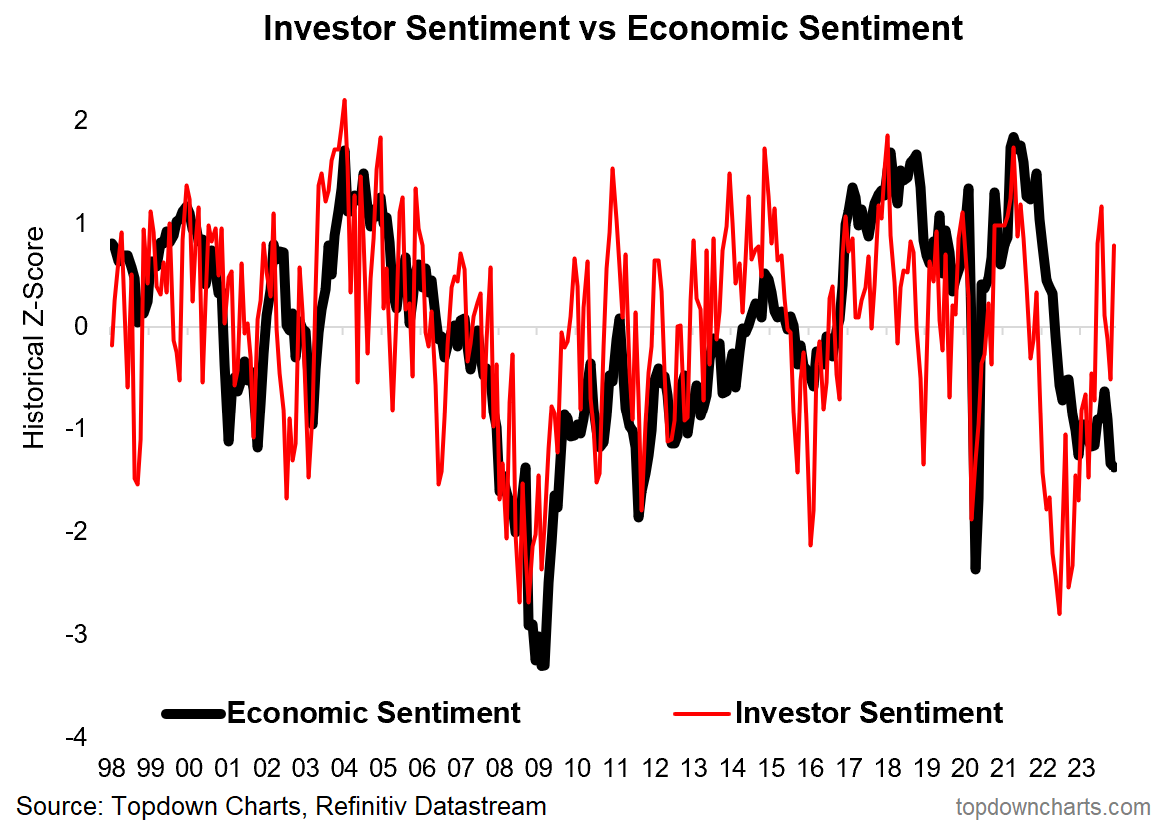
SENTIMENT WATCH
- Dynamics behind the “everything rally” in November have “absolutely run out of gas right now,” Goldman’s Scott Rubner said.
- Investors are too optimistic about the central bank easing next year, according to Goldman, which suggests selling call options to counter some of the “excessive” rate-cut pricing.
- Markets are pricing in an “unrealistic” Goldilocks economic scenario, a JPMorgan strategist said, predicting a slowdown that threatens earnings and equities.
- And it probably won’t get better anytime soon. Stocks are heading for a rocky end to the year, Morgan Stanley’s Mike Wilson said. A flat run on returns in the S&P 500 may extend into the next decade, according to Stifel.
- Citi’s Chris Montagu said the bullish sentiment around positioning is weakening for the S&P 500.
- Check out this chart of Affirm, one of the pioneers of the Buy Now Pay Later model.

- ARKK, meanwhile, is up over 42%, just since late October, and now it’s close to its highs of the year.

- Crypto lives (Axios)
Binance and its CEO pleaded guilty to money laundering and fraud charges, agreeing to pay more than $4 billion — the largest penalty in U.S. Treasury history.
- Among the charges, Binance laundered money for terrorist groups including Hamas.
- Despite the current anti-crypto atmosphere among some U.S. regulators, the settlement agreement allowed Binance to continue operating.
Under the settlement, Binance is required to create an effective anti-money laundering system — under the watchful eye of an independent outside party that reports to federal regulators.
- “It’s the first such arrangement in crypto,” explain Henry Farrell and Abraham Newman in a must-read piece for the WSJ. And, they argue it’s more significant than the monetary penalty.
- The new system will transform Binance “from a scofflaw into a watcher and enforcer on behalf of the U.S. government,” they write.
The arrangement will also change the larger crypto market.
- Anti-money laundering rules “spread like a virus,” the WSJ piece argues. That’s because anyone who wants to do business with Binance needs to get their house in order, too. And the people doing business with those Binance users will need to adjust.
- The U.S. did something similar about 10 years ago with a crackdown on big banks — levying big fines and imposing monitoring arrangements. That terrified “other financial institutions into rapid and widespread compliance,” they write.
While the crypto market lives on, the vision of what cryptocurrency could be is very different from its early days.
- Given the Binance deal, it’s hard to argue that crypto traders are operating in a decentralized Wild West market outside of U.S. dollar hegemony.
- Instead, the market has drifted toward centralization where big exchanges — Coinbase, too — operate under the watchful eye of the U.S. government. (Lawbreakers could move to smaller less centralized trading to try to avoid detection.)
Regulators aren’t done with Binance. A lawsuit filed by the SEC is ongoing.
A year ago, in the wake of Sam Bankman-Fried’s downfall, the future of crypto looked uncertain — but it has survived and even mounted a bit of a resurgence.
 But crypto’s supply/demand dynamics could change meaningfully…
EV, ESG Supply/Demand…
From Almost Daily Grant’s:
A big three automaker takes the off ramp: General Motors unveiled an instructive strategy shift this morning, increasing its quarterly dividend to $0.12 per share from $0.09 and authorizing a $10 billion share repurchase program – the largest in its history – which includes $6.8 billion in immediate purchases. For context, GM’s market cap currently stands at $44 billion.
Funding for that monster capital return program, which dwarfs the $4.2 billion reverted to shareholders over the past seven quarters, will partly come “by freeing up capital previously earmarked for the development of electric vehicles,” notes The Wall Street Journal.
Though CEO Mary Barra deemed herself “disappointed” with halting progress on the development of GM’s Ultium batteries, which are meant to underpin the company’s next-generation electric vehicle lineup, the executive declared that “there’s really no reason that EV demand won’t be higher in the years ahead.”
Global sales within the category grew by a more-than-respectable 49% clip over the first six months of the year according to research firm Canalys, but more recent trends cast some doubt on the GM boss’ upbeat appraisal. Thus, average used EV prices registered at just under $35,000 in October, newly released data from analytics firm iSeeCars.com show, off 33.7% year-over-year. That compares to a 9.6% drop for hybrids and a 5.1% decline for all used cars.
Citing data from Edmunds, the Financial Times likewise relayed on Nov. 13 that average discounts for new EVs in the U.S. now stand at $2,000, double that seen for conventional internal combustion engine autos and up from zero in January. “There are clear signs of carmakers pushing EVs,” Mike Tyndall, autos analyst at HSBC, told the pink paper. “This was almost unthinkable at the start of the year.” (…)
That growing consumer pushback is mirrored on Wall Street, as investors turn tail from environmental, social and governance-themed strategies. Thus, Morningstar determined earlier this month that fund flows in the so-called sustainable space have remained in negative territory for six of the past seven quarters after more than three years of uninterrupted quarterly inflows. Then, too, the third quarter marked the first time in which ESG-focused fund liquidations and marketing pivots from that theme outstripped new launches and sustainability-focused fund rebrandings.
“We found that the demand for ESG investing, by financial professionals working with retirement-plan participants, was more limited than we anticipated,” Ron Rice, vice president for marketing at Pacific Financial, told the WSJ.