The enemy of knowledge is not ignorance, it’s the illusion of knowledge (Stephen Hawking)

It ain’t what you don’t know that gets you into trouble. It’s what you know for sure that just ain’t so (Mark Twain)

Invest with smart knowledge and objective odds

THE DAILY EDGE: 25 APRIL 2023: Money vs GDP Revisited

Did you miss yesterday’s Economic Perspectives: Re-Acceleration!?

BTW, the Chicago Fed National Activity Index for March came out yesterday, improving from -0.13 in February to +0.01 in March, well above the -0.70 level signalling an economic contraction.

CFNAI and Recessions

(Advisor Perspectives)

April U.S. Light-Vehicle Sales to Post Strong Growth; Inventory to Fall from March

Even though the seasonally adjusted annual rate could decline slightly from the prior quarter’s 15.2 million units, sales volume is forecast to rise a robust 13% year-over-year in Q2. Inventory will undergo a seasonally related month-to-month decline in April but resume growth by the end of the quarter. (WardsAuto)

Sliding Diesel Prices Signal Warning for U.S. Economy A “freight recession” means fewer trucks carrying goods across the country.

(…) The darkening industrial outlook, which contrasts with low unemployment and a robust service sector, has pulled benchmark diesel futures down nearly 25% this year, to $2.53 a gallon. Federal record-keepers peg the year-over-year hit to domestic demand at 8.4%. (…)

In the U.S., where stores and warehouses remain overstocked after a pandemic-era boom in consumer goods, container imports in the first three months of 2023 slid about 23% from the same period last year, according to logistics technology firm Descartes Systems Group Inc. (…)

The diminished activity means fewer trips by fuel-guzzling semitrailers hauling goods across the country, a pullback that has punished trucking firms and pushed the Dow Jones Transportation Average down 7.8% from its 52-week high in February. 

Knight-Swift Transportation Holdings Inc. and J.B. Hunt Transport Services Inc. last week reported year-over-year quarterly revenue declines and earnings that missed Wall Street’s expectations. Shares in both companies have since held steady.

J.B. Hunt executives pointed to consumers’ waning hunger this year for big and bulky products such as appliances, furniture and exercise equipment. They added that the company’s customers have been less accurate recently in predicting their freight needs than ever before.

“Simply stated, we’re in a freight recession,” J.B. Hunt President Shelley Simpson told analysts in an earnings call.

Bob Costello, the American Trucking Associations’ chief economist, said he has seen trucking companies with fleets in the range of 200 to 300 vehicles failing at a rate of about one a week. 

That doesn’t bode well for even smaller operators. “I think a lot of these little ones are going out of business,” he said. (…)

After every boom, a bust happens. But this is not a typical economy-wide bust, perhaps not even an industry-wide bust.

  • Inventories swelled during the pandemic recession but booming sales quickly restored inventories/sales ratios across the economy. IS ratios are now below their pre-pandemic levels except for wholesalers and the problem there is centered on housing and home improvement related goods, including lumber.

fredgraph - 2023-04-25T061303.237

  • I/S ratios for building materials dealers are 7% above pre-pandemic levels.
  • Manufacturing production has been soft lately but new orders are 20% above their late 2019 levels and well above previous cycle peaks.
  • Last week’s April flash manufacturing PMI indicated that “manufacturing new orders returned to expansion for the first time in seven months”.

image

  • Total freight shipments are not in recession mode:

Cass Freight Index Shipments March 2023

  • The trucking industry’s main volume problems are with lumber (housing) and metals (autos, Boeing).
  • The trucking industry’s main profitability problems are that freight rates have weakened 10% while trucking wages are still up 8.3% YoY.
  • As to the “sliding diesel prices” as an economic warning signal, the reality is that diesel prices have held up much better than crude oil and gasoline prices in the past 12 months. No warning there!

fredgraph - 2023-04-25T065257.677

TECHNICALS WATCH

What about market breadth?

The percentage of stocks outperforming the index has collapsed. Bearish Wilson adds: “We are challenged to find a period in history during which these indices have underperformed to such a degree while a new bull market was beginning.” (The Market Ear)

MS

SentimenTrader’s Jason Goepfert does the analysis since 1928.

Breadth is showing negative divergences based on various (and sometimes wholly arbitrary) metrics. By this, the usual definition is that price in, say, the S&P 500 is making higher highs while fewer of its stocks are holding above their moving averages.

We can see this in the percentage of stocks trading above their 50-day moving averages. When the S&P formed a 30-day peak in February, more than 74% of its stocks traded above their 50-day; on April 18, barely 60% of stocks were.

It’s also evident in the percentage of stocks above their 200-day averages. In February, more than 78% of stocks traded above their long-term averages. By last week, that had dropped to fewer than 62%.

What the research tells us…

Based on the above [see Jason’s complete post), investors should be much more welcome of significant positive divergences in breadth than negative ones. That seems like a “duh” statement, but we’ve seen hundreds of times over the decades that “duh” shouldn’t be taken for granted in auction markets.

And even so, it might seem automatic that large negative divergences in breadth like we are seeing now, at least in two common metrics, should be a good sell signal. But they aren’t. They proved to be a couple of times over the past decade and before that, but most of the time, they gave false signals.

First Republic Shares Plunge as Deposit Drop Renews Concern Bank reports larger-than-expected drop in deposits in quarter

Executives at the San Francisco-based lender laid out plans Monday for shoring up the firm after its first-quarter results showed customer deposits plunged 41% to $104.5 billion in the period. That missed the $137 billion average of analyst estimates compiled by Bloomberg and came even after the country’s largest lenders parked $30 billion of their own cash there.

The figures underscored that First Republic is still contending with the impact of last month’s regional-banking crisis, in which wealthy customers and businesses yanked their money from small- and midsize lenders over worries that rising interest rates were eroding the value of their assets. First Republic said it will cut as much as 25% of its workforce, lower outstanding loan balances and curb other non-essential activities. (…)

Light bulb When Money Stops Talking

From David Kelly, J.P. Morgan Asset Management

(…) For many decades, it has been economic dogma that “inflation is always and everywhere a monetary phenomenon” and the monetarist school of economic thought rose to prominence in the 1970s in part because of a very strong relationship between the growth in the money stock and the subsequent growth in nominal GDP.

For those who do worry about the money supply, recent data have been very concerning. Through February, M2 has fallen for seven consecutive months and is down 2.4% from a year ago. The March data, due out on Tuesday, could show an intensifying contraction.

However, the truth is that the tight positive relationship between money supply and nominal economic growth has evaporated in recent decades. This collapse in correlation partly reflects a proliferation in alternative, easily-accessible financial stores of value and means of payment. It also could reflect a collapse in the negative correlation between policy interest rates and nominal economic activity which is the rationale for any activist monetary policy. (…)

Why M2 is Falling

(…) There are at least three big reasons behind this recent decline. The first is simply quantitative tightening.

In its most recent quantitative easing campaign, initiated to reduce the economic and financial strain of the pandemic recession, the Fed boosted its total assets from $4.1 trillion in February 2020 to almost $9 trillion two years later. This was achieved by buying huge quantities of Treasuries and mortgage-backed securities in the open market. Much of the cash received by the sellers of these securities ultimately found its way into deposit accounts and money market funds, causing M2 to vault higher from $15.7 trillion in February of 2020 to $21.7 trillion last July. This process is now firmly in reverse with the Fed ramping up quantitative tightening last summer and currently reducing its balance sheet at a pace of up to $95 billion per month.

However, beyond this obvious force in reducing the money stock, two other factors may be in play.

First, recent changes in the macro environment may have reduced the desirability of holding cash or low-interest checking accounts.

  • First, physical cash obviously pays zero interest which isn’t a big deal when inflation is 2%. However, with CPI inflation hitting a peak of 8.9% year-over-year last June and still running at 5.0% in March, there is now an incentive to conserve on cash holdings.
  • Second, even with the Fed raising short-term interest rates sharply, average bank deposit interest rates remain well below 1%, increasing the incentive to move deposits out of the banking system. That being said, money market mutual funds, which are part of M2 but not M1, pay much more competitive interest rates and this is very likely contributing to the sharper decline in M1, which has fallen by 5.8% over the past year compared to a 2.4% decline in M2.
  • Moreover, in addition to higher U.S. inflation and interest rates, the exchange rate of the U.S. dollar has been falling recently, with the dollar index now down 11% since last September. Fears of a further dollar decline give global investors a reason to transfer liquid assets out of physical U.S. dollars and dollar-denominated accounts.

Second, a decline in M2 holdings could reflect economic deceleration. If, due to worsening economic prospects, businesses are more reluctant to borrow and banks are less willing to lend, commercial and industrial loans should fall or grow more slowly and this very much appears to be the case in recent months. This, in turn, leads to a diminished flow of money into corporate checking accounts. This reluctance to lend or borrow has worsened in recent weeks in the wake of the closure of some smaller regional banks and could contribute to an expected M2 decline in March.

The Collapse of the Relationship between Money and GDP

However, while it is possible to rationalize the recent decline in the money supply, the ability of the money supply to drive or predict economic activity has collapsed in recent decades. (…)

Milton Friedman described the process very eloquently. A surge in the money supply meant that people had more money than they wanted in their pockets or their checking accounts. They would try to reduce those balances by buying goods and services, thereby boosting economic activity. However, the recipients of those dollars would also then find themselves carrying too much money and would consequently spend them down, further boosting activity. Eventually, there would be an increase in real output or prices or both to a level that was sufficient to make money holdings appropriate again.

Moreover, if a central bank increased the money supply when real output couldn’t accelerate any further, inflation was inevitable. Hence, inflation was a monetary phenomenon.

Strangely, however, as soon as the monetarist doctrine had become the dominant line of economic thought in the early 1980s, the relationship collapsed. From 1984 to 2019, year-over-year M2 growth explained less than 1% of the year-over-year change in nominal GDP two quarters later. So why did money stop talking?

The main reason appears to be that a lack of liquidity ceased to be a binding constraint on the operations of the economy.

(…) today, the proliferation of alternative payment methods and competitive interest paid on money market mutual funds and ETFs has made monetary aggregates, such as M1 and M2, much less relevant to the economy. If, for some reason, the use of cash and checking accounts was somehow constrained, the economy would seamlessly move to using other means to complete transactions.

This is likely the main reason for the decline in the relationship between the money supply and nominal economic growth. However, there is another trend that is worth considering. A time-series of rolling correlations between M2 and nominal GDP doesn’t just show a decline from positive to zero over the decades – it shows a decline from strongly positive to mildly negative, with the zero correlation since the mid-1980s being an average of small positive numbers at the start of period offsetting small negatives in this century.

But how could an increase in the money supply actually predict a decline in economic activity? This may have something to do with the Fed’s use of quantitative easing as it cuts interest rates. Prior to the Great Financial Crisis, the whole idea of quantitative easing hadn’t been tried since the 1950s. However, in recent years, it has become part of the Fed’s standard toolkit. When the economy gets into trouble, the Fed both cuts short-term interest rates and engages in quantitative easing, which boosts the money supply.

However, starting from already low interest rates, it may well be that further cuts in interest rates actually cause the economy to slow, by reducing the income of savers, increasing public worries about recession and encouraging people to wait for even lower rates before completing transactions.

Meanwhile, the interest sensitive parts of the economy, including home-building and capital spending have diminished in importance and are also highly sensitive to economic expectations.

If, over the decades, the negative lagged relationship between policy interest rates and nominal GDP growth has actually turned positive, and the Fed boosts the money supply via quantitative easing at the same time as it cut interest rates, a surge in M2 may reflect a supposedly stimulative monetary policy that is actually slowing the economy down.

On the Edge of a Swamp without a Monetary Raft

This last issue may become important in the year ahead. While the money supply data does not provide a reliable guidepost for the direction of the U.S. economy, there are plenty of other signs of trouble ahead.

In particular, while first-quarter GDP, due out on Thursday, is likely to show positive growth, unemployment claims have been rising in recent weeks. In addition, survey data show a continued tightening of lending standards both as perceived by senior loan officers and small businesses. Delinquencies on consumer loans are rising and an expected restart of student loan repayments in the next few months could force consumers to retrench elsewhere. In short, the economy remains on the edge of a swamp – not in recession yet but close to one.

In recent press conferences, Jay Powell, has stressed that the Fed has the tools to restart the economy should it fall into recession. However, it is not at all clear that this is the case. Cutting short-term interest rates proved very ineffective at boosting economic growth in the last long expansion. And if the Fed decides to resort to quantitative easing to boost the money supply, the history of recent decades suggests that this won’t work either. For this reason, the Fed would be wise to stop raising rates now to avoid adding further stress to the banking system which could, indirectly, topple the economy into recession.

However, if they instead boost the federal funds rate to above 5% next week and hold it at that level throughout the rest of 2023, a return to monetary easing in 2024 would do little to boost the economy in 2024. This would be a painful outcome for many American households. However, by ushering in a new era of low inflation and low interest rates, a succession of monetary mistakes could help boost the value of both stocks and bonds.

Generative AI at Work (NBER working paper)

We study the staggered introduction of a generative AI-based conversational assistant using data from 5,179 customer support agents. Access to the tool increases productivity, as measured by issues resolved per hour, by 14 percent on average, with the greatest impact on novice and low-skilled workers, and minimal impact on experienced and highly skilled workers.

We provide suggestive evidence that the AI model disseminates the potentially tacit knowledge of more able workers and helps newer workers move down the experience curve. In addition, we show that AI assistance improves customer sentiment, reduces requests for managerial intervention, and improves employee retention.

Researchers tested AI software with a customer service team of more than 5,000 agents at an unnamed Fortune 500 company that provides software to small businesses.

  • The AI monitored customer chats and gave agents real-time suggestions for how to respond, including ideas for wording — key to keeping customers from growing hostile — and links to technical information to help troubleshoot issues.
  • Agents were free to ignore the advice.

Use of the AI led to a 14% increase in the number of customer service chats an agent successfully responded to per hour.

  • Agents spent less time handling individual chats, and were able to take care of more customers per hour there was also a small increase in the share of chats resolved successfully.
  • The AI had the biggest impact — and helped reduce turnover — among the lowest-skilled customer service agents new to the job. Experienced customer service agents saw only a slight lift.
  • That’s because they already have learned the information the AI was sharing in this case, the AI basically serves as a way for more experienced customer service agents to transfer knowledge to newbies.

Economic Perspectives: 24 April 2023: Re-Acceleration!

U.S. Flash PMI: Stronger demand conditions support sharper growth in April, but also bring renewed inflation momentum

April data indicated a faster rise in business activity at firms based in the US, according to the latest ‘flash’ PMI™ data from S&P Global. Output rose at the sharpest pace for almost a year, as stronger demand conditions, improving supply and a steeper uptick in new orders supported the expansion. Solid growth in activity was seen across both the manufacturing and service sectors.

The headline S&P Global Flash US PMI Composite Output Index registered 53.5 in April, up from 52.3 in March, to signal the quickest upturn in business activity since May 2022. The increase in output was the third in as many months. The faster rise in activity was broad-based, with service sector firms registering the sharper rate of growth. Where a rise in activity was noted, firms linked this to greater customer confidence and a stronger uptick in new orders. Some companies also noted that an improvement in their ability to hire staff had boosted output.

image

New orders at US firms increased at the sharpest rate for 11 months in April as new client wins, improved customer confidence and successful marketing strategies drove the uptick. The rise in new business was solid overall, building on a modest gain in March and contrasting with contractions seen in the opening months of the year. Growth was led by the service sector as the upturn in manufacturing new orders was only fractional, albeit returning to expansion for the first time in seven months.

Improvements in client demand were largely focused on the domestic market as new export orders continued to contract in April. Despite the pace of decline easing to the slowest for three months, subdued foreign demand conditions were broad-based. (…)

Encouragingly, the rate of job creation accelerated at the start of the second quarter of the year. Growth in private sector employment numbers was the quickest since last July as goods producers and service providers showed some success in efforts to expand capacity. Nonetheless, backlogs of work increased for the second month running as companies mentioned further struggles finding suitable candidates and retaining staff amid rising wage costs.

Business expectations among US firms remained upbeat during April, with the degree of confidence in the year ahead outlook ticking up to the second-highest since May 2022. The level of optimism was slightly below the long-run series average, however, amid concerns surrounding higher interest rates and inflationary pressures. (…)

Public responses to the pandemic continue to influence the economy. Rising inflation and higher interest rates did not meaningfully impact consumer spending. Goods consumption has only flatlined and remains 6% above trend while services are slowly catching up but are still 1.7% below trend.

image

The March J.P. Morgan Global Manufacturing PMI revealed that “manufacturing production expanded for the second consecutive month in March” while “the rate of contraction [in new orders] was only mild and the weakest during that sequence”. New orders in China rose for the second straight month.

Last week’s April Flash manufacturing PMIs remained weak for the Eurozone and Japan but the U.S. manufacturing PMI edged up above 50, signalling “the first improvement in operating conditions at goods producers in six months” and “stabilizing demand conditions across the sector”.

Goldman Sachs shows how U.S. manufacturing has completely decoupled from other G7 countries in recent months.

image

As I expected (here), since most goods sold in the U.S. are imported, the U.S. inventory correction has mainly impacted foreign manufacturers.

fredgraph - 2023-04-24T070334.110

The April surveys of manufacturers by the N.Y. and the Philly Fed both revealed improving new orders. In fact, new orders in the N.Y. Fed’s area “rose a whopping forty-seven points to 25.1”, matching its highest levels of the past 7 years.

image

The widely forecast U.S. recession has failed to materialize so far as the economy experienced rolling recessions in housing (strong) and goods production (mild) offset by recovering services.

image

That may explain why a historically reliable indicator such as the CB LEI has yet to deliver on its recession signals. The LEI has 10 indicators; 5 of the 7 nonfinancial components are goods-related plus 1 of 3 financial components, the goods-dominated S&P 500 Index.

 Smoothed LEI 

Similarly with the Chicago Fed National Activity Index, a much broader index: of its 85 components, 65 are goods-related (74% weight). The CFNAI has been negative recently without reaching the critical 0.70 level for an economic contraction.

CFNAI and Recessions

Interestingly, the CFNAI diffusion index has remained positive most of the time since the end of the pandemic in spite of its goods bias, thanks to its income and labor related components.

So, in an economy where goods now weigh half as much as services, goods-biased indicators can be misleading when services and employment stay reasonably firm.

But the latest data now suggest that the goods recession may be ending:

  • Demand for goods has been stable at a high level in the past 15 months, even improving a little since December.
  • Retailers and wholesalers inventories are about 5% below normal. That “new orders returned to expansion” in April is not surprising and may be sustainable. Retail inventories are particularly low at 1.23x sales from 1.43x pre-pandemic and a 1.35-1.50x range since 2010.

fredgraph - 2023-04-22T121921.211

  • Manufacturing production is where it was pre-pandemic while new and unfilled orders are 23% and 20% above respectively, both substantially higher than at previous cyclical peaks. Demand for goods would need to drop meaningfully for manufacturing production and employment to sink measurably.

fredgraph - 2023-04-22T121549.700

U.S. manufacturing employment keeps rising and could actually grow in 2023 helping sustain related services employment (e.g. transportation, restaurants, banking). KKR says that “in 2022 U.S. companies have revealed plans to reshore nearly 350,000 jobs, compared to 110,000 in 2019.” That would boost manufacturing employment by 2.7% (+0.2% in total).

This chart illustrates how past jobs recessions are essentially due to manufacturing. Non-manufacturing employment (91.6% of all employment) generally only slows down without declining much on an annual basis, It’s now turning up:

fredgraph - 2023-04-23T070856.271

As I wrote in December, if KKR is right on reshoring and employers keep hanging on to their scarce employees, this could well be a soft landing after all.

And here we are, 4 months later, with indications that manufacturing, far from crashing, is now about to contribute to growth, perhaps significantly given that supply chains have normalized, inventories are very low, labor supply is improving and consumer demand remains reasonably solid. Reshoring and nationalistic policies would only add fuel to this nascent fire.

Keep in mind that manufacturing carries more economic pull than its weight suggests: high salaries and important collateral effects on many services such as transportation, restaurants and banking act as economic multipliers.

So, if no major banking crisis, the Fed may well get its soft landing. But what about inflation?

The March PMI surveys said that manufacturers were still discounting but that service providers’ “rate of charge inflation quickened for the second month running and was the fastest since last September.”

The April flash PMI says inflation is broadening:

Following back-to-back months of softening cost pressures in February and March, April data indicated a pick-up in rates of input cost and output charge inflation. Operating expenses rose at a marked and historically elevated pace that was the steepest for three months. Hikes in supplier prices were often attributed to greater incremental increases in material costs during the month. Manufacturers and service providers alike recorded sharper increases in cost burdens.

Meanwhile, overall output prices rose at the fastest pace for seven months. Firms stated that more accommodative demand conditions allowed them to continue passing through higher interest rates, staff wages, utility bills and material costs to clients.

On April 10, I thought the Fed should pause:

  • “wage growth, at 3.2% annualized in Q1 is back to its pre-pandemic range, even with an unemployment rate at 3.5%. The Fed’s narrative will need to change. This is no longer a “very, very strong labor market””
  • jobless claims are rising and are now above their pre-pandemic level;
  • slowing labor income will restrain consumer spending;
  • “CPI-Services will likely decelerate sharply in coming months from 7.3% to 4.0-5.0% which would imply near zero monthly growth over the next 3-6 months, a significant change from the +0.6% monthly average of the past 6 months.”
  • bank lending will slow, aggravating the real estate market.

But the latest PMI supports more tightening, especially if inflation re-accelerates along with the economy. “One and done” is not a sure thing.

Fed’s Inflation Expectations Index Falls to Lowest Since 2021

A broad-based measure of inflation expectations compiled by the Federal Reserve fell last quarter to its lowest level in almost two years, according to data supplied by the central bank on Friday.

The index of common inflation expectations stood at 2.22% at the end of last quarter, down from 2.31% on Dec. 31, 2022 and the lowest level since June 30, 2021, when it stood at 2.18%.

Developed by Fed board economists in late 2020, the index comprises more than 20 indicators measuring the attitudes of consumers, investors and professional forecasters toward future price increases.

This was the third straight quarterly decline in the index after it hit 2.39% in the second quarter last year, the highest level in records dating back to 1999.

US Bank Deposits Fall $76.2 Billion, Led by Large Institutions The drop was mostly at large and foreign institutions, but they also fell at small banks.

Meantime, commercial bank lending rose $13.8 billion last week on a seasonally adjusted basis. On an unadjusted basis, loans and leases fell $9.3 billion. (…)

But lending increased for a second week in a row, led by residential and consumer loans, indicating that credit conditions are stabilizing. (…)

The $13.8B rise mentioned above is for the week ended April 12. The chart below plots changes for the 2 weeks ended April 19: +18.9B after -$69.7B.

fredgraph - 2023-04-22T062214.615

From recent bank conference calls:

Most regional banks report that deposit outflows have been manageable and have slowed significantly. The key risk has therefore shifted from fast-motion bank runs to a slower-motion credit crunch.

Large banks report that they have not materially tightened lending standards, but many regional banks report that they have already reduced their lending or plan to soon. (…)

Our central estimate is that tighter credit will reduce 2023 GDP growth by 0.4pp, leaving demand growth closer to the desired below-potential pace than it appeared to be in the first months of the year. (GS)

In today’s WSJ:

(…) “What’s going on nationwide is every one of these banks has either frozen their loan-to-deposit ratio or, more likely, is very intent on shrinking it,” said former Dallas Fed President Robert Kaplan on a call hosted by investment-banking advisory company Evercore ISI this month. “That is why a lot of small and midsize businesses in this country are getting a phone call saying, politely, ‘At the end of the year, we are not going to be able to give you a loan anymore, or we’re going to reprice your loan.’” (…)

The current bank crisis “is in the second or third inning, not the seventh inning,” said Mr. Kaplan. He thinks the Fed shouldn’t raise interest rates until it has a better view of the fallout, particularly because it would be damaging to have to cut rates later this year to address a bigger crisis. “I’m afraid we’ve got something coming that we don’t fully understand,” he said.

Any lending squeeze could disproportionately affect small businesses because bigger companies that mostly borrow in the capital markets have seen little change over the past month in credit costs or availability.

Businesses with fewer than 100 employees receive nearly 70% of their commercial and industrial loans from banks with less than $250 billion in assets, and 30% of such lending from banks with less than $10 billion, according to Goldman. (…)

Credit for small biz was already tightening during Q1 when average interest rates reached 7.8%:

image

(NFIB)

Moody’s Downgrades 11 Regional Banks, Including Zions, U.S. Bank, Western Alliance

The downgrades hit lenders including U.S. Bancorp, with some $682 billion in assets, Zions Bancorp, with $89 billion, and Bank of Hawaii Corp., with $24 billion.

Western Alliance Bancorp, one of the banks hardest hit by regional banking turmoil, received a two-notch downgrade. First Republic Bank, which faced a run last month, had its preferred-stock rating cut. (…)

The rating agency said strains in the way banks are managing their assets and liabilities are becoming “increasingly evident,” and are pressuring profitability. Recent events “have called into question whether some banks’ assumed high stability of deposits, and their operational nature, should be reevaluated,” the ratings firm said in its report. (…)

The other downgraded banks are Associated Banc-Corp., Comerica Inc., First Hawaiian Inc., Intrust Financial Corp, Washington Federal Inc. and UMB Financial Corp.

FDIC Starts Selling $114 Billion of Bonds From Failed Banks Agency forecasts a $3.3 billion net loss for deposit-insurance fund

The Federal Deposit Insurance Corp. has begun selling bonds it inherited from Silicon Valley Bank and Signature Bank to recoup the cost of rescuing the failed banks’ depositors.

The FDIC put up for auction about $700 million of high-quality mortgage-backed bonds Tuesday in what could prove to be a test of how much the U.S. government recovers on the $114 billion in face value of the bonds it assumed.

“Per the median price guidance from the six dealers who have published price talk so far, the government should expect to get back around 86 cents on the dollar for the entire portfolio,” said Adam Murphy, founder of Empirasign, a bond-data service.

The FDIC estimates that its deposit-insurance fund will lose about $22.5 billion from depositor payouts. Most of that will be reimbursed through an assessment on other banks, resulting in a $3.3 billion net loss, the agency said. (…)

EARNINGS WATCH

We now have 88 reports in, a 76% beat rate (93% the previous week) and a +7.8% surprise factor (+12.7%). Only ten of the 23 Financials that reported last week beat estimates bringing the overall beat rate for Financials to 53%.

Trailing EPS are now $217.66 (19.0 P/E). Full year: $219.58e. Forward EPS: $225.86 (18.3 P/E).

The number of revisions remains negative…

image

image

…but the earnings recession is seen ending in Q3 (Q2 ex-Energy)…

image

…thanks mainly to rising margins starting in Q3 and jumping in Q4…

image

If manufacturing is turning:

image

SENTIMENT WATCH

The S&P 500 VIX was down to 16.8 on Friday. This series is highly correlated with the percent of bears, which was down to 24.0%, in the latest weekly Investors Intelligence survey. From a contrarian perspective, there may not be enough bears to drive the stock market higher for now.

In addition, the looming debt ceiling crisis might boost bearishness more than a Fed pause might boost bullishness. That would be bullish from a contrarian perspective since the debt crisis will be resolved one way or another, which should allow stock prices to move higher this summer. (Ed Yardeni)

(…) We’ve seen this rather distasteful movie before, and investors have become inured to it as annoying background noise. Dan Suzuki, deputy chief investment officer at Richard Bernstein Advisors, puts it as follows:

The debt ceiling is a game of chicken with politicians in the driver’s seat. Just like it’s difficult to predict natural disasters, it’s difficult to predict how politicians will act. One would hope that they would act as rational players, and realize that there’s a real cost to their unnecessary brinksmanship, but that has just not been the case over the past couple decades. Logic would dictate that they come to a deal well ahead of a potential default, but who knows?

(…) According to Goldman Sachs, receipts this April are running 29% below their level for April 2022. That in turn means a faster approach of “X-Day,” when there is no more financial finagling that can keep the Treasury below the debt limit. Goldman leans toward a “late July” deadline, but “it would take only a few days of slightly weaker tax collections to tip the deadline to early June”. (…)

Steve Sosnick, chief strategist at Interactive Brokers, admits that this year’s dynamic looks more troubling than past episodes:

I am more worried than usual, when we typically see brinkmanship and then cooler heads prevail to kick the can down the road for a while. This time it’s not clear that McCarthy has control of a caucus that will rely on the votes of either ideologues or nihilists that have proven resistant to the norms. I think that T-bills are nervous too.

(…) McCarthy himself is also at issue. He has prioritized keeping the Republican caucus together, which means being able to pass legislation without Democratic votes. If he can’t get a majority of his own caucus to agree, the scary possibility is that he could decide not to bring the issue to a vote at all. That would ensure that the ceiling could not be lifted, regardless of what Democrats or even moderate Republicans thought about the issue. The risk of a political accident that forces a default looks, it’s fair to say, higher than in any previous debt ceiling standoff. (…)

Dan Clifton of Strategas Research Partners emphasizes that this issue isn’t binary:

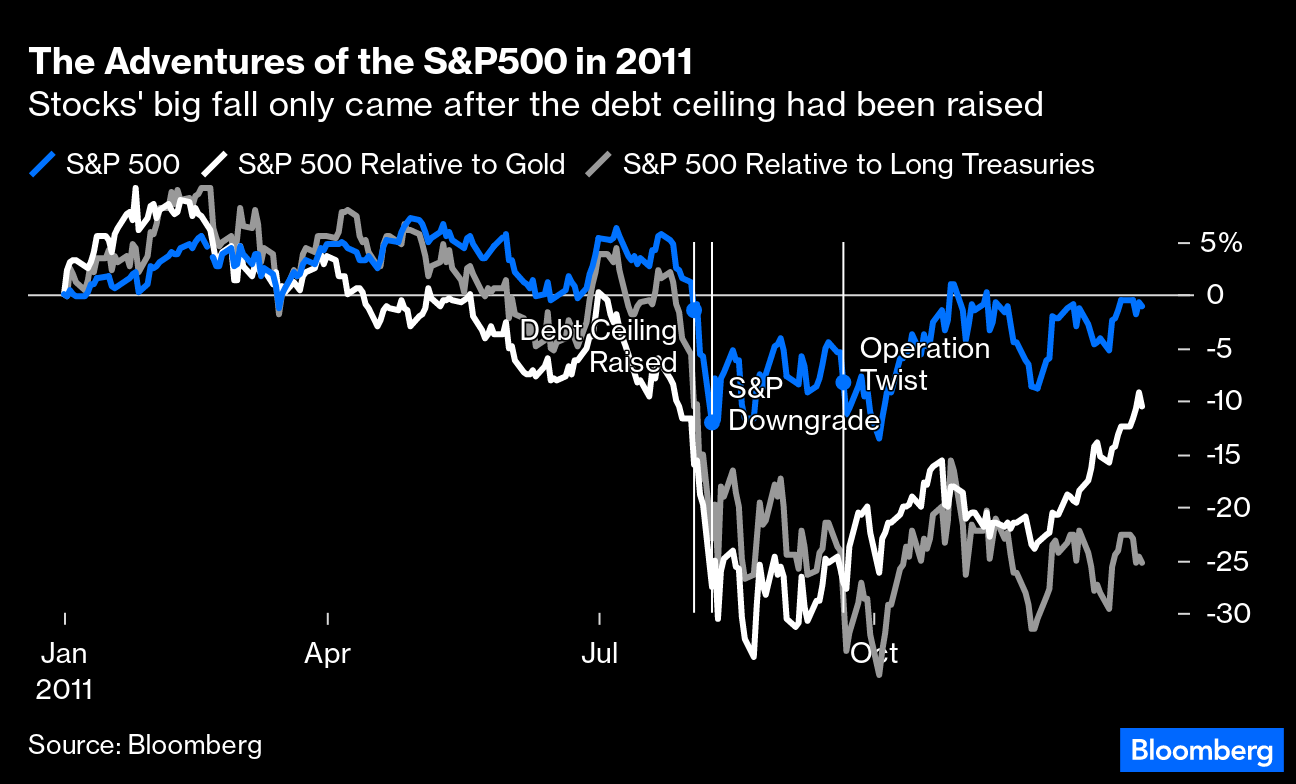
Too many investors are focused solely on whether the debt ceiling is raised. The debt ceiling is likely to be raised. The more important question is how the debt ceiling is raised. In fact, nearly all the S&P 500’s decline during the 2011 debt ceiling fight came AFTER a political agreement was reached. The reason for this is that the $2 trillion of spending cuts were far greater than the consensus expected and growth was downgraded.

Disaster came closest in 2011, when newly elected “Tea Party” Republicans clashed with President Barack Obama’s administration. What’s fascinating is to see that the S&P 500 just about held on to its gains for the year right up until late July, when the issue reached a head. With disaster averted, stocks began to fall. This became a near rout when Standard & Poor’s decided to downgrade sovereign debt from AAA to AA+. Disaster had been averted, but the ratings agency wasn’t impressed by the deal that stopped default.

Stocks only began to recover after the Federal Reserve, some two months later, resorted to “Operation Twist” — reinvesting the cash it made from maturing bonds in its portfolio into long-term bonds, a move that was meant to flatten the yield curve. But it’s notable that while the S&P 500 ended the year almost unchanged in nominal terms, and logged impressive gains relative to gold once the Fed had intervened, it ended the year a long way behind long bonds.

It’s possible that this year’s negotiations will end up obliging the Fed to buy bonds again, which would be great news for asset prices. But the bottom line for now is that uncertainty is greater than in previous episodes, and it can’t safely be ignored. Even if default is avoided, the gyrations could have profound and unanticipated effects on markets. Sadly, we’re all going to have to spend time watching events in Washington.

Investors are piling into ultrashort-term Treasury bills to avoid getting caught up in the debt-ceiling drama.

Surging demand has driven one-month T-bill prices higher, sending the yield down to 3.313% from 4.675% at the end of March. Bills maturing in three months yield 5.105%—a record incentive for lending to the government for a couple months more, according to Tradeweb data going back to 2001. …)

If the limit isn’t raised in time, investors who own maturing Treasury debt might not be paid back right away. Most investors expect they will be made whole by the government later on, but even a temporary disruption would mean an unprecedented shock to the multitrillion-dollar funding markets relied on by banks and companies for managing their daily operations.

Some worry, for instance, that financial software hasn’t been designed to handle past-due debt from the Treasury.

With the debt-ceiling deadline looming, cash managers are looking to avoid having money locked up in Treasury bills around the X date, the day the Treasury will run out of room to sell new debt. (…)

Meanwhile, the lack of government refunding has led to a shortage of Treasury bills, reducing supply and lifting prices. (…)

(…) individuals have continued buying, at about five times the rate this year as in 2017 to 2019. (…)

Individuals are increasingly favoring diversified ETFs over single stocks, they are trading less actively, and by at least one measure, they are pulling back from the riskier options market. (…)

And individual investors’ inflows into money-market funds, traditionally considered a flight to safety, remain elevated as well.

Some of that caution is likely because the average individual investor’s brokerage portfolio is down about 27% from a November 2021 peak, according to Vanda’s estimates, a reflection of their high concentration in stocks such as Tesla Inc. (…)

Brokerage company Charles Schwab Corp. on Monday reported clients opened more than 1 million new brokerage accounts in the first quarter and added a net $132 billion in assets. Yet clients’ daily average trades were down 10% from a year earlier.

That continues a recent trend. In the fourth quarter of last year, trading volume at retail brokerages dropped to around 22.5% of total U.S. equity-market volume, down from a peak of 37% in January 2021, according to a JPMorgan Chase & Co. analysis.

The share of options activity among individual investors has also been dropping, most recently making up around 12% of the total market, down from roughly 18% in July 2020, according to the analysts. The bank’s data also show individuals have been net buyers of ETFs and net sellers of individual stocks in 2023, a sign investors are seeking to diversify more. (…)

For every dollar going into the SPDR S&P 500 ETF Trust (SPY), 26 cents goes into technology stocks.

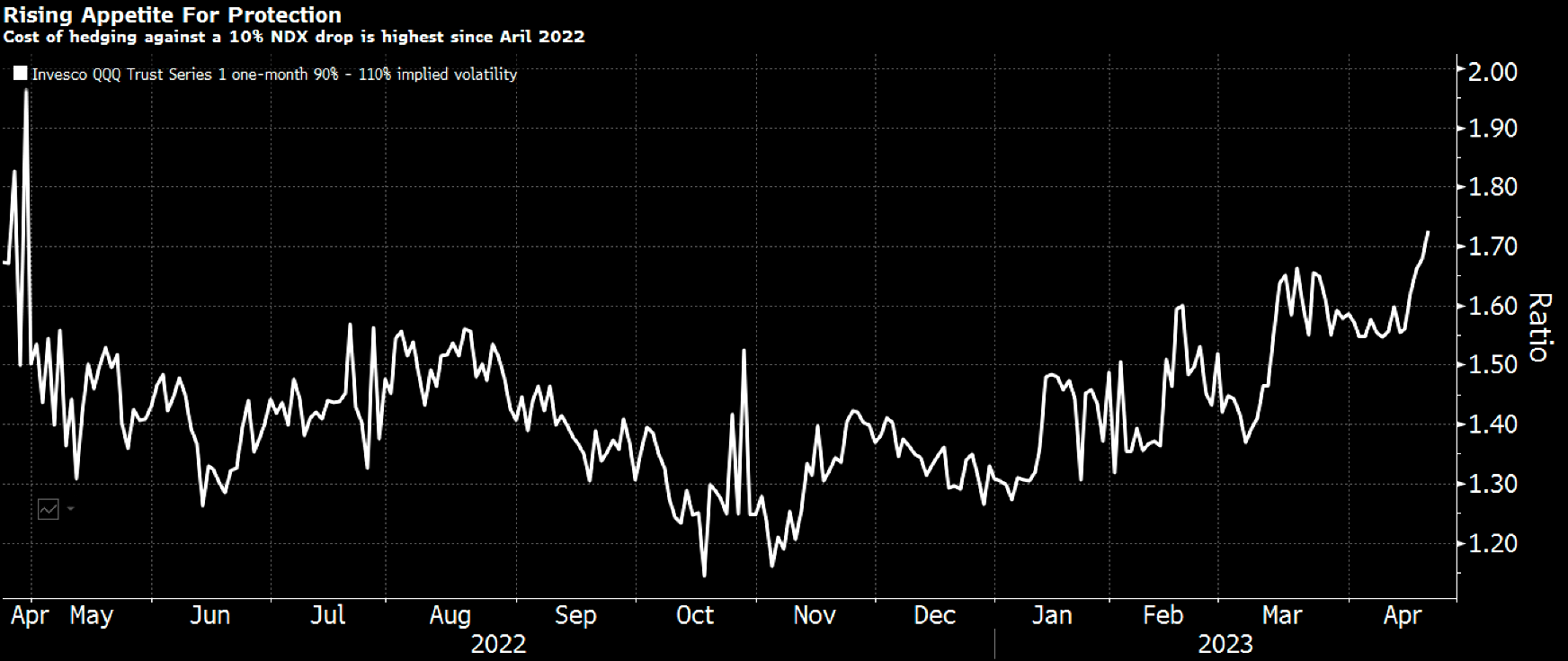
Meanwhile, the “cost of contracts protecting against 10% decline in QQQ is now 1.7 times more than cost of options that profit from 10% rally, most since April 22.” (The Market Ear)

Bloomberg

Ed Yardeni illustrates the recent jump in IT stocks’ P/Es. Ed also points out that IT forward revenues are expected to rise only 0.3% with forward earnings down 6.9%, worst since 2008. Ex-IT, S&P 500 forward revenues are seen rising 6.1% with earnings down 0.3%.

image

TECHNICALS WATCH

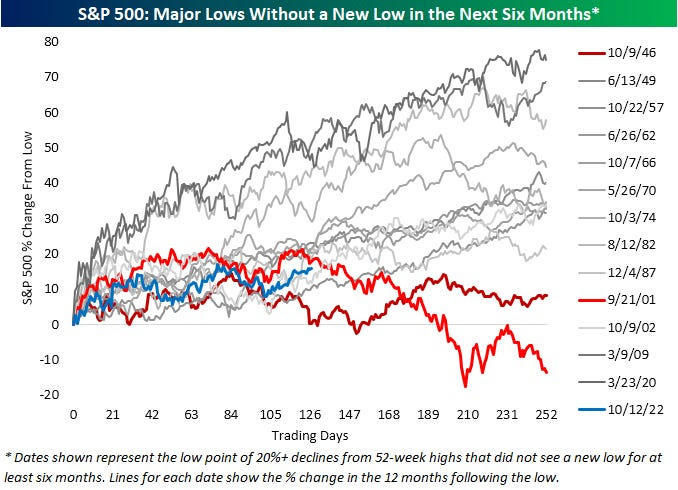
(…) one interesting angle is shown here — how the market has traded after making a major low without making a new low within the subsequent 6 months (which the Oct 2022 low qualifies for). General drift upwards, with a couple of exceptions. (Callum Thomas)

@bespokeinvest via @RyanDetrick

China’s Xi Pledges Support for Innovative Firms Amid US Rivalry

(…) Innovation led by companies is key to realizing “high-level technological self-reliance,” Xi declared at a meeting on Friday attended by senior Communist Party officials, including Premier Li Qiang. The government should help companies crack core tech challenges facing the country, the official Xinhua News Agency reported, citing the meeting Xi presided over.

Xi said the key to growing private business lies in removing institutional barriers that impede fair competition and calibrating policy to ensure better coordination and “solve companies’ real difficulties.” The state sector should be reformed to ensure national economic security, he added, while improving efficiency and oversight. (…)

President Joe Biden is considering signing an executive order in the coming weeks that will limit American business investment in key parts of China’s economy, Bloomberg News reported, citing people familiar with the deliberations.

Treasury Secretary Janet Yellen said Thursday the US was prepared to accept economic costs to protect national security interests from threats posed by Beijing. The US has already rallied Japan and the Netherlands to introduce export controls on shipments of advanced chip technology to China.

Xi’s comments also mark a shift in Beijing’s view of private business after years of intense regulatory crackdowns, especially on the tech sector. He has recently made calls for the world’s No. 2 economy to pursue self-reliance across key industries to counter the US. (…)