The enemy of knowledge is not ignorance, it’s the illusion of knowledge (Stephen Hawking)

It ain’t what you don’t know that gets you into trouble. It’s what you know for sure that just ain’t so (Mark Twain)

Invest with smart knowledge and objective odds

THE DAILY EDGE: 16 MARCH 2023: All Fed, Again!

Market Stress Snarls Trading in U.S. Treasurys Making deals now is as hard as in early days of Covid-19, traders say

The markets for the world’s safest and most liquid assets, the government bonds issued by the U.S. and other rich countries, came under immense stress on Wednesday following a week of worries about the health of global banks.

Liquidity, the capacity to trade quickly at quoted prices, has fallen sharply in two of the keystone markets, those for U.S. Treasurys and German bunds, traders said. Difficulties including wider price spreads and slower executions are now spreading to many other markets, they said, including those for derivatives that firms and traders use to lock in prices and hedge risks weeks and months ahead of time, such as options, futures and swaps. (…)

Trading was frenetic. Trading volumes in the Treasury market Wednesday appeared to be about twice typical levels, said Ian Lyngen, head of U.S. rates strategy at BMO Capital Markets.

But the spreads quoted in markets for Treasurys and derivatives tied to other government bonds, reflecting the gap between quoted prices to buy and sell, were far wider on Wednesday than they were last week, traders said, typically a sign of market anxiety.

The ICE BofA Move Index, a measure of volatility in the bond market, rose to the highest levels in at least three years, surpassing levels recorded during the March 2020 market crash.

The ease of buying and selling Treasurys makes them the bedrock of Wall Street trading, used to park money or as collateral on loans. When the market breaks down, the resulting turmoil can rapidly spread to other assets, hitting everything from stocks to currencies—as well as, eventually, the rates for mortgages and other loans.

Investors generally agreed that fear of economic distress was driving down interest-rate expectations and pushing investors to dump riskier assets in favor of safer ones, following the U.S. bank and Credit Suisse routs. (…)

One driver of the unruly trading: the significant change over the past week in the outlooks for global growth and inflation, reflecting concerns that the U.S. bank mess and trouble in Europe might signal a sharp slowdown ahead. (…)

“Markets operate on greed and fear,” Mr. Bass said. “Fear is overriding greed right now.” (…)

Some traders said that the market moves were some of the wildest they had seen in their careers. Government bond prices have logged swings not recorded in decades, when Paul Volcker was chairman of the Federal Reserve. (…)

Quantitative investment strategies also helped fuel the price swings.

After enjoying a record-breaking year betting bond prices would fall, algorithmic money managers that ride market trends are racing to close out their short positions, or purchasing securities previously borrowed and sold in a bid to benefit from falling prices.

Computer-driven funds such as commodity trading advisers, or CTAs, took large bearish positions in the Treasury market in recent weeks, according to Société Générale SA. Then bonds rallied and yields dropped, wrong-footing some traders and adding to the price swings. (…)

Monetary Tightening and U.S. Bank Fragility in 2023: Mark-to-Market Losses and Uninsured Depositor Runs?

This March 13 paper (post SVB) is from 4 researchers at USC, Northwestern, Columbia and Stanford universities.

The short of it is that the U.S. banking system is “a lot more fragile than commonly assumed”:

Even if only half of uninsured depositors decide to withdraw, almost 190 banks are at a potential risk of impairment to insured depositors, with potentially $300 billion of insured deposits at risk. If uninsured deposit withdrawals cause even small fire sales, substantially more banks are at risk. Overall, these calculations suggest that recent declines in bank asset values very significantly increased the fragility of the US banking system to uninsured depositor runs.

Post the GFC, the Fed’s QE policies brought real long-term rates substantially below normal, often driving them below zero. Its narrative of “lower-for-longer” and “transitory inflation” in 2021 convinced many investors that the Fed was in control and that bonds were relatively safe investments even if earning little in real terms.

image

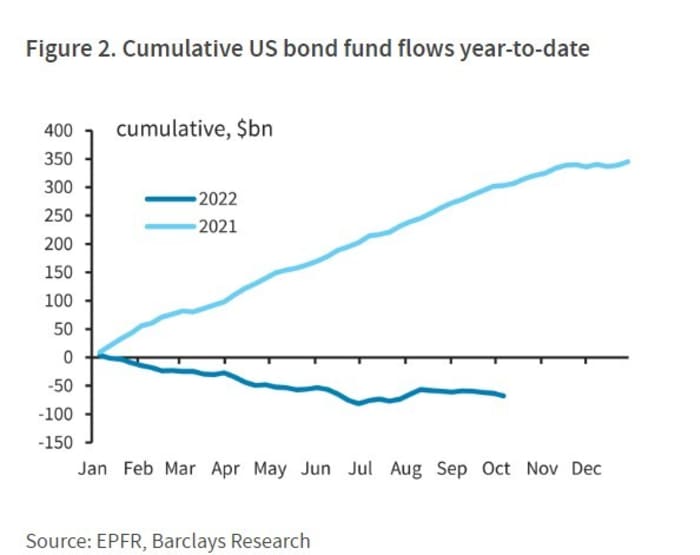
Demand for bonds exploded in 2021 and nobody should be surprised that most financial institutions yearned for yields.

US Bond Mutual Fund Flows

image

 As investors hasten to the exit, $68 billion flees U.S. bond funds in 2022  - MarketWatch image

Obviously, some went too far and are now facing losses if forced to sell to meet withdrawals.

So, what does the Fed do?

  1. Backstop depositors to prevent more bank runs.
  2. Provide low cost liquidity if needed.
  3. Set policies so that LT rates decline to restore bond portfolio values.
    1. A new QE. Really?
    2. First, stop QT.
    3. Anything else? If not…
    4. …Bring inflation down, i.e. recession, soon.

“The usage of the Fed’s Bank Term Funding Program is likely to be big,” strategists led by Nikolaos Panigirtzoglou in London wrote in a client note Wednesday. While the largest banks are unlikely to tap the program, the maximum usage envisaged for the facility is close to $2 trillion, which is the par amount of bonds held by US banks outside the five biggest, they said. (…)

The Federal Reserve may need to end its quantitative-tightening program early to preserve the amount of bank reserves in the financial system while also maintaining its hawkish signaling on interest rates, according to Citigroup Inc. (…)

“Their new BTFP facility is QE in another name – assets will grow on the Fed balance sheet which will increase reserves,” Citi strategists Jabaz Mathai, Jason Williams and Alejandra Vazquez Plata wrote in a note to clients on Monday. “Although technically they are not buying securities, reserves will grow.” (…)

The strategists see three options for the Fed. One would be stopping QT early or reducing the monthly amount of bonds it allows to roll off, to ensure reserves are relatively stable for the rest of the year.

Another choice would be to lower the maximum amount each money-market fund is allowed to park at the Fed’s reverse repurchase agreement facility from $160 billion, while allowing QT to run in the background.

A third possible route, according to Citigroup, is that the Fed stops hiking but continues its balance-sheet unwind, forcing money funds to extend the weighted average maturity of their holdings and pulling cash out of the RRP as they buy longer maturities. The strategists see this as unlikely since the Fed has shown it’s more comfortable tightening economic conditions via short-end rates. (…)

Bank Failures, Market Turmoil Fuel Bets on a Pause in Fed Rate Increases Interest-rate futures markets indicate a 50% chance of no increase at the central bank’s next meeting.

(…) “A pause now would send the wrong signal about the seriousness of the Fed’s inflation resolve,” said Michael Feroli, chief U.S. economist at JPMorgan Chase. It could also fuel fears that the Fed is hesitant to raise rates but quick to cut them, he said, because of concerns about financial stability—something economists refer to as “financial dominance.” (…)

Economy Shows Signs of Cooling as Bank Troubles Spread A drop in retail sales and an easing of inflation pressures last month shows the economy may be cooling after a hot start to the year.

(…) Spending fell at stores, online and in restaurants by a seasonally adjusted 0.4% in February, the Commerce Department said Wednesday, following a 3.2% jump in January.

A separate report Wednesday showed a measure of supplier inflation cooled last month. The producer-price index, which generally reflects supply conditions across the economy, fell 0.1% in February from the prior month, the Labor Department said. On a 12-month basis, producer prices rose 4.6% in February, slowing from January’s downwardly revised 5.7% gain. (…)

Over the past year retail sales have advanced 5.4%. (…)

In reality, retail sales were fairly strong last month. The 2.2% MoM drop in Food Services (still up 15.3% YoY!), quite normal after January’s huge 5.6% jump, masks the continued demand for goods (blue bar), up another 0.5% following January’s +2.3%.

fredgraph - 2023-03-16T061642.803

On a YoY basis, total sales are up 5.4% and control sales 7.1%. Goods inflation (35% CPI-Durables + 65% CPI-Nondurables) was 3.5% in February, down from 4.4% in January and 4.7% in December. It peaked at 14.6% in March 2022.

U.S. Producer Prices Dropped in February

The producer-price index, which generally reflects supply conditions across the economy, fell 0.1% in February from the prior month, compared with a downwardly revised 0.3% increase in January, the Labor Department said Wednesday. That compared with a 0.2% average monthly rise in the two years before the pandemic.

The so-called core price index—which excludes the often-volatile categories of food, energy and supplier margins—climbed 0.2% in February from a month earlier, compared with a downwardly revised 0.5% in January.

On a 12-month basis, prices rose 4.6% in February, slowing from January’s downwardly revised 5.7% gain. Last month’s rise was down sharply from the 11.7% peak in March 2022, and was the lowest reading since March 2021. Core PPI increased 4.4% from a year earlier, the same pace as January’s revised gain. (…)

Not as good as it seems:

  • Core PPI is up 4.2% annualized in the last 2 months from 3.6% in the previous 2 months.
  • Core PPI-Goods is up 0.3% in February after 0.6% in January. Last 2 months: +5.5% a.r. vs 2.4% in the previous two.
  • Total PPI-Services declined 0.1% in both January and February but only because retail margins and transportation and warehousing costs dropped. Excluding these items, PPI-Services rose 0.3% in February after 0.6% in January. Last 2 months: +5.6% a.r. vs 4.9% in the previous two.
JPMorgan Joins Those Saying Cash in Bond Gains The Fed may still raise rates, casting doubts on a recent rally.
ALL FED, AGAIN!

Still needing to fight inflation, it now has to mind the financial system its own policies drove into a bad pickle. The economy remains too strong, requiring more tightening, but financial markets need more liquidity while long rates must come down.

Good luck!

BTW: Empire State Manufacturing Survey: Activity Continues to Contract

Manufacturing activity continued to decline in New York State, according to the March survey. The general business conditions index fell nineteen points to -24.6, continuing the see-saw pattern of ups and downs within negative territory seen in recent months.

The new orders index fell fourteen points to -21.7, indicating that orders declined substantially, and the shipments index fell fourteen points to -13.4, pointing to a decline in shipments.

The index for number of employees fell four points to -10.1, its second consecutive negative reading, indicating that employment levels continued to decline. The average workweek index fell six points to -18.5, its lowest level since early in the pandemic, indicating that hours worked shrank for a fourth consecutive month.

Input prices and selling prices increased at a somewhat slower pace than last month: the prices paid index fell three points to 41.9, and the prices received index moved
down six points to 22.9.

image

U.S. Maternal Mortality Hits Highest Level Since 1965 The 2021 surge in maternal deaths exacerbated a yearslong trend that has made the U.S. the most dangerous place among high-income countries to give birth.

THE DAILY EDGE: 15 MARCH 2023

Inflation Eases as Fed Confronts Bank Failures Consumer prices rose 6% last month from a year earlier, the slowest pace since September 2021, as the central bank contemplates its next interest rate move.

The consumer-price index, a closely watched inflation gauge, rose 6% in February from a year earlier, down from a 6.4% gain the prior month, the Labor Department said. It was the smallest increase since September 2021. When excluding volatile food and energy costs, prices advanced a slightly slower 5.5%. (…)

Core prices increased by a seasonally adjusted 0.5% in February, the largest monthly gain in five months. Shelter costs rose 0.8% over the month, matching the largest monthly gain since the 1980s. (…)image

For U.S. consumers, inflation on CPI-Essentials at 8.0% YoY still substantially exceeds wage growth (5.3%), a negative gap persisting since November 2021. No wonder the sharp increase in the labor force nobody is talking about.

CPI ESSENTIALS vs WAGES

fredgraph - 2023-03-15T071231.345

The long awaited and widely forecast decline in rentflation has yet to materialize.

(Bespoke)

CPI-Services ex-Shelter did slow down to 0.24% in February but is still up 5.1% annualized in the last 3 months and is up 6.9% YoY.

Fed Will Walk a Tightrope Between SVB, Inflation There’s nothing like bank failure to change the risk calculus, but the latest CPI numbers give the Federal Reserve little reason to not hike rates.

(…) Digging through the measures that different branches of the Fed compile to grasp the breadth of inflation tends to confirm that generalized price pressure remain very high. The Cleveland Fed’s measure of the trimmed mean (in which outlier components in either direction are discarded and an average taken of the rest) is barely below its January level, and still above 6%. Its measure of the median has topped 7% for the first time.

Meanwhile, the Atlanta Fed divides the CPI into components whose prices are flexible, meaning they can be moved up or down quickly with little difficulty, and those that are sticky, where price rises take a while to prepare and are hard to reverse. In 2021 and early 2022, the resurgence of inflation was almost entirely about flexible pricing. Now, sticky price inflation is actually higher than flexible, and remains at an elevated level. This is exactly what the Fed will have wanted to avoid, as it implies that inflationary psychology is becoming ingrained.

(…) it’s noticeable that inflation has dipped quite significantly if shelter prices are excluded. It’s also a little disconcerting that sticky prices picked up last month, whether or not shelter was included. (…)

If we look at the Zillow Rental Index, which is based on each month’s new leases, a different picture emerges in which inflation is already dropping dramatically — although it did tick back up into positive territory in February. On the face of it, there is every reason to assume that shelter inflation will soon start to decline in the official data, which should mean that headline inflation also comes down. (…)

There’s nothing in this report to suggest that inflation is defeated already, or to justify leaving rates unchanged. Not to raise the fed funds rate next week, with median inflation above 7%, would be a sign of panic, as Jonathan Levin points out. That doesn’t mean that it won’t happen. But if the Fed leaves rates on hold, it will be because the problems of the banking sector have forced it to do so. (…)

Condensing much frantic debate, the latest macro data give no real excuse for the Fed to decide against hiking its target rate at all when the Federal Open Market Committee meets next week. Meanwhile, its remit to safeguard financial stability strongly suggests that it would be unwise to hike less than two weeks after introducing a new lending facility to rescue bank depositors. The effect of the rescue should be to tighten financial conditions, and therefore slow the economy, somewhat more than had previously been expected. (…)

Bank runs at Silicon Valley Bank, Silvergate Capital Corp (SI.N) and Signature Bank (SBNY.O) have deteriorated the operating environment for the sector that is now battling a crisis of confidence, both from investors and depositors, the ratings agency said.

Lenders that had “substantial” unrealized securities losses and uninsured deposits may be hurt more as customers look for safer alternatives to park their funds.

S&P has not placed other U.S. banks on CreditWatch negative since First Republic Bank as it has not seen widespread deposit outflows, the ratings agency said on Tuesday, hours after Moody’s cut its outlook on the U.S. banking system to negative.

(…) S&P said it had not seen evidence that the unmanageable deposit outflows seen at a few banks had widely spread across the banks it covers.

S&P said U.S. regulators’ measures gave banks additional liquidity, although the ratings agency cautioned that conditions were fluid and that some banks were showing greater signs of stress than others.

Credit Suisse shares sink to all-time low after top investor rules out more funding
NFIB: Expectations for Better Business Conditions Remain Low

image

image

image

image

China’s Economy Rebounds, Spurred by Consumption Data suggest China’s expected recovery is broadly on track after the country’s zero-Covid exit, adding to signs of resilience in the global economy.

(…) Retail sales in China grew 3.5% in January and February compared with the same period last year, marking a sharp turnaround from the 1.8% annual contraction recorded in December, China’s National Bureau of Statistics said Wednesday.

Industrial production in the first two months rose 2.4%, up from a 1.3% increase in December. Investment in fixed assets such as infrastructure and machinery increased 5.5%.

China’s statistics agency combines major economic indicators for January and February to avoid distortions from holidays around Lunar New Year, when businesses take a break and workers head home for family reunions. (…)

The unemployment rate in urban areas stood at 5.6% in February, slightly higher than January’s 5.5%, the statistics bureau said Wednesday, though it added that the change likely reflected seasonal factors as workers change jobs during the Lunar New Year holidays. Youth unemployment remained high, with 18.1% of those surveyed aged 16 to 24 out of work. (…)

Consumer prices in China rose just 1% on the year in February, down from a 2.1% increase in January.

SENTIMENT WATCH
  • Another new low print for JPM’s survey…”Are you more likely to increase or decrease equity exposure…” (The Market Ear)

JPM
Tether Becomes Unlikely Crypto Winner in Banking Crisis The stablecoin’s market cap has risen 10% this year

So far this year, tether’s market cap has risen 10% to $73 billion while that of its chief rival, USD Coin, fell by more than 11% to $39 billion, according to CoinMarketCap data. Binance USD has fallen by almost half to just over $8 billion. (…)

The shift away from USD Coin, which markets itself as the most transparent and regulated stablecoin, marks a sharp reversal of market conditions last year when the collapse of algorithmic stablecoin TerraUSD spooked investors, leading them to redeem billions of tether and switch to USD Coin. (…)

Tether is the best-known and most widely traded stablecoin—a breed of cryptocurrency that converts to and from dollars at a fixed price. Despite its tenure, the coin has faced controversy over the transparency of its operations and lack of information on how it invests the reserves that back its cryptocurrency. (…)

However, tether’s lack of transparency might be working in its favor right now.

“This is a validation of what we know about money and things that try to be money—which is when you provide too much information, you are susceptible to runs,” said Steven Kelly, a researcher at Yale University’s program on financial stability.

“We knew Circle had exposure to SVB, we found out what it was and there was a run. We don’t really know as much about tether, and it just seems safer for that reason alone,” said Mr. Kelly. Confused smile (…)

Yet:

Largest weekly outflows on record totalling US$255m

  • Digital asset investment products saw outflows for the 5th consecutive week totalling US$255m, the largest single weekly outflows on record representing 1.0% of total assets under management (AuM).
  • AuM has fallen by 10% over the week, retracing back to levels seen at the beginning of 2023. The outflows have also wiped out all the inflows seen this year.
  • Bitcoin, being the largest digital asset, was the primary focus, seeing outflows totalling US$244m last week.

Generative AI Brings Cost of Creation Close to Zero, Andreessen Horowitz’s Martin Casado Says “I think it’s going to creep into our lives in ways we least expect it,” Mr. Casado said at the WSJ CIO Network Summit.

The value of ChatGPT-like technology comes from bringing the cost of producing images, text and other creative projects close to zero, according to Andreessen Horowitz General Partner Martin Casado.

With only a few prompts, generative AI technology—such as the giant language models underlying the viral ChatGPT chatbot—can enable companies to create sales and marketing materials from scratch quickly for a fraction of the price of using current software tools, and paying designers, photographers and copywriters, among other expenses, Mr. Casado said.

“That’s very rare in my 20 years of experience in doing just frontier tech, to have four or five orders of magnitude of improvement on something people care about,” Mr. Casado said Tuesday at The Wall Street Journal’s CIO Network Summit in Palo Alto, Calif.

On Tuesday, ChatGPT maker OpenAI released GPT-4, the startup’s latest AI language model trained on massive amounts of data, as well as human feedback, to generate natural language response to user prompts. The technology can also write computer code. (…)

Though ChatGPT, which is available free online, is considered a consumer app, OpenAI has encouraged companies and startups to build apps on top of its language models—in part by providing access to the underlying computer code for a fee.

For businesses, Mr. Casado said, there are “certain spaces where it’s clearly directly applicable,” such as summarizing documents or responding to customer queries. Many startups are racing to apply the technology to a wider set of enterprise use cases, he said.

But Mr. Casado said GPT-4 and other generative AI tools are less likely to be successful when retrofitted to an existing business model. Instead, he expects the technology to spark entirely new businesses and organizations.

(…) OpenAI says it has spent the past six months making the new software safer. It claims ChatGPT-4 is more accurate, creative and collaborative than the previous iteration, ChatGPT-3.5, and “40% more likely” to produce factual responses. (…)

A user will have the ability to submit a picture alongside text — both of which ChatGPT-4 will be able to process and discuss. The ability to input video is also on the horizon. (…)

OpenAI said in a blog post that the latest iteration “still has many known limitations that we are working to address, such as social biases, hallucinations, and adversarial prompts.” (…)

(…) my initial take is that GPT-4 looks like a big step forward, but not a revolutionary advance over what OpenAI and others have been racing to put into production over the past two months. And it will only heighten the debate about whether tech companies, including OpenAI, are being irresponsible by putting this powerful technology in the hands of consumers and customers despite its persistent flaws and drawbacks.

Meanwhile, Microsoft is expected to unveil a range of A.I.-powered enhancements to its Office software suite on Thursday. And Baidu, the Chinese search giant, has a big announcement scheduled for later this week. Google, which was caught flat-footed by the viral popularity of ChatGPT and OpenAI’s alliance with Microsoft, is eager to prove that it’s not about to be sidelined in the A.I. race. And the big news today before OpenAI’s GPT-4 announcement was that Google had beaten Microsoft out of the gate with a bunch of big A.I. announcements of its own.

For most people, the main news is that the search giant said it is adding generative-A.I. features to its popular Workspace productivity tools, such as Google Docs, Sheets, and Slides. Among the things people will now be able to do is use a text box to prompt Google’s A.I. to automatically draft almost any kind of document, or to create different kinds of charts for Sheets data. Users can highlight text and ask Google’s A.I. to edit it for them or rewrite it in a different tone and style. You will also be able to automatically draft emails or summarize entire email threads in Gmail. In Google Meet you will be able to generate new virtual backgrounds and automatically create notes of conversations, complete with summaries.

But equally important was the other news Google announced: The company is allowing enterprise customers to tap its most advanced family of large language models—called PaLM —through an application programming interface on Google Cloud. (…)