The enemy of knowledge is not ignorance, it’s the illusion of knowledge (Stephen Hawking)

It ain’t what you don’t know that gets you into trouble. It’s what you know for sure that just ain’t so (Mark Twain)

Invest with smart knowledge and objective odds

THE DAILY EDGE: 2 MARCH 2023

MANUFACTURING PMIs

USA: Softest decline in output for three months as supply chain conditions improve

  • Manufacturing PMI at 47.3 from 46.9 in January but down from the earlier
    released ‘flash’ estimate of 47.8.
  • Still a solid deterioration in the health of the goods-producing sector.
  • A further drop in new order inflows contributed to the continued overall decline in manufacturing sector health in February. The rate of contraction was little-changed from that seen in January and was strong overall. Lower new sales were often attributed to destocking at customers.
  • Foreign demand conditions also weakened further, with new export orders falling for the ninth month running. The pace of decrease quickened from January and was solid overall.
  • Input prices faced by manufacturing firms increased at a sharp pace midway through the first quarter, as higher raw material costs pushed operating expenses up. That said, the rate of cost inflation eased to the second-slowest since September 2020 amid reports that some items had fallen in price.
  • Nonetheless, firms sought to pass-through higher costs to clients via another rise in selling prices in February. The rate of charge inflation gathered pace for the second month running and was the quickest since November 2022. Although slower than those seen throughout the last two years, the pace of increase was well above the series trend.
  • Manufacturers recorded the fastest pace of job creation since September 2022. Firms reported an easing labor shortages as some long-held vacancies were filled.
  • Meanwhile, goods producers registered a further fall in backlogs of work amid lower new order inflows.

 image image

The ISM:

  • ISM Manufacturing PMI at 47.7 vs 47.4.
  • 14 of 18 industries reported contraction in February (15 in January).
  • New orders 47.0 vs 42.5. New export orders 49.9 vs 49.4.
  • Employment back in contraction at 49.1 vs 50.6.

   New Orders                           New Export Orders

 image image

Recall that the S&P 500 Index is a “goods” index. This Yardeni.com chart illustrates the tight correlation between trends in the ISM Manufacturing PMI and S&P companies revenues growth.

image

At its current level, the ISM PMI suggests that revenue growth will turn negative in 2023. Not in analysts’ models yet.

image

See also the Feb. 21 Daily Edge: Margins Threats

This Gavekal chart (to January) indicates that S&P 500 earnings are facing the worst conditions since at least 1980:
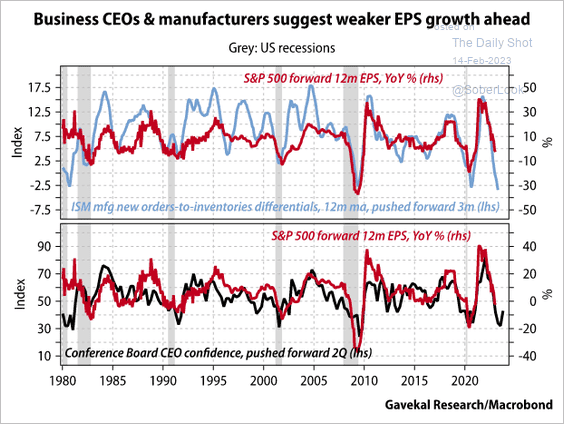
Source: Gavekal Research via The Daily Shot

David Rosenberg shows that it may not be wise to load up on cyclicals at this point:

image11[1]_thumb

CANADA: Growth accelerates in February

  • Manufacturing PMI at 52.4 from 51.0 in January.
  • Both manufacturing output and new orders continued to rise during February, with growth rates picking up from relatively modest levels seen in February to their highest since last May. There were reports of firmer market demand, linked in part to lower inflation and growing confidence in the outlook.
  • Foreign sales remained subdued, with exports down for a ninth successive month and suggestive that the current upturn in overall orders is being predominately led by the domestic market.
  • Input prices rose to the slowest degree since July 2020 amid reports that greater stability in supply chains was placing some downward pressure on costs. That said, underlying inflation remained elevated, and firms continued to pass on a significant proportion of their cost bases to clients in the form of increased output charges, albeit to the weakest degree in the past five months.
  • Staffing levels increased modestly for a fourth successive month.
  • Buying activity declined for a seventh month in a row, albeit modestly, whilst there was a similar sized decline in stocks of purchases.

image

Vehicles Sales at 14.89 million SAAR in February

Wards Auto estimates sales of 14.89 million SAAR in February 2023 (Seasonally Adjusted Annual Rate), down 5.4% from the January sales rate, and up 8.6% from February 2022.

What Now for a Fed That Has Fallen Behind the Curve Again?

By Mohamed A. El-Erian:

(…) At least three Fed officials have already publicly signaled their openness to a 50-basis-point  increase after they all opted for a downshift to 25 basis points on Feb. 1. Others have yet to weigh in and may well be on the fence because of the counterargument that it is too early to evaluate the full impact of what, after a hesitant start, was one of the most front-loaded rate-increase cycles in decades. After all, the conventional wisdom among many is still that monetary policy acts with “long and variable lags” — a consideration that assumes greater importance in the light of forward-looking data that point to a potential slowing of the economy. (…)

It is often said that the first rule of finding yourself in a hole is to stop digging. With the Fed having already dug itself a deep hole, it is no longer crystal clear to me what the right policy step should be now. I suspect I am not the only one.

This ambiguity is not just a problem for Fed policy but also for the well-being of both the domestic and global economy. As always, it is the most vulnerable segments that are most at risk.

  • BTW, the pandemic-era expansion of the food stamp program, covering 32 million Americans, expired yesterday. Food prices have jumped 23.7% over the last 3 years. The monthly support of $251 per average recipient drops $82 (-33%) to $169. And “Those who qualify for the minimum benefit under the standard income guidelines — many of whom are older Americans relying on Social Security — will see the steepest decrease, from $281 in monthly benefits to only $23”. (NYT)
  • BTW #2: Student-Loan Borrowers Likely Won’t Know for Months if Debt Will Be Forgiven The Supreme Court is expected to rule on a challenge to the Biden administration’s program in late June.

The Atlanta Fed’s Raphael Bostic:

(…) So, now we must determine when inflation is irrevocably moving lower. We’re not there yet, and that is why I think we will need to raise the federal funds rate to between 5 and 5.25 percent and leave it there until well into 2024. This will allow tighter policy to filter through the economy and ultimately bring aggregate supply and aggregate demand into better balance and thus lower inflation.

Here’s what I will need to see to consider reversing the course of monetary policy:

  • A narrowing of the gap between labor supply and demand
  • Higher interest rates more decisively affecting aggregate demand
  • Ongoing recovery in aggregate supply
  • Reduction in the breadth of inflation
  • Stable inflation expectations
Eurozone inflation comes in higher than forecasts Slight easing in inflation rate to 8.5% fuels expectations over further ECB interest rate rises this year

FYI:

How does the brain age across the lifespan? New studies offer clues.

Colorectal cancer rises among those 55 and younger Alarming new findings offer more evidence of a puzzling rise in colorectal cancer in patients under 50 and the challenges of reaching them with timely screening.

THE DAILY EDGE: 1 MARCH 2023

MANUFACTURING PMIs

Euro area manufacturing production stabilises in February as supplier delivery times see most rapid improvement since 2009

  • Final Eurozone Manufacturing PMI at 48.5 (Jan: 48.8). 2-month low.
  • New orders fell for a tenth successive month as client destocking, inflation and general economic uncertainty weighed on sales performances.
  • A notable and stronger drag on demand came from international markets, as evidenced by a quicker decline in new export orders1 during February.
  • Overall, purchase prices rose only marginally and to the weakest extent since September 2020.
  • Output price inflation proved to be more rigid, however, with the rate of increase in selling prices staying sharp and well above its long-run average. This was despite factory gate charges rising at the softest pace in two years. image 

U.K.: New orders fall but show signs of stabilising

China: Manufacturing sector returns to growth in February

  • PMI at 51.6 vs 49.2.
  • Total new business expanded for the first time in seven months, and
    at the quickest rate since May 2021.
  • Companies noted an improvement in foreign demand for Chinese manufactured goods, with new export orders rising for the first time since July 2022.
  • Backlogs of work rose for the second straight month and at the quickest rate since October 2021.
  • Purchasing activity increased for the first time in four months, and at the fastest rate since June 2021
  • Prices data indicated that inflationary pressures remained relatively muted, with input costs rising only modestly in February. Average selling prices were meanwhile lifted for the first time in ten months, albeit only slightly.

 image image

Japan: Further falls in manufacturing output and new orders in February

  • Sharpest reductions in output and new orders since July 2020
  • New sales fell for the eighth month running, and at the fastest pace since July 2020. Firms commented that orders were dampened by weaknesses in domestic and global economic conditions. Export orders also fell at a steeper rate that was the fastest for 31 months, and meant that foreign demand for Japanese manufactured goods had fallen consistently for a year.
  • Backlogs of work decrease at quickest pace for 29 months
  • Slowest rise in input prices for a year-and-a-half
  • The rate of factory gate inflation accelerated for the first time in four months.

image

ASEAN: New order inflows rose for the second consecutive month, and at a quickened pace.

image

Long-Robust U.S. Labor Market Shows Signs of Cooling Private-sector readings show job postings receding more than government reports of job openings

ZipRecruiter Inc. and Recruit Holdings Co., two large online recruiting companies, say their data show the number of job postings is declining more than Labor Department reports of job openings. (…)

The National Federation of Independent Business, which represents small businesses, and LinkUp, a research firm that tracks job listings that companies place on their own websites, also show a sharper drop in postings than recent government reports on openings. (…)

ZipRecruiter’s weak quarterly revenue numbers sent its share price down more than 20% in a day. “We are seeing a surge in job seekers,” Mr. Siegel said. (…)

“We are seeing a decline in employers’ willingness to spend to hire in many industries despite the labor shortage as they become increasingly cautious due to a potential recession in the U.S.,” Hisayuki Idekoba, chief executive of Recruit Holdings, said in a February call. (…)

The reliability of the Labor Department’s job-openings estimates has declined in recent years because fewer businesses have been responding to survey questions, said Paul Calhoun Jr., an economist at the Labor Department. The response rate for the survey fell to 30.6% last September from 56.4% in February 2020. The department increased its sample size in 2019 because of the declining response rates. (…)

From Goldman Sachs:

image

Brisk Sales Power Restaurant Stocks Even though inflation has remained stubbornly high of late, that hasn’t prevented restaurant companies—and their stocks—from thriving.

(…) Restaurants haven’t been immune to rising labor and food costs, but prices at grocery stores have actually risen more quickly than on restaurant menus over the past year, driving more traffic to restaurants. (…)

The industry had a strong fourth-quarter earnings season. Hotel, restaurant and leisure companies in the S&P 500 increased revenue by 25% from a year earlier, according to FactSet. Comparable-store sales in the U.S., a metric carefully watched by analysts and investors, rose 10% from a year earlier at Starbucks Corp., 8.7% at Wingstop and 5.9% at McDonald’s Corp. (…)

The good times have continued in 2023: Consumer spending at restaurants and bars rose 7.2% in January, the most since March 2021. (…)

Sales at food services and drinking places were 30.4% above their pre-pandemic level in December vs +28.4% for other retail sales (black). But restaurant sales surged 7.2% in January (mild weather, seasonal adjustments?) and are up 11% since June 2022 while other retail sales are only up 0.6% in nominal terms.

fredgraph - 2023-03-01T061714.042

On a YoY basis, restaurant sales are up 25.2% in January (from +13.5% in December!) while other retail sales are up only 3.9%.

CPI-Food-away-from-home is up 19.3% since February 2020, slightly slower that Food-at-home prices (+23.7%).

Car Debt Is Piling Up as More Americans Owe Thousands More Than Vehicles Are Worth

(…) “As trade-in values begin to cool, each month more and more consumers will find themselves falling from positive to negative equity,” said Ivan Drury, director of insights at auto-market researcher Edmunds. (…)

The average new-car interest rate rose to 6.9% in January from 4.3% a year earlier, according to Edmunds. (…)

Today, about two out of 13 people are making monthly car payments of $1,000 or more. (…)

For trade-ins that carry negative equity, the average amount is approaching prepandemic levels at $5,500, according to Edmunds data. The surge in prices and prevalence of 84-month loans are fueling concern among consumer advocates and within the auto industry. (…)

In January, severely delinquent auto loans hit their highest rate since 2006, based on Cox Automotive data. (…)

  • Auto loan debt is the third-largest debt category behind mortgages and student loans. Overall, Americans owe $1.52 trillion in auto loan debt, according to the Federal Reserve Bank of New York, accounting for 9.2% of American consumer debt.
  • Borrowers with credit scores 661 and higher account for 66.0% of retail vehicle financing, according to Experian, versus 15.8% for subprime borrowers.
  • Average auto loan amounts have steadily increased in the past decade, reaching $41,665 for new vehicles and $28,506 for used vehicles in the third quarter of 2022, according to Experian.
Pimco Is Saddled With a $1.7 Billion Default in Office-Market Meltdown Columbia Property Trust feels the fallout of rising interest rates

(…) The company suffered from the rise in borrowing costs and plateauing return-to-office rates in big cities, issues that are hammering many office owners. But Columbia also faced unusual circumstances, such as when Twitter Inc. stopped making rent payments in New York and San Francisco, say people familiar with the matter.

The default marks the latest sign that a meltdown is unfolding in the office market as more high-profile landlords default on debt or engage lenders in restructuring discussions. (…)

The U.S. return-to-office rate has increased slightly this year, but remains at about 50% of what it was before the pandemic started. (…)

TOPSY-CURVY

From Bloomberg’s Joe Weisenthal:

The 3M-2Y portion of the yield curve has almost totally un-inverted. This is in keeping with our new “higher for longer” and “no landing” times.

But what’s interesting is that while one curve un-inverts, another curve’s inversion gets deeper and deeper.

The 2Y-10Y spread is now at -90.4. That’s a level we haven’t seen since October 1981, more than 40 years ago. Of course, this is the part of the curve that for years people have generally talked about as having recession-predictive power. Now setting aside whether that’s true, or why it would be true, it’s arguably still flashing a deep red, perhaps signaling that ultimately the tightening the Fed will have to do to kill inflation will induce that recession after all.

Here’s the long-term relationship:

fredgraph - 2023-03-01T071546.071

Combining both lines, we see the increasingly unstable situation. This “normally normalizes” with the 3-M falling fast as the economy weakens and the Fed eases. Unlikely at this point… What if long rates are the normalizing factor?

fredgraph - 2023-03-01T072234.919

Bill White, former BIS chief economist,  William White in a recent The Market interview:

(…) the important point is that we should have higher real interest rates than in the recent past. But to get real rates up, nominal rates need to go up even more than the rate of inflation. The question is whether central banks will allow that to happen or not.

What I see lying ahead are two impediments to central banks being willing to allow rates to move up the amount that they should: The potential for financial system instability and the potential for fiscal instability.

On the financial instability side, there are just so many indicators that tell us that the system is fragile. We’ve had ultra easy money for decades, which in a nutshell has encouraged people to take out debt to do dumb things. If you look at aggregate debt numbers of corporates, households and governments, debt ratios have been going up and up and up.

As per the Institute of International Finance, total debt to world GDP was 250% in 2008, and then it went to about 320% just before the pandemic, and subsequently peaked at about 360%. These are numbers that we have never seen before in peacetime.

On top of this, there has been a decade-long deterioration of the quality of this debt. Closely related, a fascinating recent study by the McKinsey Global Institute showed that up until about the year 2000, broad measures of wealth basically tracked income or GDP. But since then, there’s been a huge discrepancy, with wealth rising much faster than GDP.

But if the production hasn’t gone up, while the wealth has, the conclusion you can come to is that it’s not really wealth. It was merely a rise in the prices measuring that wealth. I wrote a rather prescient paper about this, at the BIS in 2006, called «Real Wealth, Measured Wealth and the Illusion of Saving».

Tech Relative Strength Still Negative

(Bespoke)

Birthday cake A CENTURY OF IMPACT TIME revisits 100 years of making history—through the eyes of the people who lived it