December JOLTS: No Surprises to Finish 2023
The JOLTS report for the final month of 2023 signaled that supply and demand in the labor market continue to come into better balance. Job openings rose in December to 9.0 million, slightly above the upwardly-revised 8.9 million openings in November. Openings are currently 29% above their pre-pandemic level but have fallen by nearly the same amount from the peak in 2022.
The number of job openings per unemployed person, an indicator cited by various FOMC officials when assessing labor market supply and demand imbalances, rose slightly to 1.44. This indicator was about 1.2 before the pandemic, surging to a two-to-one ratio when the labor market was at its tightest about two years ago. (…)
The layoffs and discharge rate, a measure of involuntary separations, was 1.0% in December, the fourth straight reading of 1.0%. This measure was 1.3% before the pandemic and is consistent with other layoff indicators, such as jobless claims, that show employers are hanging onto existing workers even as demand for new workers moderates. (…)

More up-to-date data from Indeed (through Jan. 26) indicate somewhat softer labor demand in January.

But, as Ed Yardeni explains, the latest Conference Board data say “the job market remains strong”:
The series for “jobs hard to get” dropped to 9.8% of respondents, almost a record low reading. It suggests that the unemployment rate remained below 4.0% this month.
The survey’s “jobs plentiful” series jumped to 45.5% during January.
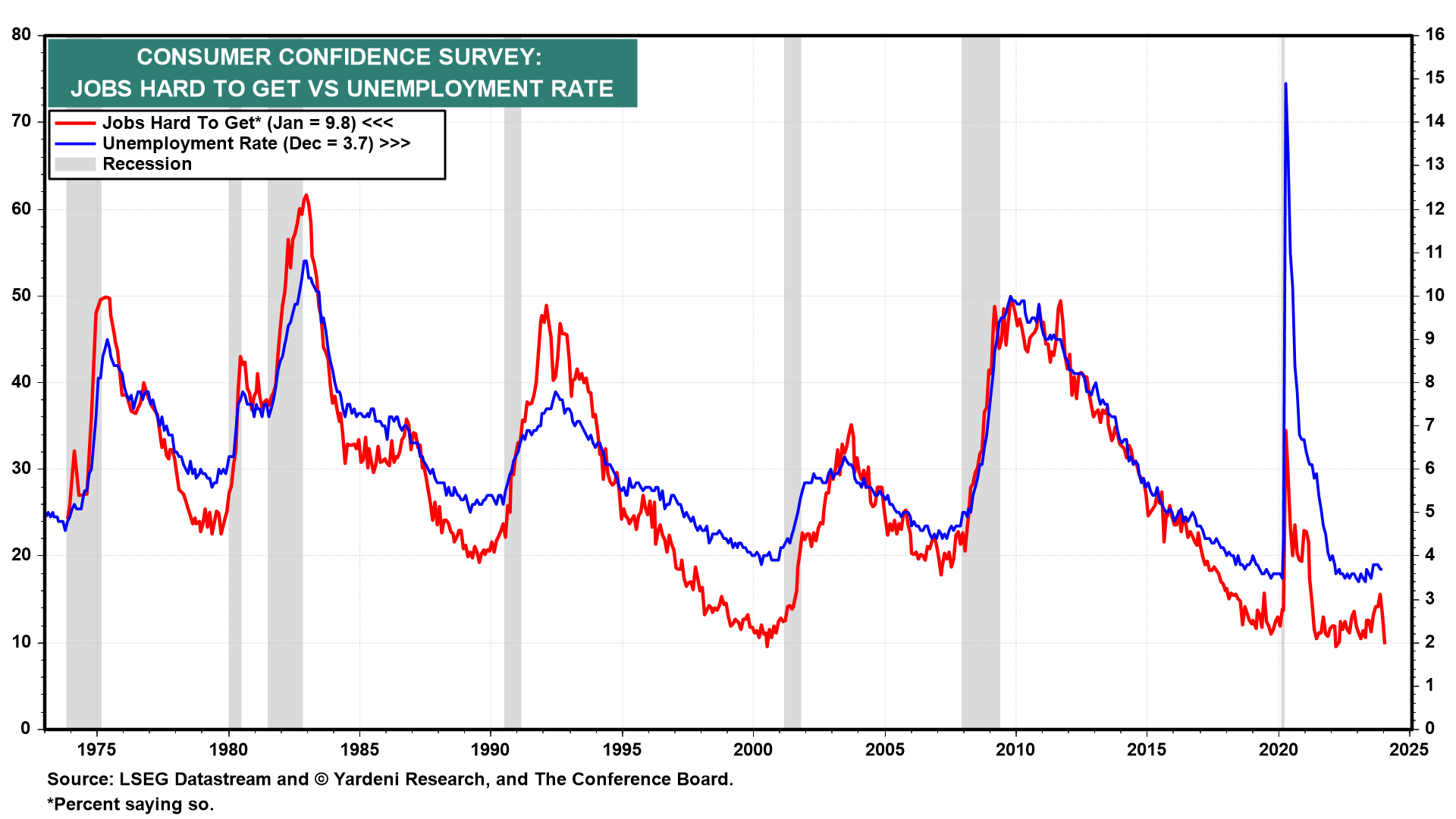
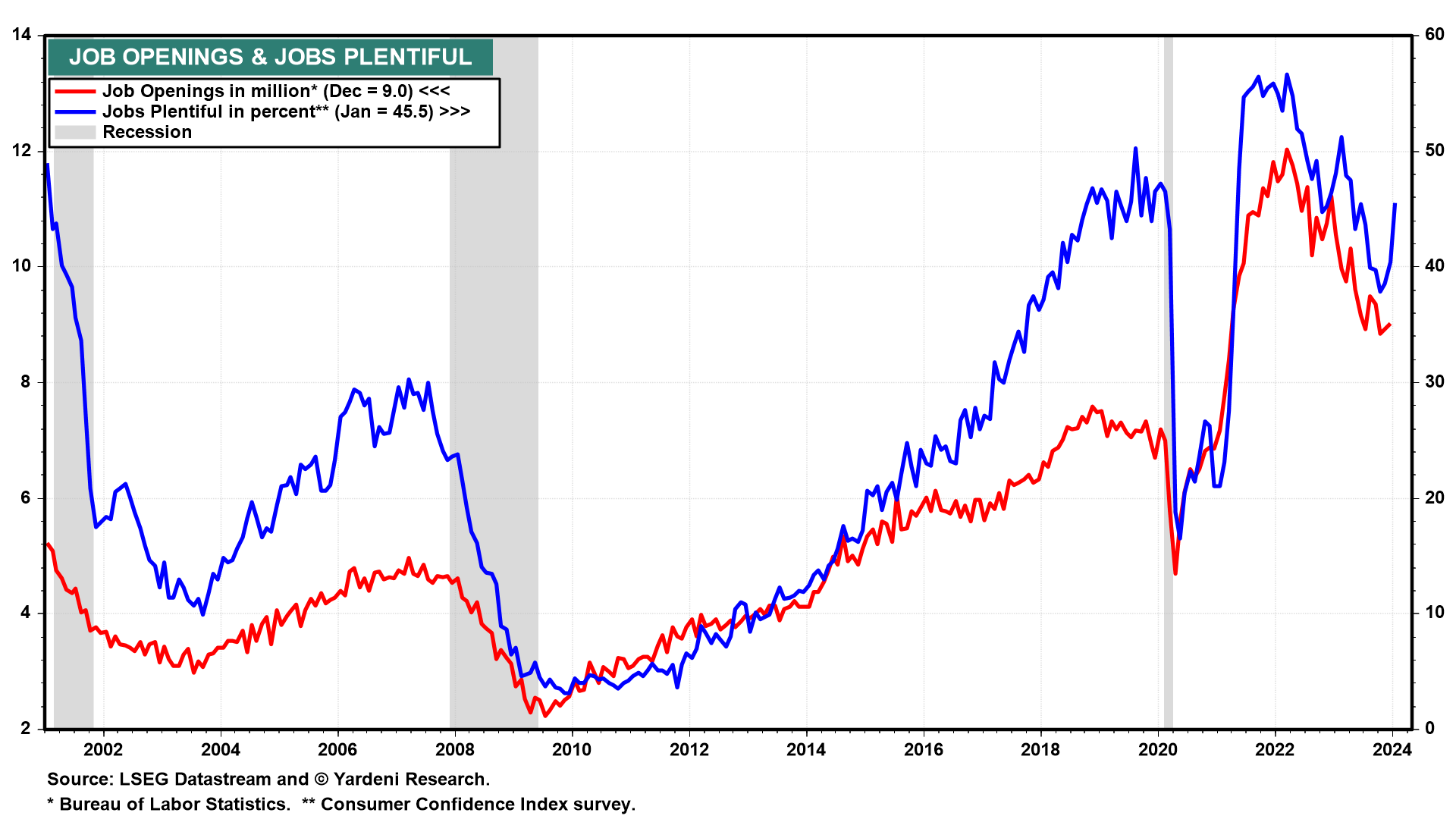
If the labor market remains strong, wages are not about to slow down much. Hopefully productivity will be strong. Today we get the Employment Cost index just before Friday’s NFP.
Tomorrow, we get the manufacturing PMIs:
 the various regional Fed surveys point to a very soft ISM print. David Rosenberg: “updating our internal model, our work points to a whopping -2.8 point decline in the PMI — implying a falloff to 44.6 in January from 47.4 in December, and a significant downside surprise to the 47.2 penned in by the consensus.
 But S&P Global’s Flash PMI released last week had its own PMI at 50.3, up strongly from 47.9 in December, “to signal the first improvement in operating conditions at goods producers in nine months.”
  Even more important: “New business expanded for the third successive month at US companies in January, with the rate of growth quickening to the sharpest since June 2023. The upturn in new orders was broad-based, as manufacturers registered the first rise in new sales since October 2023, and the fastest uptick since May 2022. Service providers reported the strongest gain for seven months.”

More confusion ahead, but I keep relying on S&P Global data.
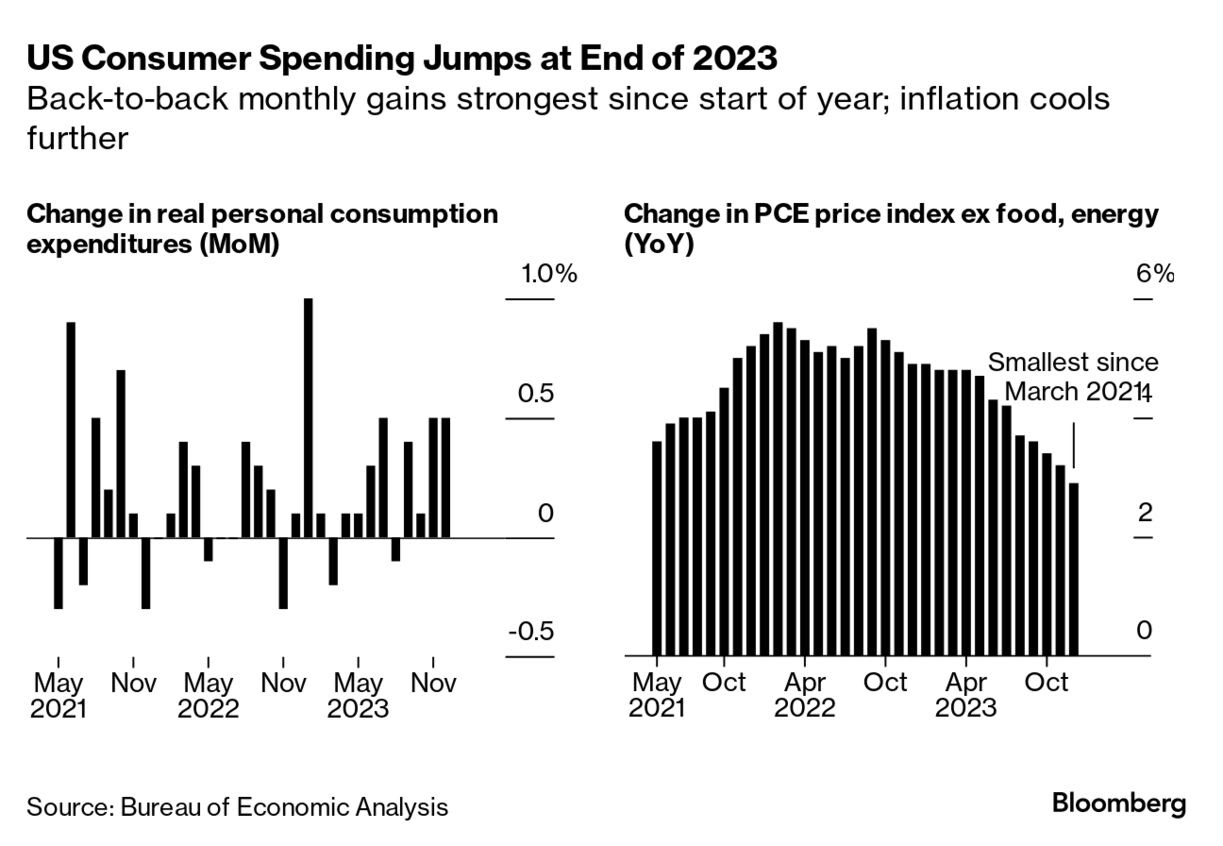
It looks like American consumers kept spending in January following strong Christmas sales. From The Transcript:
- “We are off to a solid start in 2024. Consumer spending remained resilient with first quarter year-over-year payments volume growth at 8%, U.S. payments volume grew 5% year-over-year, international payments volume grew 11%. Cross-border volume, excluding intra-Europe, rose 16% year-over-year in constant dollars with cross-border travel at 142% of 2019 levels, up from 139% in the fourth quarter… Consumer spend across all segments from low- to high-spend has remained relatively stable. Our data does not indicate any meaningful behavior change across consumer segments.” – Visa ($V ) CFO Chris Suh
- “We reached record levels of spending for both the full year and the fourth quarter in 2023. Total billed business grew 9% versus last year on an FX-adjusted basis. In the fourth quarter, billed business grew 6% as we continue to see more stable growth rates after lapping the prior year impact of Omicron back in the first quarter” – American Express ($AXP ) CFO Christophe Caillec
David Rosenberg, still wearing his recession frock, warns us that recent stats may be misleading:
(…) it was the balmiest December in recorded history, back to 1921 (40 degrees versus the norm of 33 degrees). The government statisticians are using December seasonal factors to massage the data and render them comparable sequentially when it felt more like March outside (warm weather and spending growth go together).
Monday, I wrote (So, You Think You Can Disinflate?) about the so-called immaculate disinflation:
(…) the decline in total PCE inflation from +5.9% to +2.7% from Q4’22 to Q4’23 was largely due to the stabilization in goods prices, itself largely due to deflating durable goods.
In truth, this so-called American “immaculate disinflation” is really the result of the U.S. having imported deflating goods with a strong currency coupled with very significant corporate cost reductions from much lower energy prices.
In truth, the Fed’s policies had little, if anything, to do with this recent disinflation, other than, perhaps, higher interest rates having prevented demand from exploding even more…
Wells Fargo yesterday:
Since peaking on a year-over-year basis at 9.1% in June 2022, inflation as measured by the Consumer Price Index has fallen 5.7 percentage points. The vast majority of that decline (4.9 points) has been attributable to lower goods inflation. After surging to 14.2% in March 2022—the loftiest one-year change since 1947—CPI goods inflation slowed to just 0.8% year-over-year in December. (Wells Fargo)

The retail apocalypse never happened
We haven’t seen the apocalypse everyone was expecting, Thomas LaSalvia, head of commercial real estate economics at Moody’s Analytics, tells Axios.
Retail commercial real estate is “back for good,” per a recent report from Cushman & Wakefield, a real estate services firm.
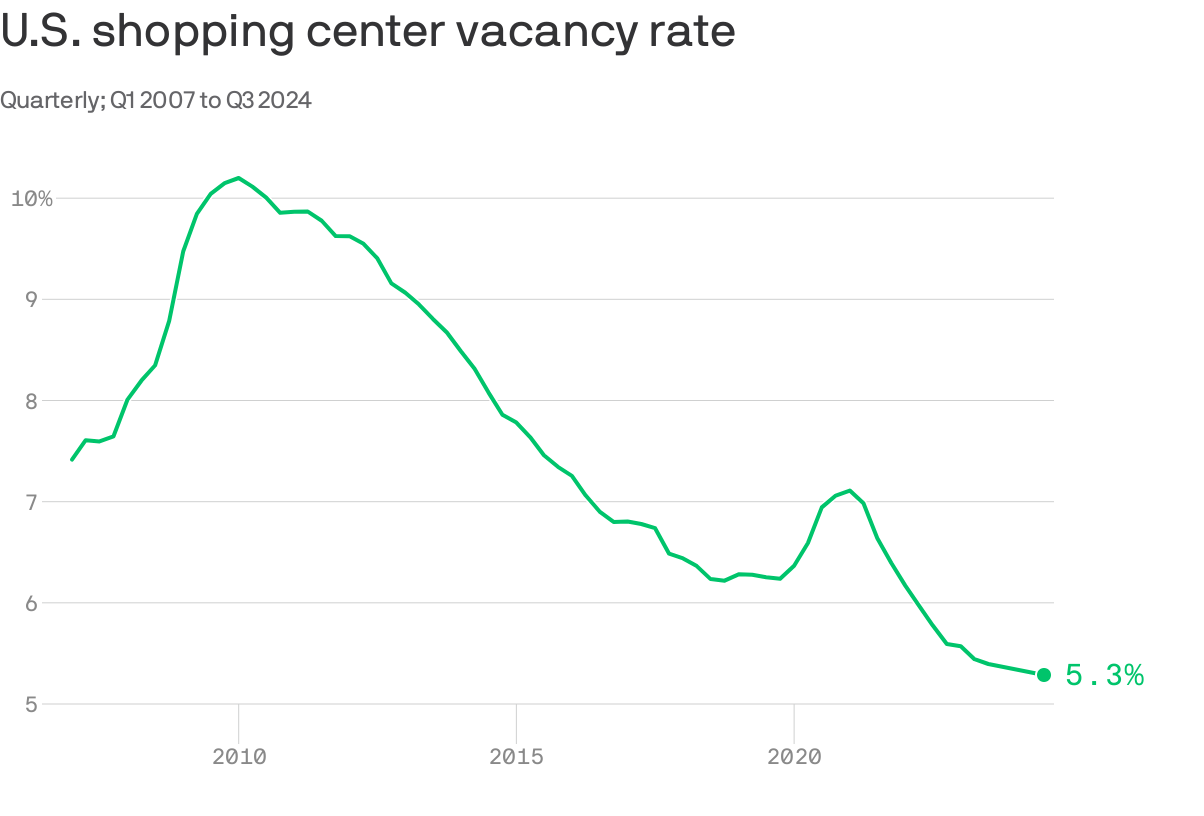
The vacancy rate at U.S. shopping centers — essentially any retail spaces outside the mall — fell to its lowest level since Cushman began tracking in 2007.
Average asking rents in the sector were 4.1% higher in Q4 compared with a year earlier. They’re up 17% cumulatively from 2019, and 41% over the past decade, per Cushman.
Demand for retail space stayed strong overall in 2023 thanks to a growing economy and strong labor market that kept Americans shopping. (…)
The sector ran a gauntlet of store closures and bankruptcies as it faced web competition — and then COVID hit, leading to worries it would never recover.
(…)That’s meant depressed levels of retail construction for the past decade. “Lack of new retail construction has kept a ceiling on the vacancy rate since the start of the pandemic,” per the Cushman report.
Last year just 8 million square feet of new retail space was constructed — that’s compared to about 20 million in 2019.
Even those numbers are small compared to a decade ago. From 2008-2014, new construction averaged nearly 40.8 million square feet per year, per Cushman.
What’s emerged is a more resilient landscape. These days e-commerce and physical retail now complement each other. Opening a brick-and-mortar store can even increase a brand’s online sales, according to a study from late last year. Closing a store has the opposite effect.
Shopping centers became more diverse — there are medical offices, gyms, day care centers, and pickleball.
For all the transformation brought by the web, online shopping still only represents about 16% of overall retail sales.
Americans’ love of shopping is one more simple reason for brick-and-mortar retail’s staying power.
- “We are social beings, we enjoy being out and one of the things we like to do when we’re out is to shop,” says Moody’s LaSalvia.
- That’s why the whole notion of a retail apocalypse “never made sense in the first place.”
Retail’s evolution may hold lessons for what’s happening in the office market, which is struggling to adapt to a remote-friendly work world.
Landlords might need to get flexible with all those empty offices, some of them might go away entirely or get converted to residential buildings or transform into a new mixed-use situation.
It took more than a decade for retail to adapt to a new era, it’s reasonable to assume the office market will need a similar amount of time.
China Factory Activity Contracts for Fourth Straight Month A lackluster start to the year points to limits in exports’ ability to drive growth as real estate struggles.
(…) China’s official manufacturing purchasing managers index rose to 49.2 in January, from 49 in December, the country’s National Bureau of Statistics said Wednesday. Though the measure marked a slight improvement from the previous month, the index remained below 50, which indicates a contraction, for a ninth month out of the past 10. (…)
A subindex of new orders edged up to 49 in January, from 48.7 the previous month, though it remained in contraction for a fourth straight month. (…)
Meanwhile, a gauge of nonmanufacturing activity, which covers both construction and services sectors, edged up to 50.7 from December’s 50.4. A measure of construction activity dropped to 53.9 from 56.9 in December, reflecting China’s ongoing property woes.
The subindex tracking service activity rose to 50.1 from December’s 49.3, edging into expansion for the first time since October. Still, economists broadly expect services, which enjoyed a boost after China removed all pandemic-era curbs roughly a year ago, will provide less of a boost to overall growth than in 2023.
Wednesday’s data release offered discouraging signs for the country’s labor market. The employment subindex for both the manufacturing and nonmanufacturing surveys came in below the 50 mark. Among manufacturers, the gauge fell to 47.6 from December’s 47.9, pointing to tepid appetite for more factory workers. (…)

EARNINGS, SENTIMENT WATCH
Microsoft, Alphabet and AMD Struggle to Meet AI Expectations Earnings disappoint investors despite companies’ AI inroads
Shares of the tech giants slipped in late trading Tuesday after they delivered results for the last three months of 2023 and forecasts for the current quarter. All three took pains to highlight progress on AI. In AMD’s case, the company predicted that its new AI processors will generate even more sales than expected. Microsoft touted how users were embracing its AI assistants, and Google said the technology was improving its search and cloud computing services.
But investors had bid up shares of the companies to record highs in recent weeks, betting that an AI bonanza would quickly fuel results. What they heard on Tuesday wasn’t enough to satisfy those hopes. (…)
Microsoft and Google, two rivals in AI software and cloud computing, delivered mostly good news in their reports — but still elicited a ho-hum from investors.
At Microsoft, revenue increased at the fastest rate since 2022, spurred in part by AI products helping drive adoption of its data-center services. Revenue from its Azure cloud-services unit jumped 30%.
AI demand boosted that growth rate by 6 percentage points, Chief Financial Officer Amy Hood said. That was up from 3 percentage points the previous quarter — an acceleration that that UBS Group AG analyst Karl Keirstead called “just extraordinary” on a call with company executives. Microsoft didn’t disclose how much it expected AI to bolster Azure in the current period.
Despite the momentum, Microsoft shares slipped in late trading. Wall Street wanted more clarity on how much AI will contribute to financial performance going forward, said CFRA Research analyst Angelo Zino. “Investors want them to quantify the AI potential over the next couple years,” he said. (…)
In November, Microsoft released its 365 Copilot — an AI assistant for Office programs like Outlook, Word, PowerPoint and Teams. The company didn’t give specifics on subscriptions for the product, but Chief Executive Officer Satya Nadella said on the conference call that adoption was “much faster” than with previous versions of the software.
With Google, softness in its core search advertising business raised concerns. But its quarterly report also sparked questions about whether it’s being aggressive enough in AI — and risks falling behind Microsoft. (…)
[AMD] said that its highly anticipated MI300 AI accelerator chip is generating much higher sales than expected.
The processor, similar to Nvidia’s popular H100, helps develop AI models by bombarding them with data. Demand is high enough for the product that AMD now expects to ring up more than $3.5 billion in sales this year, up from an earlier $2 billion forecast.
The catch: Some on Wall Street had been predicting numbers as high as $8 billion, according to Chris Caso, an analyst at Wolfe Research. AMD shares fell more than 6% in late trading.
- Risk taking is running rampant. The Mag 7 Beta is 1.4 and individual investors’ Beta is a near-historic high of 1.2. But #valuation determines longer-term returns and low beta #stocks are historically cheap. (@RBAdvisors)

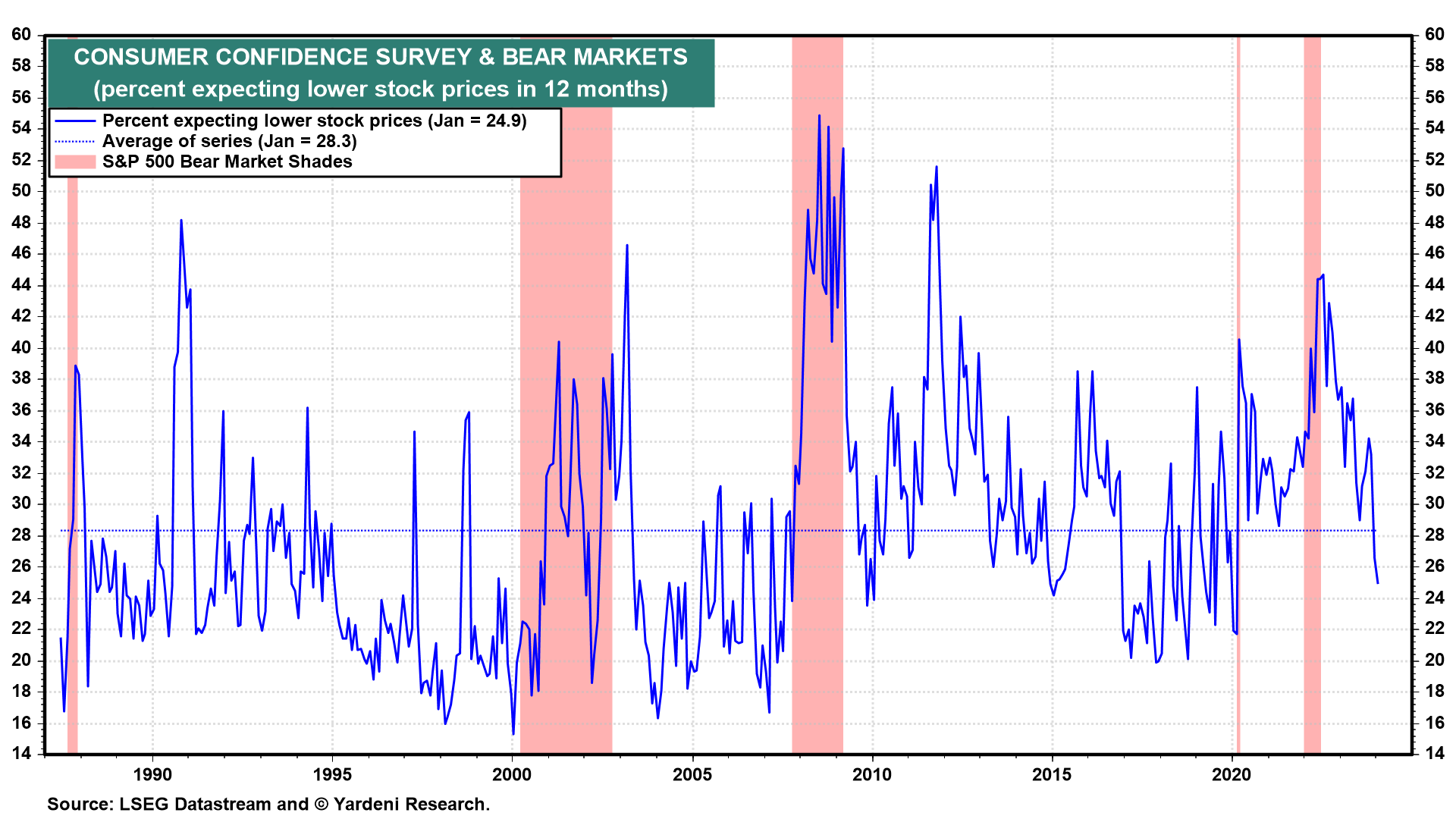
- By the way, the consumer confidence survey cited above also has a series showing the percentage of respondents who believe that stock prices will be lower in 12 months. It fell sharply in January to only 24.9%. The bull market may be running out of bears! (Ed Yardeni)
- Markets Keep US Exceptionalism Going for a Reason Earnings of the Magnificent Seven are now practically a macro event, and no one else has anything like them.
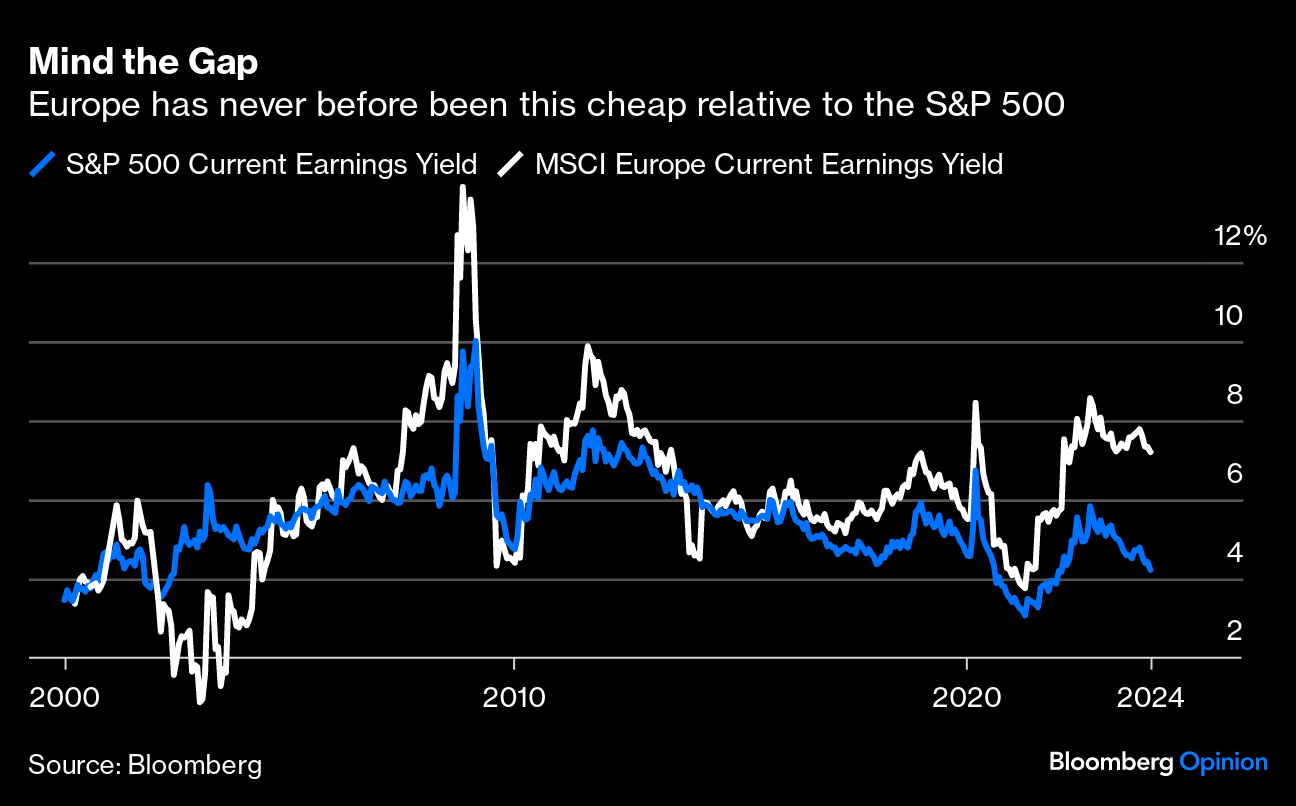
(…) The US is currently seeing the widest gap between S&P 500 current earnings yield and MSCI Europe Index ever. Put simply, Europe has never been this cheap versus the US. The earnings yield investors get from European assets looks far more attractive than the American benchmark.
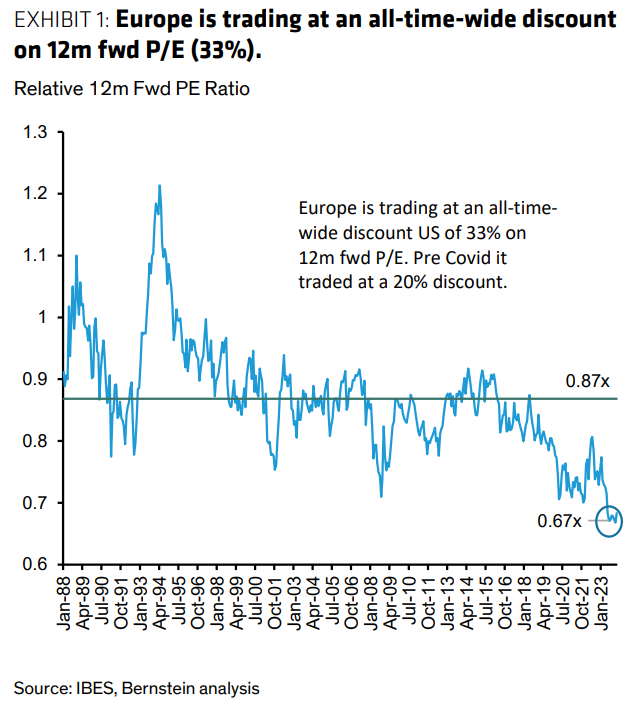
The same pattern emerges when comparing 12-month forward price/earnings multiples for the two markets. By Bernstein’s estimate, Europe is trading at an all-time deep discount of 33% compared to its US peers — steeper even than the pre-pandemic discount of 20%. That’s the widest based on the 35-year dataset that Bernstein tracks, and comfortably bigger even than during the Global Financial Crisis:
A valuation spread is warranted. Roughly 15 years of lower rates have favored the valuation of US equities. The so-called Magnificent Seven tech giants are all American, and European equities have a poor track record of delivering persistent positive earnings growth. Yet Bernstein noted the gaps in earnings-growth expectations, quality, or the economic outlook are not enough to justify the spread. (…)
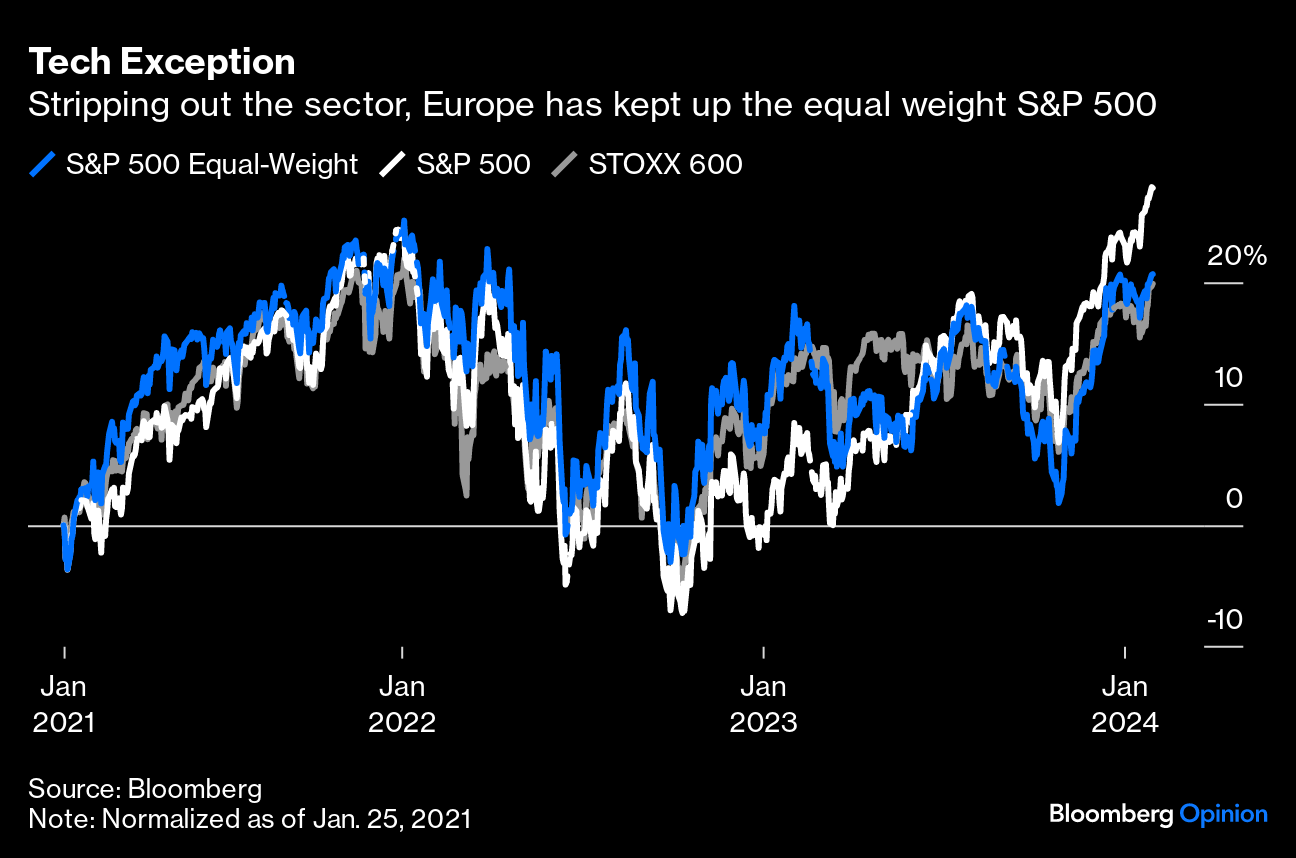
That should be a worthwhile reminder that it’s the big tech groups that really place the US apart. Judging the S&P 500 on an equal-weighted basis (so that the tech giants aren’t weighted higher than anyone else) leaves the European Stoxx 600 more or less on equal terms since the beginning of 2021. (…)
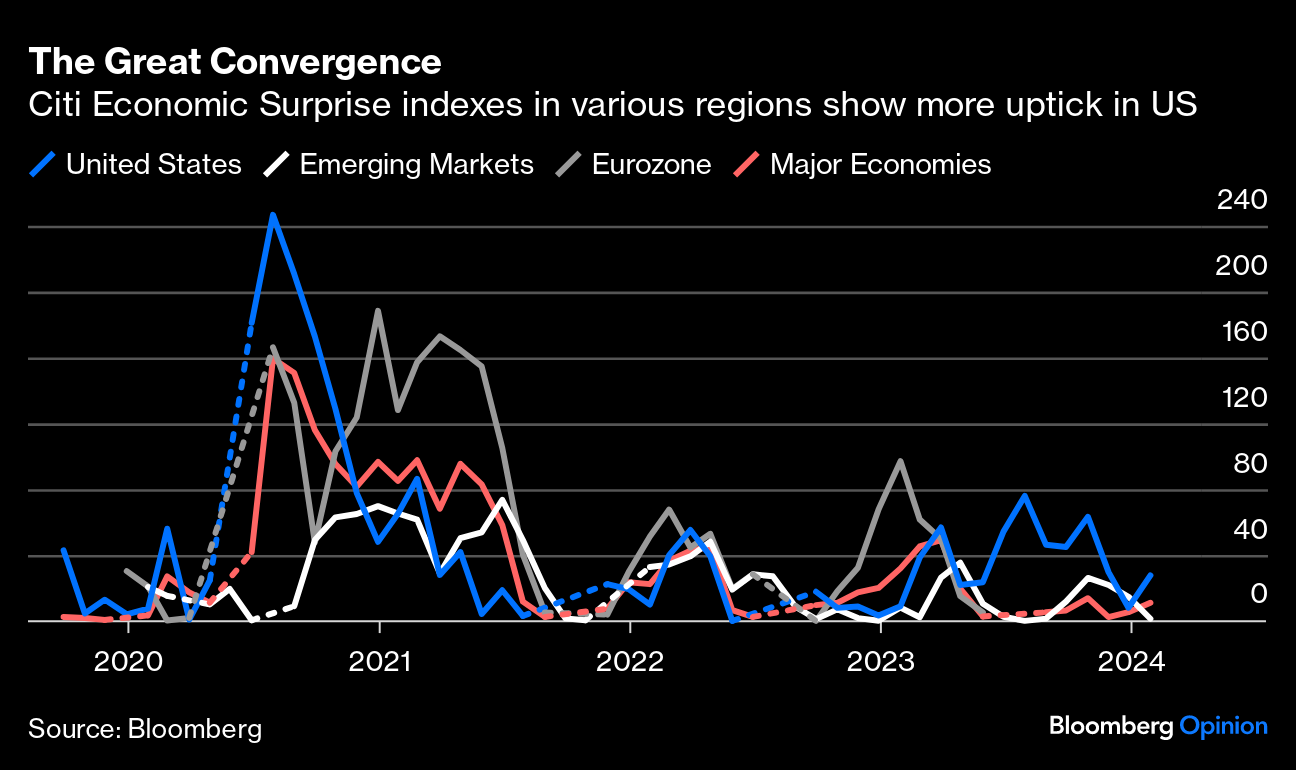
But it’s still the US whose data is coming in furthest ahead of expectations, as illustrated by the Citi Economic Surprise indexes:
To Don Rissmiller of Strategas Research Partners, the world is trying for what he calls an “economic landing.” How might this appear? “In some countries, this looks like a hard landing (China), and elsewhere, it has been bumpy (e.g.,
Europe). But the US is seeing solid growth with tame inflation — that’s the pathway to a soft landing, especially given developing fiscal cushions (e.g., as the current tax bill being considered in DC) and likely Fed rate cuts in 2024.”
Or put differently, it’s still going to take a lot of guts to bet against American exceptionalism.

BTW:
Six of the seven companies in the “Magnificent 7” are projected to be the top six positive contributors to year-over-year earnings for the S&P 500 for Q4 2023: NVIDIA, Amazon.com, Meta Platforms, Alphabet, Microsoft, and Apple. In aggregate, these six companies are expected to report year-over-year earnings growth of 53.7% for the fourth quarter. Excluding these six companies, the blended (combines actual and estimated results) earnings decline for the remaining 494 companies in the S&P 500 would be -10.5% for Q4 2023. Overall, the blended earnings decline for the entire S&P 500 for Q4 2023 is -1.4%. (…)
It is interesting to note that four of these six companies are also projected to be the top four contributors to earnings growth for the S&P 500 for Q1 2024: NVIDA, Amazon.com, Meta Platforms, and Alphabet. In aggregate, these four companies are projected to report year-over-year earnings growth of 79.7% for Q1 2024. Excluding these four companies, the remaining 496 companies in the S&P 500 would be projected to report year-over-year earnings growth of 0.3% for Q1 2024. Overall, the estimated earnings growth rate for the entire S&P 500 for Q1 2024 is 4.6%. (Factset)
- America’s money mojo (Axios)
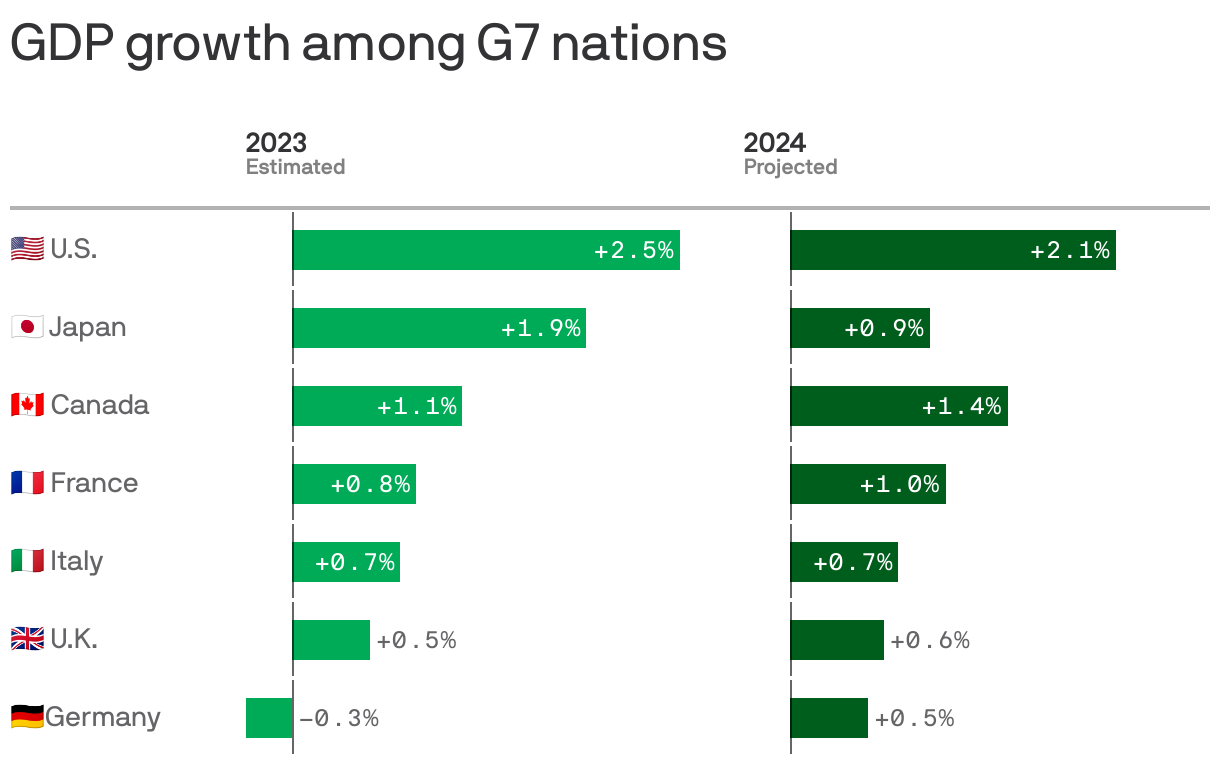
The U.S. economy grew faster than any other advanced economy last year — by a wide margin — and is on track to do so again in 2024, Axios’ Neil Irwin writes.
America’s outperformance is rooted in its distinctive structural strengths, policy choices and some luck. It reflects a fundamental resilience in the world’s largest economy that’s easy to overlook with the nation’s problems. (…)
It’s not just that the U.S. is doing well. It’s that other major economies have distinctive problems holding back growth.
Data: IMF World Economic Outlook. Chart: Axios Visuals
- Nassim Taleb Says US Faces a ‘Death Spiral’ of Swelling Debt Black Swan author says it’s hard to see a way out of problem
“So long as you have Congress keep extending the debt limit and doing deals because they’re afraid of the consequences of doing the right thing, that’s the political structure of the political system, eventually you’re going to have a debt spiral,” he said Monday night at an event for Universa Investments, the hedge fund firm he advises. “And a debt spiral is like a death spiral.”
Taleb defined the ballooning debt load as a “white swan,” a risk that’s more probable than a surprise “black swan” event. While he didn’t identify specific outcomes in markets, he did say white swans include both the US deficit and an economy that’s far more vulnerable to shocks than in prior years.
The reason for that, he said, is that the world is far more interconnected due to globalization, with issues in one region able to ricochet around the world. (…)
This month, former Treasury Secretary Robert Rubin said the world’s biggest economy is in a “terrible place” with regard to its federal deficits, while BlackRock Inc. Vice Chairman Philipp Hildebrand has warned that any default could imperil the dollar as a global currency. (…)
- ‘Big Short’ Investor Steve Eisman Shrugs Off Warnings on US Deficit, Stocks Suggests deficit worries overblown, countering Taleb, Rubin
The Neuberger Berman Group portfolio manager said there’s no real sign that elevated US debt poses a problem for markets or the US government. He’s equally sanguine on equities, despite the parallels t hat some perceive between today’s market and the dot-com bubble era. (…)
“This argument about the deficit has been going on for forty years,” Eisman said, adding there are few reasons to worry “until I see real signs there’s a problem.” (…)
Iran Vows to Retaliate Against Any Attack as US Readies Response Biden said he had made a decision on how to retaliate against the assault in Jordan.
 Musk’s $55 Billion Pay Package Voided, Threatening World’s Biggest Fortune Largest-ever compensation package struck down in ruling.
Elon Musk’s $55 billion pay package at Tesla Inc. was struck down by a Delaware judge after a shareholder challenged it as excessive, a ruling that would take a giant bite out of Musk’s wealth and put the fate of his companies in question.
That is if the ruling survives a likely appeal.
The decision Tuesday, which amounts to his first major loss in court, means that more than five years after the electric-car maker’s co-founder was granted the largest executive compensation plan in history, Tesla’s board will have to start over and come up with a new proposal. Musk never attempted to exercise his options since they’d been challenged in Delaware Chancery Court. (…)
Musk has repeatedly urged Tesla’s board to arrange another massive stock award for him, years after he sold a significant chunk of his shares in the company to acquire Twitter. The billionaire has said he needs a bigger stake in Tesla to maintain control of the electric-car maker and expand further into artificial intelligence.
The ruling leaves the future of Musk’s fortune in limbo. Worth some $51.1 billion, the options were one of his most valuable assets. Without them his net worth would drop to $154.3 billion (…).
Following a trial that ended more than a year ago, Delaware Chancery Court Chief Judge Kathaleen St. J. McCormick sided with an investor who complained Tesla directors didn’t make proper disclosures about the 2018 executive compensation package and the performance benchmarks required of Musk. She also found that conflicts of interest marred the board’s consideration of the pay plan.
“In the final analysis, Musk launched a self-driving process, recalibrating the speed and direction along the way as he saw fit,” the judge wrote in a 200-page ruling. “The process arrived at an unfair price. And through this litigation, the plaintiff requests a recall.” (…)
Speaking of Elon Musk:
EVs vs. bugs (Axios)
General Motors is racing to diagnose and fix software issues that have caused flickering screens, looping error messages and glitchy charging in some of its most important new electric vehicles (EVs), Joann reports.
Similar problems are plaguing the entire auto industry as vehicles morph into battery-powered “supercomputers on wheels.”
Software bugs on your phone or laptop are an annoyance. A software snafu in a car isn’t just aggravating, it could be life-threatening.
Cars are exponentially more complex than smartphones, and software updates can have unintended consequences that affect other systems.
Multiple carmakers, including GM, Volkswagen, Volvo Cars and Polestar, have delayed new EVs while they rethink their approach to software development.
I have been driving Tesla cars (X, 3, and Y models) since 2020 without any meaningful software issues. Tesla software is completely Tesla-coded, unlike other car manufacturers which rely on various suppliers and struggle to integrate them.
Most traditional automakers don’t have the required software skills and are struggling to reorient their businesses around this approach, Sam Abuelsamid, principal research analyst at Guidehouse Insights, tells Axios.
GM is a prime example of the software headaches automakers are facing.
- It stopped selling its new Chevrolet Blazer EV in December after early owners and reviewers encountered software issues and other problems.
- GM’s software and services team, led by former Apple exec Mike Abbott, is working “with a huge sense of urgency” to get the Blazer EV back on sale, CEO Mary Barra told investors yesterday during a fourth-quarter earnings call.
- “We disappointed these customers, and we know it,” Barra said. “We are determined to get the software right, and we will.”
Barra described “several organizational and process improvements” in GM’s software and services team, including a new software quality division and revamped testing and validation procedures.
- That group has been quality-auditing the Blazer EV and other delayed models in GM’s pipeline to root out coding problems, a company spokesperson said.
It’s still a work in progress, Barra noted.
- GM postponed an investor update previously scheduled for March in part to give the software team more time to complete its work. (…)
Legacy automakers are great at hardware — it’s software that’s the challenge.




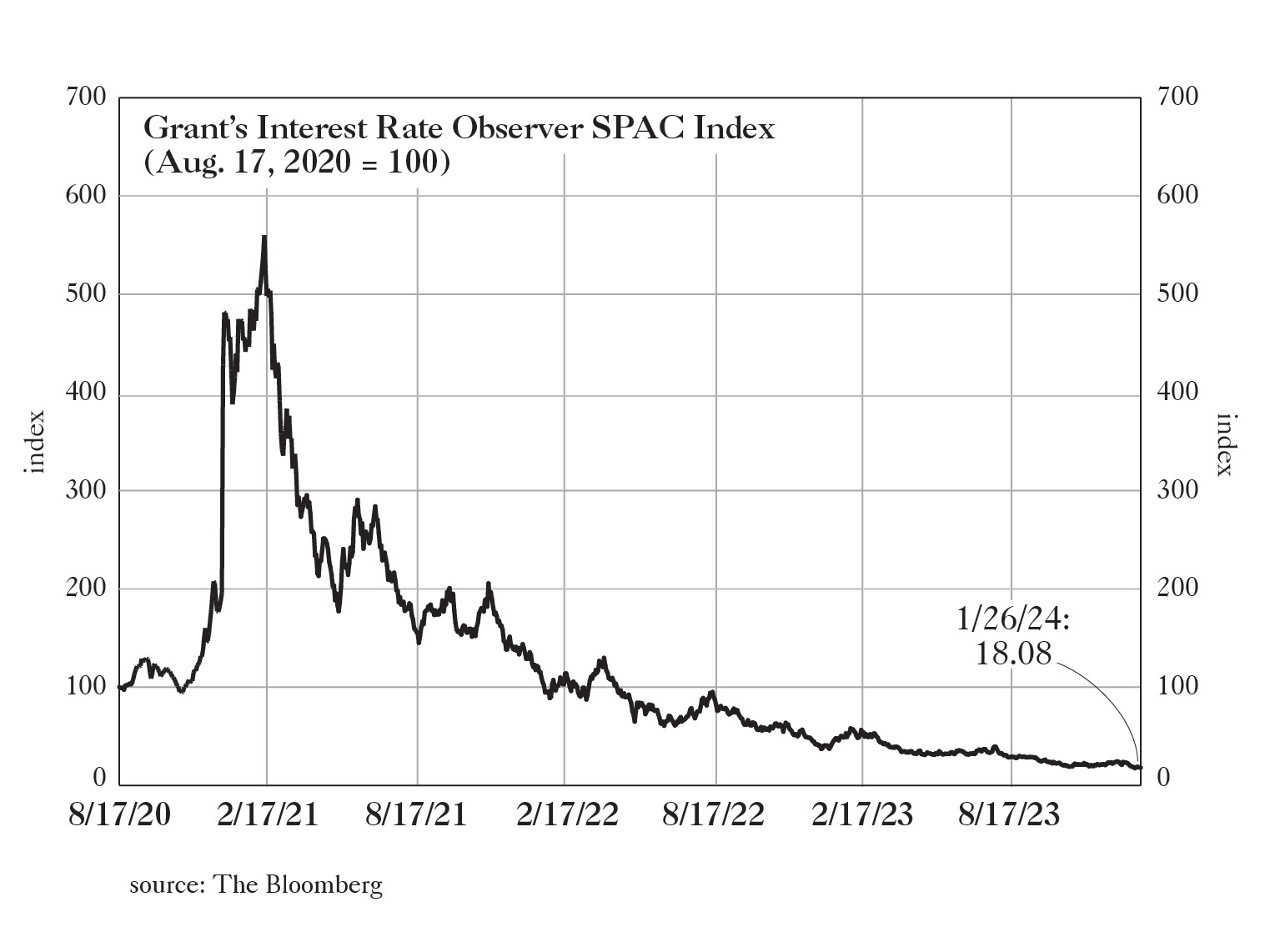 Meanwhile, 21 so-called de-SPACs, or operating businesses that merged with those blind pools, filed for bankruptcy last year (including three in the Grant’s gauge), wiping out what had been a combined $46 billion in market capitalization. Nearly 44% of SPAC-affiliated firms issued going concern warnings in 2023 annual reports according to data from research outfit Hudson Labs.